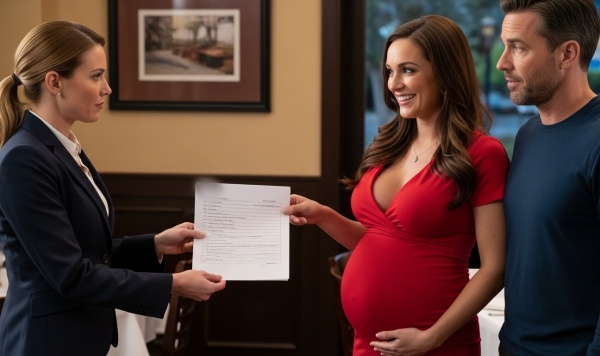
When I found out my husband was having an affair, I Didn’t Fight Back—I Just Handed My Husband’s Mistress One Piece of Paper That Made Her Disappear Forever
When I found out my husband was having an affair, I didn’t yell, cry, or confront him in anger. Instead, I did something that shocked everyone—I calmly scheduled a DNA test and sent the mistress a single piece of paper.
What happened next proved that sometimes the smartest response isn’t fighting fire with fire, but being strategic and calm. This is the story of how one document changed everything.
PART I: THE BREAKING POINT
I married my husband, Michael, when I was twenty-six years old. I thought I was marrying a good man. I thought I was marrying someone who would be a good father, a good provider, a good partner. I was wrong.
The first few years of our marriage were fine. We had two beautiful children—Sarah was born when I was twenty-eight, and James came along two years later. Michael seemed like a decent father. He went to work, he came home, he spent time with the kids. But slowly, things started to change. Or maybe they didn’t change—maybe they were always like this, and I just didn’t see them until it was too late.
Michael started drinking. At first, it was just a beer or two after work. Then it became three or four beers. Then it became entire nights out at bars in downtown Chicago with his friends, coming home at two or three in the morning, reeking of alcohol and cigarette smoke. He started smoking again after quitting for five years before we got married.
He started staying out late on weekends, disappearing for hours without telling me where he was going. He started being dismissive when I tried to talk to him about his behavior, rolling his eyes and telling me I was being a nag, that I was controlling, that I needed to give him more freedom.
I tried everything. I tried being supportive, thinking that maybe he was going through something and that my patience would help him work through it. I tried being firm, setting boundaries and consequences. I tried being understanding, trying to figure out what was driving him to drink and party and neglect his family. Nothing worked. He just got worse.
The drinking got heavier. The nights out got longer. The dismissiveness became cruelty. He would come home and barely acknowledge me or the kids. He would spend entire weekends hungover on the couch, leaving me to handle everything—the kids, the house, the bills, the emotional labor of keeping our family together. I was exhausted. I was angry. I was heartbroken.
But I stayed. I stayed because I had two children, and I wanted them to have a father. I stayed because I didn’t want to be a single mother. I stayed because I was afraid of what would happen if I left. I stayed because I kept hoping that the man I had married would come back, that this was just a phase, that things would get better.
They didn’t get better. They got worse.
PART II: THE TEXT MESSAGE THAT CHANGED EVERYTHING
It was a Tuesday evening in March. Michael was in the shower, and I was in the bedroom folding laundry. His phone was on the nightstand, and the screen lit up with a notification. I wasn’t trying to invade his privacy—I just happened to glance over at the sound. What I saw made my blood run cold.
The message was from an unknown number, and it read: “I’m pregnant. What are we going to do about this?”
I stood there, frozen, holding a pair of Michael’s socks in my hand. I read the message again. And again. And again. I thought maybe I was misreading it. Maybe it was a joke. Maybe it was spam. Maybe it was someone sending it to the wrong number.
But deep down, I knew the truth. I knew exactly what that message meant.
I wrote down the phone number with a shaking hand. I didn’t confront Michael. I didn’t yell or cry or scream. I just finished folding the laundry, put it away, and went downstairs to make dinner. When Michael came out of the shower, I smiled at him and asked about his day. He looked at me suspiciously, like he could sense that something was wrong, but he didn’t say anything.
That night, after the kids were asleep, I called the number from my own phone. A young woman answered—she sounded like she was in her early twenties, maybe younger. Her voice was high-pitched and uncertain.
“Hello?” she said.
“Hi,” I said, keeping my voice calm and steady. “I’m calling about the text message you sent to Michael. I’m his wife. I think we need to meet and talk about this.”
There was a long pause on the other end of the line. I thought she might hang up. But instead, she said, “Okay. Tomorrow? There’s a coffee shop on Michigan Avenue.”
I was shocked. I expected her to deny everything, to make excuses, to hang up on me. But she agreed to meet me, just like that. It was almost too easy, which made me even more suspicious.
The next morning, I dropped the kids off at school and drove to the coffee shop. I was nervous. I was angry. I was terrified. I didn’t know what I was going to say to this woman, or what I was going to do when I saw her.
I was sitting at a table by the window when she walked in. She was young—much younger than I expected. She looked like she was barely out of her teens, maybe twenty-two or twenty-three at most. She had blonde hair and was wearing a tight pink sweater that showed off her pregnant belly. She looked around the coffee shop until she saw me, and then she walked over to my table with a smug expression on her face.
“So you’re the wife,” she said, sitting down across from me without being invited. “I’m Brittany. I’m carrying your husband’s baby.”
I looked at her—this girl who was young enough to be my younger sister, this girl who had slept with my husband, this girl who was now sitting across from me claiming to be pregnant with his child—and I felt something shift inside me. The anger, the hurt, the betrayal—it all crystallized into something cold and clear and focused.
“Okay,” I said calmly. “If that’s true, then we need to do a DNA test to confirm that the baby is actually Michael’s. I’m going to arrange an amniocentesis—that’s a test where they take a sample of amniotic fluid to determine the father’s DNA. I’ve already scheduled an appointment with a doctor at Northwestern Memorial Hospital for Monday. I’ll pick you up and take you there myself.”
Brittany’s smug expression faltered. “What? No, I don’t need a test. I know it’s his baby.”
“If you’re sure it’s his baby, then you won’t have any problem taking the test,” I said. “But if you’re lying—if this baby isn’t actually Michael’s—then you need to know that I will pursue legal action against you for fraud and extortion. I have documentation of this conversation. I have the text messages. I have everything I need to prove that you were trying to manipulate my husband into giving you money under false pretenses.”
I leaned forward and looked her directly in the eye. “So here’s what’s going to happen. You’re going to take the DNA test on Monday. And if the baby is Michael’s, then we’ll figure out what to do from there. But if the baby isn’t his, then you’re going to disappear, and you’re never going to contact my husband again. Do you understand me?”
Brittany’s face went pale. She stood up abruptly, knocking her chair backward. “I don’t have to do this,” she said. “I don’t have to take any test.”
“You’re right,” I said. “You don’t have to. But if you don’t, then I’m going to assume the baby isn’t Michael’s, and I’m going to proceed with legal action. Your choice.”
She stared at me for a long moment, and I could see the wheels turning in her head. She was trying to figure out if I was bluffing. She was trying to figure out if I had the resources to actually pursue legal action. She was trying to figure out if her plan was going to work.
Finally, she turned and walked out of the coffee shop without saying another word. I watched her go, and I felt a small sense of satisfaction. But I also knew that this wasn’t over. This was just the beginning.
PART III: THE CONFRONTATION WITH MICHAEL
When Michael came home from work that evening, I was waiting for him in the living room. The kids were at my mother’s house—I had dropped them off after school and told her I needed to handle something important.
“We need to talk,” I said.
Michael looked at me warily. “About what?”
“About Brittany,” I said. “About the baby. About the fact that you’ve been having an affair and you got another woman pregnant while you’re married to me.”
Michael’s face went white. He opened his mouth to deny it, but I cut him off.
“Don’t bother lying,” I said. “I saw the text message. I met with her. I know everything.”
Michael sat down heavily on the couch. For a long moment, he didn’t say anything. Then he said, “It was just one night. It didn’t mean anything. She was just some girl I met at a bar. We were drunk. It was a mistake.”
“A mistake?” I said, my voice rising. “Michael, you got her pregnant. That’s not a mistake. That’s a choice. That’s a consequence of your actions.”
“I don’t even know if the baby is mine,” Michael said desperately. “She could be lying. She could have been with other guys. She could be trying to trap me.”
“I know,” I said. “Which is why I’ve arranged for her to take a DNA test. But regardless of whether the baby is yours or not, we need to talk about what happens next. Because I’m not going to stay in this marriage if you keep doing this. I’m not going to raise my children in a household where their father is constantly drunk, constantly cheating, constantly lying to me.”
Michael looked at me with panic in his eyes. “What are you saying?”
“I’m saying that if you don’t change—if you don’t stop drinking, if you don’t stop cheating, if you don’t get help for your problems—then I’m going to file for divorce. I’m going to take the kids, and I’m going to move on with my life. I’ve already written up the divorce papers. I have a lawyer ready to file them. All you have to do is sign.”
I pulled out the folder that I had prepared—the one that outlined the terms of the divorce, the custody arrangement, the division of assets. I had spent the last two weeks working with a lawyer, preparing for this moment, making sure that I had a plan in place.
Michael looked at the papers like they were a bomb that was about to explode. “You can’t be serious,” he said.
“I’m completely serious,” I said. “I’ve given you years to change. I’ve tried everything I can think of. I’ve been patient. I’ve been supportive. I’ve been understanding. But I can’t do this anymore. I can’t watch you destroy yourself and our family. I can’t watch you hurt our children. I can’t watch you betray me over and over again.”
I stood up and looked down at him. “You have a choice to make, Michael. You can either get help—real help, not just promises—or you can sign the divorce papers. But either way, things are going to change. I’m not going to live like this anymore.”
Michael didn’t say anything. He just sat there, staring at the divorce papers, looking like his entire world was collapsing around him.
“And one more thing,” I said. “You’re not going to contact Brittany anymore. You’re not going to answer her calls or her text messages. You’re not going to see her. You’re going to let me handle this, and you’re going to do exactly what I tell you to do. Do you understand?”
Michael nodded slowly. “Okay,” he said. “Okay, I understand.”
For the first time in years, I felt like my husband was actually listening to me. For the first time, I felt like I had some control over the situation.
PART IV: THE ONE PIECE OF PAPER THAT CHANGED EVERYTHING
Two days later, I sent Brittany a letter. Inside the envelope was a single piece of paper—a form for an amniocentesis DNA test. I had printed it out from the hospital’s website and filled in all the details. I had also included a handwritten note that said:
“The appointment is scheduled for Monday at 2 PM at Northwestern Memorial Hospital. I will pick you up at 10 AM from the address you provided. Bring your insurance card and a valid ID. If you don’t show up, I will assume that the baby is not my husband’s, and I will proceed with legal action against you for fraud and extortion. I have documentation of all your communications with my husband. I have the text messages. I have the phone records. I have everything I need to prove that you were attempting to manipulate my husband into giving you money under false pretenses. You have until Monday to decide whether you want to take this test or whether you want to disappear. The choice is yours.”
I sent the letter via certified mail, so I would have proof that she received it.
And then I waited.
Monday came and went. Brittany didn’t show up for the appointment. She didn’t call. She didn’t text. She didn’t send any messages to Michael. She simply disappeared.
I tried calling her number a few times, but she didn’t answer. I sent her text messages, but they went unanswered. I checked Michael’s phone to see if she had tried to contact him, but there was nothing. It was like she had vanished into thin air.
A week went by. Then two weeks. Then a month. Brittany never contacted Michael again. She never sent another text message. She never called. She never tried to arrange a meeting. She simply disappeared from our lives as quickly as she had entered them.
I realized what had happened. Brittany had been bluffing the entire time. She had never actually been pregnant. She had been trying to manipulate Michael into giving her money by claiming to be pregnant with his child. When I called her bluff—when I offered to arrange a DNA test—she realized that her scheme wasn’t going to work. So she disappeared.
The one piece of paper—the amniocentesis form—had been enough to expose her lie and make her go away.
PART V: THE AFTERMATH AND THE HEALING
After Brittany disappeared, things changed in my marriage. Michael was terrified. He was terrified that I would follow through on my threat to divorce him. He was terrified of losing his children. He was terrified of the consequences of his actions finally catching up with him.
So he changed. Not overnight—change doesn’t happen that quickly. But gradually, over the course of several months, I saw real changes in his behavior. He cut back on his drinking. He stopped going out to bars. He started spending more time with the kids. He started being more present, more engaged, more attentive to my needs and the needs of our family.
He also got help. He went to therapy. He joined an Alcoholics Anonymous group. He worked with a counselor to address the underlying issues that had driven him to drink and cheat in the first place. It was a long process, and there were setbacks along the way, but he was genuinely trying to change.
I also changed. I stopped waiting for Michael to change on his own. I stopped hoping that things would magically get better. I took control of the situation. I made it clear what I would and wouldn’t tolerate. I set boundaries and enforced them. I prepared for the possibility that I might have to leave, which paradoxically made it more likely that Michael would actually change.
We went to couples counseling together. We worked through the betrayal and the hurt and the broken trust. It was painful. There were many nights when I cried, when I wondered if I was making the right decision by staying. But slowly, we began to rebuild our relationship.
A year after Brittany disappeared, Michael and I were in a much better place. He had been sober for nine months. He had rebuilt his relationship with the kids. He had started being the husband and father that I had always wanted him to be. We were still in therapy, still working on our marriage, but we were moving in the right direction.
One evening, Michael and I were sitting on the back porch of our house in Chicago, watching the sun set over Lake Michigan. The kids were asleep inside, and we had a rare moment of peace and quiet.
“Thank you,” Michael said.
“For what?” I asked.
“For not giving up on me,” he said. “For giving me a chance to change. For being strong enough to set boundaries and enforce them. For being smart enough to figure out that Brittany was lying and for handling it the way you did.”
I looked at my husband—this man who had hurt me deeply, who had betrayed my trust, who had made terrible choices—and I realized that I still loved him. Not the same way I had loved him before, not with the naive optimism of a young woman who thought marriage would be easy. But with a deeper, more mature love that came from choosing to stay, from choosing to work through the pain, from choosing to believe that people could change.
“I didn’t do it for you,” I said. “I did it for me and for the kids. I did it because I wasn’t going to let some girl manipulate us into giving her money. I did it because I wasn’t going to let your mistakes destroy our family.”
“I know,” Michael said. “And I’m grateful for that.”
We sat in silence for a while, watching the sun disappear below the horizon. I thought about that one piece of paper—the amniocentesis form—and how it had changed everything. I thought about how sometimes the smartest thing you can do is not to fight back with anger or violence or drama, but to simply call someone’s bluff and make them face the consequences of their lies.
I thought about how I had taken control of my life, how I had stopped being a victim of Michael’s choices and started being an active participant in determining my own future. I thought about how sometimes the most powerful thing a woman can do is to be calm and rational and strategic, instead of emotional and reactive.
The amniocentesis form had been a simple piece of paper, but it had been enough to expose Brittany’s lie and make her disappear. It had been enough to shock Michael into realizing that his behavior had real consequences. It had been enough to change the trajectory of my entire life.
And as I sat on that porch, watching the sun set, I realized that I was going to be okay. My marriage was going to be okay. My family was going to be okay. Not because everything was perfect—it wasn’t. But because I had finally taken control of my own destiny, and I had refused to let anyone—not Michael, not Brittany, not anyone—determine my future for me.
The sealed envelope that Brittany had received, with that one piece of paper inside, had been the turning point. It had been the moment when everything changed. It had been the moment when I stopped being a victim and started being a survivor.
And I would never forget it.
