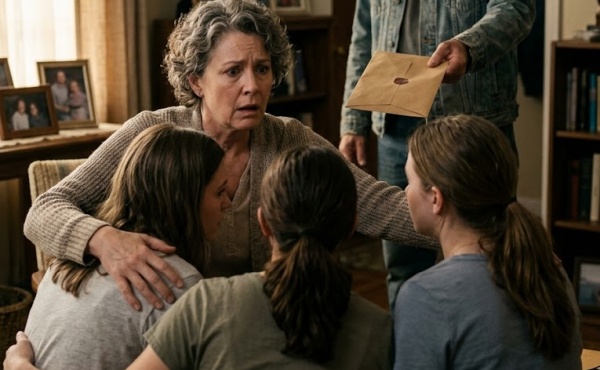
“I Raised My Brother’s 3 Orphaned Daughters for 15 Years—Last Week, He Showed Up With a Sealed Envelope That Changed Everything”
PART I: THE DAY MY BROTHER DISAPPEARED
Fifteen years ago, I got a phone call that changed my life forever. My sister-in-law, Amanda, had been in a car accident on I-35 near Austin, Texas. She didn’t survive. She was only thirty-four years old. My brother James was devastated—we all were. The funeral was held on a gray November morning at Westlake Hills Funeral Home, and I remember thinking that nothing would ever be the same again.
But I had no idea how right I was.
James had three daughters: Emma was eight years old, Sophie was five, and little Lily was only three. They were beautiful girls—Emma had her mother’s dark curly hair and serious eyes, Sophie had James’s stubborn chin, and Lily was just a tiny thing with blonde ringlets and a laugh that could light up a room. At the funeral, they didn’t understand what was happening. Emma cried quietly. Sophie asked when Mommy was coming home. Lily just held her stuffed rabbit and looked confused.
Three days after the funeral, there was a knock on my door.
It was a social worker named Mrs. Chen, and she was holding the hands of three little girls. Behind them stood my brother James, looking like a ghost of himself. His eyes were hollow. His face was unshaven. He looked like he hadn’t slept in days—which, I would later learn, he hadn’t.
“I can’t do this,” he said to me, and his voice was barely a whisper. “I can’t be a father right now. I can’t look at them without seeing Amanda. Every time I look at Emma’s eyes, I see Amanda. Every time I hear Sophie laugh, I hear Amanda. I can’t… I just can’t.”
I remember standing there, frozen, not understanding what he was saying. Mrs. Chen explained that James had signed emergency temporary guardianship papers, giving me custody of the girls. He said he needed time to grieve. He said he needed space. He said he would come back for them once he had gotten himself together.
“How long?” I asked him.
“I don’t know,” he said. “A few months, maybe. I just… I need to figure out how to live without her.”
He kissed each of his daughters goodbye. Emma hugged him and cried. Sophie asked him not to leave. Lily didn’t understand what was happening. Then he turned and walked back to his car, and I watched him drive away down the street.
I told myself he would be back in a few weeks. Maybe a month. Certainly not longer than that. No father abandons his children. No brother leaves his sister with three young girls and disappears. There had to be an explanation. There had to be a reason. Something must have happened to him. Some crisis I didn’t know about. Some emergency that forced him to leave.
But as I stood in my doorway with three confused, frightened little girls and one suitcase containing all of their possessions, I felt something shift inside me. A door closing. A life changing. A future I had never planned for suddenly becoming my reality.
The youngest still asked when Mommy was coming back. The oldest stopped crying after the first week—which somehow felt worse. The middle one refused to unpack her clothes for months, like she thought this was temporary, like she was waiting for her father to come back and take them home.
I told myself he would come back. I told the girls he would come back. I told everyone who asked that this was temporary, that my brother was just going through a difficult time, that he would return once he had processed his grief.
But deep down, I knew the truth. He wasn’t coming back.
PART II: THE YEARS OF WAITING AND BECOMING
Weeks turned into months. Months turned into years. No calls. No letters. No birthday cards. No Christmas presents. Nothing.
I stopped waiting.
I became the one who packed their lunches every morning before school. I became the one who sat through school plays and soccer games and piano recitals. I became the one who stayed up all night when they had fevers, who held them when they had nightmares, who helped them with their homework and taught them how to ride bikes and took them to their first day of middle school.
I was the one who had “the talk” with Emma when she was thirteen. I was the one who Sophie called when she got her first heartbreak—a boy named Marcus who didn’t appreciate her. I was the one who Lily ran to when she scraped her knee or had a bad dream or just needed someone to hold her.
Somewhere along the way, they stopped being “my brother’s daughters.” They became my daughters. Not legally—the guardianship was always temporary, always with the understanding that James could come back and reclaim them. But in every way that mattered, they were mine.
I gave up dating. I gave up my career ambitions. I worked as a paralegal at a law firm in downtown Austin, and I structured my entire life around their schedules. I took them to soccer practice and dance class and violin lessons. I helped them with their college applications.
I drove Emma to her first day at the University of Texas at Austin, where she was studying pre-med. I attended Sophie’s high school graduation and watched her walk across the stage, and I cried because I was so proud of her, and because I wished James could have been there to see it.
I never told them that their father had abandoned them. I told them he was sick. I told them he was dealing with his grief in his own way. I told them that sometimes people make mistakes, and sometimes people need time to figure out who they are. I told them that their father loved them, even if he couldn’t show it right now.
I lied to protect them. I lied to protect myself. I lied because I didn’t know what else to do.
The girls grew up. Emma became a strong, independent young woman who wanted to be a doctor. Sophie became an artist—she painted beautiful murals around Austin, and her work was starting to get recognized. Lily became a writer, quiet and introspective, always observing the world around her and turning her observations into stories.
They were resilient. They were beautiful. They were mine.
And I never stopped wondering where James was. I tried to find him a few times over the years. I hired a private investigator once, when Emma was twelve. The investigator found him living in Dallas, working as a construction manager, living a quiet, solitary life. He had never remarried. He had no other children. He seemed to be living like a ghost, going through the motions of existence without really living.
I thought about reaching out to him. I thought about telling him about his daughters’ accomplishments, about Emma’s scholarship to medical school, about Sophie’s art exhibitions, about Lily’s first published short story. But I didn’t. I was angry at him. I was hurt by his abandonment. I was protective of my girls, and I didn’t want him to waltz back into their lives and hurt them all over again.
So I kept his secret. I kept his absence. I became the parent they needed, and I tried to fill the void that he had left behind.
Fifteen years passed. Emma graduated from medical school and became a pediatrician. Sophie opened her own art studio. Lily published her first novel. They were all grown women now, successful and strong and beautiful. And they still didn’t know the full truth about their father—that he had chosen to leave them, that he had signed away his parental rights, that he had abandoned them because he couldn’t handle his grief.
I had protected them from that truth for so long that I almost believed it myself.
And then, last week, everything changed.
PART III: THE MAN WHO CAME BACK
I was sitting on my front porch in my home in South Austin, drinking my morning coffee, when I saw the car pull up. It was an old Toyota Camry, faded blue, with a small dent in the side. The man who got out was thin, grayer than I remembered, with lines on his face that told stories of a hard life. But I recognized him immediately.
It was James.
My brother looked like he had aged twenty years in the fifteen years since I had last seen him. His hair was mostly gray now. His face was weathered and lined. His eyes were the same—that same deep brown that all three of his daughters had inherited—but they were haunted, filled with a pain so deep that it was almost unbearable to look at.
I stood up slowly, my coffee cup forgotten on the porch railing.
“James,” I said. It was all I could manage.
He didn’t smile. He didn’t apologize. He didn’t explain where he had been or why he had come back now. He just looked at me with those haunted eyes and said, “Are they here?”
“No,” I said. “Emma is at the hospital. Sophie is at her studio. Lily is at home working on her second novel.”
He nodded slowly, like he was processing this information. “They’re grown up now,” he said. It wasn’t a question.
“Yes,” I said. “They’re grown up. They’re successful. They’re happy. They’re everything you missed.”
He flinched at that, like I had hit him. And I realized that I wanted to hurt him. I wanted him to feel the pain that his daughters had felt, the confusion and abandonment and loss. I wanted him to understand what he had done to them, what he had done to me.
“I know,” he said quietly. “I know I missed everything. I know I have no right to be here. I know I have no right to ask for anything from you or from them.”
“Then why are you here?” I asked.
He reached into his jacket pocket and pulled out an envelope. It was old, worn, like it had been carried around for a long time. The envelope was sealed, and my name was written on it in handwriting I didn’t recognize.
“I need you to read this,” he said. “Before you see them. Before they see me. I need you to understand.”
I took the envelope from his hands. It felt heavy, like it contained more than just paper. It felt like it contained years of secrets, years of pain, years of things left unsaid.
“What is this?” I asked.
“The truth,” he said. “The real reason I left. The real reason I’ve been gone for fifteen years. The real reason I’m here now.”
I looked at him—this man who was my brother but also a stranger, this man who had abandoned his daughters and left me to raise them alone, this man who had haunted my life for fifteen years with his absence.
“Not in front of them,” he said. “Please. Read it first. Understand first. Then we can figure out what to do.”
I nodded slowly. I didn’t know what else to do.
He turned to leave, but I stopped him.
“Where are you staying?” I asked.
“The Motel 6 on I-35,” he said. “Room 247. I’ll be there until you’re ready to talk to me. Or until you tell me to leave and never come back. I understand either way.”
And then he was gone, driving away in his faded blue Camry, leaving me standing on my porch with a sealed envelope in my hands and a thousand questions in my heart.
PART IV: THE SEALED ENVELOPE
I sat on my porch for a long time after James left, just staring at the envelope. I didn’t open it. I couldn’t. I was afraid of what it might contain. I was afraid that it would change everything. I was afraid that it would force me to reconsider the anger I had been carrying toward my brother for fifteen years.
Finally, as the sun began to set and the sky turned orange and pink, I opened it.
Inside was a letter, handwritten in shaky handwriting, dated fifteen years ago—the day after James had left his daughters with me. There were also several medical documents, newspaper clippings, and photographs.
The letter began:
“Dear [My name],
I know I have no right to ask you to forgive me. I know that what I am about to tell you will not excuse what I have done. But I need you to understand. I need you to know that I did not abandon my daughters because I didn’t love them. I abandoned them because I loved them so much that I couldn’t bear to watch what was happening to me.
Amanda was diagnosed with early-onset Alzheimer’s disease six months before she died. The doctors said it was rare for someone her age, but it was happening. She was only thirty-three years old when we got the diagnosis. She was losing her memory. She was losing herself.
I watched my wife disappear. I watched the woman I loved become a stranger. I watched her forget my name. I watched her forget our children’s names. I watched her forget who she was.
And then she died in that car accident, and I realized something that terrified me more than anything I had ever experienced in my life: I had inherited her genes. My mother had Alzheimer’s. My grandmother had Alzheimer’s. And the genetic testing confirmed what I already knew in my heart—I have the same genetic mutation. I will develop early-onset Alzheimer’s disease. I will lose my memory. I will lose myself. And I will do it while my daughters watch.
I couldn’t do that to them. I couldn’t let them watch me disappear the way I watched Amanda disappear. I couldn’t let them become caregivers to their own father. I couldn’t let them experience that trauma.
So I left. I thought that if I left, they would eventually forget me. I thought that if I left, they would be spared the pain of watching me deteriorate. I thought that if I left, you would raise them to be strong and independent and resilient, and they would not be burdened by the knowledge that their father was going to become a shell of himself.
I was wrong. I know that now. I have spent the last fifteen years living with the consequences of that decision. I have spent fifteen years alone, watching myself for the first signs of the disease. I have spent fifteen years wondering if I made the right choice.
The answer is no. I didn’t make the right choice. I made the coward’s choice.
But I am writing this letter now because something has changed. I went to the doctor last month for my regular checkup—the checkup I have been having every year for the past fifteen years, the checkup where they test my cognitive function and my memory and my ability to think clearly. And the doctor told me something I never expected to hear.
I don’t have Alzheimer’s disease. The genetic mutation I inherited did not activate. I will not develop the disease. I am going to live a normal, healthy life.
And I have wasted fifteen years of that life running away from a disease that never came.
I have wasted fifteen years not knowing my daughters. I have wasted fifteen years not being there for them. I have wasted fifteen years letting fear control my life.
I don’t know if they will forgive me. I don’t know if you will forgive me. I don’t know if I deserve forgiveness. But I am coming back. I am going to try to make this right. I am going to try to be the father they deserve. I am going to try to be the brother you deserve.
I am terrified. I am ashamed. I am heartbroken over the years I have lost.
But I am coming home.
Your brother,
James”
I sat on my porch and I cried. I cried for my brother, who had made a terrible decision based on fear. I cried for my nieces, who had grown up without their father. I cried for myself, for the fifteen years I had spent raising three children alone, thinking I was protecting them from an absent father who was simply running away from his own demons.
I cried because I understood him. I understood the fear that had driven him to leave. I understood the terror of watching someone you love disappear into the fog of dementia. I understood the desperate desire to protect the people you love from pain, even if it meant causing them more pain in the process.
But I also cried because I was angry. I was angry that he had made that decision without consulting me, without giving me a choice. I was angry that he had let me believe he didn’t care about his daughters. I was angry that he had let me carry the burden alone for fifteen years.
I called Emma first. I asked her to come home. I didn’t tell her why. I just asked her to come home.
Then I called Sophie and Lily and asked them to do the same.
And then I sat down and waited for my nieces to arrive, knowing that their lives were about to change forever.
PART V: THE TRUTH AND THE HEALING
Emma arrived first, still in her white doctor’s coat from the hospital. Sophie came next, with paint stains on her jeans. Lily was the last to arrive, carrying her laptop, probably working on her novel.
They sat in my living room, confused and concerned. Emma asked if I was sick. Sophie asked if something had happened. Lily just watched me with those writer’s eyes, observing, analyzing, waiting for the story to unfold.
I took a deep breath and told them everything.
I told them about their father’s letter. I told them about their mother’s diagnosis. I told them about the genetic mutation. I told them about the fear that had driven their father to leave. I told them about the test results that had come back negative. I told them that their father was coming home.
Emma’s reaction was anger. She stood up and walked to the window, her hands clenched into fists. “He abandoned us because he was afraid?” she said. “He left us for fifteen years because he was afraid of something that never even happened?”
Sophie cried. She cried for the father she had lost, for the years she had spent wondering what she had done wrong, for the pain of abandonment that she had carried with her into adulthood.
Lily was quiet. She sat on the couch, her hands folded in her lap, and she said nothing. But I could see the wheels turning in her mind. I could see her processing this information, turning it into a story, trying to understand the complexity of human fear and human pain.
“He wants to see you,” I said. “He’s staying at the Motel 6 on I-35. He wants to explain. He wants to try to make this right. But I need you to know—you don’t have to see him. You don’t have to forgive him. You don’t have to do anything you don’t want to do.”
Emma left the house without saying anything. I didn’t know where she was going. Sophie went to her room and cried. Lily asked me to tell her everything I knew about her father, everything I remembered about him from before he left.
I told her about the man he had been—a good man, a loving father, a devoted husband. I told her about the way he used to make pancakes on Sunday mornings and let them help him flip them. I told her about the way he used to read bedtime stories with different voices for each character. I told her about the way he used to hold her when she was a baby and sing lullabies to her.
“He was a good father,” I said. “Before everything happened, he was a good father. And I think he still is, deep down. I think he just got lost for a while.”
Lily nodded slowly. “I want to meet him,” she said. “I want to hear his story from him. I want to understand.”
Sophie came out of her room an hour later, her eyes red from crying. “I want to meet him too,” she said. “I want to know who he is now. I want to know if he’s still my father.”
Emma came back to the house at midnight. She didn’t say anything about where she had been. She just sat down on the couch and said, “I’ll meet him. But I’m not promising anything.”
The next morning, I drove my three nieces to the Motel 6 on I-35. My brother was waiting in the parking lot, standing by his faded blue Camry, looking like a man facing his own execution.
When he saw them, he broke down. He fell to his knees in the parking lot and he cried. He cried for the years he had lost. He cried for the daughters he didn’t know. He cried for the man he had been and the man he had become.
Emma stood there, watching him, her face unreadable. Sophie went to him and held him. Lily stood back, observing, processing, turning this moment into a story she would tell for the rest of her life.
“I’m sorry,” James said, over and over again. “I’m so sorry. I’m so sorry.”
“I know,” Emma said finally. “I know you’re sorry. But sorry doesn’t give me back fifteen years with my father.”
“No,” James said. “It doesn’t. But maybe it’s a start.”
It took time. It took months of therapy, both individual and family. It took conversations that were painful and difficult and honest. It took James proving, day after day, that he was committed to being the father his daughters deserved.
But slowly, something shifted. The anger didn’t disappear completely—it couldn’t, not after fifteen years of abandonment. But it transformed into something else. It transformed into understanding. It transformed into forgiveness.
Emma learned that her father had been a victim of his own fear, just as much as she had been a victim of his abandonment. Sophie learned that sometimes the people we love make terrible decisions, but that doesn’t mean they don’t love us. Lily learned that human beings are complex and contradictory and capable of both great love and great harm.
James started attending Emma’s medical school graduation. He attended Sophie’s art exhibitions. He read Lily’s novel—the one she was working on when I told her the truth about her father—and he cried because it was, in many ways, their story.
A year after James came back, I was sitting on my porch again, drinking my morning coffee. Emma was inside, helping me prepare for a family dinner. Sophie was in the kitchen, laughing about something with her father. Lily was upstairs, working on her second novel, which was also about family and abandonment and forgiveness.
James came out and sat down next to me on the porch.
“Thank you,” he said.
“For what?” I asked.
“For raising my daughters. For loving them when I couldn’t. For protecting them. For being the parent I should have been.”
I looked at him—this man who was my brother, who had hurt me deeply, who had made a terrible decision based on fear, but who was also trying so hard to make things right.
“You’re welcome,” I said. “But they’re your daughters too. And I think you’re going to be a good father to them now. I think you’re going to show them that people can change, that people can come back from their mistakes, that it’s never too late to try to make things right.”
He nodded, and we sat together in silence, watching the sun rise over Austin, watching the day begin, watching a family heal.
The sealed envelope that James had given me that first day is now framed on my wall. It’s a reminder of the power of fear, the consequences of running away, and the possibility of redemption. It’s a reminder that sometimes the people we love make terrible decisions, but that doesn’t mean they don’t deserve a second chance.
It’s a reminder that family is complicated and messy and painful and beautiful all at the same time.
And it’s a reminder that it’s never too late to come home.
