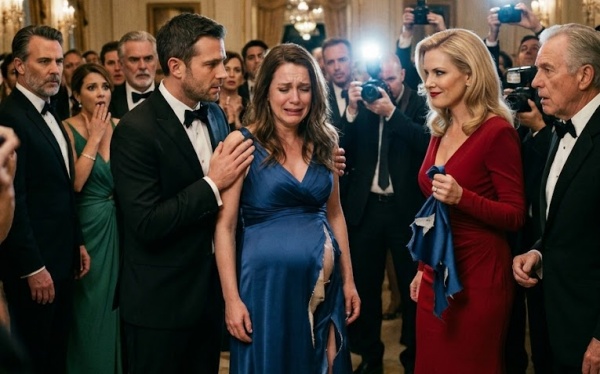
My husband’s mistress tore my gown open in front of three hundred guests at the gala. Then she smiled at my pregnant belly and said, “Everyone knows that baby was your last negotiation.”
What she didn’t know was that the contract in my clutch could take his company, his penthouse, and the one thing he loved more than her—his reputation.
PART ONE: The Night Everything Fell Apart
The Hartwell Charity Gala was the kind of event where old money shook hands with new ambition, and everyone pretended they couldn’t smell the desperation underneath the Chanel No. 5. The Grand Ballroom of The St. Regis New York glittered under three thousand crystal pendants, and the women wore gowns that cost more than most Americans’ monthly mortgage payments. I was one of them — or at least, I used to belong in rooms like this.
My name is Vivienne Caldwell-Mercer, and that night I was seven months pregnant, dressed in a custom ivory Vera Wang maternity gown that my mother-in-law had gifted me before she passed. The fabric was silk duchess satin, hand-embroidered along the bodice with tiny seed pearls. I had worn it to feel like myself again — like the woman I was before two years of betrayal had slowly hollowed me out.
My husband, Dominic Mercer, stood across the room near the bar. He was laughing too loudly at something, his hand resting on the small of a woman’s back — a woman I recognized. Celeste Hargrove. Twenty-nine years old. Senior VP at his firm. The woman whose perfume I had found on his collar six months ago, whose name appeared in his phone under “C — Client,” and whose voice I had heard through a cracked hotel-room door in Chicago last February when I was supposed to be at a baby shower in Connecticut.
I had known for a long time. I just hadn’t been ready to move.
My best friend Dana squeezed my elbow from beside me. “Viv,” she whispered, her eyes cutting across the room. “Don’t look. Not tonight. You’ve got the folder, remember? Tonight is about the contract, not the drama.”
She was right. I pressed my clutch — a small vintage Judith Leiber minaudière — closer to my side. Inside it was a USB drive and a two-page summary of a legal document that had taken my attorney, Margaret Cho of Cho & Associates on Park Avenue, eight months to quietly prepare. A postnuptial asset protection agreement that Dominic had signed three years ago, drunk on scotch and guilt after his first affair, believing it was a standard “estate planning update.” It wasn’t.
It was the document that would give me his forty-two percent stake in Mercer Capital Group — worth approximately $380 million — in the event of documented marital misconduct.
I had the documentation. I had the witnesses. I had everything.
What I hadn’t planned for was Celeste.
She found me near the dessert table at 9:15 PM. I heard her heels first — that sharp, deliberate click on marble that women use when they want you to know they’re coming. I turned slowly, one hand resting on my belly, and looked at her. She was wearing a red Valentino slip dress and the kind of smile that comes from years of winning by playing dirty.
“Vivienne,” she said, drawing out each syllable like it tasted sweet. “You look… tired.”
“Celeste,” I said evenly. “You look exactly like what you are.”
Her smile didn’t waver. Around us, conversations had begun to quiet — that subtle social hush that spreads through a room when people sense a confrontation brewing. In New York’s elite circles, this was better than theater. This was free.
“I’ve been meaning to talk to you,” she said, stepping closer. “Woman to woman. I think it’s time you accepted the truth. Dominic and I — we’re not just an affair. We’re a future. And you?” She glanced down at my stomach with something worse than contempt. Something cold and calculated. “You’re a liability he’s been too sentimental to cut loose.”
I kept my voice level. “You should walk away right now.”
She didn’t.
What happened next took less than four seconds. She reached out — and I still cannot explain whether it was a deliberate act or a final impulsive snap of a woman who had been told “yes” too many times — and grabbed the neckline of my gown. The sound of tearing silk in that silent ballroom was obscene. Loud. Final. The bodice split open from the shoulder down six inches, seed pearls scattering across the marble like tiny white accusations.
Three hundred people saw it happen.
The room erupted.
PART TWO: The Brothers in the Room
I stood very still. I think that was what frightened people most — that I didn’t scream, didn’t cry, didn’t crumble. I pressed the torn fabric against my chest with one hand and looked at Celeste with the calm of a woman who had already burned down the version of herself that could be broken by moments like this.
“You just assaulted a pregnant woman,” I said quietly, “in front of three hundred witnesses.”
The first person to reach me wasn’t Dana. It wasn’t even the gala’s head of security, who was already pushing through the crowd. It was a man I recognized but had never formally met — a tall man in a navy Tom Ford suit with the kind of composed authority that doesn’t need to announce itself.
Beckett Harlow.
The eldest of the three Harlow brothers. Forty-one years old. Co-founder of Harlow Capital, a private equity firm that managed roughly $14 billion in assets. His family had been in finance for three generations, but Beckett was the one who had taken the Harlow name from respected to untouchable. He was also, I would later learn, the lead investor in a deal with Mercer Capital Group that Dominic had been chasing for the past eighteen months.
“Ma’am,” Beckett said, removing his suit jacket in one smooth motion and placing it over my shoulders. He didn’t make a spectacle of it. He simply stood between me and the rest of the room like a wall. “Are you hurt? Do you need medical attention?”
“I’m fine,” I said. “The baby’s fine.”
“Good.” He turned briefly to the man beside him — his younger brother, Flynn, thirty-seven, in a charcoal Brioni suit — and said two words: “Get security.”
Flynn was already moving.
The third brother, Reid, was the one who handled Celeste.
Reid Harlow was thirty-four, the youngest, and the one the press called “the quiet one” — which in their family meant he was the one who actually read contracts on weekends for fun. He had a law degree from Yale and an MBA from Wharton, and when he stepped in front of Celeste with his hands clasped behind his back and said, “I’d strongly recommend you don’t say another word until you’ve spoken to an attorney,” she finally stopped smiling.
“Do you know who I am?” she said.
“Celeste Hargrove,” Reid said pleasantly. “SVP of Client Strategy at Mercer Capital. You live at 432 West 56th Street, apartment 14C. You drive a leased 2024 BMW 5 Series, and you are currently named in a pending HR complaint filed last October by two junior analysts at Mercer.” He paused. “Yes. I know exactly who you are.”
The color left her face.
Dominic had pushed through the crowd by then and was standing at the edge of the scene, his expression cycling through confusion, panic, and the particular brand of cowardice that had defined our entire marriage. He looked at me. He looked at Beckett Harlow. He looked at the torn fabric of my mother-in-law’s gown.
“Vivienne, I—”
“Don’t,” I said.
I had waited two years for this moment, and I had imagined it a hundred different ways. I had imagined screaming. I had imagined crying. I had imagined throwing a drink in his face — though that felt more cinematic than satisfying. What I hadn’t imagined was how quiet I would feel. How certain. Like a storm that had finally decided exactly where it was going to land.
I opened my clutch and removed a single business card. Not mine. My attorney’s.
“Have your lawyer call Margaret Cho by Monday morning,” I said. “Or she’ll be calling yours.”
PART THREE: What Was Inside the Clutch
The next morning, I sat at the kitchen table of my sister Rachel’s brownstone in Brooklyn Heights, my hands wrapped around a mug of chamomile tea, watching the morning light come in over the East River. My back ached. My feet were swollen. I was seven months pregnant and I had spent the previous night giving a statement to a New York City police officer about the assault, then two hours on the phone with Margaret, and then approximately forty-five minutes crying into Rachel’s shoulder in a way I hadn’t allowed myself to cry in years.
“Okay,” Rachel said, refilling her own coffee and sitting across from me. “Walk me through the document again. In plain English.”
I took a breath. “Three years ago, when Dominic had the first affair — the one with the paralegal, remember? — he was terrified I was going to leave and take my family’s investment with me. My grandfather left me a twenty-percent stake in Caldwell Logistics when he died. That stake was worth about sixty million at the time. Dominic needed it in the company’s balance sheet to secure a line of credit.”
“So he begged you to stay.”
“He did more than beg. He signed a postnuptial agreement. He thought it was a routine asset protection document — his own lawyer drafted the first version. But Margaret amended it. Quietly. Legally. With full disclosure, technically, in the form of a forty-page exhibit that his attorney absolutely should have read but didn’t, because they were billing hourly and wanted to close before the weekend.”
Rachel stared at me. “Viv.”
“The amendment included a marital misconduct clause. Any documented, verified instance of adultery during the marriage — verified meaning witnessed, photographed, or corroborated by sworn affidavit — triggers an automatic transfer of his forty-two percent equity stake in Mercer Capital to me.” I set down my mug. “I have seven sworn affidavits, a hotel receipt from the Four Seasons in Chicago, three years of phone records, and last night, I have three hundred witnesses who watched his mistress physically assault me in public.”
The silence in Rachel’s kitchen was the loudest thing I’d ever heard.
“How long have you been building this?” she finally said.
“Since the Chicago trip.”
She let out a long, slow breath. “And the Harlow brothers? Do they know what’s in that document?”
“Not yet. But they will.” I looked out at the river. “Dominic has been trying to close a deal with Harlow Capital for eighteen months. A co-investment structure worth about $200 million. It was supposed to be announced at the gala last night.” I paused. “It wasn’t announced.”
Rachel understood immediately. “Because Beckett Harlow watched his potential business partner’s mistress tear a pregnant woman’s dress open in the middle of the St. Regis ballroom.”
“In front of every major investor, journalist, and philanthropist in New York City,” I confirmed. “Yes.”
Margaret called at 9 AM sharp.
“The Harlow brothers’ legal team reached out this morning,” she said, without preamble. “All three of them. They want a meeting.”
“With me?”
“With you and your counsel. They’re not moving forward with the Mercer deal until they understand the full legal picture.” A pause. “Vivienne, they already retained a forensic accounting firm. Last night. They had one on retainer for due diligence, but apparently Beckett Harlow made some calls after he got home.”
I felt something loosen in my chest. “Set the meeting.”
“Thursday at ten. Their offices in Midtown.”
“I’ll be there.”
After I hung up, I sat quietly for a moment. Then I did something I hadn’t done in a very long time. I smiled.
PART FOUR: The Meeting at Harlow Capital
The Harlow Capital offices occupied the entire forty-fourth floor of a tower on 57th Street, with floor-to-ceiling windows that looked out over Central Park. It was the kind of office designed to communicate a single message: we don’t need to impress you, but we will anyway. The furniture was clean-lined and expensive without being showy. The receptionist offered me still or sparkling water and a choice of herbal teas. There were fresh flowers on the side table that I recognized as garden roses — probably from the flower market on 28th Street.
I wore a deep navy maternity dress and carried the same vintage clutch from the night of the gala, because I wanted them to remember what had happened — and what was in it.
Margaret sat beside me. Across the glass conference table were Beckett, Flynn, and Reid Harlow, along with two attorneys I didn’t recognize and a woman introduced as their head of risk and compliance.
Beckett opened the meeting.
“Mrs. Caldwell-Mercer,” he said, “I want to begin by saying that what happened at the St. Regis two nights ago was unacceptable. On behalf of everyone present, I apologize that you experienced that in what should have been a safe environment.”
“Thank you,” I said. “But I’m not here for apologies.”
A faint smile crossed his face. “No. I didn’t think you were.” He glanced at Margaret. “We’ve reviewed the summary your attorney provided this morning. We have questions.”
“Ask them.”
What followed was three hours of the most focused, precise legal and financial conversation I had ever been a part of. Reid walked through the postnuptial agreement clause by clause. Flynn’s team presented their forensic accounting preliminary findings — Dominic, it turned out, had been doing more than cheating. There were irregular transfers, undisclosed liabilities, and two shell entities in Delaware that appeared to be funneling consulting fees to a personal account. The forensic accountant estimated the total irregular transfers at somewhere between $4 million and $8 million over four years.
“He was stealing from his own company,” Flynn said flatly.
“Which is also partially my company,” I said. “My family’s original investment is still in the capital structure.”
“We know,” Reid said. “That’s actually why this is cleaner than it looks.” He slid a document across the table. “If your postnuptial clause triggers as written, and our attorneys believe it does, you will hold Dominic’s forty-two percent stake plus your existing family position. Combined, that gives you majority control of Mercer Capital.”
I looked at the document. Then I looked up.
“What are you proposing?”
Beckett leaned forward slightly. “We still want to do the deal. Two hundred million, co-investment structure, exactly as originally planned. But we want to do it with you as the controlling stakeholder. Not Dominic.”
The room was quiet.
“We’d also want you to retain an independent CEO,” he added. “Given your current circumstances.” His eyes moved briefly to my belly and back without any judgment in them — only the practical clarity of a man who thought about risk for a living.
“I have someone in mind already,” I said.
Later, I would think about what that meeting meant — not just legally or financially, but personally. Three men who had no obligation to me, who had been positioned as my husband’s future partners, had looked at the evidence and chosen the right side. Not because they were sentimental. Not because they felt sorry for me. But because they were the kind of people who valued integrity as a business asset.
That distinction mattered to me. I had spent two years surrounded by people who knew what Dominic was doing and said nothing, because saying something was expensive and silence was free. The Harlow brothers weren’t heroes. They were simply people who did the math and concluded that a man who cheats on his pregnant wife in plain sight, who allows his mistress to assault her in a ballroom full of witnesses, is also a man who will eventually cheat you.
They weren’t wrong.
PART FIVE: What Happened After
Dominic’s attorney called Margaret the following Monday morning, as instructed.
The negotiation was, by the standards of Manhattan divorce proceedings, remarkably short. I think Dominic’s team had reviewed the postnuptial agreement over the weekend and understood that the litigation path was a losing one. His forty-two percent stake transferred in accordance with the document. He retained his personal accounts, his car — a 2023 Porsche Cayenne — and the apartment in Tribeca, which he had purchased in his name before we married and which I had no interest in anyway. I kept the co-op on the Upper East Side that had been in my family since 1987.
Celeste was arrested the morning after the gala on a charge of assault in the third degree — a Class A misdemeanor in New York — following the statements of multiple witnesses. She posted bail and retained an attorney. Her employment at Mercer Capital was terminated the same week, consistent with a code-of-conduct clause in her contract that had been triggered by the pending HR complaint Reid had referenced.
I was told she moved to Los Angeles several months later. I don’t know if that’s true. I stopped keeping track.
My daughter was born on a Tuesday morning in late October at Lenox Hill Hospital on the Upper East Side. Seven pounds, four ounces. Twenty inches long. She had Dominic’s dark hair and my grandmother’s stubborn chin, and when the nurse placed her on my chest, I looked at her face and felt something crack open inside me — not in pain, but in the way that ice cracks in spring, when the melt finally comes.
I named her Eleanor Margaret. Eleanor for my grandmother. Margaret for my attorney.
Rachel was in the room. Dana was in the waiting area, stress-eating a bag of pretzel M&Ms she had smuggled in from the gift shop. Beckett Harlow sent flowers — a large arrangement of white garden roses that arrived at the hospital room with a handwritten card that said simply: Congratulations. She’s already the majority stakeholder. It made me laugh for the first time in what felt like years.
I became CEO of Mercer Capital eight months later, after a unanimous board vote and a six-month transition period dur
ing which the independent CEO I had proposed — a woman named Patricia Osei, formerly of Goldman Sachs — guided the company through the integration of the Harlow co-investment deal. The deal closed at $215 million, slightly above original projections. Patricia stayed on as President. I took the CEO title and, with it, the kind of responsibility that I had spent my entire career being told I wasn’t ready for.
The company’s name changed too. Caldwell Capital Group. The board suggested it. I accepted without pretending I didn’t want it.
People ask me sometimes — usually in the comments, sometimes in DMs — whether I feel guilty. Whether I think I was too calculated. Whether it bothers me that I spent months quietly building a legal case against my husband instead of confronting him or leaving sooner.
Here is what I tell them:
I tried confronting him. Twice. The first time, he cried, promised to end it, and booked us a weekend at the Inn at Little Washington in Virginia as a gesture of reconciliation. The second time, he told me I was paranoid, that I was letting my “anxiety” distort my perception of reality, and that I should consider seeing my therapist more frequently.
After that, I stopped confronting and started documenting.
I’m not proud of everything about those two years. I’m not proud that I stayed as long as I did, or that I let the fear of disruption — of scandal, of financial uncertainty, of becoming a single mother — keep me in a marriage that had been over for a long time before I admitted it. I wasted time I can’t get back.
But I’m not ashamed of the clutch. I’m not ashamed of the postnuptial agreement. I’m not ashamed of the seven affidavits or the hotel receipt or the three years of phone records. Because the alternative — walking away with nothing, letting a man who had lied to me for years keep the company my family helped build while I started over from scratch, seven months pregnant — was not an option I was willing to accept.
Women are taught, from a very young age, to be gracious in defeat. To step aside. To take the high road, which usually means taking the road that benefits everyone else.
I took a different road.
Eleanor is eighteen months old now. She took her first steps in the living room of our co-op on a Saturday afternoon while Patricia and I were on a work call, and I watched her wobble across the hardwood floor with her arms out for balance, and I thought: that is exactly what it looks like. That wobble. That refusal to sit down just because standing is harder.
I think about that gala night sometimes. The scatter of seed pearls across marble. The sound of silk tearing. The three hundred faces turning toward me in that particular silence that comes before a crowd decides what kind of story it’s watching.
They were watching a woman at the end of something.
They just didn’t know it was the end of the old version — the one who waited, and accommodated, and gave the benefit of the doubt long past the point where the doubt had earned any benefits.
The new version was already there, standing in a torn gown with a clutch full of evidence, waiting for the right moment to introduce herself.
Her name is Vivienne Caldwell.
She runs a $600 million company.
She has a daughter named Eleanor Margaret.
And she is done being the last negotiation.
