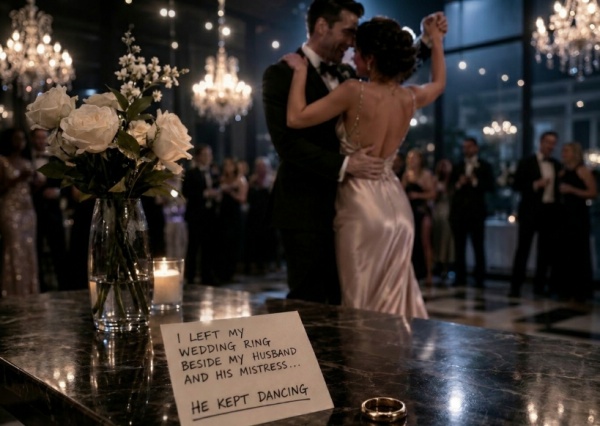
I Slid My Wedding Ring Across the Bar to My Husband and His Mistress Without Saying a Word. He Kept Dancing All Night. By 9 AM, His $1.4 Billion Empire Was Frozen and He Couldn’t Access a Single Dollar.
Part 1: The Night Everything Was Supposed to Be Perfect
My name is Diane Calloway, and I want to begin with the ballroom, because the ballroom is where the story ends and where it also, in the specific way that endings are always also beginnings, starts. It was the Grand Hyatt on East 42nd Street in Manhattan, on a Saturday evening in late October, and the occasion was the annual Calloway Group investor gala — the event that my husband, Reed Calloway, had hosted every year for the preceding nine years as the centerpiece of his company’s relationship management calendar.
The Calloway Group was a New York-based commercial real estate development firm with a portfolio valued at approximately $1.4 billion, and the gala was the specific, annual performance of a man who understood that in his industry, confidence is a product and the gala was where you manufactured it — three hundred investors, partners, and civic figures in a ballroom that cost $180,000 to rent for the evening, with a live band, a four-course dinner, and the specific, ambient message that the man at the center of it all had everything under control.
I had attended every one of those nine galas. I had helped plan seven of them. I had chosen the floral arrangements for the last four — tall arrangements of white peonies and eucalyptus that the event coordinator always said were the most elegant she had worked with — and I had stood beside Reed at the entrance for every one of them, greeting guests with the specific, practiced warmth of a woman who has learned that her husband’s professional relationships are also her professional relationships and who has decided to be good at that work because she is good at everything she decides to do.
I was thirty-six years old, a former Columbia University architecture professor who had left my academic position four years into our marriage to manage the interior design and architectural oversight of the Calloway Group’s development projects — work I did without a formal title, without a salary, and without, I had come to understand in the preceding months, adequate recognition of what it was actually worth.
Reed Calloway was forty-two, broad-shouldered, with the specific, silver-at-the-temples authority of a man who has arrived at the age where his appearance has caught up with the confidence he has always projected. He was charming in the specific, high-wattage way of men who have spent their careers in rooms where charm is currency, and he was generous in the specific, public way of men who understand that generosity, when performed correctly, is the most efficient form of reputation management available.
He had been, for most of our eight-year marriage, a good husband in the specific, functional sense of a man who provides well, appears reliably, and maintains the surface performance of a partnership without always being present in the ways that a partnership actually requires. I had told myself, for years, that this was enough. I had been wrong, but I had been wrong in the specific, gradual way of a woman who has been slowly adjusting her expectations downward without noticing the direction of the adjustment.
I had known about Natalie Voss for six weeks before the gala. Not suspected — known, with the specific, documented certainty of a woman who has found the evidence and has spent six weeks deciding what to do with it. Natalie was thirty-one, a marketing director at a Midtown PR firm called Voss & Partners that the Calloway Group had retained eighteen months earlier for brand management.
She was attractive in the specific, polished way of a woman who works in a field where appearance is professional currency, and she had been, for the preceding eight months, conducting an affair with my husband that he had managed with the specific, arrogant carelessness of a man who believes his wife is not paying attention.
I had found the evidence in the specific, accidental way that evidence presents itself when someone has stopped being careful — a hotel receipt in a jacket pocket, a text preview on a shared iPad, a credit card statement line item for a West Village restaurant that I had never been to and that Reed had never mentioned. I had not confronted him. I had documented everything, consulted an attorney, and waited for the right moment. The gala was the right moment.
Part 2: What I Had Built and What He Had Forgotten
I want to be precise about the specific, financial and professional reality of the Calloway Group, because that reality is the foundation of everything that happened after I left my ring on the table, and because I think it is important to understand it fully before the story of that evening continues.
When Reed and I married eight years ago, the Calloway Group was a $340 million firm with a solid but unremarkable portfolio of New Jersey and outer-borough New York commercial properties and a reputation that was respectable but not distinguished. What it became — the $1.4 billion firm that hosted $180,000 galas at the Grand Hyatt and had its projects featured in Architectural Digest and The New York Times real estate section — was not entirely, or even primarily, the result of Reed’s deal-making.
The Calloway Group’s transformation had been driven, in significant part, by the architectural and design vision that I had brought to its development projects after leaving Columbia. The Meridian Tower project in Long Island City — the mixed-use development that had been the firm’s highest-profile project and that had won a 2021 AIA New York design award — had been conceived and designed under my architectural direction.
The Harbor Point residential complex in Hoboken — which had sold out in pre-construction at prices that exceeded the market by 23% — had been designed to my specifications. The Calloway Group’s brand identity, its design language, its reputation for projects that were architecturally distinguished rather than merely financially adequate — all of it had been built on work that I had done without a formal employment agreement, without equity in the projects I designed, and without any legal documentation of my contribution beyond the specific, informal understanding of a wife who had decided that her husband’s success was also her success and that formal documentation was unnecessary between people who love each other.
I had understood, six weeks before the gala, that this informal understanding had been a significant mistake. I had retained Patricia Osei of Osei & Partners — a Midtown Manhattan family law firm recommended by a former Columbia colleague whose divorce Patricia had handled — and in our initial consultation, Patricia had asked me a series of questions about the structure of my contributions to the Calloway Group that had produced, in their answers, a picture that was both clarifying and alarming.
Under New York Domestic Relations Law, marital property includes assets acquired during the marriage, and the appreciation of marital assets is generally subject to equitable distribution. But the specific question of how my architectural and design contributions would be valued in a divorce proceeding depended significantly on documentation — and the documentation of my contributions was, Patricia told me, inadequate for the purpose of establishing their full value.
We had spent the six weeks before the gala doing the work of creating that documentation: gathering project records, design files, correspondence, meeting notes, and the specific, accumulated evidence of eight years of professional contribution that had been performed without formal recognition.
Patricia had also retained Marcus Webb of Webb Financial Consulting in Midtown — a forensic accountant who had spent three weeks reviewing the Calloway Group’s financial structure and who had produced, the week before the gala, a report that contained information I had not expected. Reed had, in the preceding fourteen months, been making a series of financial arrangements that Patricia recognized immediately as the specific pattern of a man who is preparing for a divorce he has not yet announced.
A Delaware LLC — Calloway Ventures III — had been established with Reed as sole member, and three of the firm’s most valuable properties had been transferred into it through a series of transactions structured to appear as routine portfolio management. A Cayman Islands account had been opened under a subsidiary entity. Two life insurance policies had been revised. The specific, ugly architecture of a man who is planning his exit while his wife is still in the house was fully visible in the documents that Marcus had assembled, and it was fully documented, and it was going to be fully presented to a New York court at the earliest available opportunity.
I had known all of this when I put on my gown on the evening of the gala — a navy silk dress that I had bought for the occasion with the specific, deliberate attention of a woman who has decided that the last time she appears in a room as Reed Calloway’s wife, she is going to look exactly like herself.
I had known all of this when I arrived at the Grand Hyatt and stood beside Reed at the entrance and greeted three hundred guests with the specific, composed warmth that nine years of these evenings had made second nature. And I had known all of this when I took my seat at the head table and watched the evening unfold with the specific, patient attention of a woman who is waiting for the right moment and who has decided, with considerable care, exactly what the right moment looks like.
Part 3: The Ring
The band started at 9:15 PM — a twelve-piece jazz ensemble that Reed had booked because he understood that live music at a certain quality level communicates something specific about the host’s relationship to money, which is that he has enough of it to spend on things that are beautiful rather than merely functional.
The dance floor filled with the specific, practiced ease of people who attend enough events of this kind to be comfortable in formal wear and who have had enough champagne to be comfortable on a dance floor. Reed was at the center of it, as he always was at these events — moving through the room with the specific, kinetic energy of a man in his element, shaking hands, laughing at the right moments, placing his hand on the right shoulders.
At 9:47 PM, I saw him with Natalie. They were at the far end of the bar — not the main bar, but the secondary bar near the east wall that was slightly less trafficked and slightly less visible from the main floor. They were standing close in the specific, practiced way of two people who have learned to calibrate their proximity in public to the minimum that satisfies the need for contact while remaining technically deniable.
Reed’s hand was on the bar beside her hand. Natalie was wearing a burgundy dress that I recognized from an Instagram post she had made three weeks earlier, captioned date night 🍷, which I had screenshot and forwarded to Patricia at the time. They were not kissing. They were not doing anything that, in isolation, would have been unambiguous.
But I had been watching Reed Calloway for eight years, and I knew every register of his body language, and what I saw at that bar was a man who was entirely comfortable with the woman beside him in a way that he had not been entirely comfortable with me in longer than I wanted to calculate.
I sat with this for approximately four minutes. I want to be honest about those four minutes, because I think they matter — not because anything dramatic happened in them, but because they were the specific, quiet minutes in which I arrived at a complete and final certainty that required no more deliberation.
I was not angry in the hot, destabilizing way of a woman who has just been surprised. I had known for six weeks. The anger had arrived and been processed and had settled, over those six weeks, into something cooler and more useful — the specific, functional clarity of a woman who has made her decision and is simply waiting for the moment to execute it.
I reached under the table. I removed my wedding ring — a 1.8-carat oval diamond in a platinum setting that Reed had given me at our engagement at the Boathouse in Central Park eight years earlier and that I had worn every day since without removing it once. I held it in my palm for a moment. Then I stood up.
I walked to the bar. I walked with the specific, unhurried composure of a woman who has somewhere to be and is not in a hurry to get there, because hurrying would suggest urgency and urgency would suggest that the situation has power over her, and she has decided that it does not. Reed saw me coming when I was approximately ten feet away.
His expression shifted in the specific, subtle way of a man who has been caught in a context he cannot immediately explain and is running through his available responses. Natalie saw me a second later and her expression did the specific thing that expressions do when a person realizes that the situation they are in has just changed in a way they cannot manage.
I did not look at Natalie. I looked at Reed. I set my wedding ring on the bar between his hand and hers — not dramatically, not with force, but with the specific, deliberate precision of a woman placing something exactly where she intends to place it. I looked at him for a moment. He opened his mouth. I said, quietly enough that only the two of them could hear: “I’ll see you in court, Reed.” Then I turned around and walked back across the ballroom.
I did not run. I did not cry. I did not look back. I walked to the coat check, retrieved my coat, walked through the lobby of the Grand Hyatt, and stepped out onto East 42nd Street into the October night. I took out my phone and called Patricia. She answered on the first ring. “It’s done,” I said. “File everything in the morning.” Patricia said: “It’s already ready. Get some sleep.” I got into a cab and went to my sister’s apartment in Brooklyn Heights, where I had arranged to stay, and I slept better than I had in six weeks.
Behind me, in the Grand Hyatt ballroom, the band was still playing. Reed was still at the bar. And the ring I had left between his hand and his mistress’s was sitting on the polished wood surface, catching the light, waiting for him to understand what it meant.
Part 4: What Morning Brought
Reed called me eleven times between 10:03 PM and 2:17 AM. I did not answer. He texted — first confused, then explanatory, then apologetic, then, as the hours passed and the apologies produced no response, increasingly urgent in the specific, escalating way of a man who is beginning to understand that the situation is not going to resolve through the channels he is accustomed to using.
At 7:09 AM, Patricia’s office filed the petition for divorce in New York County Supreme Court, along with a motion for a temporary restraining order freezing all assets of the Calloway Group and its subsidiaries pending the proceedings, supported by Marcus Webb’s forensic accounting report documenting the Delaware LLC transfers, the Cayman account, and the life insurance revisions.
The motion also included a request for an emergency order requiring Reed to provide full financial disclosure within 72 hours, supported by evidence that the preceding fourteen months of asset restructuring constituted deliberate concealment in anticipation of divorce proceedings.
The process server reached Reed at the Calloway Group’s offices on Park Avenue South at 9:22 AM — I know the time because Patricia’s paralegal confirmed the service. Reed’s response was to call Patricia’s office directly, which Patricia had anticipated and which her receptionist handled with the specific, professional composure of someone who has been instructed on exactly this scenario.
His attorneys — a team from a Midtown firm that specialized in high-net-worth divorce defense — filed an emergency opposition to the restraining order by 11:30 AM, arguing that it was disproportionate and would cause irreparable harm to the company’s ongoing operations. The judge, the Honorable Margaret Osei-Williams of New York County Supreme Court, reviewed both filings and granted the restraining order at 2:15 PM, with a written note that the forensic accounting evidence presented by the petitioner was “sufficiently specific and documented to justify immediate asset preservation measures.”
By 3:00 PM on the Sunday after the gala, the Calloway Group’s primary operating accounts were frozen. The Delaware LLC transfers were subject to a court-ordered hold pending review of whether they constituted fraudulent conveyance under New York Debtor and Creditor Law § 276.
Reed’s personal accounts — including the joint accounts that I had, on Patricia’s advice, already partially protected through a series of transfers she had confirmed were legally appropriate — were frozen. His corporate credit cards were suspended pending the financial disclosure order.
The Cayman account, which Marcus had documented through transaction records and which was subject to disclosure under the court’s emergency order, was identified in the filing and flagged for forensic review. Reed Calloway, who had been dancing at the Grand Hyatt nine hours earlier with his hand beside his mistress’s on a bar, was standing in his Park Avenue South office unable to access the financial infrastructure of the empire he had spent a decade building.
Natalie Voss, I learned through a mutual acquaintance three weeks later, had not returned Reed’s calls after the gala. The specific, practical calculus of a woman who has been conducting an affair with a man she believed was powerful and has just watched that power become legally complicated is not, in my experience, a complicated calculus.
She had, by the account I received, moved on with the specific, unsentimental efficiency of a person who has decided that the situation no longer serves her interests and who has other options. Reed had gone to Monaco for her — or somewhere like it, in some form — and she had left the moment the bill came due. That is the specific, reliable pattern of these situations, and I had known it would be the pattern, and I had felt nothing about it except the specific, clean neutrality of a woman who has already processed her grief and arrived at the other side of it.
Part 5: What the Ring Left Behind
The divorce proceedings lasted fourteen months — fourteen months of forensic accounting, depositions, expert testimony, and the specific, grinding work of a New York high-net-worth divorce that involves a business whose value is disputed and whose financial history has been deliberately obscured.
Patricia was, throughout those fourteen months, exactly what my Columbia colleague had described her as: the specific kind of attorney who thinks three moves ahead and who has prepared for every contingency before the other side has identified the contingency. The Delaware LLC transfers were found by the court to constitute fraudulent conveyance under New York law, and the transferred properties were returned to the marital estate for distribution purposes.
The Cayman account was disclosed and its balance — approximately $8.2 million — was added to the marital estate. The forensic valuation of my architectural and design contributions to the Calloway Group — prepared by an expert witness that Patricia retained from the American Institute of Architects — established a figure that Reed’s attorneys disputed vigorously and that the court ultimately accepted in substantial part.
The final decree was entered on a Tuesday morning in December, and I sat in the courtroom and listened to Judge Osei-Williams read the terms with the specific, still attention of a woman who has been working toward this moment for fourteen months and who wants to hear every word clearly.
Equitable distribution of the marital estate — weighted in my favor at 58% to 42%, reflecting the court’s findings regarding intentional asset concealment and the documented value of my professional contributions to the firm’s appreciation during the marriage — produced a settlement that included a $47 million lump sum payment, the Calloway Group’s interest in the Meridian Tower project transferred to my ownership, and the West Village townhouse that Reed and I had purchased together and that I had renovated under my own architectural direction.
Spousal maintenance was awarded at $35,000 per month for seven years. Attorney fees were assessed against Reed at $1.8 million as a sanction for the concealment. The Meridian Tower interest alone — the project I had designed, the project that had won the AIA award, the project whose value derived almost entirely from the architectural vision I had brought to it — was valued at approximately $28 million at the time of transfer.
I want to talk about what I did with the Meridian Tower interest, because I think it is the most important part of the aftermath and the part that I am most proud of. I established Calloway Design Group — a New York-based architectural and development firm, incorporated in my name, with offices in Tribeca — using the Meridian Tower interest as the foundational asset and the eight years of project experience I had accumulated at the Calloway Group as the professional foundation.
I hired four architects from firms I had worked with during those eight years, a project manager I had collaborated with on the Harbor Point development, and a financial director who had been recommended by Marcus Webb. Within eighteen months of the firm’s founding, Calloway Design Group had three active development projects in New York and New Jersey, a design commission for a mixed-use development in Austin, Texas, and a reputation in the New York architectural community that was, by every measure I could apply, entirely and unambiguously mine.
Reed is, by the accounts I receive through the specific, indirect channels of a professional community that is smaller than it appears, managing. The Calloway Group survived the divorce proceedings in a reduced form — several investors withdrew during the litigation, citing the reputational uncertainty, and the firm’s portfolio was significantly diminished by the asset distribution. He has rebuilt, partially, with the specific, determined resilience of a man who has been in this industry long enough to know how to recover from a setback, and I do not wish him ill in any active sense.
I wish him the specific, neutral outcome of a person who is no longer relevant to my life and who is therefore not something I spend energy on. He is not dancing at the Grand Hyatt this October. The gala has not been held since the divorce was filed. That is, I think, the appropriate outcome.
The ring is in a box in the top drawer of my desk at Calloway Design Group. I have not thrown it away and I have not sold it and I have not done anything dramatic with it, because drama was never the point. I keep it because it is a reminder — not of the marriage, not of Reed, not of the specific, painful inventory of what those eight years cost me — but of the specific, exact moment when I set it on a bar in the Grand Hyatt ballroom and walked away.
That moment was the moment I stopped organizing my life around someone else’s performance of success and started building something that was actually, structurally, legally, and in every other way that matters, mine. The ring reminds me of what it felt like to make that decision — the specific, clean weight of it, the specific, cold clarity of a woman who has done her preparation and is ready to execute it and who knows, with the settled certainty of someone who has thought it through completely, that she is doing the right thing.
He kept dancing that night. He had no idea that by morning, the empire he thought he had built alone was already in the process of being accurately divided between the two people who had actually built it. He had no idea that the woman who had just set her ring on the bar beside his hand had spent six weeks preparing for that moment with the specific, methodical thoroughness of a woman who does not do things halfway. He had no idea that the ring was not a gesture of defeat but a declaration of clarity — the specific, irreversible clarity of a woman who has finally decided to stop performing in someone else’s production and start directing her own.
I left the ring on the table. I walked out of the ballroom. I built something better. That is the whole story, and it is enough.
