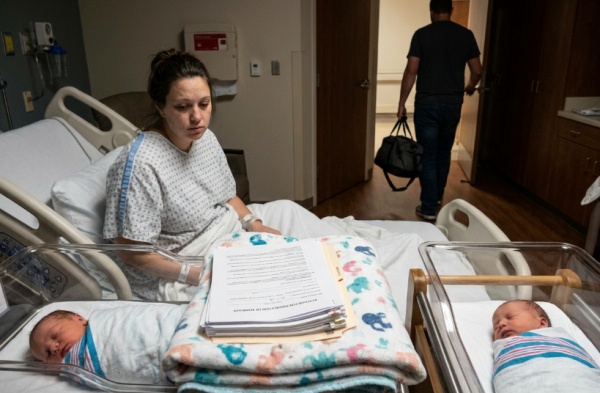
My Husband Dropped Divorce Papers on My Newborn Twins’ Blanket Three Days After I Gave Birth — Then Walked Out to His Mistress. He Had No Idea My Father Had Already Built Me a Way Out Before He Died.
On the morning of October 14th, I was three days postpartum, recovering from delivering twins in a hospital room in Atlanta, when my husband walked in wearing street clothes, set a manila envelope on the cream-colored blanket my mother had knitted for our babies, and told me he was in love with someone else. He said he hoped we could “be civil for the children’s sake,” straightened his jacket, and walked out — and I sat there listening to his footsteps fade down the maternity ward hallway while our daughter and son were still getting their newborn assessments down the hall…
Part 1: The Woman I Was Before the Hospital Bracelet
My name is Vivienne Hartley, and I want to begin with the woman I was before the morning of October 14th, because she deserves to be seen clearly before the story of what happened to her — and what she did about it — begins. I grew up in Savannah, Georgia, the only child of Robert and June Calloway, in a three-bedroom house on Habersham Street with a front porch that caught the afternoon breeze off the river and a father who read to me every night until I was old enough to read to him. My father was a quiet man in the specific way of people who have thought carefully about most things and have arrived at a settled relationship with the world — not passive, not resigned, but genuinely at peace with the difference between what he could control and what he could not. He was a civil engineer who spent thirty years with the Georgia Department of Transportation and who, in his spare time, restored antique clocks in the garage workshop that smelled of machine oil and cedar and the particular, unhurried patience of a man who believed that broken things were worth fixing.
He died of pancreatic cancer when I was twenty-nine, fourteen months before the twins were born, and the specific, irreversible absence of him is the background frequency of every day of my life since. He left me the house on Habersham Street, a modest life insurance policy, and a letter in a sealed envelope that his attorney, James Whitfield of Whitfield & Associates in Savannah, had been instructed to deliver to me “when you need it most.” James had called me the week after my father’s funeral and told me about the letter, and I had asked him to keep it, because I was not ready, and because I trusted my father’s judgment about timing more than I trusted my own grief.
I met Donovan Hartley at a fundraising gala in Atlanta when I was twenty-six. He was thirty-two, a commercial real estate developer from Buckhead with the specific, polished confidence of a man who had grown up with money and had made more of it and had never experienced a significant consequence for anything he had done. He was charming in the way that certain men are charming — not because they are genuinely interested in you, but because they are genuinely skilled at performing interest, and the performance is good enough that the distinction takes years to become clear. We dated for two years. We married at a ceremony at the Biltmore Ballroom in Atlanta that his mother planned and that I smiled through with the specific, accommodating grace of a woman who has decided that the relationship matters more than the wedding. I was twenty-eight. I was in love. I was also, I would understand later, already in the process of becoming smaller than I was, in the specific, incremental way that happens when you spend enough time around someone who needs to be the largest person in every room.
The pregnancy was difficult. I was thirty years old, carrying twins — a boy and a girl — and the physical demands of a twin pregnancy at that age, combined with the emotional demands of a marriage that had been quietly deteriorating for two years, produced a kind of exhaustion that went deeper than sleep could reach. Donovan was present in the logistical sense — he attended the appointments, he set up the nursery, he told his colleagues at the Hartley Development Group that he was “thrilled” — but he was absent in the way that mattered, the specific, attentive presence of a person who is genuinely with you rather than adjacent to you. I told myself it was the stress of the business. I told myself it would change when the babies came. I told myself the things that women tell themselves when the alternative is a truth they are not yet ready to hold.
Part 2: The Third Day
Rosalind June and Robert Calloway Hartley — Rosie and Cal, named for my parents — were born at Piedmont Atlanta Hospital on October 11th at 6:42 and 6:44 in the morning, respectively. Rosie came first, seven pounds even, with her grandfather’s dark eyes and a quality of alert stillness that the delivery nurse said she had never seen in a newborn. Cal came two minutes later, six pounds eleven ounces, already making the specific, indignant sound of a person who has opinions about his circumstances. I held them both in the recovery room while the morning light came through the window and my mother, who had driven up from Savannah the night before, sat in the chair beside the bed and cried in the specific, grateful way of a woman who has recently lost her husband and has just watched her daughter bring two new lives into the world.
Donovan was there. He held them. He took photographs. He sent the announcement text to his contacts list. He did all of the things that are performed at the arrival of children, and he performed them with the specific, surface warmth of a man who understands what the moment requires and is capable of delivering it on demand. I was too exhausted and too overwhelmed and too flooded with the specific, oceanic love of a woman who has just met the two people she will spend the rest of her life protecting to examine his warmth too closely. I simply accepted it. I was grateful for it. I slept when the babies slept and woke when they woke and existed, for two days, in the suspended, luminous unreality of new parenthood.
On the morning of October 14th — the third day — my mother had gone to the hospital cafeteria for breakfast, and the nurse had taken Rosie and Cal for their morning assessments, and I was alone in the room for the first time since the birth. Donovan came in at 8:15. He was wearing street clothes rather than the previous days’ casual hospital attire, and he had the specific, coiled energy I had learned to recognize over four years of marriage — the energy of a man who has made a decision and is in the process of executing it. He sat in the chair beside the bed. He did not reach for my hand. He placed a manila envelope on the blanket beside me — the blanket my mother had knitted during the pregnancy, cream-colored with small yellow stars — and he said, “I need you to look at these.”
I opened the envelope. Inside were divorce papers — a Petition for Dissolution of Marriage filed in Fulton County Superior Court, already signed by Donovan, already dated, already prepared by an attorney whose name I did not recognize. I read the first page. I read the second. My hands were steady in the specific way that hands are steady when the body has gone into a kind of protective shock that precedes the full arrival of pain. “Donovan,” I said. My voice was very quiet. “The babies are three days old.” “I know,” he said. “I’m sorry for the timing. But I think it’s better to be honest.” He said her name then — Melissa, a woman I had suspected for seven months and had never confronted because confrontation felt like an admission that the marriage I had been trying to save was already gone. He said they had been together for a year. He said he had been “unhappy for a long time.” He said he hoped we could “be civil for the children’s sake.”
Then he stood up, straightened his jacket, and walked out of the room. I heard his footsteps in the hallway, the specific, receding sound of a man leaving, and then I heard nothing except the distant sounds of the maternity ward and the cream-colored blanket with the yellow stars and the divorce papers sitting on top of it. I did not cry immediately. I sat very still for approximately four minutes, looking at the papers, looking at the blanket, looking at the window where the Atlanta morning was proceeding with the specific, indifferent brightness of a world that does not pause for private devastation. Then my mother came back from the cafeteria with two coffees and a blueberry muffin, and she looked at my face, and she set the coffees down, and she came to the bed and held me while I cried in a way I had not cried since my father died.
Part 3: The Letter
I called James Whitfield from the hospital room on October 16th — five days after the birth, two days after the divorce papers, the day before I was discharged with two newborns and a marriage that had been unilaterally ended on a cream-colored blanket. My mother was with the babies in the nursery. I sat in the hospital bed with my phone and dialed James’s number, and when he answered I said, “I think it’s time for the letter.”
James drove up from Savannah the following morning. He was sixty-seven, a tall man with silver hair and the specific, unhurried dignity of a Southern attorney who has been practicing long enough to have seen most of what human beings are capable of doing to each other and has arrived at a compassionate rather than cynical relationship with that knowledge. He had known my father for thirty years. He sat in the chair beside my bed in the discharge room, with Rosie asleep in the bassinet and Cal making small, exploratory sounds in my arms, and he handed me the envelope.
My father’s handwriting on the front said simply: For Vivienne. When you need it.
I opened it carefully. The letter was three pages, handwritten on the cream stationery my father had used for important correspondence my entire life, in the specific, precise cursive of a man who had been taught that handwriting was a form of respect for the reader. I will not reproduce it in full, because it belongs to me and to my children and to the private architecture of a relationship between a father and a daughter that does not require a public audience. But I will share what it gave me, because that is the part of the story that matters.
My father had known, in the specific, quiet way that fathers who pay close attention know things, that my marriage was not what I had presented it to be. He had watched Donovan at family gatherings with the careful eyes of a man who restores broken things and has learned to identify the difference between something that is structurally sound and something that looks sound but has a fault line running through it. He had not said anything, because I had not asked, and because he respected my autonomy in the specific, loving way of a parent who understands that his child’s mistakes are hers to make and hers to learn from. But he had prepared.
The letter told me three things. The first was that the house on Habersham Street in Savannah was mine, fully paid, with no encumbrances, and that the property taxes were covered for five years by a separate account he had established for that purpose. The second was that he had, over the previous decade, established a revocable living trust — the Calloway Family Trust — that held, in addition to the house, a portfolio of conservative investments currently valued at approximately $380,000, of which I was the sole beneficiary, and that James Whitfield was the trustee with instructions to transfer management to me at the time of the letter’s delivery. The third was a paragraph that I have read so many times since that I could recite it from memory, and that I will share here because my father wrote it for me but it belongs to anyone who needs it:
“Vivienne, you were never someone who needed saving. You are someone who occasionally needs reminding of what you already know. You know how to build things. You know how to be patient with broken things. You know that the most important work is usually the work that no one sees. Whatever has brought you to this letter, I want you to know that I have left you the tools. The rest is yours. It always was. I love you more than clocks. — Dad.”
I sat in the discharge room of Piedmont Atlanta Hospital with my son in my arms and my daughter in the bassinet and my father’s letter in my hand, and I felt something shift — not the grief, which was still there and would always be there, but something underneath the grief, something load-bearing and permanent. My father had built me a foundation before he left. He had done it quietly, without telling me, because he understood that the knowledge of its existence might change the choices I made before I was ready to make different ones. He had trusted my timing. He had trusted me.
I folded the letter carefully, put it back in the envelope, and looked at James Whitfield. “I need a family law attorney in Atlanta,” I said. “The best one you know.” James nodded. “I have a name,” he said. “She went to law school with my daughter. Her name is Patricia Osei.”
Part 4: What Patricia Built
Patricia Osei of Osei Family Law in Midtown Atlanta was forty-four years old, a Spelman College and Emory University School of Law graduate, and possessed of the specific, grounded authority of a woman who has spent twenty years in high-stakes family law and has stopped being surprised by the specific ways that men underestimate the women they are divorcing. She met me in her office on Peachtree Street ten days after I was discharged from the hospital, with Rosie and Cal in their car seats on the floor beside my chair and my father’s letter in my bag and the divorce papers Donovan had left on the yellow-starred blanket in a folder on the table between us.
She read everything without speaking. When she finished, she looked at me over the top of her reading glasses and said, “He filed three days after the birth.” “Yes,” I said. “In Georgia,” Patricia said, “that timing is legally permissible but it is also, in my experience, strategically revealing. It tells me he wanted to file before you had recovered enough to think clearly.” She set the papers down. “He made a mistake.” I asked her what the mistake was. “He filed first,” she said, “which means he set the timeline. But he filed before he understood what you have. Let’s talk about what you have.”
Georgia is an equitable distribution state, and Patricia explained the landscape with the specific, efficient clarity of someone who has navigated it hundreds of times. The Calloway Family Trust assets — the $380,000 portfolio and the Habersham Street property — were my separate property, inherited from my father, and were not subject to division in the divorce. The marital assets, however — the Buckhead condominium Donovan and I had purchased together, the joint investment accounts, the marital interest in Hartley Development Group that had appreciated significantly during the marriage — were subject to equitable distribution, and the specific, documented nature of my contributions to the marriage, including four years of unpaid support for Donovan’s professional life and the physical and emotional cost of a twin pregnancy, were factors the court would consider.
Patricia also explained the child support and custody framework under Georgia law — O.C.G.A. § 19-9-3 — and the specific factors that courts consider in determining parenting arrangements for infants. Donovan had left a three-day-old mother of twins to move in with his mistress in a rented house in Sandy Springs. Patricia said, without editorializing, that this fact would be relevant to the court’s assessment of his judgment and his commitment to the children’s welfare. She said it in the specific, neutral tone of a woman who has learned that the most devastating observations are the ones delivered without emphasis.
I retained Patricia that afternoon. Over the following four months, she built a case with the methodical precision of someone who understands that family court outcomes are determined by documentation, consistency, and the specific, patient accumulation of facts rather than by the dramatic gestures that betrayed spouses are tempted to make. She retained a forensic accountant to analyze the marital finances and document the appreciation of Donovan’s business interests during the marriage. She retained a child development specialist to provide expert testimony on the specific needs of infant twins and the importance of primary caregiver continuity. She documented, through bank records and communications obtained in discovery, the financial transfers Donovan had made to Melissa over the preceding year — approximately $67,000 in gifts, travel, and living expenses paid from accounts that contained marital funds.
Donovan’s attorney — a man named Carter Webb from a large Buckhead firm that specialized in protecting the assets of high-net-worth individuals in divorce — was aggressive and expensive and accustomed to winning by attrition, by making the process so costly and exhausting that the opposing party eventually accepts less than they deserve simply to make it stop. Patricia had anticipated this strategy. She had told me about it in our first meeting. “He will try to wear you down,” she said. “My job is to make sure you have the foundation to outlast him.” I thought about my father’s letter. I thought about the Calloway Family Trust. I thought about the house on Habersham Street with the front porch that caught the afternoon breeze. “I have the foundation,” I said.
Part 5: The Life He Begged to Reenter
The divorce was finalized in Fulton County Superior Court fourteen months after Donovan placed the papers on the yellow-starred blanket. I will not detail the full terms of the settlement, because the agreement includes confidentiality provisions that I intend to honor, and because the specific numbers are less important than what they represented: the legal recognition that four years of marriage, a twin pregnancy, and the specific, structural contribution of a woman who had subordinated her own professional ambitions to support her husband’s were not nothing, and that two children born three days before their father walked out deserved a financial foundation that reflected the seriousness of that obligation.
What I will share is this: I received primary physical custody of Rosie and Cal, with Donovan having parenting time on alternating weekends and one weeknight per week — an arrangement that reflected the court’s assessment of the children’s needs and the parenting history of the preceding fourteen months, during which I had been their primary caregiver in every meaningful sense while Donovan had been present at his scheduled visitation times with the specific, performative engagement of a man who is aware that he is being observed. I received the marital interest in the Buckhead condominium. I received a child support order calculated under Georgia’s Child Support Guidelines that reflected Donovan’s income from Hartley Development Group. And I received, in the property settlement, a sum that Patricia described as “appropriate” and that I understood as the court’s translation of fourteen months of documented facts into a number.
I moved back to Savannah six weeks after the divorce was finalized. I moved into the house on Habersham Street — my father’s house, my house — with Rosie and Cal and the cream-colored blanket with the yellow stars and a U-Haul truck that my mother and her neighbor Mrs. Fontaine helped me unload on a Saturday morning in February while the Savannah winter light came through the live oaks on Habersham Street and the twins slept in their car seats on the front porch and the house smelled, faintly and impossibly, of machine oil and cedar.
I enrolled in the MBA program at the Savannah College of Art and Design the following fall, because my father had left me the tools and I intended to use them. I started a small business — Calloway Restoration, named for my father — restoring antique furniture and clocks, working from the garage workshop where my father had spent his evenings, using the tools he had left exactly where he had always kept them. It was not a large business. It was not meant to be. It was meant to be mine — entirely, structurally, unambiguously mine — and it was.
Donovan called me eleven months after the divorce was finalized. He had ended his relationship with Melissa approximately four months after the settlement, which I mention not with satisfaction but as a fact. He called to talk about the children’s upcoming birthday — Rosie and Cal were turning two — and then, at the end of the call, in the specific, careful tone of a man who has been rehearsing something, he said he had been thinking about things and that he missed his family and that he wondered if there was any possibility of talking about “what we had.”
I was in the garage workshop when he called, sanding the case of a Seth Thomas mantel clock from the 1890s that a client in the Historic District had brought me the previous week. I set down the sandpaper. I looked at my father’s tools hanging on the pegboard above the workbench, each one in its specific, designated place, each one clean and ready. I thought about the morning of October 14th and the cream-colored blanket and the manila envelope and the specific, receding sound of footsteps in a hospital hallway. I thought about the letter in the cedar box on my father’s desk, the one I had read so many times that I could feel the weight of his handwriting without opening it. I thought about what he had written: You were never someone who needed saving.
“Donovan,” I said, my voice steady and without anger, because anger was an energy I had stopped spending on him a long time ago, “I want you to be a good father to Rosie and Cal. That is the only thing I need from you. Everything else I have already built.”
He was quiet for a moment. “You seem — different,” he said. “You seem really settled.” “I am,” I said. “I moved back home.” I picked up the sandpaper. “I’ll see you at the birthday party on Saturday. Bring the gift they asked for, not the one you think is impressive. They’re two. They want the bubble machine.” I hung up.
The Seth Thomas clock took three more weeks to restore. When I finished it, the mechanism ran cleanly and the chime was clear and the case was smooth under my hands in the specific, satisfying way of a thing that has been broken and is now, genuinely, repaired. I set it on the mantel in the front room of the house on Habersham Street, where the afternoon light came through the windows and Rosie and Cal played on the floor with the focused, exploratory intensity of two-year-olds who are discovering that the world is larger and more interesting than they previously understood.
My father had believed that broken things were worth fixing. He had also understood — and this is the thing I carry with me, the thing that lives in the cedar box with the letter — that not everything broken is worth fixing in the same form it broke in. Sometimes the most honest thing you can do with something that has been broken is to understand clearly what it was, set it down with care, and build something new from what remains.
I am building something new. It is mine. It fits in my hands. And it runs clean.
