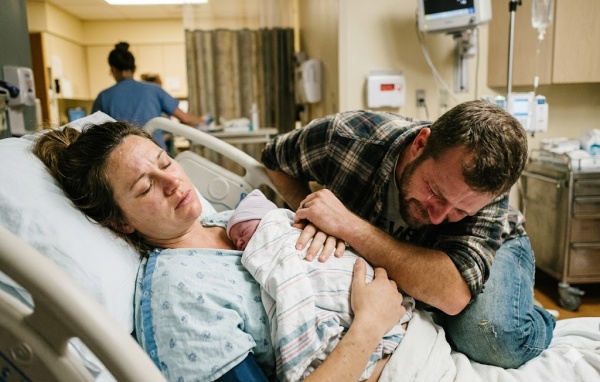
My Wife Di//ed in That Delivery Room and I Resented Our Newborn Daughter for Six Weeks. Then One Night I Walked Into Her Nursery and Found a Red Bracelet on Her Wrist That Nobody Had Put There — and My Dead Wife’s Phone, Powered On, Under Her Pillow.
Part 1: The Night I Lost Everything and Gained Something I Couldn’t Look At
There are griefs that arrive with warning — the slow, terrible approach of a diagnosis, the gradual dimming of someone you love — and there are griefs that arrive in a single second, without announcement, without preparation, without the specific mercy of time to brace yourself. The second kind does not give you the chance to be ready. It simply arrives, and the person you were before it arrived is gone, and the person standing in the wreckage is someone you do not recognize and are not sure you want to become.
My name is Daniel Rowe. I am thirty-four years old, a high school history teacher in Asheville, North Carolina, and I am writing this from the living room of a house on Kimberly Avenue that I have lived in for four years and that is, today, a home — warm and imperfect and full of the specific, irreplaceable sounds of a life being lived inside it. I am writing it because I have been asked to, by a grief counselor named Dr. Anita Marsh who has been working with me for the past year and who believes, as I have come to believe, that the story of the first six weeks of my daughter’s life is a story that other people — other fathers, other grieving people, other human beings who have found themselves on the wrong side of a feeling they are ashamed of — need to hear. I am writing it because shame, kept in the dark, grows. And because the truth of what I felt and what I did and what I found on a Tuesday night in November is a truth that deserves the light.
My wife’s name was Cara Rowe. She was thirty-two years old, a pediatric nurse at Mission Hospital in Asheville, and she was the most alive person I have ever known — not in the performative, look-at-me way of someone who needs an audience, but in the specific, cellular way of a person whose presence in a room changes the quality of the air in it. She laughed easily and argued passionately and made friends with strangers in grocery store lines and cried at commercials and remembered the birthdays of people she had met once at a party three years earlier. She had been my wife for five years and my best friend for seven, and the life we had built together in the house on Kimberly Avenue was the specific, ordinary, irreplaceable life of two people who had chosen each other completely and who were, in the September of the year our daughter was born, as happy as I had ever been.
The pregnancy had been uncomplicated. Cara was a nurse — she monitored everything, attended every appointment, followed every protocol with the specific, informed attention of a medical professional who understood what the numbers meant and what they were supposed to be. We had painted the nursery in October, a soft yellow that Cara had chosen from forty-seven paint chips with the specific, joyful deliberateness of a woman who is making a room for someone she already loves completely. We had assembled the crib together on a Sunday afternoon, arguing cheerfully about the instructions, and Cara had declared the finished product “structurally sound enough” with the specific, dry humor that was her particular form of affection.
Our daughter was born on a Thursday morning in November, at Mission Hospital, three blocks from where Cara had worked for six years.
Cara died forty-seven minutes after delivery from a postpartum hemorrhage — a catastrophic, rapid blood loss that the medical team responded to with everything available and that was not, despite everything available, survivable. I was in the room. I was holding her hand. And then I was not holding her hand, and the room was full of people moving with urgent, terrible purpose, and then the room was quiet in the specific, absolute way that rooms go quiet when the thing that was being fought for has been lost.
Our daughter was in a bassinet six feet away, wrapped in a hospital blanket, making the specific, insistent sounds of a newborn who is alive and present and entirely unaware of what has just happened in the room.
I looked at her.
I felt nothing that I am proud of.
I felt, in the specific, raw, unprocessed way of a man who has just watched his wife die and who is standing in the ruins of the life they built together, that the baby in the bassinet was the reason Cara was gone. I knew, in the rational part of my mind that was still functioning, that this was not true — that postpartum hemorrhage is a medical event, not a cause-and-effect transaction, that my daughter had not taken Cara from me, that the feeling was grief looking for somewhere to land. I knew all of that. The knowing did not change the feeling. The feeling was there, and it was enormous, and it was the specific, terrible feeling of a man who looks at his newborn daughter and cannot find love and finds, instead, something that he will spend the next six weeks being ashamed of.
I named her Cara. It was the only thing I was certain of in the first twenty-four hours — that her name would be her mother’s name, that whatever else I failed to give her, I would give her that.
I brought her home on a Saturday.
I put her in the yellow nursery.
I closed the door.
Part 2: Six Weeks of Surviving
I want to be honest about the six weeks, because the honesty is the point and because the version of the story that softens the six weeks is a version that does not serve the people who need to hear it.
I fed her. I changed her. I kept her alive with the specific, mechanical efficiency of a man who is performing the functions of a father without inhabiting the role — going through the motions with the focused, joyless competence of someone who has been given a task and who is completing the task and nothing more. My mother, Sandra, flew in from Charlotte the day after I brought Cara home and stayed for three weeks, and she was the reason my daughter survived the first three weeks in any meaningful sense — not because I was negligent, but because my mother provided the warmth and the presence and the specific, instinctive tenderness that I was not capable of providing, and she did it without judgment and without comment and with the specific, quiet love of a woman who understood that her son was drowning and who was keeping him afloat until he could swim again.
My mother went home at the end of the third week because she had to — my father had a medical appointment, there were things at home that needed her, and she left with the specific, reluctant concern of a woman who is not sure the person she is leaving is ready to be left. She hugged me at the door and held on for a moment longer than usual and said: “Call me. Any time. Day or night.”
“I will,” I said.
I didn’t call.
The fourth and fifth weeks were the hardest weeks of my life, which is a significant statement for a man whose hardest week had previously been the week his wife died. They were harder because my mother was gone and the house was just me and the baby and the specific, relentless reality of a grief that had nowhere to go and a child who needed things I did not know how to give. I was sleeping in two-hour increments. I was eating whatever required the least preparation. I was teaching remotely — the school had given me six weeks of bereavement leave and I was in the final two weeks of it — and the hours between feedings were hours I spent sitting in the living room in the specific, empty stillness of a man who has been hollowed out and who does not yet know what will fill the hollow.
I did not go into the nursery unless I had to.
I did what needed to be done — the feeding, the changing, the burping, the specific, functional choreography of infant care — and I did it quickly and efficiently and without lingering, because lingering required me to look at my daughter’s face, and looking at my daughter’s face required me to feel things I was not ready to feel.
She had Cara’s nose.
I noticed it the second week and I have not forgiven myself for the fact that noticing it made me put her down faster rather than slower.
The sixth week arrived with the specific, grinding weight of a period that has been endured rather than lived. My bereavement leave was ending. I was going back to the classroom on Monday. It was Tuesday evening, and Cara — my daughter, little Cara — had been crying for forty minutes, the specific, sustained cry of a baby who is not hungry or wet or cold but who needs something that the clinical checklist of infant care does not cover, something that I understood, in the rational part of my mind, was simply human presence and human warmth and the specific, irreplaceable comfort of being held by someone who loves you.
I stood outside the nursery door.
I had read, in one of the infant care books that Cara — my wife — had stacked on the nightstand during the pregnancy, that it was acceptable to let a baby cry for a period of time, that not every cry required immediate response, that babies needed to develop self-soothing mechanisms. I had been holding onto that paragraph for six weeks like a man holding onto a life preserver, using it to justify the specific, shameful distance I had been maintaining from my daughter.
I was going to let her cry it out.
I was going to go back to the living room and sit in the hollow stillness and wait for the crying to stop.
I opened the nursery door.
I stepped inside.
And I stopped.
Part 3: The Bracelet and the Phone
The nursery was lit by the soft yellow glow of the nightlight that my mother had plugged in during her three weeks with us — a small, moon-shaped light that cast the room in the specific, warm quality of the color Cara had chosen from forty-seven paint chips, and that made the room look, in the nighttime, like the room it had been designed to be before everything changed.
Little Cara was in the crib, on her back, her arms moving in the specific, uncoordinated way of a six-week-old whose motor control is still developing, her face red from crying, her eyes — Cara’s eyes, the specific, dark brown of her mother’s eyes — wet and open and looking at the ceiling with the unfocused attention of a baby who is too young to understand where she is but old enough to understand that she is alone.
I stood at the side of the crib.
I looked at her.
I was about to turn around.
And then I saw the bracelet.
It was on her left wrist — a small, red string bracelet, the kind that is knotted rather than clasped, the kind that you tie on and wear until it falls off on its own. It was sized for an infant wrist, tied with the specific, careful knot of someone who wanted it secure but not tight, and it was red — a particular, specific red that I recognized before I fully understood why I recognized it.
I had not put it on her.
My mother had not mentioned it.
The home health nurse who came twice a week had not mentioned it.
I stood at the side of the crib and looked at the red bracelet on my daughter’s wrist and felt the specific, cold clarity of a man who is looking at something that should not exist and who is trying to understand what he is seeing.
I picked up my daughter.
I am not sure, even now, whether I picked her up because of the bracelet or because she was crying and I had finally, in the specific, involuntary way of a man who has been holding himself back for six weeks and who has just run out of the will to keep holding back, simply reached for her. I picked her up and she was warm and small and she smelled like the specific, irreplaceable smell of a newborn that I had been avoiding for six weeks because it was the smell of the person I had not allowed myself to know, and I held her against my chest and she stopped crying with the specific, immediate quiet of a baby who has been waiting for exactly this and who has finally received it.
I stood in the yellow nursery holding my daughter and looking at the red bracelet on her wrist.
I looked at the crib.
I do not know what made me look under the pillow — the small, flat infant pillow that my mother had placed in the crib for positioning purposes, pushed to the far corner away from where little Cara slept. Some instinct, some specific, wordless pull that I cannot explain more precisely than that. I reached into the crib with my free hand and lifted the edge of the pillow.
Cara’s phone was under it.
My wife’s phone.
The phone that had been in her hospital bag, that I had brought home with her other belongings, that I had placed in the top drawer of the dresser in our bedroom six weeks ago and had not touched since because touching it meant opening it and opening it meant seeing her contacts and her photos and her messages and I was not ready for any of that, had not been ready, had been telling myself I would be ready eventually and had been using eventually as a way of never.
The phone was powered on.
The screen was lit.
I stood in the yellow nursery holding my daughter with one arm and holding my wife’s phone with the other hand, and I looked at the screen, and what I saw on the screen was the last thing I expected and the only thing, I understand now, that could have reached me in the specific, sealed-off place I had been living for six weeks.
The screen showed a voice memo app.
There was a recording.
It had been made on the morning of the day Cara went into labor.
The file was labeled, in my wife’s handwriting — she had a habit of labeling voice memos with written titles in the app’s notes field — with two words: For Daniel.
Part 4: What Cara Had Left
I sat down in the rocking chair in the corner of the yellow nursery — the chair we had bought at an antique store in Weaverville on a Saturday in August, the chair Cara had sat in and rocked in and declared “perfect” with the specific, satisfied certainty of a woman who knows what she wants — and I held my daughter against my chest and I pressed play.
Cara’s voice came out of the phone speaker.
I want to tell you what it was like to hear her voice for the first time in six weeks, but I do not have language sufficient for it. I will say only that it was the specific, physical experience of something returning that you had believed was gone permanently, and that the return was simultaneously the best and the most painful thing I had felt since the night she died, and that I did not try to stop crying because there was no stopping it and because some things should not be stopped.
She had recorded it on a Thursday morning, the morning her contractions started, before she called me at work to tell me it was time. She had been alone in the house, and she had sat down — I could hear the specific, familiar creak of the kitchen chair she always sat in — and she had recorded twelve minutes and forty-three seconds that I am going to tell you about, not word for word, because the words belong to me and to my daughter, but in the essential truth of what they contained.
She said she had a feeling.
Not a premonition in the dramatic sense — she was a nurse, she did not traffic in premonitions. She said she had the specific, clinical awareness of a medical professional who has spent six years in a hospital and who understands that childbirth carries risks that statistics describe but do not eliminate, and that she had been carrying a quiet, private acknowledgment of those risks for the final weeks of the pregnancy and had decided, on the morning of the day she went into labor, that she needed to say some things out loud in case the opportunity to say them in person did not come.
She talked about me.
She talked about the specific, ordinary things she loved about me — the way I made coffee too strong and defended it as a preference, the way I fell asleep during movies and then denied it, the way I talked to my students about history with the specific, infectious enthusiasm of a person who genuinely believes that the past matters and that understanding it changes how you live in the present. She talked about the five years of our marriage with the specific, warm precision of a woman who has been paying attention and who wants the person she loves to know that she has been paying attention.
Then she talked about the baby.
She said: “I know you, Daniel. I know that if something happens to me, you are going to look at her and see the thing that took me away from you. I know that because I know how you love — completely and without reservation — and I know that the other side of loving that way is that the grief is just as complete and just as without reservation. And I need you to hear me say this, clearly and directly, the way you always asked me to say things: she did not take me from you. She is the thing I am leaving with you. She is the best of both of us, and she needs you to see that, and I need you to let yourself see it.”
She paused.
I could hear her breathing.
“The red bracelet is in the top drawer of the nursery dresser,” she said. “The one my grandmother gave me when I was born. I want her to wear it. I want her to have something of mine from the beginning, something she can feel against her skin before she’s old enough to understand what it means. Will you put it on her for me? I would have done it myself, but just in case — will you do it?”
I looked at the red bracelet on my daughter’s wrist.
I had not put it on her.
I had not known it was in the nursery dresser.
I had not listened to the recording.
I sat in the rocking chair in the yellow nursery and I looked at the bracelet and I thought about who had put it there — who had gone into the nursery dresser and found the bracelet and tied it on my daughter’s wrist with the specific, careful knot of someone who wanted it secure but not tight — and I understood that I was not going to be able to explain it, and that the not-explaining was not the point, and that some things arrive in your life through channels that are not available for examination and that the correct response to them is not explanation but acceptance.
Cara — my wife — had found a way to reach me.
I do not know how.
I know that she did.
I held my daughter against my chest and I listened to the rest of the recording — the twelve minutes and forty-three seconds of my wife’s voice in the kitchen on a Thursday morning, talking to me across the specific, impossible distance of six weeks and a grief I had been drowning in — and I let myself feel everything I had been refusing to feel since the night she died.
I felt it all.
It was enormous.
It was survivable.
Part 5: The Morning After and the Life That Followed
I did not sleep that night.
I sat in the rocking chair in the yellow nursery with my daughter on my chest and I listened to the recording four times and I talked to my wife in the specific, one-sided way of a person who is not sure they believe in the thing they are doing but who needs to do it anyway, who needs to say out loud the things that have been accumulating for six weeks in the sealed-off place where the grief had been living.
I told her I was sorry.
I told her I had been failing our daughter and that I knew it and that I was going to stop.
I told her that little Cara had her nose and her eyes and that I had been avoiding looking at her because of it and that I understood now that I had it exactly backward — that the nose and the eyes were not the evidence of what I had lost but the evidence of what she had left me, and that the difference between those two things was the difference between a man who is drowning and a man who has just found something to hold onto.
I told her I loved her.
I told her I was going to be okay.
I told her our daughter was going to be okay.
Little Cara slept on my chest through most of it, with the specific, trusting weight of a baby who has finally been picked up by the person she has been waiting for and who has decided, in the uncomplicated way of a six-week-old, that this is where she belongs.
She was warm and small and she smelled like the specific, irreplaceable smell of a newborn.
She had Cara’s nose.
I held her tighter.
I called Dr. Anita Marsh the following morning — a grief counselor who had been recommended by the hospital’s bereavement coordinator six weeks earlier and whose card I had put in a kitchen drawer and not touched. I called her at eight a.m. and she answered and I said: “I need help. I’ve needed it for six weeks and I’m asking now.”
She said: “I’m glad you called. Come in today.”
I went in that day.
I have been going in every week since.
The work of grief counseling is not the work of getting over something — Dr. Marsh was clear about that in the first session, with the specific, direct honesty of a clinician who does not believe in softening the terms of the work she is asking her clients to do. It is the work of learning to carry something that does not get lighter but that you get stronger for carrying, and of learning the difference between the grief that is part of loving someone and the grief that is preventing you from living, and of finding, gradually and imperfectly and with significant backsliding, the specific, sustainable way of being a person who has lost something enormous and who is still here and who has someone depending on them to be here fully.
I went back to the classroom three weeks after the night in the nursery — two weeks later than planned, because Dr. Marsh and I had agreed that I needed the additional time and because the school, to their considerable credit, had agreed without hesitation. My students were kind in the specific, slightly awkward way of teenagers who want to express something and are not sure how, and I received their kindness with the specific, genuine gratitude of a man who has been reminded, by a red bracelet and a voice recording and a six-week-old baby on his chest, that the world contains more warmth than he had been able to see from inside the grief.
Little Cara is fourteen months old now.
She walks — unsteadily, with the specific, determined concentration of a person who has recently discovered that forward motion is possible and who is committed to the discovery regardless of how many times the floor comes up to meet her. She has seven words, of which her favorite and most frequently deployed is “no,” delivered with a conviction that I find both exhausting and magnificent. She has Cara’s nose and Cara’s eyes and, I have recently discovered, Cara’s specific, unself-conscious laugh — the laugh that arrives without warning and without apology and that fills whatever room it is in with the specific, irreplaceable quality of someone who finds the world genuinely funny.
I hear Cara in that laugh every time.
I used to brace for it.
Now I wait for it.
The red bracelet is in a small box on the dresser in the nursery — she outgrew it at four months, and I took it off carefully and put it in the box with the specific, deliberate attention of a man who understands that some things need to be preserved. I have told little Cara about the bracelet, in the age-appropriate way of a father who is trying to give his daughter her mother in every form available — in photographs and stories and the specific, daily practice of saying Cara’s name out loud so that her mother is a presence in her life rather than an absence.
I played her the recording last month.
She is fourteen months old and she cannot understand the words, but she sat in my lap in the rocking chair in the yellow nursery and listened to her mother’s voice with the specific, focused attention of a baby who recognizes something she cannot name, and when the recording ended she looked at me with Cara’s eyes and put her hand on my face.
I held her hand against my cheek.
I thought about the night six weeks after she was born, when I had stood outside the nursery door ready to let her cry, and I had walked in and found the bracelet and the phone and the recording and the specific, impossible, inexplicable evidence of a woman who had loved us both enough to find a way to reach us across the distance that should have been uncrossable.
I do not know how the bracelet got on her wrist.
I have asked everyone who was in the house in those six weeks. My mother. The home health nurse. The neighbor who had a key and checked in twice. No one put it there. No one knows how it got there.
I have stopped trying to explain it.
Some things are not for explaining.
Some things are for receiving.
I received it.
And I am here — in the house on Kimberly Avenue, in the yellow nursery, in the rocking chair from the antique store in Weaverville, with my daughter in my lap and my wife’s voice on a phone in the dresser drawer and the specific, ordinary, irreplaceable life of a man who almost missed it and who did not, and who is grateful every single day for the red bracelet that brought him back.
Cara would have liked that.
She always knew exactly what I needed.
She always found a way to make sure I got it.
She still does.
