My Partner of 11 Years Said I Wasn’t His Wife Because We Never Had a License — While I Was Emptying His Sick Mother’s Bedpan. His Mother Called Me “Daughter” Only When She Needed Clean Sheets. That Tuesday Morning in Tucson, I Finally Stopped Carrying the Bucket.
Part 1: The Life I Built on a Promise
My name is Delia Voss, and I want to start with the word “common-law,” because it is the word that defined eleven years of my life without my full understanding of what it meant — or more precisely, what it did not mean — until a Tuesday morning in Tucson, Arizona, when I was standing in a hallway outside a bedroom that smelled of stale urine and antiseptic, holding a plastic bucket of dirty water, and the man I had loved since I was twenty-four years old told me, with the specific, flat certainty of someone delivering a legal opinion rather than ending a relationship, that I was not his wife.
I want to start with that word because I think a lot of women live inside it the way I did — not carelessly, not naively, but with the genuine, good-faith belief that love documented by years and shared by a household and witnessed by a community is a form of marriage in every way that matters. I believed that. I believed it for eleven years. I was wrong in the specific, costly way that people are wrong when they trust the substance of a thing without verifying its legal form.
I met Marcus Voss at a Fourth of July party in Tucson when I was twenty-four and he was twenty-seven. He was a general contractor who had built his own small company — Voss Construction — from a pickup truck and a set of tools his father had given him when he graduated from Pima Community College, and he had the specific, grounded confidence of a man who builds things with his hands and understands the relationship between effort and result in a direct, physical way.
He was funny and warm and genuinely kind in the early years, the kind of kind that is not performed for an audience but expressed in small, consistent ways — the way he remembered how I took my coffee, the way he called his mother every Sunday, the way he fixed things around the apartment without being asked because he noticed when things were broken and believed that noticing obligated you to act.
We moved in together after eight months. We combined our finances after two years, opening a joint checking account at Desert Financial Credit Union and splitting the mortgage on a three-bedroom house in the Midvale Park neighborhood that we bought together, both names on the deed, both signatures on the loan.
We told people we were together. We introduced each other as partners, then as husband and wife, because after a certain number of years the social architecture of a shared life produces its own vocabulary and the people around you begin using it and you begin using it and it becomes, in the specific, unreflective way of things that are simply true, the way you describe yourself. I was Delia Voss. I had been Delia Voss for so long that I had stopped thinking about the mechanism by which I had become her.
Marcus proposed twice. The first time was on a camping trip to Sabino Canyon when we were three years in — he had a ring, a simple solitaire from a jeweler on Fourth Avenue, and I said yes and we celebrated and the ring went on my finger and we told his parents and my mother and everyone was happy.
Then the wedding planning began, and Marcus discovered that he had opinions about weddings that were primarily expressed as reasons why the specific wedding being planned was not quite right — too expensive, wrong time of year, his sister’s schedule, the venue deposit, the catering cost. The planning stalled. The ring stayed on my finger. The years continued.
The second proposal happened at year seven, after a difficult conversation about the future, and it followed the same arc — genuine emotion, a ring upgrade, family excitement, and then a gradual, almost imperceptible deceleration of planning that ended, again, in nothing formalized.
I told myself it didn’t matter. I told myself that a piece of paper didn’t define what we were. I told myself, in the specific, self-protective way of a woman who has invested eleven years and does not want to examine the investment too closely, that the substance of our life together was the marriage and the ceremony was just the ceremony. I was wrong. And the morning I understood how wrong I was, I was standing in a hallway in Tucson holding a bucket of dirty water.
Part 2: The Years of Mrs. Carmen
Marcus’s parents — Carmen and Harold Voss — had lived in a small ranch house in the South Tucson neighborhood their entire adult lives, a house that smelled of tamales and old newspapers and the specific, layered warmth of a family that has occupied the same space for forty years. Carmen was sixty-eight when her health began to decline seriously, a combination of Type 2 diabetes and congestive heart failure that required increasing levels of daily care.
Harold was seventy-one and had his own mobility limitations from a knee replacement that had not healed cleanly, and the practical reality of their situation was that they needed help — daily, physical, unglamorous help of the kind that does not appear in the stories people tell about family loyalty but that constitutes, in actual practice, the majority of what family loyalty looks like.
Marcus was an only child. There was no sibling to share the responsibility, no other family member in Tucson with the proximity and availability to step in. Marcus worked six days a week running Voss Construction, which had grown to a twelve-person operation with active projects across Pima County and a schedule that did not accommodate the specific, unpredictable demands of elder care.
So I stepped in. I want to be precise about what that meant, because I think precision matters when we talk about the work that women do inside families that is never formally acknowledged.
I drove to Carmen and Harold’s house four mornings a week before my own workday began — I was a medical billing specialist working remotely for a Phoenix-based healthcare group, which gave me schedule flexibility that Marcus’s construction work did not. I managed their medications, which by the third year of Carmen’s decline had grown to eleven daily prescriptions requiring careful timing and monitoring.
I coordinated their doctor appointments at Banner University Medical Center and El Rio Community Health Center, driving them when Harold could no longer drive safely and sitting in the examination rooms taking notes because Carmen’s memory had begun to slip in the specific, frightening way of a woman whose body was working harder than it should have to.
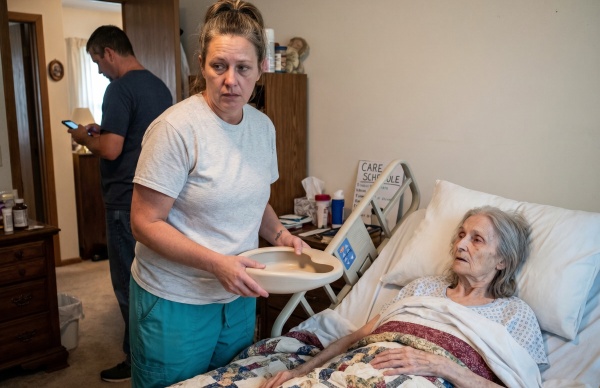
I changed their sheets. I did their laundry. I cleaned their bathroom. I sat with Carmen on the afternoons when the pain was bad and the television was company but not enough company, and I listened to her stories about Marcus as a boy and about the early years of her marriage to Harold and about the neighborhood as it had been forty years ago, and I held her hand when she cried because she was frightened and because being frightened at sixty-eight with a failing heart in a house that smelled of your own illness is a specific kind of loneliness that deserves to be witnessed.
Carmen called me “daughter” when she wanted something. She called me “Delia” when she was simply talking to me, and she called me “daughter” when she needed clean sheets or a medication refill or someone to call the insurance company on her behalf. I noticed the distinction early and filed it in the specific, quiet place where I kept the things I noticed but did not yet know what to do with.
Harold called me “hon” with the uncomplicated warmth of a man who was grateful and expressed it simply, and I loved Harold for that, and I love him still.
Marcus thanked me. He thanked me regularly, in the specific, efficient way of a man who understands that gratitude is owed and delivers it on schedule without examining too closely what the debt actually is. He said I was “incredible” and “a saint” and that he “didn’t know what they’d do without me.”
He said these things and then he went back to his job sites and his project schedules and the specific, consuming demands of a business that was growing faster than his capacity to manage it, and I went back to Carmen’s house and changed the sheets and managed the medications and sat with the loneliness and the antiseptic smell and the plastic bucket that I emptied and refilled and emptied again, week after week, for three years.
Part 3: The Tuesday Morning
The conversation happened on a Tuesday in March, in the hallway outside Carmen and Harold’s bedroom, at approximately 8:40 in the morning.
I had arrived at the house at 7:15 to help Carmen with her morning routine — bathing, medications, breakfast, the specific, careful sequence of tasks that her condition required and that I had learned so thoroughly over three years that I could perform them in the dark.
Harold had had a difficult night, and the bedroom needed to be cleaned and the sheets changed, and I had done what needed to be done with the specific, unsentimental efficiency of someone who has long since moved past squeamishness about the physical realities of caring for sick people. I was in the hallway with the bucket when Marcus arrived. He had come from a job site in Marana — I could tell from the dust on his boots and the specific, distracted energy of a man whose mind is still on a project schedule. He looked at me in the hallway. He looked at the bucket. He said, “I need to talk to you about something.”
What he said, in the specific, careful language of a man who has been thinking about how to say something for a while and has settled on directness as the most efficient approach, was this: he had been talking to his attorney about the business — Voss Construction was in the process of restructuring, taking on a silent partner, and the attorney had raised questions about marital property and liability exposure.
Marcus had explained that we were not legally married. The attorney had said that Arizona recognized common-law marriage under certain conditions, but that the specific legal status of our relationship was ambiguous and that, from a liability protection standpoint, it would be cleaner if things were “clarified.” Marcus had decided that the cleanest clarification was to make clear — to me, to the attorney, to the paperwork — that we were not married.
“If we’re not legally married,” he said, standing in his parents’ hallway with his work boots still dusty from Marana, “then you’re not my wife.”
I stood there with the bucket in my hands. I looked at him. I thought about eleven years. I thought about the ring on my finger — the second one, the upgrade from year seven. I thought about the joint mortgage on the house in Midvale Park. I thought about the joint checking account at Desert Financial. I thought about Carmen calling me “daughter” when she wanted clean sheets and “Delia” when she was just talking to me.
I thought about three years of four mornings a week and eleven medications and Banner University Medical Center and the specific, physical weight of a plastic bucket that I had carried more times than I could count. I thought about the two proposals and the two sets of wedding plans that had decelerated into nothing and the specific, patient explanations I had accepted for why the timing was never quite right.
I set the bucket down on the hallway floor. I looked at Marcus for a long moment. “Okay,” I said. My voice was very steady. “I need to make some calls.”
Marcus looked slightly surprised — I think he had expected tears, or an argument, or the specific, destabilizing emotional response that would allow him to manage the conversation on his terms. What he got was a woman setting down a bucket and reaching for her phone. He said, “Delia, I’m not trying to hurt you. This is just about the business.” “I understand,” I said. “I need to make some calls.”
I walked out of his parents’ house, got in my car, and drove to a Starbucks on Speedway Boulevard where I sat in the parking lot for twenty minutes and thought with the specific, cold clarity of a woman who has just had eleven years of assumptions removed from underneath her and has discovered, to her own surprise, that she is still standing.
Then I called Renata Flores.
Part 4: What Arizona Law Said
Renata Flores was a family law attorney in Tucson with offices on Oracle Road, recommended to me by a colleague at the healthcare billing group who had used her during a divorce two years earlier and described her as “the kind of attorney who does not waste your time or her own.” She was fifty-one, a University of Arizona law school graduate who had practiced family law in Pima County for twenty-three years, and she had the specific, grounded efficiency of a woman who has heard most variations of most stories and has learned to move quickly to the part where she can actually help.
I want to be honest about what Renata told me, because I think honesty about the legal reality is more useful than a story that implies the law always delivers justice in the form we hope for. Arizona does not recognize common-law marriage — under Arizona Revised Statutes § 25-111, a valid marriage in Arizona requires a license and a ceremony.
Renata explained this clearly and without softening it. Whatever Marcus and I had been to each other for eleven years, we were not, under Arizona law, legally married, and the protections that marriage provides — community property rights, spousal support eligibility, inheritance rights — did not automatically apply to our relationship.
What she told me next, however, was where the conversation became more interesting. Arizona law does recognize certain rights and remedies for unmarried partners in long-term cohabiting relationships, and the specific facts of our situation — the joint mortgage, the joint accounts, the documented financial interdependence, and the three years of uncompensated caregiving I had provided to Marcus’s parents — created a legal landscape that was more complex than Marcus’s attorney had apparently led him to believe.
Renata explained the concept of unjust enrichment — a legal doctrine under which a person who has received a benefit at another’s expense may be required to compensate that person, even in the absence of a formal contract. She explained quantum meruit — the principle that a person who provides services to another with a reasonable expectation of compensation may be entitled to the fair market value of those services.
She explained that the joint mortgage and the joint accounts created specific, documentable property interests that existed entirely independent of the question of whether we were legally married.
She also asked me a question that I had not thought to ask myself: “Did Marcus ever represent to third parties — to lenders, to his parents’ doctors, to insurance companies, to anyone in a formal or semi-formal context — that you were his wife?” I thought about the mortgage application, where I had been listed as his spouse.
I thought about the insurance forms at Carmen’s doctor’s office, where I had signed as a family member. I thought about the Voss Construction company holiday party where Marcus had introduced me as his wife to his business partners and their spouses for eight consecutive years. “Yes,” I said. “Many times.” Renata wrote something down. “Good,” she said.
The legal process took nine months. I will not detail every step, because the procedural specifics of an unmarried cohabitation dispute in Pima County Superior Court are less important than what they produced. Renata filed claims based on unjust enrichment, quantum meruit, and the specific, documentable property interests created by the joint mortgage and joint accounts.
She retained a forensic accountant to calculate the fair market value of the caregiving services I had provided to Carmen and Harold over three years — four mornings per week, averaging four hours per visit, at the prevailing rate for professional home health aide services in Tucson, which at the time was $28 per hour. The calculation produced a figure of approximately $87,000 in uncompensated labor.
She documented, through bank records and the mortgage, the financial contributions I had made to the Midvale Park house over eleven years. She documented, through the testimony of Marcus’s own business partner, the representations Marcus had made about our marital status in professional contexts.
Marcus’s attorney — the same one who had apparently advised him that “clarifying” our status would be clean and simple — was not, it turned out, a family law specialist. He was a business attorney who had wandered into territory he did not fully understand, and the specific, documented complexity of what Renata presented was not what he had prepared for.
The case settled in mediation after six months of litigation. The settlement terms are confidential, but I will say this: I walked away from eleven years with my financial contribution to the Midvale Park house recognized, a settlement that reflected the caregiving services I had provided, and a clear, legal acknowledgment that the word “wife” — however it had been used, however it had been performed, however it had been accepted by everyone around us for eleven years — had carried real weight and real value, even if it had never been formalized on a piece of paper.
Carmen called me the week after the settlement. Not “daughter.” She called me Delia. She said she was sorry. She said she had not known what Marcus had said in the hallway, and that when Harold told her, she had cried. She said I had been more of a daughter to her than the word had deserved when she used it.
I told her I knew. I told her I did not blame her. I told her I would still come by on Thursdays, because Harold needed his medications managed and because Carmen’s loneliness was real and because the care I had given them had never been about Marcus — it had been about them, and that did not change because the legal proceedings had ended. I still go on Thursdays. I will go until they no longer need me. That is not a legal obligation. It is a human one, and it is mine by choice, which is the only kind of obligation worth keeping.
Part 5: What I Know Now
I am writing this from the house I rent in the Sam Hughes neighborhood in Tucson — a two-bedroom adobe on a street lined with palo verde trees that bloom yellow every spring in the specific, extravagant way of desert plants that have been storing beauty all year and release it all at once. It is not the house in Midvale Park. It does not have eleven years of accumulated life inside its walls. It is mine in the way that things are yours when you have chosen them freely, without the weight of a history that was built on a foundation you did not fully understand.
I have thought a great deal, in the months since the settlement, about what I would say to the woman I was at twenty-four, standing at a Fourth of July party in Tucson, meeting a man who was funny and warm and genuinely kind and who would spend eleven years being all of those things and also, simultaneously, the man who would stand in his parents’ hallway with dusty boots and tell me that the word I had been living inside was not legally binding.
I do not think I would tell her not to love him. Love is not the mistake I made. The mistake I made was in believing that love, expressed consistently and witnessed publicly and embedded in the practical architecture of a shared life, constitutes a legal protection. It does not. It constitutes a human reality, which is important and real and worth having, but which is a different category of thing from a legal right, and the difference between those two categories matters enormously when the relationship ends.
What I would tell her — what I want to say clearly, for anyone reading this who is living inside a long-term relationship that has not been formalized — is this: know your legal status. Not because love requires legal validation, but because you deserve to know what protections you have and what protections you do not have, so that you can make informed decisions about your own life.
In Arizona, and in the majority of U.S. states, an unmarried partner does not have the automatic property rights, inheritance rights, or support rights of a legal spouse, regardless of how long the relationship has lasted or how completely it has functioned as a marriage in every practical sense.
There are legal remedies available in some circumstances — unjust enrichment, quantum meruit, cohabitation agreements, domestic partnership registrations in some jurisdictions — but they are not automatic, they are not simple, and they require documentation and legal action to access.
I also want to say something about the caregiving. I want to say it clearly and without the specific, self-deprecating deflection that women are trained to apply to the work they do inside families. The work I did for Carmen and Harold for three years was skilled, demanding, physically taxing, emotionally costly, and worth $87,000 at prevailing market rates. It was worth that whether or not anyone acknowledged it.
It was worth that whether or not Marcus said “thank you” on a regular schedule. It was worth that whether or not Carmen called me “daughter” or “Delia” or anything at all. The work had value because work has value, and the fact that it was performed inside a family relationship rather than under a formal employment contract does not diminish that value — it only makes it easier for the people who benefit from it to avoid accounting for it.
Renata Flores made them account for it. And I am grateful for that in the specific, grounded way of a woman who has learned that gratitude and self-advocacy are not in conflict — that you can be a caring person and also a person who knows what her care is worth and is willing to say so in a courtroom if necessary.
Marcus remarried eight months after our settlement — a woman named Tiffany who works in his office and who is, by all accounts, lovely. I wish them well in the specific, genuine way that is possible when you have fully processed a loss and have arrived at the other side of it without bitterness, which takes longer than people tell you it will and is worth every day of the work it requires.
I do not think Marcus is a bad man. I think he is a man who made a series of choices over eleven years that he did not examine carefully enough, and who was surprised, when the consequences arrived, by their specificity and their cost. That surprise is its own kind of information.
I am forty years old. I have a job I am good at, a house I chose, a neighborhood I love, and two Thursday mornings a month with an old woman who calls me Delia and means it. I have a clearer understanding of the difference between love and legal protection than I had at twenty-four, and I have the specific, hard-won confidence of a woman who has been told she is not something she spent eleven years being — and who proved, in a Pima County courtroom, that the word had weight regardless of the paperwork.
I was always his wife in every way that mattered to the people around us. The law just needed a little help understanding that.
