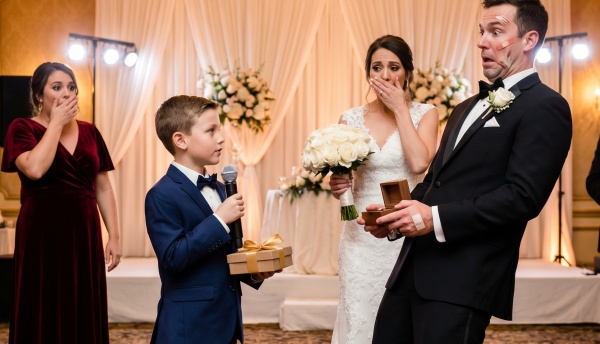
My Ex-Husband Cheated, Abandoned Me and Our Son, Then Invited Us to His Wedding. During His Speech, he laughed and said, “Leaving that piece of trash was the best decision of my life!”. The crowd burst into laughter.
Then, my son calmly took the microphone. “I brought a special gift for you, Dad,” he said, giving his father a box. When my ex-husband opened the box, his scream silenced the entire room.
Part 1: The Woman He Decided Was Not Worth Keeping
My name is Rachel Harmon, and I want to start with the version of myself that existed before Marcus Harmon decided I was disposable — because that woman deserves to be seen clearly, not just as the setup to someone else’s cruelty.
I am thirty-eight years old. I grew up in Columbus, Ohio, the daughter of a high school football coach and a registered nurse who worked the overnight shift at OhioHealth Riverside Methodist Hospital for twenty-two years without once calling in sick unless she was genuinely incapacitated. My parents were not people who quit things. They were not people who walked away from difficulty and called it wisdom. They were people who showed up, repeatedly and without fanfare, because showing up was what you did when you had made a commitment to something.
I carried that into my marriage to Marcus the way you carry something you received so young it feels like your own DNA.
I met Marcus at a mutual friend’s cookout in Clintonville on a Saturday in July when I was twenty-six. He was thirty, a pharmaceutical sales representative covering central Ohio, and he had the specific charm of a man who is very good at making whoever he is talking to feel like the most interesting person in the room. He was funny. He was attentive. He asked follow-up questions. He called when he said he would call, remembered things you mentioned in passing, and showed up to the second date with the specific coffee order you had mentioned once, which is the kind of detail that registers as thoughtfulness and is, in retrospect, simply the practiced technique of a man who has learned what works.
We dated for two years. We married at a ceremony at a venue in Dublin, Ohio, on a Saturday in June with eighty guests and a reception that went until midnight and a first dance to a song we had argued pleasantly about for three months before agreeing on. We bought a house in Worthington — four bedrooms, a backyard with a deck Marcus built himself over two weekends in September, a neighborhood with good schools and sidewalks and the specific suburban steadiness that feels, when you are twenty-eight and newly married and genuinely hopeful, like the foundation of everything you are going to build.
Our son Noah was born fourteen months after the wedding.
He weighed seven pounds, nine ounces, and had Marcus’s jaw and my eyes and a quality of alertness in his first hours that made the delivery nurse say he was going to be a thinker. She was right. Noah has been a thinker since the moment he arrived — observant, precise, the kind of child who notices everything and says nothing until he has decided exactly what the right thing to say is.
He got that from me. I know that now. At the time, I thought he got it from both of us.
The marriage began to change when Noah was two years old.
The changes were the kind that are individually explainable and collectively damning — the late nights that increased in frequency, the phone that migrated from the counter to the pocket, the specific quality of distraction that settles over a person who is managing a secret. Marcus traveled for work, which had always been true, but the travel became longer and the check-ins from the road became shorter and the particular warmth he had always brought home with him began to arrive diluted, like something that had been used up somewhere else before he got to us.
I noticed. I said something, once, carefully. Marcus told me I was insecure. He said it with the specific confidence of a man who has learned that naming the other person’s emotion is an effective way of ending a conversation about your own behavior. I accepted it, because I had been raised by people who did not quit things, and I confused not quitting with not seeing.
I was wrong to confuse them.
The truth arrived on a Tuesday evening in March when Noah was three years old, in the form of a text notification that appeared on Marcus’s iPad while he was in the shower — a message from a woman named Brittany that contained enough specific detail to make explanation impossible and denial pointless.
I did not confront him that evening. I waited until Noah was asleep. Then I sat down at the kitchen table and told Marcus what I had seen, and I watched his face move through denial and then calculation and then the specific resignation of a man who has been caught and has decided that the most efficient response is to stop pretending.
He told me it had been going on for eight months. He told me her name was Brittany Caldwell, that she was twenty-four years old, that she worked at one of his client accounts in Cincinnati. He told me — and this is the part I have thought about most in the years since — that he was not sorry. He said he had been unhappy for a long time, that our marriage had become routine, that he felt like he had lost himself somewhere in the mortgage payments and the pediatrician appointments and the specific domestic weight of a life that was more obligation than joy.
He said all of this at our kitchen table in Worthington, Ohio, while our three-year-old son slept twenty feet away.
He moved out two weeks later.
Part 2: The Years He Was Not There
The divorce was filed in Franklin County Court of Common Pleas six weeks after Marcus moved out.
Ohio is an equitable distribution state, and the marital assets — the house in Worthington, the joint accounts, Marcus’s pension and investment portfolio accumulated during the marriage — were divided through a settlement negotiated over three months by attorneys on both sides. I kept the house, because Noah’s school was in the district and uprooting him on top of everything else felt like a cruelty I was not willing to add to the list. Marcus paid child support as ordered by the court — $1,850 per month, calculated according to the Ohio Child Support Guidelines based on both parties’ incomes.
He exercised his parenting time inconsistently.
I want to be precise about this, because it is the part of the story that matters most and the part that is most easily softened into something more palatable than what it actually was. The court order provided for Marcus to have Noah every other weekend and one weeknight per week. In the first year after the divorce, he exercised that time approximately sixty percent of the time. In the second year, it dropped to forty percent. By Noah’s sixth birthday, Marcus was seeing his son perhaps once a month, and the calls he had promised to make every Sunday evening had become sporadic and then occasional and then effectively nonexistent.
Noah noticed. Children always notice. They notice with the specific, wordless precision of people who have not yet learned to explain things away, and what they notice lives in them in ways that surface years later in the particular shape of who they become.
I watched my son learn, over the course of several years, that his father was a person who made promises he did not keep. I watched him stop asking when Daddy was coming. I watched him stop running to the window when a car pulled into the driveway. I watched him develop, in the place where that expectation had been, a quiet self-sufficiency that was both admirable and heartbreaking in equal measure.
I did not speak badly about Marcus to Noah. I want to be clear about that, because it was the hardest discipline I maintained through those years and I maintained it without exception. When Noah asked why his dad didn’t come to his school play, I said Dad was busy with work and that he loved him. When Noah asked why his dad forgot his birthday call two years in a row, I said sometimes grown-ups have a lot going on and it doesn’t mean they don’t care. I protected Marcus’s image for Noah’s sake, at the cost of my own honesty, because I believed — and still believe — that a child’s relationship with his parent is not the place for a wronged spouse’s grievances.
What I could not protect Noah from was the simple arithmetic of presence and absence.
His father was absent. Noah counted. Children always count.
Meanwhile, I built.
I had a degree in accounting from Ohio State University and eight years of experience as a staff accountant at a mid-size manufacturing firm in Westerville before Noah was born. I had taken a reduced schedule during his early years. After the divorce, I went back full-time, and within two years I had been promoted to Senior Accountant. Within four years, I had passed the CPA exam — studying after Noah was in bed, at the kitchen table in the house in Worthington, with a cup of coffee and the specific focused determination of a woman who has decided that the life she is building is going to be built on credentials that belong entirely to her.
I was promoted to Controller at my firm when Noah was seven. I was recruited to a larger company in Columbus as Director of Finance when he was ten. I bought out Marcus’s equity in the Worthington house with the proceeds of a refinance and a portion of my own savings, so that the house was mine — entirely, legally, without qualification.
Noah grew up in that house. He grew up watching his mother work and study and build and show up, every single day, without drama and without complaint and without ever once suggesting to him that the life they had was less than it should be.
He grew up to be, at seventeen years old, one of the most remarkable people I have ever known.
Part 3: The Invitation That Arrived in Our Mailbox
The envelope arrived on a Thursday afternoon in September.
Noah brought it in from the mailbox with the rest of the mail and set it on the kitchen counter without comment, which is how he handles most things — without comment, until he has decided what the comment should be. I was making dinner when I saw it. Cream-colored envelope, heavy stock, our names written in calligraphy: Rachel Harmon and Noah Harmon.
The return address was Marcus’s apartment in Dublin, Ohio.
I opened it at the counter while the pasta water came to a boil.
Inside was a wedding invitation. Marcus James Harmon and Brittany Anne Caldwell requested the honor of our presence at their marriage ceremony on the fourteenth of October at a venue in New Albany, Ohio. Dinner and reception to follow. RSVP by September 30th.
I read it twice.
Then I set it on the counter and stirred the pasta water and thought about what kind of man sends a wedding invitation to the wife he cheated on and the son he abandoned, and I concluded that the answer was: a man who has never once considered how his actions land on the people they affect, because he has never had to.
Noah came into the kitchen twenty minutes later and looked at the invitation on the counter.
He picked it up. He read it. He set it back down.
“Are we going?” he asked.
I looked at my son — seventeen years old, six feet tall, his father’s jaw and my eyes and fourteen years of watching and counting and saying nothing until he had decided exactly what the right thing to say was.
“That’s up to you,” I said.
He thought about it for a moment.
“I want to go,” he said.
I did not ask why. I had learned, in seventeen years of raising Noah, that when he said he wanted to do something in that specific tone — quiet, certain, with the particular stillness of a decision already made — the reason would reveal itself in time.
“Okay,” I said. “We’ll go.”
I RSVP’d for two.
What I did not know — what I would not know until the evening of October 14th — was that Noah had already been thinking about what he wanted to bring.
Part 4: The Wedding, the Speech, and the Box
The venue in New Albany was a converted estate property on the eastern edge of Columbus — the kind of place that costs between $8,000 and $12,000 to rent for a Saturday evening and signals, through its very existence, that the people getting married want you to understand they have arrived somewhere. There were approximately one hundred and twenty guests. The ceremony was in the garden. The reception was in the main hall, with round tables and centerpieces and a DJ setting up in the corner and the specific festive noise of people who are happy to be celebrating something.
I wore a simple black dress. Noah wore the navy blazer and gray slacks I had bought him for his junior year homecoming. He carried a wrapped box — about the size of a shoebox, wrapped in silver paper with a white ribbon — that he had brought from the car without explanation and set under his chair at our assigned table.
I had not asked about the box. I had learned to trust Noah’s timing.
Marcus and Brittany were married at five o’clock in the garden. She was twenty-nine now, pretty in the specific way of someone who has always been told she is pretty and has organized her presentation around that fact. Marcus was forty-two, slightly heavier than I remembered, wearing a suit that fit well and the expression of a man who has decided that the life he chose is the right one and is performing that conviction for an audience.
He acknowledged Noah with a handshake at the cocktail hour. He acknowledged me with a nod that contained everything he had decided about our history and nothing he was willing to examine about his role in it.
I smiled. I drank my club soda with lime. I watched.
The reception dinner was pleasant in the way that events are pleasant when you have decided in advance to observe rather than participate. The food was good — a filet mignon option and a salmon option, served with roasted vegetables and a wild rice pilaf that was genuinely excellent. The toasts were the standard sequence: best man, maid of honor, a college friend of Marcus’s who had known him for twenty years and spoke about him with the specific warmth of someone who only knows one version of a person.
Then Marcus took the microphone.
He spoke for about four minutes. He talked about Brittany — how she had changed his life, how she had shown him what it felt like to be genuinely happy, how she had given him back the version of himself he had lost somewhere along the way. The crowd responded warmly, the way crowds respond to wedding speeches that hit the expected notes.
Then he paused. He smiled the specific smile of a man who is about to say something he has been looking forward to saying.
“You know,” he said, “people ask me sometimes if I have any regrets. And I want to be honest tonight, because this is a night for honesty.” He paused for effect. “Leaving that piece of trash behind was the best decision I ever made.”
The crowd laughed. Not everyone — some people shifted in their seats, uncertain — but enough people laughed that the laughter filled the room, and Marcus smiled wider, satisfied, the way people are satisfied when a calculated risk pays off in front of an audience.
I did not move. I did not change my expression. I had spent fourteen years developing the specific discipline of a woman who does not give people the reaction they are performing for.
But Noah stood up.
He stood up slowly, the way he does everything — without urgency, without drama, with the specific unhurried certainty of a person who has already decided what happens next. He picked up the silver-wrapped box from under his chair. He walked to the front of the room. He held out his hand for the microphone with the quiet confidence of a seventeen-year-old who has never once in his life needed to raise his voice to be heard.
Marcus, surprised, handed it over.
The room went quiet in the specific way rooms go quiet when something unexpected is happening and no one is sure yet whether it is wonderful or terrible.
“Hi,” Noah said. “For those of you who don’t know me, I’m Noah. Marcus’s son.” He paused, letting the introduction settle. “I wanted to come tonight because I thought it was important to be here. And I brought a gift.”
He held out the silver box to Marcus.
Marcus took it with the uncertain smile of a man who is not sure what is happening but is performing graciousness for the audience.
He pulled the white ribbon. He removed the silver paper. He lifted the lid of the box.
And then he screamed.
Not a startled sound — a genuine, involuntary cry that came from somewhere below composure, the kind of sound a person makes when they are confronted with something they cannot immediately process. He dropped the box. Its contents scattered across the white tablecloth in front of him.
The room erupted in confused noise.
Inside the box were documents.
Fourteen years of documents, assembled by Noah over the course of three months with the specific methodical precision of a seventeen-year-old who has inherited his mother’s accounting mind and his father’s gift for presentation and has decided to use both of them for exactly this purpose.
There were fourteen birthday cards — one for each year of Noah’s life — that Marcus had never sent, printed alongside the text messages Noah had sent his father on each of those birthdays, most of which had gone unanswered or received a response days later. There were court records from Franklin County documenting the eleven times Marcus had been found in arrears on child support payments over fourteen years, and the three times the Ohio Child Support Enforcement Agency had been required to intervene. There were printed records of sixty-three scheduled parenting time visits that Marcus had canceled or simply not shown up for, compiled from the calendar app Noah had kept since he was eleven years old because his mother had told him to document everything and he had listened.
And on top of all of it, in the center of the box, was a single photograph.
Noah’s sixth grade graduation — the one Marcus had promised to attend and had not come to. In the photograph, Noah was standing in his graduation gown between me and my father, who had driven up from Cincinnati to be there. Noah was smiling the specific smile of a child who has learned to smile for photographs regardless of what he is feeling.
On the back of the photograph, in Noah’s handwriting, were four words.
“You missed all of it.”
Part 5: What the Room Understood
The silence after Marcus’s scream lasted approximately four seconds.
Then the room erupted — not in laughter this time, but in the specific, complicated noise of one hundred and twenty people simultaneously processing something they had not expected to witness and were not sure how to respond to. Some people were talking. Some people were not. Several of the guests nearest to Marcus’s table were leaning forward to look at the documents scattered across the white tablecloth.
Noah took the microphone back.
“I’m not here to ruin anything,” he said. His voice was steady — not cold, not angry, but the specific steadiness of a person who has prepared for this moment and is executing it exactly as planned. “I’m here because my dad said tonight was a night for honesty. And I thought that was a good idea.”
He set the microphone on the nearest table.
He walked back to where I was sitting.
He sat down beside me, picked up his water glass, and took a drink.
I looked at my son.
He looked at me.
“Okay?” he said.
“Okay,” I said.
We left twenty minutes later, before the cake was cut, before the DJ started, before Marcus had recovered enough composure to do anything other than stand at the front of the room with Brittany’s hand on his arm and the scattered documents on the table in front of him and the specific expression of a man who has been handed, in public, the full accounting of what his choices have cost.
The drive home to Worthington took thirty-five minutes on I-270.
Noah was quiet for the first twenty minutes, which is his natural state after something significant — he processes inward before he processes outward, always has. I did not push. I drove and let the highway do what highways do at night, which is give you something to look at that requires just enough attention to let the rest of your mind settle.
“Are you okay?” I asked, somewhere near the Route 161 exit.
“Yeah,” he said. He looked out the passenger window for a moment. “I’ve been thinking about that box for a long time.”
“I know,” I said.
“I didn’t do it to hurt him,” Noah said. “I did it because he stood up in front of all those people and called you trash. And I needed him to understand that the record exists. That someone kept it. That it doesn’t just disappear because he decided to move on.”
I did not say anything for a moment.
“The record exists,” I said. “You’re right about that.”
“You never said anything bad about him,” Noah said. “Not once. I know that cost you something.”
I looked at the highway.
“It did,” I said. “But you were worth it.”
He nodded. He looked back out the window.
“He’s going to be angry,” he said.
“Probably,” I said.
“Do you care?”
I thought about it honestly, the way I try to think about everything.
“No,” I said. “Not anymore.”
Marcus called my phone twice the following morning. I did not answer. He left a voicemail that I listened to once and then deleted — the specific voicemail of a man who is angry about being held accountable and has framed his anger as the other person’s wrongdoing. He sent a text that said Noah had humiliated him at his own wedding and that I had clearly put him up to it and that he intended to speak to his attorney.
I forwarded the text to my own attorney, Patricia Webb of Webb Family Law in Columbus, as a precautionary measure. Patricia reviewed it and advised me that Noah, as a seventeen-year-old, had committed no actionable wrong — the documents he had presented were all matters of public record or personal correspondence, and their presentation at a private event, while dramatic, was entirely within his legal rights. There was nothing Marcus could do.
There was nothing Marcus could do.
I want to sit with that for a moment, because it is the sentence I have returned to most in the weeks since October 14th. There was nothing Marcus could do — not because the system had failed him, not because he had been treated unfairly, but because the record existed. Because Noah had kept it. Because fourteen years of choices, documented with the quiet precision of a boy who had learned from his mother that the truth does not require volume to be true, had been laid out on a white tablecloth at a wedding venue in New Albany, Ohio, in front of one hundred and twenty people.
The record existed.
And Marcus had stood up at his own wedding and handed Noah the microphone.
I think about the woman I was when Marcus told me, at our kitchen table in Worthington, that he was not sorry. I think about the years of child support enforcement actions and the sixty-three missed visits and the birthday calls that never came. I think about Noah at his sixth grade graduation in the photograph, smiling the smile of a child who has learned to smile for photographs regardless of what he is feeling.
I think about what it cost him to keep that smile, and what it cost me to protect a man who was not protecting either of us.
And then I think about my son standing at the front of a reception hall in New Albany with a silver-wrapped box and the specific unhurried certainty of a person who has already decided what happens next — and I feel something I do not have a precise word for. Not triumph. Not vindication. Something quieter and more permanent than either of those.
Something that feels like the truth, finally, taking up the space it was always owed.
Noah is applying to colleges this fall. He wants to study pre-law at Ohio State University, which surprises no one who knows him. He wants, he told me over dinner last week, to do family law — specifically, to work with children in custody cases, to be the person in the room who makes sure the record is kept and the child’s experience is documented and the truth does not get smoothed over by the adults who find it inconvenient.
I looked at him across the dinner table in the house in Worthington that is entirely mine, in the neighborhood with the good schools and the sidewalks, and I thought about the delivery nurse who said he was going to be a thinker.
She had no idea.
Neither did I, honestly.
But I am not surprised.
He has been preparing for this his whole life.
To every mother who has spent years protecting her children from the truth about someone who was not protecting them — your children see more than you know. They are keeping the record even when you think they aren’t. And when the time comes, they will know exactly what to do with it.
Share this for the mother who has been showing up quietly, alone, without recognition, building something real while someone else was busy being absent. She deserves to be seen. 💛
Tell me in the comments — have you ever watched your child handle something with more grace and precision than you ever could have? 👇
