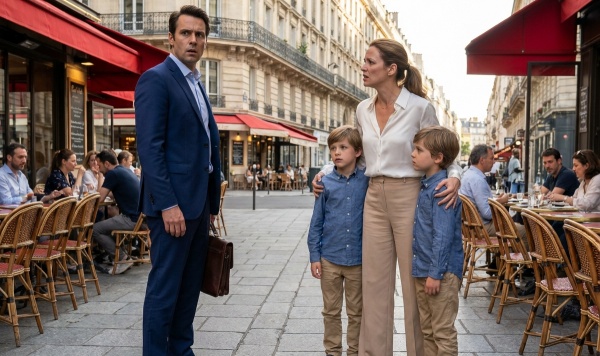
When Emily told Ryan she was pregnant, he didn’t hold her hand or promise to stay. Instead, He Told Her to Erase His Number—Four Years Later, Two Little Boys at the Park Had His Face. What he discovered next forced him to face the choice that had shattered them all.
Part 1 — The Number She Deleted
When Emily Carter first met Ryan Whitmore, rain was pouring so hard that downtown Nashville looked like a painting left out in a storm. She was standing beneath the awning of a closed bakery on 12th Avenue, clutching a broken umbrella after a long shift at Vanderbilt University Medical Center. Ryan pulled up in a dark blue pickup truck, rolled down the window, and asked if she needed a ride somewhere safe.
Emily almost said no because she had been raised to be careful, especially around strangers with charming smiles. But Ryan wore scrubs beneath his jacket, had a hospital badge clipped to his collar, and looked just as exhausted as she felt. He did not pressure her; he simply said he could wait nearby until her rideshare came. That was the first thing she noticed about him—he offered help without demanding trust.
A month later, they were meeting for coffee after work. Three months later, Ryan was carrying groceries up the stairs to Emily’s small apartment and teasing her about owning six kinds of herbal tea but no real coffee. Six months later, Emily knew the sound of his key in her front door better than she knew her own ringtone. She believed she had found the kind of love people spend years waiting for.
They were not a perfect couple, but Emily thought they were real. Ryan came from an old Tennessee family with money, polished manners, and expectations that filled every room before anyone spoke. Emily came from a trailer outside Clarksville and had worked nights to put herself through nursing school. At first, Ryan made her feel like none of that mattered.
Then Ryan’s father had a stroke, and everything began to change. Ryan spent more time at his parents’ large brick home in Belle Meade, where the lawn looked flawless and every conversation felt like a test. His mother, Margaret Whitmore, called Emily “sweetheart” in a voice that sounded polite but never warm. Emily tried harder anyway, because love often makes warning signs look like challenges.
One Sunday dinner, Margaret waited until Ryan stepped outside to take a call before setting down her fork and looking directly at Emily. “You seem like a hardworking girl,” she said, “but Ryan has obligations. His father’s health is fragile, and this family has a reputation to protect.” Emily felt her cheeks burn but answered quietly that she loved Ryan and was not asking for anything from his family.
Margaret smiled without kindness. “People don’t always know what they’re asking for.” When Ryan returned, Emily expected him to notice something was wrong, but he either did not see it or chose not to. That night, she told herself she was being too sensitive. Two weeks later, she found out she was pregnant.
Emily took three pregnancy tests in the tiny bathroom of her apartment, lining them up on the sink like evidence in a trial. Her hands shook so badly she had to sit on the closed toilet lid. She was twenty-six, working double shifts, still paying off student loans, and suddenly the future had a heartbeat. She was scared, but somewhere beneath the fear, she felt something like wonder.
When she told Ryan, she expected fear or silence. She even expected him to need time. What she did not expect was the coldness in his voice as they sat in his truck outside a Kroger in Green Hills. He stared at the appointment card in his hand and asked, “Are you sure it’s mine?”
The words hurt more than shouting would have. Emily turned toward the window because if she looked at him too long, she might fall apart right there in the parking lot. “You’re the only person I’ve been with,” she said. Ryan rubbed both hands over his face and told her this was not the time, as if a baby could be rescheduled.
“My dad is barely speaking, my mother is losing her mind, and I’m applying for the fellowship in Boston,” he said. “And now this?” Emily repeated the words back to him because she could not believe what she had heard. “This is our baby,” she whispered. Ryan shook his head and said he could not do it.
She waited for him to take it back. She waited for the man who once brought her soup when she was sick and kissed her forehead in grocery store aisles. But the man sitting beside her looked distant, cornered, and almost unfamiliar. Then he said the words she would remember for the rest of her life.
“Erase my number.”
For a moment, Emily could not breathe. Outside the windshield, a woman pushed a cart across the parking lot while a toddler ate crackers in the front seat, and the ordinary world kept moving. Emily said his name once, softly, as if that might bring him back. But Ryan looked away and said, “I’m serious.”
So Emily got out of the truck. She stood beneath the gray Tennessee sky as he drove away, her phone heavy in her hand. She opened his contact, stared at the picture of him laughing at a Predators game, and deleted it before she could change her mind. That night, she cried until her throat hurt, then called her mother.
Linda Carter answered on the second ring and listened without interrupting. When Emily finally stopped sobbing long enough to breathe, Linda said, “Come home, baby. We’ll figure out tomorrow when tomorrow gets here.” Two weeks later, Emily moved back to Clarksville. She took a nursing job at a family clinic and let her mother turn the spare room into a nursery with secondhand cribs.
At twelve weeks, another surprise arrived. The ultrasound technician smiled, tilted the screen, and told Emily to take a deep breath. Emily gripped her mother’s hand, terrified something was wrong. Instead, the technician said gently, “There are two heartbeats.”
Twins.
Emily laughed and cried at the same time. Linda cried too, though later she admitted she had secretly hoped for one calm baby instead of two tiny roommates with opinions. They ate cheeseburgers afterward because Linda said every life-changing announcement deserved fries. Emily never contacted Ryan.
Not when she found out she was having boys. Not when the final month of pregnancy made it impossible to sleep comfortably. Not when the hospital bill arrived and she had to arrange a payment plan. She had deleted his number because he had told her to, and pride was sometimes the only blanket she had left.
On a cold February morning, Henry James Carter and Noah Ryan Carter entered the world six minutes apart. Henry screamed like he had a complaint to file, while Noah blinked slowly as if he was judging everyone in the room. Emily held them both against her chest and felt something inside her become unbreakable. From that moment on, she was no longer just surviving for herself.
The boys had dark hair from birth. By six months, their eyes turned the same hazel-green as Ryan’s. By one year, Henry had Ryan’s crooked half-smile, and Noah had the same crease between his brows when he concentrated. Linda noticed but only said, “Those boys are yours before they are anybody else’s.”
Emily built a life around that truth. She worked at the clinic during the day, picked up occasional weekend shifts, bought diapers in bulk, and learned how to carry two car seats through a parking lot without dropping her keys. Some nights, after the boys fell asleep, she cried quietly on the kitchen floor. Not because she regretted them, but because being strong all day still left a person tired at night.
By the time Henry and Noah turned four, Emily no longer checked every crowd for Ryan. His name became less of a wound and more of a weathered scar. She had survived him, and she had built a family without him. She did not know fate was about to put him in front of her again.
Part 2 — The Boys at Centennial Park
Ryan Whitmore returned to Nashville in late April, four years after leaving for Boston. He was thirty-four now, a pediatric cardiologist with a polished résumé, a high salary, and a loneliness he refused to name. His father had passed away the year before, and his mother had begun using grief as a reason to pull him back home more often. On paper, Ryan had everything he once thought he wanted.
But success had not quieted his memory. The more respected he became, the more often he thought about Emily and the words he had thrown at her like they meant nothing. He had searched for her online more times than he admitted, but her social media was private and her old Nashville apartment belonged to someone else. He told himself she had moved on, perhaps married someone kind.
One Saturday morning, Ryan went to Centennial Park because his mother’s house felt too full of ghosts. The Parthenon rose white against the blue Tennessee sky, and families spread blankets over the grass like patchwork quilts. A food truck sold hot chicken sliders, lemonade, and overpriced kettle corn nearby. Ryan bought coffee and walked without direction.
Then he heard laughter. Two little boys were racing around a large oak tree, both wearing red sneakers and matching Nashville Sounds baseball caps. One darted left, quick and fearless, while the other stopped to study a line of ants on the sidewalk. Their mother sat on a picnic blanket nearby, reaching into a tote bag for juice boxes.
Even before she turned, Ryan knew. Emily. His chest tightened so sharply he nearly dropped his coffee. She looked older, but not in a bad way—stronger, calmer, softer around the eyes. Then one of the boys turned toward him, and Ryan’s world stopped.
The child had his face. Not exactly, of course; he had Emily’s cheeks and small chin. But the eyes, the crooked smile, the tilt of the head—that was Ryan at four years old in old family photographs. Then the second boy ran up beside him, laughing, with the same dark hair and the same serious crease between his eyebrows.
“Henry, Noah, come get your snacks,” Emily called.
The names hit Ryan like a door closing. Henry James. Noah Ryan. He remembered Emily once saying she liked the name Noah because it sounded gentle, and he had joked that James should be included because every man in his family had a James somewhere. Now those names were standing in front of him wearing baseball caps.
Emily looked up and saw him. For one second, her face showed no emotion at all. Then recognition flashed, followed by something guarded and sharp. She stood slowly, wiping her hands on her jeans. The boys came close to her legs, sensing the sudden change in the air.
“Ryan,” she said.
“Emily,” he managed.
Neither of them moved closer. A dog barked in the distance, a child cried near the playground, and someone laughed by the food truck. The park stayed full of life, completely unaware that Ryan’s world had split open. He looked at the boys again and swallowed hard.
“Are they…” he began.
“Don’t,” Emily said.
The single word stopped him. Henry tugged at her shirt and asked, “Mommy, who’s that?” Emily took a breath and said, “Someone I used to know.” Ryan flinched because that was what he had made himself.
He crouched slightly, careful not to come too close. “Hi. I’m Ryan.” Henry studied him with open curiosity and said, “You look like me.” Emily closed her eyes for half a second, while Noah whispered, “Henry, that’s rude.”
Ryan laughed once, but it came out broken. Emily began packing the blanket and snack wrappers with shaking hands. He wanted to help, but he knew he had lost the right to act familiar. “Can we talk?” he asked.
“No,” she said.
“Emily, please.”
“Not here,” she answered. “You don’t get to appear in a park after four years and ask for a conversation like you missed a phone call.” Ryan lowered his eyes and said he knew. Emily’s voice softened but stayed firm. “No, you don’t.”
She took Noah’s hand and told Henry they were going home. Henry protested that they had just arrived, but Emily only said they would come back another day. Ryan stepped aside as she lifted the tote onto her shoulder. Before she walked away, he asked the question he could no longer hold back.
“Are they mine?”
Emily stopped but did not turn around right away. When she finally faced him, her eyes were bright but dry. “You told me to erase your number,” she said. “So I did.” Then she walked away with the boys.
Ryan stood in Centennial Park long after they disappeared into the parking lot. His coffee went cold in his hand. Every cruel word he had said four years earlier came back sharper than memory should allow. Panic had explained what he did, but it did not excuse it.
The next morning, Ryan found Emily’s clinic profile online. There was no personal phone number, no address, and no way to reach her without crossing a line. So he wrote a letter by hand because anything easier felt disrespectful. He told her he had no right to demand anything, but if the boys were his sons, he wanted one conversation on her terms.
He ended the letter with the only sentence that mattered. “I am sorry I made you face the hardest years alone.” Then he mailed it to her clinic and waited. Three days passed, then five. On the sixth day, his phone rang from a Tennessee number he did not recognize.
“Ryan Whitmore?” Emily asked.
“Yes.”
“There’s a coffee shop on Franklin Street in Clarksville,” she said. “Thursday at 10 a.m. One hour. No boys.” Ryan agreed immediately. Before hanging up, Emily added, “If you bring your mother, a lawyer, or an excuse, I’ll walk out.”
On Thursday, Ryan arrived thirty minutes early and sat near the window with a coffee he could not drink. At 9:59, Emily walked in wearing jeans, a gray cardigan, and the expression of someone who had already decided she could leave. She sat across from him without ordering anything. Then she placed a folder on the table.
Inside were copies of birth certificates, medical records, and photographs. Henry and Noah as newborns, as toddlers, covered in birthday cake, riding training bikes, smiling with Ryan’s face. Ryan covered his mouth with one hand. Emily watched him carefully and said, “I didn’t bring these to hurt you. I brought them so you understand they are real.”
Ryan nodded, unable to speak. Emily’s voice stayed steady. “They are not an idea you can regret from a distance. They are children.” Then she said the words that made a tear slip down his face. “Yes, they’re yours.”
Emily did not comfort him. She had spent four years learning not to.
Part 3 — The Price of Coming Back
Ryan expected anger from Emily, and she gave him plenty of it. What surprised him most was her fairness. She did not insult him or raise her voice, and she did not make the past easier by pretending it had been smaller than it was. “Henry and Noah are happy,” she said. “They are loved, safe, and they do not know they were unwanted by anyone.”
Ryan winced. “I never wanted them to feel that.”
“You weren’t there to want or not want anything,” Emily replied.
He accepted it because it was true.
Emily had brought a notebook filled with questions in neat blue ink. Ryan recognized the habit; she made lists when she was afraid. She asked if he wanted a DNA test, and when he said no, she told him he should do one anyway. “If you enter their lives, there can’t be any shadow of doubt—not from you, not from your family, not from anyone.”
They arranged legal paternity testing through a certified lab. Ryan insisted on paying, but Emily made it clear that paying for one thing did not buy access to the boys. She also told him he needed to speak with a family law attorney, not to fight her, but to do things properly. “We’re not making emotional decisions in a coffee shop,” she said.
The DNA results came back two weeks later. Probability of paternity: 99.99%. Ryan stared at the report in his apartment until the numbers blurred. Henry and Noah were his sons, and he had missed their first steps, first words, first birthdays, and every fever that had kept Emily awake at night.
No apology could return those days. He met Emily again at her attorney’s office in Clarksville, a modest building with a faded American flag outside. Her lawyer, Denise Howard, had kind eyes and a firm voice. Ryan brought his own attorney, Martin Ellis, with clear instructions: no attacks, no threats, no games.
They discussed child support first, and Ryan did not argue. He provided income documents, insurance information, and agreed to handle back support through the proper legal channels. Emily did not look triumphant. She only looked tired and said, “This isn’t punishment. It’s responsibility.”
Parenting time was harder. Ryan wanted to meet the boys, but Emily wanted to protect them. Denise suggested a gradual plan: video calls first, then short supervised visits, then longer visits if the boys felt comfortable. Ryan agreed to everything because he understood he was not entitled to rush healing.
The first video call lasted seven minutes. Henry appeared on screen in dinosaur pajamas, eating apple slices, while Noah sat beside him with a stuffed raccoon under one arm. Emily introduced Ryan as a doctor who helped kids’ hearts. Henry immediately asked whether doctors were allowed to eat candy.
Noah leaned closer to the camera and asked, “Can you fix a dinosaur heart?” Ryan thought seriously and said, “Depends on the dinosaur.” Henry gasped and said, “A T. rex.” Ryan replied, “That might require a very big hospital,” and both boys laughed.
Emily stood behind the phone, mostly out of frame. Ryan could only see part of her shoulder and hand, but when Noah giggled, he heard her breathe out like she had been holding it for four years. The first in-person visit happened at the Customs House Museum in Clarksville. Emily stayed nearby, seated on a bench with a book she did not read.
Ryan brought no expensive gifts, only sketch pads and washable markers because Emily had warned him not to buy affection. Henry warmed up quickly, asking thirty questions about ambulances, dinosaurs, and whether doctors ever got shots. Noah took longer. He watched Ryan carefully, as if comparing him to a picture he had seen in a dream.
At one point, Noah dropped his marker. Ryan picked it up and handed it back without making a big deal. “Thanks,” Noah said. “You’re welcome,” Ryan answered. It was a tiny moment, but Emily’s eyes filled with tears when she thought no one was looking.
Over the next few months, visits became part of the boys’ lives. Saturday mornings at parks, lunches at Chick-fil-A, trips to the library, and slow walks where Noah stopped to inspect every rock. Henry loved books about storms, while Noah loved maps. Ryan learned these things like they were sacred.
Emily remained careful. She did not introduce Ryan as their father right away, and Ryan did not push. That decision came after conversations with a child therapist, the attorneys, and many quiet nights where Emily weighed what was best for the boys. One evening in August, she called Ryan after the boys were asleep and said, “I think it’s time.”
They told the boys together on a Sunday afternoon in Emily’s living room. The room smelled like crayons, laundry detergent, and banana bread Linda had dropped off earlier. Henry and Noah sat on the rug with toy trucks while Ryan sat in an armchair, palms sweating. Emily sat between them and explained that families can look different.
“Ryan is not just Mommy’s friend,” Emily said gently. “Ryan is your dad.”
The room went very still. Noah looked at Ryan, then back at Emily. “Like a real dad?” he asked. Emily’s voice shook slightly but stayed soft. “Yes, sweetheart. A real dad.”
Henry frowned. “Where was he?”
Emily looked at Ryan, giving him the chance to tell the truth in a way children could carry. Ryan moved to the floor, keeping space between them. “I made a very wrong choice before you were born,” he said. “I wasn’t there when I should have been, and that was not your fault.”
Henry asked if Ryan had known them. Ryan said he had known their mom was going to have a baby, but he had not known there were two until he saw them. Then Noah hugged his raccoon tighter and asked the question Ryan had feared most. “Did you not want us?”
Ryan’s heart cracked. “I was scared, and I acted badly,” he said. “But since I met you, I have wanted to know you every day. I’m sorry I wasn’t there before.” Henry stared at him for a long moment, then asked, “Are you leaving again?”
“No,” Ryan said. “I’m not leaving. But I know trust takes time, so I’ll keep showing up.” The boys were quiet for several minutes. Then Henry handed him a toy fire truck and said, “You can play, but Noah gets the ladder truck because he had it first.”
Ryan took the toy like it was made of gold. Noah did not move closer that day, but when Ryan left, he whispered, “Bye, Dad,” so softly Ryan almost missed it. Emily heard it too. She turned away quickly, but not before Ryan saw her wipe her eyes.
Part 4 — The Grandmother Who Wanted Control
Margaret Whitmore found out about the twins from a photograph. Ryan had kept his mother away from the situation at first, not to be cruel, but to protect Emily and the boys from unnecessary pressure. Then one of his cousins posted a picture from a community fall festival in Franklin. In the background, Ryan was kneeling beside Henry and Noah as they painted pumpkins.
Margaret called within twenty minutes. “Ryan,” she said sharply, “who are those children?” Ryan was rinsing paint from his hands in his apartment. “My sons,” he answered.
There was silence. Then Margaret said, “Excuse me?” Ryan repeated it clearly. “My sons. Henry and Noah. They’re four.” Margaret inhaled like the news was an insult.
She demanded to know when he had planned to tell her. Ryan said, “When it was appropriate.” Margaret reminded him that she was his mother. Ryan answered, with more strength than he expected, “And I’m their father.”
Margaret immediately blamed Emily. Ryan stopped her before she could say more. “Do not speak about her that way,” he said. Margaret insisted Emily had kept the children from him. Ryan said, “No. I left.”
The next morning, Margaret arrived at his apartment wearing pearls, perfume, and outrage. “I want to meet them,” she said. Ryan answered, “No.” Her face changed as if she had never heard that word from him before. He told her the boys were children, not an extension of her pride.
Margaret tried to soften her voice and said she had only been protecting him years ago. Ryan looked at her and said, “You were protecting an image.” For a moment, he saw grief and fear beneath her control, but then the mask returned. She warned him that “a woman like Emily” might see opportunity now that he was successful.
Ryan felt something inside him go cold. “Get out,” he said. Margaret stared at him, shocked. “Ryan,” she began, but he repeated it. “Get out of my apartment.” She left in tears, and for the first time, he did not chase her.
The next day, Emily called him from the clinic parking lot, her voice tight. Margaret had come to her workplace, asked for her at the front desk, and told her supervisor she was family. She had also said she had a right to see her grandsons. Emily told Ryan she needed boundaries, not promises.
That afternoon, Ryan sent Margaret a written message. She was not to contact Emily at work, home, or through third parties. She was not to approach the boys, their school, daycare, or caregivers. Any future meeting would happen only if Emily agreed and only when the children’s therapist believed it was healthy.
Margaret replied with one sentence. “You are breaking your father’s heart from the grave.” Ryan did not answer. A month later, she tried again by sending expensive coats, monogrammed backpacks, boutique toys, and a check for $10,000 to Emily’s house. Emily called Ryan immediately.
“There’s a box on my porch that looks like guilt wrapped in tissue paper,” she said. Ryan came over and saw the gifts stacked by the door. Henry and Noah were at preschool, and Emily stood with her arms crossed, furious. Ryan told her he had not known, and she said, “I believe you.”
Together, they repacked everything. Emily kept nothing, not even the coats, though Ryan knew she could have used them. She wrote a short note saying the boys were not available for relationships built through gifts or pressure. Ryan mailed the boxes back himself.
The conflict with Margaret forced Ryan and Emily into harder conversations. They talked in parking lots, on porches, and over late-night calls after the boys were asleep. They discussed discipline, school, medical history, holidays, and what to say when the boys asked why Ryan did not live with them. Slowly, something changed between them.
It was not romance, and it was not forgiveness in the easy way people imagine. It was partnership. Emily began to trust that Ryan would back her up, and Ryan began to understand that fatherhood was not about dramatic speeches. It was about showing up on time, packing snacks, remembering that Noah hated tags in his shirts, and knowing that Henry got overwhelmed by loud bathroom hand dryers.
By Christmas, Ryan had regular parenting time. He rented a small house in Clarksville instead of staying in Nashville when he visited. It had a fenced yard, two twin beds shaped like little cabins, and a kitchen where he burned pancakes the first morning the boys slept over. Henry declared them “crispy but okay.”
Noah asked if Mommy knew Ryan was bad at breakfast. “She probably suspects,” Ryan said, and the boys laughed until syrup dripped onto the table. On Christmas Eve, Emily invited Ryan to stop by for an hour while Linda made chili and cornbread. It was careful, awkward, and tender around the edges.
Linda watched Ryan with the expression of a woman who had once wanted to throw something at him and still might if necessary. But when he helped Henry assemble a train track and carried a sleeping Noah from the couch to bed, her face softened slightly. Later, on the porch, she stood beside him in the cold. “You hurt my daughter,” she said.
“I know,” Ryan answered.
“No,” Linda said. “I don’t think you do. Not all the way.” She told him Emily had built the family when he walked away. Ryan looked through the window at Emily laughing with Henry and said, “She did an incredible job.” Linda shook her head. “She did more than that. She made sure those boys had so much love, they never noticed the empty chair.”
Ryan had no answer. Inside, Noah woke and called for Emily, and she went to him immediately, brushing a hand through his hair with practiced tenderness. Watching her, Ryan finally understood something he should have known years ago. Love was not the feeling that made promises; love was the labor that kept them.
Part 5 — The Chair at the School Play
The boys turned five in February, and Ryan was there for the birthday party. Emily hosted it at a community center because her house was too small for fifteen preschoolers, three grandparents, and a dinosaur-themed cake. Ryan arrived early to set up folding chairs and tape green paper footprints to the floor. He wore jeans, a sweatshirt, and the focused expression of a man determined not to ruin streamers.
Henry ran in wearing a T. rex hoodie, while Noah followed in a triceratops hat, holding Emily’s hand until he spotted the balloon table. They both shouted, “Dad!” at the same time. Ryan froze for half a second. Emily noticed, smiled faintly, and went back to arranging cupcakes.
Margaret did not attend. After months of silence, she had agreed to meet Ryan with a family therapist. It was not reconciliation, but it was a beginning. Ryan had made it clear that if she wanted any relationship with Henry and Noah, she would need to respect Emily fully.
At the party, Linda took pictures while Ryan helped children pin tails on a cardboard dinosaur. Emily stood near the snack table, speaking with another mother from preschool. Every so often, her eyes found Ryan, not with fear, but with cautious peace. After cake, Henry opened Ryan’s gift: a children’s weather station kit.
Noah opened his gift next, a large illustrated atlas with maps of every state. Henry immediately wanted to measure wind, while Noah asked how long it would take to drive to Oregon. “About thirty-five hours,” Ryan said. Noah’s eyes widened. “That’s too many snacks.”
Emily laughed, and Ryan looked at her for a second longer than he meant to. He remembered the young woman in the rain, the woman in his truck, and the woman holding a folder across a coffee shop table. He also saw the mother she had become, steady and tired and luminous in the quiet way real love often is. After the party, when everyone had gone, he found her stacking leftover cupcakes.
“Thank you for letting me be here,” he said.
She did not look up. “They wanted you here.”
“I know,” he replied. “But you made space for it.”
Emily closed the container and said, “I made space for them.” Ryan nodded because that was fair. After a pause, she looked at him and said, “You’re different now.” He answered softly, “I hope so.”
“I don’t say that to make you feel better,” she said.
“I know.”
Emily leaned against the table and admitted that sometimes she still got angry. Randomly, while folding pajamas or washing cups, she would remember being pregnant alone and hate him for ten minutes. Ryan told her she was allowed. Emily said she did not want to live in that anger, but she would not pretend it had never happened.
Spring came with thunderstorms, muddy shoes, and preschool art projects taped to Emily’s refrigerator. Ryan attended parent-teacher conferences, signed up for snack week, and learned how the teachers described his sons. Henry was “a natural leader,” which meant bossy but charming. Noah was “deeply observant,” which meant he noticed everything and forgot nothing.
One evening in May, Emily texted Ryan a photo of a flyer. “Spring Program — Families Welcome. Little Stars Preschool. Friday, 6:30 p.m.” Under it, she wrote, “The boys asked if you’re coming.” Ryan replied immediately, “I’ll be there.”
He arrived early with flowers for Emily because the boys had insisted Mommy needed flowers for clapping. He also brought two small bouquets for Henry and Noah, which Henry accepted proudly and Noah sniffed suspiciously. The preschool gym smelled like floor polish and cookies. Folding chairs filled the room while parents held up phones and grandparents saved seats.
Ryan sat beside Emily. Not behind her. Not across the room. Beside her. Linda sat on Emily’s other side and handed him a program, whispering, “Noah’s been practicing his line all week.”
The children filed onto the small stage wearing paper flower crowns. Henry waved so hard his crown slipped over one eye. Noah stood very straight, scanning the audience until he found Emily and then Ryan. When he smiled, Ryan felt it land somewhere deep.
The program was chaotic and wonderful. Some children sang loudly, others forgot the words, and one little girl announced she needed the bathroom in the middle of a song about sunshine. Parents laughed gently while the teacher guided everyone back on track. Then Noah stepped forward for his line.
He gripped the microphone with both hands. “Families help us grow,” he said clearly. The gym applauded, and Noah looked proud for exactly two seconds before rushing back to Henry. Henry patted his shoulder like a coach after a big game.
Ryan wiped his eyes quickly. Emily noticed but said nothing. After the show, the boys ran to them, Henry crashing into Ryan first, all elbows and excitement. Noah hugged Emily, then turned and wrapped his arms around Ryan’s leg.
“Did you hear my line?” Noah asked.
“I did,” Ryan said. “You were perfect.”
Henry bounced beside them. “I sang the loudest.”
“You definitely sang the loudest,” Emily said.
They walked out together into the warm Tennessee evening. Fireflies blinked over the grass near the parking lot. Somewhere nearby, someone was grilling burgers, and the smell drifted through the air like summer arriving early. At Emily’s car, the boys climbed into their booster seats, still talking over each other.
Ryan buckled Henry while Emily buckled Noah. Suddenly, Henry became serious and asked, “Dad, were you sad when you didn’t know us?” Ryan paused with one hand on the seat belt. Emily looked over the roof of the car, waiting.
Ryan answered carefully. “I think part of me was sad, but I didn’t understand why yet.”
Henry thought about that. “Now you know.”
“Now I know,” Ryan said.
Noah leaned forward and said, “Don’t forget again.” The simple justice of the words pierced Ryan’s heart. He looked at his son and said, “I won’t.” After the boys were secured, Emily closed the car door and stood beside Ryan under the parking lot lights.
“I used to imagine this moment,” Ryan admitted.
“Which moment?” Emily asked.
“Standing next to you after something for our kids,” he said. “A school play, a game, maybe a graduation someday. In my imagination, I had earned it from the beginning.” Emily’s face softened slightly. “Life doesn’t always give us the clean version.”
“No,” Ryan said. “It doesn’t.”
She looked through the window at the boys. “But sometimes it gives us a version we can still build from.” Ryan nodded and did not ask for more. He had learned that some doors open slowly, not because someone is cruel, but because they are wise enough to check what stands on the other side.
A year earlier, Ryan had wanted forgiveness like a verdict. Now he understood it was more like a garden. You did not demand fruit from soil you had neglected. You showed up, cleared stones, watered quietly, and accepted that some seasons were only for roots.
Emily opened her car door, then paused. “Ryan?” she said.
“Yes?”
“They’re having pancakes Saturday morning. At your place.”
He smiled. “I’ll try not to burn them.”
“You will burn them,” she said. “Buy extra eggs.”
Then she got in the car. Ryan stood in the parking lot as Emily drove away with their sons, the taillights glowing red before turning onto the main road. He did not feel abandoned watching them leave. He felt entrusted.
Four years earlier, he had told Emily to erase his number. She had erased it. She had also raised two beautiful boys, built a home from courage, and protected their hearts with a strength he had not deserved but would spend his life honoring. Ryan took out his phone and looked at the contact he had saved months earlier.
Emily Carter.
This time, he knew a number was not a connection. Showing up was. Telling the truth was. Staying when things were uncomfortable was.
He put the phone away and walked to his car beneath the soft Tennessee sky. For the first time in years, Ryan Whitmore understood what family meant. It was not blood alone, not a last name, not a perfect past. It was the chair you kept returning to.
It was the child who looked at you and asked you not to forget. It was the woman who had every reason to close the door, yet left one small opening—not for him, but for the children who deserved every good thing adults could become brave enough to give them. And Ryan knew, with a certainty that humbled him, that he would spend the rest of his life proving he could be one of those good things.
