Part 1 — The Night I Came Home Late
I got home at 8:47 on a Thursday night, still wearing my hospital badge and the same navy scrubs I had put on fourteen hours earlier. I worked as a respiratory therapist at a hospital in Tampa, Florida, and flu season had turned every shift into a marathon. My feet hurt, my lower back ached, and all I wanted was a shower, a bowl of soup, and ten minutes where nobody needed anything from me.
My name is Emily Carter, and I was thirty-one years old, seventeen weeks pregnant, and still telling myself my marriage could be saved. My husband, Grant, had not always been cruel in obvious ways. At first, he was charming, attentive, the kind of man who opened doors and remembered coffee orders. The cruelty came later, disguised as concern, stress, and “jokes” I was supposedly too sensitive to understand.
We lived in a two-story house in Brandon, just east of Tampa. The house belonged to Grant’s family trust, though he loved calling it “our home” whenever he wanted to sound generous. His mother, Patricia, lived fifteen minutes away and treated our marriage like a department she supervised. She had a key, an opinion about everything, and no understanding of boundaries.
That night, her Lexus was in the driveway when I pulled in.
My stomach tightened before I even opened the car door.
Patricia did not visit casually. She arrived when Grant wanted backup, when he wanted me outnumbered, or when he needed someone to nod while he explained why I was disappointing him. I sat in my car for a full minute, one hand on my belly, trying to breathe slowly. The baby fluttered faintly, a tiny movement that still felt like a secret between us.
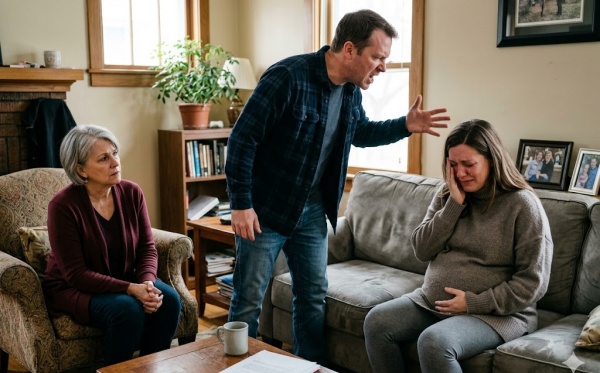
Inside, the house smelled like lemon cleaner and roasted chicken. The kitchen lights were too bright. Grant stood near the island in his white dress shirt with the sleeves rolled up, looking like a man posing for a version of himself he wanted other people to believe. Patricia sat at the breakfast table, her pearls resting against a pale blue cardigan, watching me like a judge waiting for a defendant.
“You’re late,” Grant said.
Not hello.
Not how was your shift.
Just accusation.
I set my work bag down by the door. “There was an emergency intubation at the end of my shift. I texted you.”
“You texted at 7:10,” he said. “Then nothing.”
“I was working.”
Patricia sighed softly, the way she did when she wanted to sound disappointed but refined. “A wife still communicates, Emily. Especially when she is carrying a child.”
I looked at her, too tired to pretend respect. “I was taking care of patients.”
Grant laughed once, sharp and humorless. “You always have an excuse.”
That was how it started most nights. A small sentence, a trapdoor opening under my feet. If I defended myself, I was argumentative. If I stayed quiet, I was disrespectful. If I cried, I was manipulative.
I walked toward the stairs. “I’m going to shower. We can talk later.”
Grant stepped in front of me.
“No,” he said. “We’re talking now.”
I felt the old fear rise, familiar and humiliating. I hated that my body reacted before my mind could. I hated that Patricia sat there watching, not shocked, not concerned, almost satisfied. I placed one hand over my belly and tried to keep my voice steady.
“Move, Grant.”
His face changed.
Not dramatically.
Just enough.
His jaw tightened, his eyes went flat, and before I could step back, his hand came across my face. The sound cracked through the kitchen. My head turned with the force of it, and for one strange second, all I could hear was the refrigerator humming.
Then I tasted blood.
My lip had split against my tooth.
Patricia gasped, but it was not a gasp of horror. It sounded more like inconvenience. Grant stared at me, breathing hard, as if I had forced his hand by standing there in my own home, tired and pregnant and not obedient enough.
I touched my mouth and looked at my fingers.
Red.
“Emily,” he said, his voice lower now. “Don’t make this bigger than it is.”
Something inside me went quiet.
Not calm.
Quiet.
The kind of quiet that happens when your mind finally stops negotiating with danger.
I whispered, “You hit me.”
Patricia stood up quickly. “Grant, go cool off. Emily, don’t escalate. You know how stressful things have been.”
I stared at her.
She was looking at my lip, at the blood, at my shaking hands, and still her first instinct was to protect the man who had done it.
Then the cramping started.
At first, it was a tightening low in my abdomen, sharp enough to make me grab the edge of the island. I told myself it was shock. Stress. Maybe round ligament pain. Pregnancy came with strange aches, and I had learned not to panic at every sensation.
Then I felt warmth.
My hand moved down before my brain formed the thought.
When I looked at my scrubs, my whole body went cold.
“No,” I whispered.
Grant frowned. “What now?”
I did not answer him.
I could not.
The pain came again, stronger this time, and I doubled over against the kitchen island. Patricia finally moved toward me, but not with comfort. With alarm, yes, but also with fear of what this moment would mean for her son.
“I need an ambulance,” I said.
Grant stepped back. “Emily, don’t be dramatic.”
I looked up at him with blood on my mouth and terror in my chest.
“Call 911.”
Nobody moved.
So I did it myself.
My hands shook so badly I almost dropped the phone, but I pressed the numbers and held it to my ear. When the dispatcher answered, my voice broke. “My husband hit me. I’m pregnant. I’m bleeding. I need help.”
That was the first time I said it out loud.
And once I said it, the house changed.
Not because Grant became sorry.
Because the secret was no longer only inside the walls.
Part 2 — The Kitchen Became Evidence
The dispatcher kept me on the phone until the paramedics arrived. She told me to sit down if I could, to stay on the line, and to tell her if Grant came near me. Her voice was steady, professional, and kind in a way that made me want to collapse. I had spent years making excuses for Grant, and a stranger believed me faster than my own mother-in-law did.
Grant paced near the living room, whispering harshly to Patricia. I heard pieces of it. “She’s overreacting.” “This will ruin me.” “She knows I didn’t mean it.” Not once did he ask if the baby was okay.
Patricia came toward me with a towel. “Here,” she said. “Clean yourself up before they get here.”
I looked at the towel in her hand.
White.
Neatly folded.
Like this was a spill on the counter instead of the end of something I had prayed for.
“No,” I said.
Her face hardened. “Emily, be reasonable.”
“I am being reasonable,” I whispered. “I’m not touching anything.”
That sentence did not come from courage. It came from training. I worked in a hospital. I understood documentation. I understood that what people say later is often different from what the body, the room, and the records can prove.
The ambulance arrived first, then two sheriff’s deputies from Hillsborough County. Red and blue lights flashed through the front windows, making the kitchen look unreal. One paramedic knelt in front of me and asked how many weeks pregnant I was. When I said seventeen, her eyes softened for half a second before she became professional again.
A deputy asked Grant to step into the living room.
Grant suddenly found his calm voice.
He told them we had argued. He said I had been emotional. He said he had “put a hand up” and I had “moved into it.” Even through the pain, I almost laughed. Men like Grant do not just hurt you. They audition explanations while you are still bleeding.
Patricia backed him up at first.
“She was hysterical,” she said. “My son was trying to calm her down.”
The female deputy, Deputy Lawson, turned toward me. She looked at my lip, my scrubs, my hands gripping the edge of the chair. Her face did not show pity. It showed focus.
“Emily,” she said, “can you tell me what happened?”
So I did.
Short sentences.
Facts.
I came home late from work.
He blocked me.
He hit me.
I started cramping.
I began bleeding.
I called 911 myself.
Grant interrupted from the living room. “That is not what happened.”
Deputy Lawson did not look away from me. “Sir, you need to wait.”
The paramedics loaded me onto a stretcher. As they moved me through the front door, I saw my neighbor, Mrs. Alvarez, standing on her porch in a robe, one hand over her mouth. I felt shame rise like heat in my face. Then she lifted her other hand slightly, not waving, just telling me she saw me.
That mattered more than I expected.
At Tampa General, everything became bright lights and medical words. Triage. Vitals. Ultrasound. OB consult. I kept asking if the baby was okay, and the nurse kept saying, “We’re going to check.” That is hospital language for when nobody wants to promise what they cannot control.
My best friend, Jenna, arrived before midnight. She was an ER nurse at a different hospital and the kind of woman who could look gentle while preparing to fight God. She found me behind a curtain with dried blood at the corner of my mouth and an IV in my arm. For one second, her face cracked.
Then she pulled a chair beside me.
“I’m here,” she said.
That was all.
It was enough.
The ultrasound technician came in quietly. She dimmed the lights and warmed the gel, small kindnesses in a room where my world was ending. I watched the screen, searching for movement, a flicker, any sign that my baby was still with me. The technician’s face stayed carefully neutral.
I knew before the doctor said it.
There was no heartbeat.
The OB, Dr. Kim, sat beside the bed and spoke softly. She explained what had happened in medical terms, gentle but clear. I had experienced a pregnancy loss. They could not say with absolute certainty that the assault caused it, because medicine and law require precision. But trauma and acute stress were significant factors to document, and the timing mattered.
The timing mattered.
Ten minutes after Grant hit me, I started losing our baby in his kitchen.
Jenna held my hand while I cried without sound. I had thought grief would be loud. Mine was silent, animal, too deep for language. I kept thinking about the tiny flutter I had felt in the car before going inside.
I had sat in the driveway trying to calm myself.
I had walked into danger anyway.
That is one of the cruelest things abuse does. It makes you blame yourself for not predicting the exact moment someone else would choose to hurt you. It makes you review every decision like a crime scene where you were both victim and suspect.
A hospital social worker came in around 2 a.m. Her name was Marisol, and she specialized in domestic violence cases. She asked if I felt safe going home. I looked at her and could not answer.
Jenna answered for me.
“No.”
Marisol nodded. “Then we make a safety plan.”
A safety plan.
Not a marriage plan.
Not a forgiveness plan.
Not a keep-the-family-together plan.
A safety plan.
That was the first time anyone in authority treated my survival like the priority.
Part 3 — They Thought Silence Was Still an Option
Grant was arrested that night on a domestic violence charge. I learned that from Deputy Lawson, who came to the hospital to take my formal statement. She photographed my lip, documented my clothing, and asked if there had been prior incidents. I said no at first because no had been my survival answer for years.
Then Jenna looked at me.
Not pressuring.
Just present.
I corrected myself. “Not like this before.”
Deputy Lawson waited.
So I told her about the wall he punched beside my head in January. The time he grabbed my wrist hard enough to leave bruises, then said I bruised easily. The night he took my car keys because I was “too emotional” to drive to my sister’s. The names he called me when nobody else was around.
None of those moments had felt big enough to report.
Together, they became a map.
Grant made bail the next afternoon. Before I even left the hospital, Patricia called me twelve times. I did not answer. She sent texts instead.
This has gone too far.
Grant is devastated.
You need to think about his career.
You both lost the baby. Don’t destroy what’s left.
That last one made me physically sick.
We both lost the baby.
As if he had been on the kitchen floor with me.
As if his hand had not been the last violent thing before the pain began.
Jenna took my phone and turned it face down. “You do not have to read cruelty while you’re recovering.”
I stayed with Jenna for three nights in her apartment near Hyde Park. She gave me the bedroom and slept on her own couch, ignoring my protests. Her cat, Biscuit, sat outside the door like a small, judgmental security guard. I alternated between sleeping, crying, and staring at the ceiling fan.
On the second day, a victim advocate helped me file for a temporary protective order. My hands shook while I signed the paperwork. Not because I doubted myself, but because signing made everything official. Official meant my marriage was not just “hard.” It was unsafe.
Grant was ordered not to contact me directly.
Patricia apparently believed the order did not apply to mothers.
She left a voicemail that began with “I love you like a daughter” and ended with “you are ruining my son’s life over one bad moment.” I saved it and forwarded it to the advocate. Then I blocked her number.
That felt like inhaling after years underwater.
My sister, Allison, flew in from Atlanta the next day. She had never liked Grant, though she had tried for my sake. When she walked into Jenna’s apartment, she hugged me so carefully I almost broke. Then she sat on the edge of the bed and said, “Tell me what you need, and don’t say you’re fine.”
“I need clothes,” I said.
“Done.”
“I need my documents.”
“Done.”
“I need to not go back to that house.”
Her eyes filled.
“Also done.”
We arranged for a civil standby through law enforcement so I could retrieve personal belongings safely. That phrase sounded so formal for something so intimate. A deputy standing in the hallway while I packed underwear, work shoes, prenatal vitamins I no longer needed, and a framed ultrasound photo from twelve weeks. I put that photo in my purse, then took it out, then put it back again.
Grant was not allowed to be there.
Patricia was.
She stood in the foyer with her arms crossed, watching me like I was stealing from her family instead of rescuing what remained of myself. “Emily,” she said, “you can still choose grace.”
I paused with my hand on a box.
“Grace for whom?”
“For your marriage,” she said. “For Grant. For the child you both wanted.”
The deputy looked uncomfortable but stayed silent.
I turned to Patricia. “Your son hit me in front of you. I called 911 because neither of you did. Ten minutes later, I was losing my baby in this kitchen. Do not ask me to make your silence holy.”
Her face went white.
For once, she had no answer.
I packed my birth certificate, Social Security card, passport, nursing school transcripts, tax records, and the small jewelry box my grandmother left me. I took my work clothes, my laptop, and the baby blanket I had started knitting but never finished. I left the nursery untouched. I could not walk into that room yet.
As I left, Patricia whispered, “You’ll regret this.”
I turned back.
“No,” I said. “I regret waiting this long.”
Outside, the Florida sun was too bright. Birds were chirping in the palm trees like the world had no manners. I placed the box in Allison’s rental car and sat in the passenger seat, shaking.
Allison started the engine.
“You did it,” she said.
“No,” I whispered. “I just left the house.”
She looked at me.
“That is doing it.”
Part 4 — Courtrooms, Paperwork, and the Truth
The next six months were not a clean empowerment montage. They were messy, exhausting, and expensive in ways nobody puts on inspirational posters. There were criminal hearings, family court filings, medical follow-ups, therapy appointments, and nights when grief sat on my chest so heavily I could barely breathe. Leaving was not the end of pain.
It was the end of pretending pain was love.
I hired a family law attorney named Dana Whitfield. Her office was in downtown Tampa, with framed degrees on the wall and a box of tissues on every table. She had the calm voice of someone who had heard every excuse a spouse could make. When I told her I felt guilty, she did not tell me I was crazy.
She said, “Guilt is common when someone trained you to be responsible for their consequences.”
That sentence stayed with me.
Dana filed for divorce and requested exclusive use considerations, financial disclosures, and protection through the appropriate court channels. Because the house belonged to Grant’s family trust, I was not fighting to keep it. I wanted my personal property, my retirement accounts, my car, and enough support to restart my life without being punished for leaving. Most of all, I wanted distance.
Grant’s attorney tried to frame the assault as “an isolated marital conflict.” Dana placed the police report, hospital records, photographs, 911 call documentation, and Patricia’s voicemails into the file. Suddenly, isolated looked less convincing. Documentation does not heal you, but it can keep other people from burying you.
Grant eventually accepted a plea arrangement that included probation, mandatory counseling, a batterer intervention program, and continued no-contact provisions for a period of time. Some people wanted me to be angry that he did not go to prison for years. I was too tired to build my healing around his punishment. I wanted accountability, safety, and a record that told the truth.
The truth mattered.
It mattered when his coworkers heard “domestic violence” instead of “messy divorce.”
It mattered when Patricia told relatives I had “overreacted” and my aunt sent back, “Overreacting does not require an ambulance.”
It mattered when I woke up at 3 a.m. wondering if I had imagined the worst parts, then reread the social worker’s notes and remembered I was not crazy.
Therapy was harder than court. Court asked what happened. Therapy asked why I had stayed after the first warning signs. That question felt unfair at first, like blame wearing concern. But my therapist, Dr. Avery, never asked it that way.
She asked, “What did staying help you survive at the time?”
That changed everything.
Staying had helped me believe I was loyal. Staying had helped me avoid shame. Staying had helped me protect the fantasy of a safe family for my baby. Staying had helped me postpone the terrifying truth that the man I loved was also the man I feared.
Once I understood that, I stopped calling myself stupid.
I started calling myself conditioned.
There is a difference.
I moved into a small apartment in St. Petersburg, five blocks from the water. It had old floors, a stubborn air conditioner, and a balcony just big enough for two chairs and a basil plant I kept forgetting to water. It was not the house I had imagined raising a child in. But it was mine, and nobody had a key unless I gave it to them.
The first night there, I slept with every light on.
The second night, only the hallway light.
By the end of the month, I could sleep in the dark.
That felt like a miracle nobody else would recognize.
Grief came in waves. Sometimes I cried in the grocery store when I passed the baby aisle. Sometimes I felt nothing and then hated myself for feeling nothing. Sometimes I dreamed I was still pregnant and woke with one hand on my belly, confused by the flatness, the silence, the absence.
Dr. Kim referred me to a pregnancy loss support group. I almost did not go because I thought my story was too messy, too tangled with violence, too ugly for a circle of grieving women. But the first night, a woman named Monica said, “Loss does not become less real because someone made it complicated.” I cried so hard the group leader moved the tissue box closer without saying a word.
There were women who had lost babies to medical conditions, accidents, unknown causes, and trauma. Nobody compared pain. Nobody asked me why I had gone home that night. Nobody told me everything happened for a reason. That alone made the room sacred.
I named the baby privately.
Noah.
I had not known whether the baby was a boy or girl, and medically, I never got certainty. But the name came to me and stayed. Noah meant rest, or comfort, depending on where you looked. I needed both.
On what would have been my due date, Allison flew back down, and Jenna took the day off. We drove to Fort De Soto Park and stood by the water at sunset. I held the unfinished baby blanket against my chest. Then I folded it carefully and placed it back in my bag.
I did not release it into the ocean.
I did not need a dramatic gesture.
I needed to keep one soft thing from a brutal story.
So I did.
Part 5 — The Woman They Thought They Could Break
A year after that night, I was promoted to clinical education coordinator at the hospital. It was not a glamorous title, but it meant regular hours, better pay, and fewer twelve-hour shifts that left me hollow. On my first day in the new role, I wore a white blouse that made me feel brave and earrings Jenna said looked “like a woman who reads contracts.” I laughed for the first time in a way that surprised me.
Grant tried to reach out once after the no-contact restrictions changed. The message came through his attorney, carefully worded and polished until it barely sounded like him. He said he was sorry for “the pain surrounding the end of our marriage.” Dana read it aloud and looked at me over her glasses.
“Do you want to respond?”
I thought about it.
Then I said, “No.”
Because I did not need an apology shaped like an escape hatch.
Patricia sent a letter too. Hers was worse. It was full of scripture, family reputation, and sentences that never quite admitted what she saw. She wrote, I wish that night had gone differently for all of us. I circled those words with a pen and wrote in the margin, It did go differently for me. I survived.
Then I put the letter in a box labeled Do Not Revisit Alone because healing is not pretending old wounds cannot reopen.
The divorce finalized in a courthouse conference room on a rainy Tuesday. Grant did not look at me. Patricia sat behind him, wearing black like she was attending the funeral of her control over me. Dana squeezed my arm once when it was over.
Outside, the air smelled like wet pavement and jasmine.
I expected to feel free immediately.
Instead, I felt tired.
Freedom, I learned, is not always fireworks. Sometimes it is exhaustion without fear. Sometimes it is driving home alone and realizing nobody will be angry about how long you took. Sometimes it is buying peaches at Publix and not checking your phone in the checkout line because no one is waiting to punish you.
My apartment slowly became a home. I bought yellow curtains. I framed a print from a local artist. I replaced the couch Grant had chosen with a green velvet one that Patricia would have called impractical. Biscuit, Jenna’s cat, eventually became my cat after Jenna claimed he had “emotionally imprinted” on me.
He slept at the foot of my bed like a furry little bodyguard.
I began volunteering once a month with a local domestic violence shelter, helping women prepare résumés and practice interview questions. I never told them my story unless it was useful. I did not want to become a symbol. I wanted to become proof that the practical stuff mattered too: documents, bank accounts, safe phones, trusted friends, a bag packed quietly before you think you need it.
Some women arrived with bruises.
Some arrived with no visible marks at all.
I learned not to rank wounds by what the eye can see.
One evening, a young woman in the shelter whispered, “He never hit me. He just scares me.” I took her hand and said, “Being scared in your own home is enough reason to get help.” I wished someone had said that to me years earlier. Maybe I would have believed them.
Maybe not.
But I say it now whenever I can.
Two years have passed since that Thursday night. I am not “over it,” because that phrase belongs to people who want trauma to be tidy. I am living beyond it. That is different. I still have hard days, especially around dates only my body remembers.
But I also have ordinary days.
Beautifully ordinary days.
I wake up, make coffee, feed Biscuit, drive over the Howard Frankland Bridge with the sun rising over Tampa Bay, and feel my life belonging to me. I laugh with coworkers. I visit Allison in Atlanta. I have dinner with Jenna on Fridays and let her order dessert first because she says survival requires chocolate.
Sometimes I think about the woman I was in the driveway that night, sitting in her car with one hand on her belly, trying to gather enough courage to walk inside. I wish I could tell her not to go in. I wish I could tell her to drive straight to Jenna’s. I wish I could spare her what happened next.
But I cannot change that night.
I can only tell the truth about it.
Grant hit me in front of his mother.
I called 911 when they would not.
I lost my baby in a kitchen where two people tried to protect a reputation before they protected me.
And they still thought they could make me smaller afterward.
They thought shame would silence me.
They thought grief would weaken me.
They thought a woman who had already endured so much would keep enduring because that was what she had been trained to do.
They were wrong.
The strongest thing I ever did was not screaming, not revenge, not destroying Grant’s life in return. It was telling the truth in a shaking voice. It was signing the paperwork. It was sleeping under a roof where nobody could hurt me and call it love.
I am Emily Carter.
I lost a child.
I left a dangerous marriage.
I built a life from the pieces they thought I would crawl back to collect.
And if there is one thing I know now, it is this: when someone shows you that your pain means less to them than their image, believe them the first time.
Then choose yourself before they ask you to disappear.
