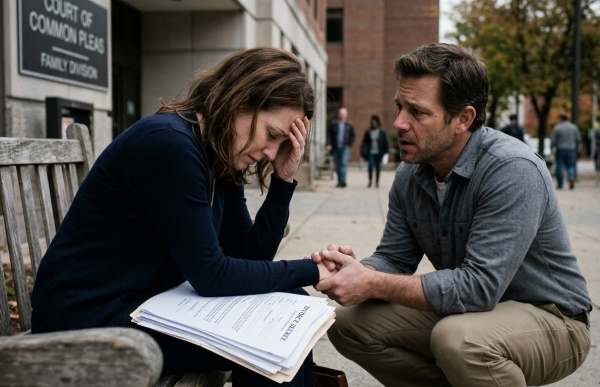
Just as we finalized the divorce, my husband suddenly grabbed my hand and said something that left me crumbling with regret.
What he actually said made me want to collapse right there on the courthouse steps—not from heartbreak, but from the crushing realization of how much time I’d wasted on a man who would never put me first. Here’s what happened in those final moments of our marriage.
Part 1: The Breaking Point
I never imagined my marriage would end like this—standing outside the Cook County Courthouse on a gray Tuesday morning in March, clutching divorce papers that felt like they weighed a thousand pounds. But after three years of living in my in-laws’ house in suburban Chicago, enduring constant criticism and feeling invisible in my own marriage, I knew I had made the right choice. Or at least, that’s what I kept telling myself.
My name is Sarah Mitchell, and I’m 32 years old. I met my husband, David, five years ago at a mutual friend’s barbecue in Naperville. He was charming, attentive, and seemed like everything I’d been looking for. We dated for a year before he proposed at Navy Pier, with the Chicago skyline glittering behind us. It felt like a fairy tale. Looking back now, I realize the red flags were there all along—I just chose not to see them.
The problems started almost immediately after our wedding. David had always been close to his mother, Patricia, but I didn’t realize just how much influence she had over him until we moved into their family home in Oak Park. David insisted it was temporary, just until we saved enough for a down payment on our own place. “Maybe a year, tops,” he promised. That was three years ago, and we never left.
Living with Patricia was like walking on eggshells every single day. Nothing I did was ever good enough. The way I folded laundry was wrong. My cooking was too bland—or too spicy. I worked too much as a marketing coordinator at a downtown firm, but I also didn’t contribute enough to household expenses. When our daughter, Emma, was born two years ago, things got even worse. Patricia criticized everything from how I held the baby to what I fed her. She’d swoop in and take Emma from my arms, saying things like, “Let me show you how it’s supposed to be done, dear.”
The worst part wasn’t Patricia’s constant interference—it was David’s silence. Every time I tried to talk to him about his mother’s behavior, he’d brush it off. “That’s just how she is,” he’d say. “She means well.” Or my personal favorite: “You’re being too sensitive.” He never once stood up for me. Not when his mother rearranged our bedroom without asking. Not when she threw away the organic baby food I’d carefully prepared because she thought it was “nonsense.” Not even when she told me at Thanksgiving dinner, in front of the entire family, that I was “lucky David settled for someone like me.”
I tried to make it work. God knows I tried. I bit my tongue so many times I’m surprised it’s still intact. I went to therapy, read books on dealing with difficult in-laws, and even attended a support group at the community center on Wednesday evenings. But nothing helped. The constant stress was eating me alive. I started having panic attacks at work. I couldn’t sleep. I lost fifteen pounds in two months. My doctor warned me that if I didn’t make changes, I was heading straight for a breakdown.
The final straw came on a cold February night. Emma had been running a fever of 102°F, and I wanted to take her to the emergency room at Rush University Medical Center. Patricia insisted it was “just a little cold” and that I was being “hysterical.” When I picked up my car keys anyway, she physically blocked the door. I looked at David, silently begging him to support me, to choose his daughter’s wellbeing over his mother’s ego. He looked away.
That’s when something inside me broke. I realized that if I stayed in this marriage, I would lose myself completely. Worse, Emma would grow up thinking this was what love looked like—a woman diminished, her voice silenced, her needs ignored. I couldn’t let that happen.
The next morning, I called a divorce attorney. Her name was Rebecca Chen, and she had stellar reviews on Google. Her office was in the Loop, in one of those old buildings with character. When I told her my story, she didn’t seem surprised. “You’d be amazed how common this is,” she said, sliding a box of tissues across her desk. “Enmeshed family dynamics destroy more marriages than infidelity.”
David was shocked when I served him the papers. “You’re really doing this?” he asked, as if I’d been bluffing the entire time. “Over some disagreements with my mother?”
“Some disagreements?” I repeated, my voice shaking. “David, I’ve been drowning for three years, and you’ve just stood on the shore watching.”
He didn’t fight the divorce, which somehow hurt even more. If he’d fought for me, for us, maybe I would have reconsidered. But he just signed the papers with a resigned sigh, like I was an inconvenience he was ready to be done with.
The divorce process took four months. Illinois requires a 180-day waiting period for divorces involving children, but we managed to expedite things since we agreed on custody terms. I would have primary custody of Emma, with David getting her every other weekend and Wednesday evenings. I didn’t ask for alimony—I just wanted out. I moved into a small two-bedroom apartment in Forest Park, about twenty minutes from my office. It wasn’t much, but it was mine. For the first time in years, I could breathe.
Part 2: The Final Hearing
The final hearing was scheduled for March 15th at 10:00 AM. I took the Blue Line downtown, watching the city pass by through smudged train windows. Spring was just beginning to show itself—a few brave crocuses pushing through the half-frozen ground in the parks we passed. I wondered if this was what rebirth felt like: painful, uncertain, but necessary.
Rebecca met me outside the courtroom. She looked professional and confident in a navy suit, her briefcase probably worth more than my monthly rent. “Ready?” she asked.
I nodded, though I wasn’t sure if “ready” was the right word. Relieved? Terrified? Heartbroken? All of the above?
David was already inside with his attorney, a middle-aged man named Robert something-or-other. David looked tired. He’d lost weight too, I noticed. There were dark circles under his eyes that I’d never seen before. For a moment, I felt a pang of something—not quite regret, but a deep sadness for what we’d lost, for the life we’d planned that would never happen.
The hearing itself was surprisingly brief. Judge Morrison, a woman in her sixties with kind eyes and a no-nonsense demeanor, reviewed our settlement agreement. We’d already worked out all the details: custody arrangements, division of our minimal assets (we didn’t have much—a 2019 Honda CR-V that I would keep, about $8,000 in a joint savings account that we’d split, and our personal belongings). The only real asset was David’s 401(k) from his job as an IT specialist at a healthcare company, which I waived any claim to. I just wanted a clean break.
“I’ve reviewed your parenting plan,” Judge Morrison said, looking over her reading glasses at both of us. “It seems fair and in the best interest of the child. Mr. Mitchell, you understand that you’re required to pay $850 per month in child support, correct?”
“Yes, Your Honor,” David said quietly.
“And both parties have agreed to this settlement without coercion?”
We both confirmed that we had.
“Very well.” She signed the papers with a flourish. “Your marriage is hereby dissolved. I wish you both the best moving forward, and I hope you can maintain a civil relationship for the sake of your daughter.”
Just like that, it was over. Three years of marriage, five years of being together—ended with a signature and a gavel. We stood up, and Rebecca shook my hand. “You’re free now,” she said with a small smile. “Go live your life.”
David’s attorney said something to him in a low voice, and they both walked toward the exit. I gathered my things slowly, not quite ready to leave. This courtroom had been the site of my liberation, and I needed a moment to let it sink in.
Part 3: The Unexpected Encounter
I finally walked out of the courtroom about ten minutes later. The courthouse hallway was busy with people—other couples going through their own legal dramas, attorneys in expensive suits talking on their phones, a security guard directing someone to the right floor. I headed toward the elevator, ready to go back to my office and try to focus on the product launch presentation I had due on Friday.
That’s when I noticed David. He was standing near the elevator bank, not quite blocking my path but clearly waiting for something. Or someone. When he saw me, he straightened up, and I saw something flicker across his face—nervousness? Guilt? I couldn’t quite read it.
“Sarah,” he said, taking a step toward me.
I stopped, my hand instinctively tightening around my purse strap. “What is it, David?”
He seemed to struggle with his words, which was unusual for him. David had always been articulate, maybe too much so—he could talk his way around any difficult conversation, deflecting and rationalizing until I forgot what we were even arguing about.
“I just… I wanted to…” He trailed off, then suddenly reached out and grabbed my hand. Not aggressively, but firmly, like he was afraid I’d disappear if he didn’t hold on.
My heart did something complicated in my chest. Despite everything, despite the pain and the anger and the three years of feeling invisible, there was still a part of me that remembered loving this man. A part of me that had hoped, even as I filed for divorce, that he would wake up and fight for us. That he would finally choose me over his mother.
For a split second, looking at his face, I thought maybe this was it. Maybe he was going to tell me he’d made a terrible mistake. That he’d found us an apartment, that he’d set boundaries with Patricia, that he wanted to try again. I felt hope flutter in my chest like a trapped bird, desperate and foolish.
“I remember,” he started, and my breath caught, “when we were dating, I gave you that jewelry set. The one from Tiffany’s—the necklace and earrings. It cost me almost $3,000.”
I blinked, confused. This wasn’t where I thought this conversation was going.
“My mom mentioned that, you know, since we’re divorced now, you should probably give it back. And I thought about it, and… well, she’s right. It was expensive, and it was a gift from before we were married, so technically…”
He kept talking, but I couldn’t hear him anymore. There was a ringing in my ears, like someone had set off an alarm inside my skull. He wanted the jewelry back. That’s why he’d waited for me. That’s why he’d grabbed my hand—not because he missed me or regretted losing me, but because his mother had sent him to collect her son’s property.
The jewelry set. I remembered it so clearly. He’d given it to me on our six-month anniversary. We’d gone to dinner at Alinea, this fancy restaurant I’d always wanted to try. It had cost him a fortune—the dinner and the jewelry—and I’d been so touched by the gesture. The pieces were beautiful: a delicate silver necklace with a small diamond pendant, and matching stud earrings. Not flashy, but elegant. Timeless.
I’d treasured that set. Even during the worst times in our marriage, I’d kept it in its original Tiffany blue box, tucked safely in my drawer. I’d never worn it—it felt too precious, too special. I was saving it for… I don’t know what. A special occasion that never came. When I moved out of David’s family home two months ago, I’d deliberately left behind almost everything. The clothes I’d bought after we got married. The kitchen gadgets Patricia had given me (always with some passive-aggressive comment about how I needed to learn to cook properly). The framed wedding photos. I’d wanted to leave with nothing that tied me to that house, to that suffocating life.
But I’d taken the jewelry. It was one of the few things I’d packed carefully in my suitcase, wrapped in tissue paper. Because despite everything, it had represented a time when I’d believed David loved me. When I’d believed we had a future.
Part 4: The Crushing Reality
“Sarah? Did you hear me?” David’s voice cut through my thoughts.
I looked down at his hand, still holding mine, and suddenly it felt like a trap rather than a connection. I pulled away.
“You want the jewelry back,” I said flatly. It wasn’t a question.
“Well, yeah. I mean, it was really expensive, and Mom pointed out that—”
“Your mother,” I interrupted, and I heard my voice crack. “Of course. Your mother pointed it out.”
“Sarah, don’t be like that. It’s just practical. We’re not together anymore, and it’s not like you ever wore it anyway. It’s just sitting in a drawer somewhere, right? It makes sense for me to have it back. I could sell it, or…” He shrugged. “I don’t know. But it’s worth almost three grand.”
Three thousand dollars. That’s what our relationship had been reduced to. Not the promises we’d made to each other, not the daughter we’d created together, not the dreams we’d shared. Three thousand dollars in jewelry that his mother wanted back.
“Did you wait out here just to ask me this?” I asked, my voice barely above a whisper. “Did you plan this?”
He had the decency to look uncomfortable. “Mom just mentioned it this morning, and I thought, since we were both here anyway…”
“Since we were both here anyway,” I repeated. “At our divorce hearing. You thought that would be the perfect time to ask for your gifts back.”
“It’s not like that—”
“Then what is it like, David?” I could feel tears burning behind my eyes, but I refused to let them fall. Not here. Not in front of him. “Help me understand. Because from where I’m standing, it looks like you’re still doing exactly what your mother tells you to do. Even now. Even after our marriage is over.”
“That’s not fair,” he said, his jaw tightening. “You always made everything about my mother. Maybe if you’d tried harder to get along with her—”
“I tried!” The words burst out of me, louder than I intended. A couple walking past us glanced over curiously. I lowered my voice. “I tried for three years, David. I tried until I had nothing left. And you know what? It was never about me getting along with her. It was about you being too afraid to set boundaries. Too afraid to be your own person.”
“I’m not afraid—”
“You’re terrified,” I said, and suddenly I felt exhausted. “You’re so terrified of disappointing her that you’ll sacrifice anything—your marriage, your wife, your own happiness. And now you’re standing here, asking for jewelry back because she told you to. Do you even hear yourself?”
He opened his mouth, then closed it. For a moment, I thought I saw something in his eyes—recognition, maybe, or shame. But then it was gone, replaced by defensiveness.
“You know what? Forget it,” he said. “Keep the damn jewelry. I don’t care.”
“No,” I said, surprising myself. “You want it back? Fine. You can have it.”
“Sarah—”
“I’ll mail it to you,” I continued, my voice cold now, detached. “Consider it my final gift to you and your mother. I hope it makes her happy.”
I turned toward the elevator, but his voice stopped me.
“Why do you have to be so dramatic about everything?” he asked, and there was genuine bewilderment in his tone. “It’s just jewelry. It’s not that big of a deal.”
I turned back to look at him, really look at him. This man I’d loved, who I’d built a life with, who I’d hoped would be my partner through everything. And I realized, with a clarity that was almost painful, that he truly didn’t understand. He didn’t understand what he’d just done, what he’d been doing for three years. He didn’t understand that asking for that jewelry back wasn’t about the money—it was about reducing our entire relationship to a transaction. It was about proving that his mother still came first, even now.
“You’re right,” I said quietly. “It’s not a big deal. Nothing about us was ever a big deal to you, was it?”
Part 5: Moving Forward
I didn’t wait for his response. I walked to the elevator, pressed the button, and stepped inside when the doors opened. As they closed, I saw David still standing there, looking confused and frustrated, like I was the unreasonable one.
The elevator ride down felt like descending from one life into another. When I stepped out onto the street, the March air hit my face, cold but refreshing. I started walking, not toward the train station, but just… walking. I needed to move, to process what had just happened.
I ended up at Millennium Park, standing in front of Cloud Gate—the Bean, as everyone calls it. Tourists were taking selfies, kids were running around, and life was just… happening. Normal, everyday life. I stood there, looking at my distorted reflection in the sculpture’s surface, and I let myself cry.
I cried for the marriage I’d lost. For the man I’d thought David was. For the three years I’d spent trying to be enough for a family that would never accept me. For my daughter, who would grow up in a broken home. But mostly, I cried from relief. Because as painful as this moment was, I was free. I didn’t have to go back to that house. I didn’t have to endure Patricia’s criticism or David’s indifference. I could build a new life, on my own terms.
After about twenty minutes, I wiped my eyes, pulled out my phone, and called my best friend, Jessica.
“Hey!” she answered cheerfully. “How did it go?”
“It’s done,” I said. “I’m officially divorced.”
“Oh, Sarah. How are you feeling?”
“Honestly? I don’t even know. But Jess, you won’t believe what just happened…”
I told her everything—about David waiting for me, about the jewelry, about his mother’s influence even in our divorce. By the time I finished, Jessica was livid.
“Are you kidding me?” she practically shouted. “He asked for the jewelry back? At the courthouse? Right after your divorce was finalized?”
“Yep.”
“What an absolute…” She used a word I won’t repeat. “Sarah, please tell me you’re not actually going to give it back to him.”
I thought about it. The jewelry was sitting in my apartment, in its blue box, in my nightstand drawer. It would be so easy to keep it, to hold onto this one piece of what we’d had. But I knew I couldn’t. Not because David deserved it back, but because I needed to let go. Completely.
“I’m going to give it back,” I said. “But not because he asked. Because I don’t want anything from him or his family. I want a clean slate.”
Jessica sighed. “I get it. I do. But God, he doesn’t deserve your grace.”
“This isn’t about him,” I said. “It’s about me. I need to close this chapter completely.”
That evening, after I picked up Emma from daycare and we had dinner (mac and cheese, her favorite), I put her to bed and retrieved the jewelry box. I sat on my couch, holding it, remembering the night David gave it to me. We’d been so happy then. Or at least, I’d thought we were.
I opened the box and looked at the necklace and earrings one last time. They were beautiful. But they were also a lie—a symbol of a love that hadn’t been strong enough to survive reality. I closed the box, wrapped it carefully in bubble wrap, and addressed a padded envelope to David’s mother’s house.
The next morning, I dropped it off at the post office on my way to work. As I handed it to the postal worker, I felt something shift inside me. Lighter. Freer.
Three days later, I got a text from David: “Got the jewelry. Thanks.”
That was it. No apology. No acknowledgment of how hurtful his request had been. Just “thanks,” like I’d returned a borrowed lawn mower.
I didn’t respond. Instead, I deleted his number from my phone. We’d still have to communicate about Emma, but we could do that through a co-parenting app. I didn’t need his number taking up space in my contacts anymore.
The weeks that followed were hard. Divorce is never easy, even when it’s the right choice. There were nights when I lay awake, second-guessing everything. Wondering if I’d given up too easily. Wondering if I should have tried harder to make it work for Emma’s sake.
But then I’d remember that moment outside the courthouse. David’s hand gripping mine, and for one foolish second, me hoping he’d changed. Only to have him ask for jewelry back at his mother’s request. And I’d remember why I left.
I started therapy with a wonderful counselor named Dr. Martinez. She helped me work through the guilt and the grief. She helped me see that leaving wasn’t giving up—it was choosing myself. Choosing my daughter. Choosing a life where I wasn’t constantly diminished.
I also joined a divorce support group that met Tuesday evenings at a community center in Oak Park. Hearing other people’s stories—their pain, their struggles, their eventual healing—helped me feel less alone. I made friends there, people who understood what I was going through in a way my married friends couldn’t.
Emma adjusted better than I’d expected. She was only two, so she didn’t fully understand what was happening. But she seemed happier in our little apartment than she’d ever been at her grandmother’s house. She had her own room, decorated with butterflies and rainbows. We had dance parties in the living room. We made cookies on Sunday afternoons, and if we made a mess, nobody criticized us.
David saw her every other weekend, as agreed. The first few handoffs were awkward, but we developed a routine. He’d pick her up Friday at 6:00 PM and drop her off Sunday at 6:00 PM. We kept our conversations brief and focused on Emma. I never asked about his mother, and he never mentioned her.
Six months after the divorce, I ran into an old colleague at a coffee shop in the Loop. His name was Marcus, and we’d worked together at my previous job. We got to talking, and he mentioned that his company was hiring for a senior marketing position. The pay was $15,000 more than what I was currently making, and it came with better benefits.
I applied, interviewed, and got the job. My first day was September 1st, and I felt like I was finally moving forward, not just surviving but actually building something.
Around that same time, I heard through mutual friends that David had finally moved out of his mother’s house. He’d gotten an apartment in Schaumburg, about thirty minutes away. I felt nothing when I heard the news—not satisfaction, not vindication, not even curiosity. Just… nothing. He was no longer a part of my emotional landscape.
A year after our divorce, on a crisp March morning, I woke up in my apartment and realized something: I was happy. Not the giddy, butterflies-in-your-stomach happiness of new love, but something deeper. Contentment. Peace. I had a job I enjoyed, a daughter I adored, friends who supported me, and a life that was entirely my own.
I thought about that moment outside the courthouse, when David had grabbed my hand and asked for the jewelry back. At the time, it had felt like a crushing betrayal, proof that I’d wasted three years of my life on someone who’d never truly valued me.
But now, with the perspective of time and healing, I saw it differently. That moment had been a gift, in its own painful way. It had shown me, with absolute clarity, that I’d made the right choice. If I’d had any lingering doubts about the divorce, David had erased them with that one request.
Sometimes, I think, we need that final, undeniable proof that we’re doing the right thing. We need the universe to show us, in the starkest terms possible, that the person we loved isn’t who we thought they were. It hurts like hell in the moment, but it’s necessary. It’s the push we need to stop looking back and start moving forward.
I never regretted giving the jewelry back. It wasn’t mine to keep—not because David had a legal right to it, but because it represented something that no longer existed. Keeping it would have been like keeping a piece of my old life, the life where I was small and silent and constantly trying to earn love that should have been freely given.
These days, I wear jewelry I buy for myself. Nothing expensive—just pieces I find at local boutiques or craft fairs, things that make me smile. Emma likes to help me pick them out. “That one, Mommy!” she’ll say, pointing to a pair of colorful earrings or a funky bracelet. And I’ll buy it, not because it’s from Tiffany’s or because it cost thousands of dollars, but because it makes my daughter happy. Because it’s mine, chosen by me, for me.
That’s what freedom looks like, I’ve learned. It’s not dramatic or glamorous. It’s quiet moments in a small apartment. It’s dance parties with your toddler. It’s buying yourself jewelry that makes you smile. It’s building a life where you don’t have to ask permission or apologize for taking up space.
David taught me a lot, though not in the way he intended. He taught me that love without respect is worthless. That you can’t build a life with someone who won’t stand beside you. That sometimes, the bravest thing you can do is walk away.
And his mother? She taught me that no amount of trying will ever be enough for someone who’s determined not to accept you. That you can’t earn love from people who see you as a threat. That sometimes, the problem isn’t you—it’s them.
I’m grateful for those lessons, even though they came at a high cost. I’m grateful for the strength I discovered in myself, the strength I didn’t know I had until I needed it. I’m grateful for my daughter, who will grow up watching her mother stand up for herself, who will learn that it’s okay to walk away from situations that diminish you.
Most of all, I’m grateful that I didn’t stay. That I didn’t let fear or guilt or false hope trap me in a marriage that was slowly killing my spirit. That when David grabbed my hand outside that courthouse and asked for jewelry back, I saw it for what it was: not a moment of connection, but a final goodbye to a life I’d outgrown.
Sometimes, the end of something is really the beginning of everything else. My marriage ended on that March morning, but my life—my real life, the one where I’m the author of my own story—that’s when it truly began.
And I wouldn’t change a thing.
