He couldn’t have been older than eight. He was holding a baby girl on his hip, and she had fallen asleep against his shoulder with her mouth slightly open.
He walked up to the counter and asked if we had anything left over from yesterday — anything cheap.
I’ve worked in customer service my whole life. I thought I had seen everything. I was wrong.
Here is my story.
[Image suggestion: A small-town bakery storefront on a quiet morning, warm light through the window]
The Boy at the Counter
It was a Tuesday morning in late October in Clover Falls, Tennessee — one of those cold gray days where the sky sits low and the wind has teeth.
The bakery had been open for forty minutes. The morning rush of coffee drinkers and commuters had already come and gone, and the shop had settled into its mid-morning quiet. The display cases were full. The air smelled like cinnamon and warm butter. The kind of smell that makes you feel like everything is going to be okay.
I was behind the counter restocking the napkin holders when the door opened.
He came in sideways — leading with his shoulder to push the door, because both arms were occupied. His left arm was wrapped around a baby girl, maybe fourteen or fifteen months old, bundled in a pink fleece jacket that was starting to fray at the cuffs. His right hand held the door.
He was wearing a blue hoodie with a small bleach stain on the left sleeve. His sneakers were clean but the soles were separating at the toe on one side. He had dark hair that needed a trim and eyes that were doing something I recognized but couldn’t immediately name — they were doing the math. Looking at the prices on the display case and calculating before he even opened his mouth.
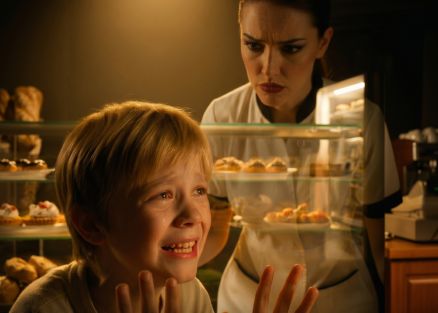
I had seen adults do that. I had never seen a child do it.
He walked up to the counter and waited. Very politely. He didn’t tap the glass or shift impatiently. He just stood there holding his sister, looking at the pastries through the case with an expression that was carefully, deliberately neutral.
When I came to the counter, he looked up at me.
“Excuse me, ma’am. Do you sell anything from yesterday? Like day-old stuff? Anything that’s cheaper because it’s not fresh?”
His voice was clear and steady. He had clearly rehearsed this sentence. Or said it enough times in enough places that it had become smooth from repetition.
I felt something tighten in my chest.
I told him what the policy was. No day-old sales. Everything was baked fresh daily and whatever didn’t sell by close was donated to the shelter on Route 9. It was a good policy. In that moment, standing across from this boy and his sleeping sister, it felt like the wrong answer.
He nodded slowly. He looked back at the display case for just one more second — the way you look at something you’ve already decided you can’t have, giving yourself one last moment before you walk away.
“Okay,” he said. “Thank you, ma’am.”
He turned toward the door.
The baby stirred. She made a small sound, the beginning of a whimper, and the boy immediately shifted her higher on his hip and made a soft shhh sound without even thinking about it. The gesture was automatic. Practiced.
That was when I understood what I had seen in his eyes.
It wasn’t childhood hunger. It was the look of someone responsible.
He was eight years old and he was responsible for someone else.
What Nobody in That Shop Knew
His name was Marcus. Marcus Elliot Webb.
And in the four months since his mother had been admitted to Saint Catherine’s Medical Center with a condition that the doctors called serious and the nurses called critical and that Marcus just called Mom being sick — he had become the most responsible person in a household that had no other options.
Their father had left when Marcus was five and his sister Ava was not yet born. He existed in Marcus’s memory as a smell — something sharp and sweet, like aftershave — and as a voice that called once on a birthday and then stopped calling.
Their mother, Diana Webb, was twenty-seven years old. She worked two jobs — mornings at a laundromat on Carver Street and evenings cleaning offices downtown — and she was the kind of woman who held the world together with both hands and never asked anyone to notice.
She had been in the hospital since June.
The neighbor downstairs, Mrs. Patrice Holloway, was sixty-eight years old and had bad knees and a good heart, and she had been watching the children in the evenings. But mornings were difficult for her. Getting up early was painful. And so most mornings, Marcus got himself up, got Ava dressed, made sure she had whatever was left in the kitchen, and then figured out the rest.
On this Tuesday morning in October, the kitchen had a half-empty jar of peanut butter, four crackers, and two packets of instant oatmeal that required hot water.
Marcus didn’t know how to use the stove safely. He was afraid of the burners.
He had given Ava the last of the crackers with peanut butter. She had eaten two and dropped one on the floor and fallen asleep before she finished the fourth.
Marcus had not eaten anything.
He had found $1.47 in the kitchen junk drawer — three quarters, six dimes, six nickels, and two pennies — and he had put it in his pocket and carried his sister the three blocks to the bakery on Sycamore Street, because he had walked past it many times and the smells coming out of it were the best smells he knew, and he thought maybe they would have something from yesterday that cost less than a dollar.
He had not bought himself anything to eat in three days.
He was eight years old.
[Image suggestion: A small apartment kitchen, early morning light, nearly empty counter, a jar of peanut butter and a few crackers on a plate]
The Man in the Back
His name was Arthur Bellamy. He was sixty-four years old, and he had owned Bellamy’s Bakery on Sycamore Street for thirty-one years.
He had opened it the year his wife Eleanor was pregnant with their first child. He had almost lost it twice — once in a recession, once when a water main broke and flooded the kitchen. He had kept it both times through stubbornness and early mornings and a genuine, undiminished love for the smell of bread in the oven at 5 a.m.
He knew his shop the way you know a house you’ve lived in for decades. He knew every sound it made. The specific creak of the back door. The hum of the proofing drawer when it cycled on. The particular way conversations in the front of the shop drifted back through the kitchen pass-through.
He heard the boy’s voice through that pass-through on a Tuesday morning in late October.
He heard: Do you sell anything from yesterday? Anything cheaper?
He heard my answer.
He heard the silence after.
And then he heard the small sound of a baby beginning to stir, and the quiet automatic shhh of an older sibling, and the soft bell of the door opening as the boy prepared to leave.
Arthur Bellamy set down the pastry brush he was holding. He wiped his hands on his apron. He walked through the kitchen door and into the front of the shop.
The boy had his hand on the door.
“Son,” Arthur said.
The boy turned. He was polite. He waited.
Arthur looked at him for a moment. At the sleeping baby on his hip. At the bleach-stained hoodie. At the sneaker with the separated sole.
He said: “You hungry?”
The boy’s jaw tightened slightly. Not out of offense, but the way children tighten when they don’t want to admit something that feels shameful.
“We’re okay, sir.”
Arthur nodded slowly. “I didn’t ask if you were okay. I asked if you were hungry.” He paused. “There’s a difference.”
The boy looked at him for a long moment.
Then, very quietly, he said: “Yes, sir.”
Arthur stepped back from the counter and gestured toward the small round table near the window — the one with the two mismatched chairs that Eleanor had picked out at a garage sale in 1997 and that Arthur had never had the heart to replace.
“Sit down,” Arthur said. “Both of you. Order whatever you want.”
The boy didn’t move immediately. He was still calculating. Still doing the math.
“Sir, I only have a dollar forty-seven.”
Arthur said: “I didn’t say anything about money. I said order whatever you want.”
Whatever You Want
The baby woke up when Marcus sat down.
She blinked at the lights, looked around at the unfamiliar place, and opened her mouth in the way that babies open their mouths before deciding whether or not to cry. Then she smelled the cinnamon. And she closed her mouth. And she looked at the display case.
Marcus whispered to her. A string of soft, private words that I couldn’t hear, but that made her lean forward on his lap and point at a pastry.
I came to the table. Marcus looked at the menu board above the case for a long time.
He ordered a cheese Danish and a small orange juice for Ava. He ordered a plain bagel with butter for himself.
Not the chocolate croissant. Not the cinnamon roll. The plain bagel.
I looked at Arthur. Arthur looked at me. He shook his head almost imperceptibly — meaning: don’t say anything, just bring him more.
I brought the cheese Danish and the orange juice. I also brought a cinnamon roll, a hot chocolate, a blueberry muffin, and a small container of apple slices.
Marcus looked at the table. Then up at me.
“I only ordered—”
“I know what you ordered,” I said. “These are on the house. Mr. Bellamy’s rules.”
Marcus looked across the shop to where Arthur was standing near the counter, pretending to review an order form and very pointedly not looking at the table.
Marcus was quiet for a moment.
Then he picked up the fork, cut a piece of the cheese Danish, and put it in his sister’s mouth.
He watched her chew. He watched her eyes go wide with the sweetness. She grabbed for the fork and he let her have it and guided her hand. She got pastry everywhere. He didn’t care.
He picked up his bagel.
He ate like someone trying very hard not to eat fast. Like someone exercising a discipline that should not belong to an eight-year-old.
What Arthur Did Next
After the children finished eating, Arthur came to the table himself.
He sat down in the third chair — a stool he dragged over from near the counter — and he set a small paper bag on the table between them.
“For later,” he said. “Sandwiches. A couple of things to get you through the day.”
Marcus said thank you. Then: “Why are you doing this, sir?”
Arthur was quiet for a moment. He looked at the boy in a straightforward way, the way older men sometimes look at young people when they are trying to decide how much honesty is appropriate.
He said: “When I was about your age, someone did something kind for me. At a time when I needed it very badly. And I decided a long time ago that if I ever had the chance to do the same thing, I would.”
Marcus absorbed this.
“Who was it?” he asked.
“A man who ran a hardware store in Bowling Green. I’d gone in to try to return a broken rake that wasn’t even mine — it was my grandfather’s — and I didn’t have enough money and I was trying to figure out how to explain it. He just looked at me and said, ‘Don’t worry about it, kid. Just come back someday and do something good for somebody else.'”
He paused.
“I never forgot that.”
Marcus nodded slowly. The way children nod when they are actually listening — when they are filing something away.
“My name’s Arthur,” the old baker said. “What’s yours?”
“Marcus. And this is Ava.”
Ava, who had cheese Danish on her chin, waved at Arthur with her whole hand.
Arthur smiled. It was the kind of smile that rearranges a face.
“Nice to meet you both,” he said.
What Happened After That Tuesday
Arthur Bellamy was not an impulsive man. He did not make large decisions quickly.
But he also did not forget things that mattered.
He asked Marcus a few questions before the children left. Gently. Without prying. He learned that their mother was at Saint Catherine’s. He learned about Mrs. Holloway downstairs. He learned that Marcus was in third grade at Jefferson Elementary and that Ava was supposed to start at the day care on Birch Street but the enrollment had been paused because of the family’s situation.
Arthur said: “Come back tomorrow morning, Marcus. Same time. Breakfast is on me.”
Marcus looked at him very seriously. “You don’t have to do that, sir.”
“I know I don’t,” Arthur said. “That’s the whole point.”
Marcus came back the next morning. And the morning after that.
Within two weeks, Arthur had spoken to a social services caseworker named Linda Park, who had been assigned to the Webb family since Diana’s hospitalization and who was, as she told Arthur, doing everything she could with not enough of anything. He had connected her with a nonprofit he’d served on the board of for twelve years — the Clover Falls Family Foundation — which was able to provide emergency grocery support and temporary childcare assistance while Diana remained in the hospital.
He had also spoken to his daughter-in-law, who worked in hospital patient advocacy, who made two phone calls that resulted in Diana Webb being connected with a social worker inside Saint Catherine’s who helped her apply for three types of assistance she had not known she qualified for.
None of this was dramatic. None of it happened in a single moment. It was the slow, persistent work of a person who understood that kindness is not a gesture — it is a practice.
The Future They Couldn’t See Yet
Diana Webb came home on a Thursday in February, four months after Marcus first walked into Bellamy’s Bakery.
She was still recovering. She would be for a while. But she was home.
Marcus was at school when she arrived — Arthur had made sure of it. Kids belong in school, he’d told Mrs. Holloway firmly. We’ll handle the rest.
When Marcus walked home that afternoon and opened the apartment door and found his mother sitting on the couch with Ava in her lap, he stood in the doorway for a long moment.
Diana said: “Hey, baby.”
Marcus put down his backpack. He walked across the room and sat next to his mother and leaned his head against her shoulder and didn’t say anything at all.
Ava put her hand on his face.
The years that followed were not easy. Recovering from serious illness is never easy. Rebuilding a household on a modest income, in a small apartment, with two children and a mountain of medical bills, is never easy.
But things changed.
Diana found steady work as a medical records administrator — a job she trained for through a program that the Clover Falls Family Foundation had helped her access. It was nine-to-five, with benefits, and she was good at it.
Marcus grew into the kind of young man that his third-grade teachers would later say they had seen coming — the one who stayed after class to help, who noticed when someone was left out, who carried things without being asked.
At thirteen, he started working at Bellamy’s on Saturdays. Busing tables, learning the register, eventually learning to bake. Arthur taught him how to make cinnamon rolls from scratch. It took four Saturday mornings before Marcus got the dough right. When he finally did, Arthur told him: That’s it. That’s the one. You feel the difference?
Marcus said he did.
At seventeen, Marcus Webb was offered a partial scholarship to a culinary program at a college in Nashville. He declined it initially — too far from home, too much uncertainty — and then Arthur sat him down at the same small table by the window and said:
Marcus. Your family is okay now. It’s time for you to go become something. That’s not abandoning them. That’s honoring them.
Marcus went to Nashville.
He graduated at twenty-one. He came home.
At twenty-four, he opened a small café on Carver Street — three blocks from the laundromat where his mother used to work mornings — and called it Ava’s.
Ava, who was seventeen by then, rolled her eyes at the name and said it was embarrassing.
And then she came in every single day after school and sat at the counter and did her homework, because it was warm and it smelled like cinnamon and her brother was there.
What a Tuesday Morning in October Taught Me
I have thought many times about what would have happened if Arthur had stayed in the back that morning.
If the pastry brush had held his attention one more minute. If the conversation at the counter had been slightly quieter and he hadn’t caught the exact words through the pass-through. If he had decided it wasn’t his business, or that there were systems for these things, or simply that he was too busy.
Marcus would have said okay, thank you, ma’am, and walked out the door. He would have gone home to the peanut butter and crackers. He would have gone to school, and come home, and gotten through the day the way he had been getting through every day — with the compressed, careful endurance of a child who has decided that need is a private matter.
And Arthur would have baked his bread and sold his pastries and never known what walked out that door.
One sentence changed everything.
You hungry?
Not: Can I help you? Not: Are you all right? Not some careful, distanced version of concern.
Just the simplest, most direct question one human being can ask another.
And then he meant it. He followed it. He made it real over weeks and months, in practical unglamorous ways, without expecting anything back except the thing he’d already asked for in a hardware store in Bowling Green forty years ago:
Come back someday and do something good for somebody else.
Marcus Webb spent his career doing exactly that.
The small café on Carver Street became known, in the years that followed, for one particular policy. Every morning, at 7 a.m., if anyone came to the counter and asked whether there was anything left over from yesterday, anything cheaper — Marcus would pull up a stool, sit them down at the table by the window, and say:
