He Left His Wife in the Delivery Room for His Mistress. He Didn’t Know His Father-in-Law Held the Keys to His Empire.
Part 1 — The Delivery Room Exit
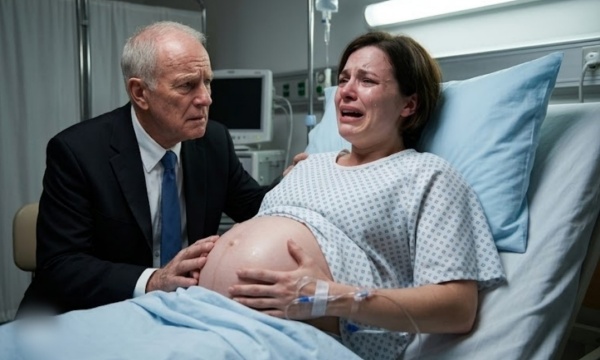
The smell of hospital disinfectant should have reminded me that something sacred had just happened. Instead, it made me restless. The fetal monitor had finally gone quiet, the nurses were moving softly in and out of the room, and my wife, Claire, was lying in a hospital bed at Northwestern Memorial in downtown Chicago after fourteen hours of labor. Six hours earlier, she had given birth to our first son.
Our baby was sleeping in the bassinet beside her, wrapped in a striped hospital blanket with a blue cap pulled low over his tiny forehead. Claire looked pale and exhausted, her hair damp at the temples, one hand resting protectively near the baby even in sleep. Any decent man would have looked at that scene and felt humbled. I looked at my Rolex Submariner and thought about how badly I wanted to leave.
My name is Liam Vance, and at thirty-eight, I believed I had engineered the perfect life. I was the CEO of Sterling Urban Development, a powerful subsidiary under Sterling Holdings, one of the largest private real estate and infrastructure groups in the Midwest. I lived in a Gold Coast mansion, drove a silver Porsche 911, wore Tom Ford suits, and sat in boardrooms where men twice my age asked for my opinion. I thought that meant I was untouchable.
Claire was the reason I had most of it.
She was Claire Sterling before she became Claire Vance, the only daughter of Arthur Sterling, a billionaire who had built his empire from parking garages, construction contracts, logistics centers, and downtown redevelopment projects. Claire never acted like an heiress. She worked for a literacy nonprofit in Chicago, wore simple jewelry, and still wrote handwritten thank-you notes after dinner parties. That quietness fooled me into thinking she was weak.
I had married her five years earlier in a wedding at the Chicago History Museum, surrounded by people who mattered. Investors, politicians, architects, attorneys, and old family friends filled the room. I told myself I loved Claire because she was kind, steady, and loyal. The uglier truth was that I also loved what her last name opened for me.
Arthur Sterling had not liked me at first. He had looked at me across a dinner table in Lake Forest with the calm, cold eyes of a man who had spent decades detecting lies before they became expensive. But Claire loved me, or believed she did, and Arthur eventually brought me into the company. He gave me responsibility, then authority, then a title that made magazines call me “the new face of Chicago development.”
I mistook opportunity for conquest.
By the time Claire was pregnant, I had already stopped acting like a husband and started behaving like a man performing marriage for an audience. I attended the baby shower, smiled through the nursery reveal, posted the ultrasound photo with a caption about blessings, and accepted congratulations at work as if fatherhood were another promotion. But privately, I felt trapped. The closer Claire got to delivery, the more I resented the life I had helped create.
Then there was Sienna.
Officially, Sienna Vale was my executive assistant. Unofficially, she was the woman who laughed at my jokes, praised my decisions, remembered how I liked my coffee, and made me feel like the version of myself I preferred. She lived in a luxury high-rise in the West Loop, in a unit paid through a corporate housing benefit that I had approved under a consulting arrangement. I told myself it was harmless because powerful men always had complicated lives.
That was the kind of lie that sounds sophisticated only to the person telling it.
My phone buzzed for the seventh time that night while Claire slept. I stepped toward the window and checked the screen. Sienna had sent a photo of the Chicago skyline from her apartment, followed by one sentence: Still awake. Missing you. I should have deleted it. Instead, I felt the familiar pull of being wanted without being needed.
Claire stirred in the bed. “Liam?”
I turned quickly, slipping the phone into my pocket. “I’m here.”
She looked toward the bassinet and smiled weakly. “Is he okay?”
“He’s perfect,” I said, because that was the correct line.
She closed her eyes for a second. “I can’t believe he’s really here.”
I stood beside her bed and placed my hand on her hair, making the gesture look tender. “You were amazing.”
She smiled, trusting me completely.
That trust should have stopped me.
It did not.
I leaned closer and lowered my voice. “I’m going to run home for a little bit. I’ll grab the car seat base, your overnight bag, and take a quick shower before the 8 a.m. board meeting. I’ll be back before you wake up.”
Claire blinked slowly, too tired to question anything. “Are you sure you’re okay to drive?”
That was who she was. She had just given birth, and she was worried about me.
“I’m fine,” I said. “You get some rest.”
She nodded. “Okay. Don’t forget the blue blanket from the nursery. The one my dad gave us.”
“I won’t.”
I kissed her forehead, glanced at my son for half a second, and walked out.
The hallway outside the maternity ward was quiet except for nurses’ shoes and distant elevator chimes. I remember feeling light, almost relieved, as if I had escaped a room where too many expectations had been breathing on me. I passed a tired father sleeping upright in a chair with a diaper bag at his feet and felt superior to him. He looked trapped.
I did not yet understand that he was the better man.
Downstairs, the valet brought my Porsche around. The air off Lake Michigan was cold enough to sharpen my lungs, and the city glittered like it belonged to me. I got in, started the engine, and told myself I had earned a few hours of freedom. Instead of heading north to the Gold Coast, I turned toward Lake Shore Drive and cut west toward Sienna’s building.
At 1:07 a.m., I parked beneath her tower.
By 1:12, she opened the door in a silk robe, smiling like I was exactly where I was supposed to be.
“Baby,” she said, “I thought you’d be stuck playing happy family all night.”
I laughed and stepped inside.
Behind me, the door closed softly.
Across town, my wife was alone in a hospital room with our newborn son.
Part 2 — The King of Chicago
Sienna’s apartment smelled like expensive perfume, candles, and chilled white wine. Floor-to-ceiling windows looked out over the West Loop, where restaurants still glowed and rideshares moved like red and white sparks through the streets. The whole place was designed to make a man forget consequence. For a few hours, I did.
She poured wine I should not have been drinking and asked about the baby with a smirk that made the question feel like a joke. I told her he was healthy. I told her Claire was exhausted. I told her everything was “handled,” as if my wife and newborn were a scheduling issue that had been resolved.
Sienna curled beside me on the sofa. “So now you’re officially a dad.”
“Technically,” I said.
She laughed. “That sounds enthusiastic.”
I looked out at the skyline and smiled. “I have a board meeting in a few hours. That’s where my head is.”
That was not entirely false. Sterling Urban Development was preparing to announce a major redevelopment partnership near Fulton Market, a project worth hundreds of millions of dollars. The board meeting at 8 a.m. was supposed to finalize next-phase financing and public relations strategy. I had spent weeks positioning myself as the architect of the deal.
I believed the company needed me.
That was my favorite mistake.
Arthur Sterling had stepped back from daily operations the year before, or so I thought. He spent more time at his vineyard in Connecticut and let younger executives speak to reporters. I called him “semi-retired” when I wanted to sound respectful. In private, I told Sienna that Arthur was old money trying to understand a new world.
“He built parking lots,” I once said. “I build cities.”
Sienna loved that line.
So did I.
What I did not know was that Arthur had never stopped watching the company he built. He read every report, knew every board member personally, and still had final control through voting shares held in Sterling Family Trust structures I had never bothered to understand. I had mastered the image of power. Arthur still held the keys.
At 2:30 a.m., my phone buzzed again. I ignored it. A few minutes later, it buzzed twice more. I assumed it was Claire asking about the blanket or a nurse calling with a discharge question. I turned the phone face down.
Sienna noticed. “Aren’t you going to check?”
“She’s fine,” I said. “Hospitals make people dramatic.”
The sentence tasted ugly even as I said it.
I drank more wine.
Around 3 a.m., Sienna fell asleep beside me. I remember the city outside the windows, the hum of the building, and the smug satisfaction of believing I could move between worlds without either one colliding. Husband in public. Father when convenient. CEO at sunrise. Lover when bored.
Then my phone rang.
The sound cut through the room like an alarm.
I reached for it, irritated, expecting Claire. Instead, the caller ID showed two words that made my stomach tighten.
Arthur Sterling.
I sat up so fast I nearly knocked the wineglass off the table. Sienna opened her eyes. I put a finger to my lips and answered, forcing my voice into the polished tone I used around board members.
“Arthur,” I said. “Is everything okay? Is it Claire?”
For a moment, there was only silence.
Not confusion.
Not static.
Silence.
Then Arthur’s voice came through, low and calm.
“Sleep well, Liam?”
My mouth went dry.
“I’m sorry?”
“I asked if you were sleeping well,” he said. “I imagine the linens at Sienna Vale’s apartment are more comfortable than a hospital chair.”
The room tilted.
Sienna sat up.
I stood and walked toward the window as if distance could save me. “Arthur, I don’t know what you think—”
“Stop.”
One word.
That was all it took.
“I have neither the time nor the patience for a lie at 3:15 in the morning,” Arthur said. “My daughter delivered your son today. She tore herself open bringing life into this world. And you left her recovery room to go to another woman’s apartment.”
My heart began hammering.
“I went to get the car seat and bag,” I said weakly.
“No, you didn’t.”
His voice remained terrifyingly even.
“You drove a company-insured Porsche from Northwestern Memorial to a corporate-leased residential tower in the West Loop. Your building access was recorded. Your corporate phone connected to the apartment’s Wi-Fi at 1:18 a.m. Your assistant’s housing arrangement is also tied to a benefits package you authorized. Every piece of that is company property, company policy, or company liability.”
That was the legal difference.
He was not saying he had stalked me.
He was saying I had been arrogant enough to commit personal betrayal using corporate systems.
“Arthur, please,” I said. “Let me explain.”
“There is nothing to explain tonight.”
“Claire doesn’t need to know this way.”
Arthur gave a short, humorless breath. “Claire already knows you are not at home. She woke up asking for the blanket you promised to bring. Her nurse called the house line because your phone was not answering. I answered.”
I closed my eyes.
For the first time all night, I pictured Claire awake in that hospital bed.
Not as an obstacle.
As a person.
Arthur continued. “She asked me not to make a scene. She is still thinking about your dignity while holding your son six hours after labor.”
That should have broken me.
Instead, fear made me selfish.
“Arthur, my position at the company—”
“Your position at the company will be addressed at 8 a.m.”
My knees almost weakened.
“You can’t do that.”
“I can,” he said. “The board can. Your employment agreement can. Your conduct tonight created reputational risk, misused corporate benefits, and exposed Sterling to potential ethics violations. You signed the morality clause yourself, Liam. I assume you read it.”
I had not.
My attorney had.
I had skimmed the compensation section and looked at the bonus structure.
Arthur’s voice dropped lower.
“Enjoy the next few hours. They will be the last hours you spend pretending you built what you were only allowed to borrow.”
The line went dead.
Sienna stared at me from the sofa. “What happened?”
I looked at the phone in my hand.
For the first time since I married into the Sterling family, I felt the floor beneath my life begin to disappear.
Part 3 — Access Denied
I did not sleep. I dressed in the dark, splashed water on my face, and ignored Sienna’s questions because I had no answers that made me sound powerful. She kept asking whether Arthur could really fire me. I kept saying no. But every time I said it, my voice sounded less convincing.
At 5:40 a.m., I drove to the Gold Coast house.
The front gate opened because the system had not yet been changed. Inside, the house was silent, staged, and cold. The nursery light was on, the blue blanket still folded over the rocking chair where Claire had left it. I picked it up and, for one strange second, felt the softness of it against my palm like an accusation.
On the kitchen island, there was a note in Claire’s handwriting.
Please bring this if you come back.
If.
Not when.
If.
I stood there longer than I should have, holding that blanket. Then my phone buzzed with an email notification from Sterling Holdings Legal. The subject line read: Notice of Emergency Board Meeting and Administrative Leave.
My stomach dropped.
The email stated that effective immediately, my access to company systems had been suspended pending board review. I was instructed not to delete, alter, or remove company records. I was to preserve all communications related to corporate housing, executive benefits, discretionary spending, and personnel reporting lines.
Preserve communications.
That phrase did not belong in a misunderstanding.
It belonged in litigation.
At 7:15 a.m., I put on my best navy suit and drove to Sterling Plaza downtown. I told myself appearance mattered. Men like me survive scandals by looking calm, expensive, and offended. If I walked in like the CEO, people would remember I was the CEO.
At 7:43 a.m., I pulled into the executive garage entrance on Wacker Drive.
The gate did not open.
I scanned my badge again.
Nothing.
Behind me, a delivery van honked. I lowered my window and waved my badge at the camera. A moment later, the side door opened, and Marcus Hale, the head of corporate security, stepped out. Marcus was a former Chicago police lieutenant, broad-shouldered, steady, and one of the people I had treated like furniture for years.
“Open the gate,” I snapped.
“Good morning, Mr. Vance,” he said. “You are not authorized to enter the garage.”
I stared at him. “I’m the CEO.”
“As of 7:00 a.m., you have been placed on administrative separation pending final board documentation. Your employment has been terminated for cause under Section 9 of your executive agreement, subject to formal written notice.”
“You have no authority to keep me out.”
Marcus held a folder through my window.
“I’m acting under instructions from Sterling Holdings Legal and the Board of Directors. You may accept this notice here, or we can have counsel send it to your attorney.”
My face burned.
People were starting to look.
A junior associate I recognized from acquisitions walked past on the sidewalk and slowed for half a second. I had once corrected him in a meeting so sharply he had gone red in front of twenty people. Now he looked away, but not before I saw recognition. News travels fastest when people have been waiting for it.
I snatched the folder.
Inside was a termination letter.
The phrases jumped out at me.
Gross misconduct. Misuse of corporate benefits. Failure to disclose conflict of interest. Violation of executive morality clause. Conduct creating reputational harm. Immediate revocation of access.
I felt my phone vibrating nonstop.
Corporate email: locked.
Internal messaging: logged out.
Company credit card: suspended.
Executive travel profile: disabled.
Board calendar: removed.
My professional life was being erased in real time, not with drama, but with passwords.
I called the CFO.
Straight to voicemail.
I called the general counsel.
No answer.
I called two board members who had laughed at my jokes the week before.
Neither picked up.
Then I called Arthur.
He answered on the second ring.
“You can’t do this,” I said.
“I did not do it alone,” Arthur replied. “That is why boards exist.”
“I built Sterling Urban.”
“You led a division my family funded, governed, insured, audited, and legally controlled. You confused leadership with ownership.”
I looked at the building rising above me, all glass and steel, with the Sterling name carved into stone near the entrance.
“My name is on contracts,” I said.
“Your signature is on contracts,” Arthur said. “There is a difference.”
“You’re destroying me over a personal matter.”
“No,” he said. “Your marriage is personal. Misusing a corporate apartment, misclassifying benefits, compromising reporting lines, lying to the board, and abandoning basic judgment on the night your wife gave birth became professional. You dragged the company into your private choices.”
I had no answer.
Marcus tapped lightly on my car window.
“Mr. Vance,” he said, “the vehicle is a company asset. Legal has requested that it remain on the premises or be returned by close of business. If you prefer, we can arrange a neutral pickup.”
I almost laughed.
It came out like a cough.
“The Porsche?”
Marcus did not blink. “Yes, sir.”
I looked at the steering wheel, the leather seats, the dashboard I had treated like a symbol of my success. It was leased through the company. Insured through the company. Maintained through the company. Like everything else, it had never truly been mine.
At 8:06 a.m., a black Rolls-Royce Cullinan pulled up behind me.
Arthur Sterling sat in the back seat.
He did not lower the window right away.
He let me sit there, blocked by a gate I used to enter without thinking, holding a folder that said my kingdom had been revoked.
Then the window came down.
Arthur looked at me for a long moment.
“You should have stayed with my daughter,” he said.
It was not shouted.
That made it worse.
Part 4 — The Keys to the Empire
Arthur’s lead counsel, Evelyn Hart, stepped out of the Rolls with a leather portfolio in her hand. She was a small woman in a charcoal suit, the kind of attorney who did not waste motion or emotion. I had seen her dismantle zoning objections, hostile investors, and one very confident state senator without raising her voice. Now she was walking toward me.
“Mr. Vance,” she said, “you are being served with several notices. This includes your employment termination packet, preservation obligations, notice regarding company property, and preliminary correspondence from Mrs. Vance’s domestic counsel.”
My throat tightened at the word Mrs. Vance.
“Claire hired a lawyer?”
Evelyn’s expression did not change. “Mrs. Vance has retained counsel to advise her regarding marital rights, custody, financial protections, and enforcement of the prenuptial agreement.”
“She gave birth yesterday.”
“Yes,” Evelyn said. “And despite that, she is capable of making decisions.”
That sentence cut deeper than it should have because I had always counted on Claire’s gentleness to delay consequences.
Evelyn handed me another envelope.
“The Gold Coast residence is owned by the Sterling Family Residential Trust. You were a permitted occupant by virtue of marriage and written occupancy consent. That consent has been revoked, subject to lawful notice procedures. Essential personal belongings have been inventoried and moved to a secure storage unit in Cicero at the direction of counsel. You will receive access information through your attorney.”
“My house,” I said.
“No,” Evelyn replied. “The trust’s house.”
“The furniture?”
“Trust property, except for items documented as personally owned by you prior to marriage.”
“The art?”
“Trust property.”
“The wine cellar?”
“Trust property.”
I gripped the steering wheel.
The life I had shown off to investors, friends, and women like Sienna was being itemized into things I had never owned.
Arthur finally spoke from the car. “You always liked keys, Liam. Executive keys. House keys. Car keys. Club access. Private elevators. You never asked who owned the locks.”
I turned toward him. “You think Claire will just let you do this?”
His eyes hardened.
“Claire asked me not to humiliate you publicly.”
That stunned me.
“She did?”
“Yes,” he said. “Even now, she is kinder than you deserve. The board action is based on company policy. The marital action is through her attorney. The trust action is through legal notice. If you are embarrassed, that is because facts have become visible.”
Evelyn continued. “Regarding the prenuptial agreement, Illinois is a no-fault divorce state. The court will determine family matters according to law, especially anything involving your child. However, the agreement clearly defines separate property, trust-owned assets, spousal support limitations, and certain financial consequences tied to undisclosed relationships and misuse of marital or family-controlled resources.”
I barely heard the legal precision.
All I heard was limitation.
Consequence.
Separate property.
“You can’t leave me with nothing,” I said.
Arthur leaned forward slightly. “You came into my daughter’s life with debt, ambition, and charm. I gave you salary, title, access, and benefit of the doubt. If you now have nothing, ask yourself what you did with everything.”
For the first time, rage gave way to fear.
“What about my son?”
Arthur’s face changed then.
Not softened.
Changed.
“My grandson is not a bargaining chip,” he said. “You will speak to Claire’s attorney about appropriate visitation when she is medically ready to have that conversation. You will follow court process. You will not use that child to punish his mother.”
“I’m his father.”
“Then begin acting like it.”
The Rolls window went back up.
That was the end of the conversation.
By 9:00 a.m., the Porsche had been handed over for company retrieval. Marcus arranged a rideshare because, despite everything, he was more professional than I had ever been kind. I stood on the sidewalk with two garment bags, a folder of legal notices, and a phone that kept lighting up with headlines I could not stop.
Someone had leaked that I was out.
By noon, a business journal posted: Sterling Urban CEO Terminated Following Emergency Board Review.
By 12:30, industry group chats were circulating theories.
By 1:00, Sienna called.
For one pathetic second, I felt relief.
“Sienna,” I said. “Listen, everything is being blown out of proportion. I need to stay with you for a few days while my lawyers—”
“No,” she said.
The word was flat.
“What?”
“No, Liam.”
I stepped away from the curb noise. “Baby, I just need time.”
“Don’t call me baby.”
My stomach tightened.
She continued. “Sterling Legal contacted me this morning. My housing benefit is under review, my consulting agreement is suspended, and I’ve been advised to cooperate with internal compliance. I am not losing my career because you told me you controlled things you clearly didn’t control.”
“You knew what this was.”
“I knew you were powerful,” she said. “Apparently I was wrong.”
That was the most honest thing she had ever said to me.
“You’re just leaving?”
“You left your wife in a hospital bed six hours after she had your baby,” Sienna said. “Did you think I believed I was special?”
The line went dead.
I stood outside Sterling Plaza in a five-thousand-dollar suit with no car, no office, no home I could enter, no mistress waiting, and no wife answering my calls.
Chicago moved around me like I was nobody.
For the first time in years, that was exactly what I was.
Part 5 — The Man Outside the Room
I spent that night in a hotel near O’Hare because it was the only place I could book quickly with a personal credit card that still worked. The room smelled like carpet cleaner and reheated coffee. Planes passed overhead every few minutes, rattling the window slightly. I lay on top of the bed in my dress shirt and stared at the ceiling until sunrise.
At 6:20 a.m., I called Claire.
It went to voicemail.
I deserved that.
At 7:05, I sent a text.
Can I see you and the baby? Please.
No answer.
At 9:30, an attorney named Rebecca Nolan called and identified herself as Claire’s counsel. Her voice was calm, professional, and completely uninterested in my panic. She told me Claire and the baby were medically stable. She told me all communication regarding divorce, parenting time, and hospital visitation should go through counsel for now.
“She won’t talk to me?” I asked.
“Mrs. Vance is recovering from childbirth,” Rebecca said. “Her priority is her health and the baby’s health. She has requested space.”
“I’m his father.”
“No one is disputing that,” she said. “But fatherhood does not entitle you to ignore the mother’s recovery, hospital policies, or legal boundaries.”
Legal boundaries.
That phrase followed me for weeks.
The first time I saw my son after leaving the hospital, it was in Claire’s father’s house in Lake Forest with a temporary parenting agreement in place. A nurse was helping Claire upstairs, and Rebecca was present in the next room. Arthur stood near the fireplace, silent. He did not threaten me. He did not need to.
Claire came down slowly, holding the baby against her chest.
She looked different.
Not fragile.
Finished.
Not with motherhood.
With me.
“His name is Henry Arthur Vance,” she said.
I swallowed. “Arthur?”
“For my father,” she said.
I nodded because any objection would have sounded insane.
She placed Henry carefully in my arms. He was warm, tiny, and impossibly light. His eyes were closed, his mouth moving in little sleeping motions. I looked down at him and felt something I should have felt in the delivery room.
Fear.
Not fear of losing money.
Not fear of public shame.
Fear that I had already failed someone who had not even learned my face.
Claire watched me without expression.
“I’m sorry,” I said.
Her eyes did not fill with tears.
That hurt more than if they had.
“I know you’re sorry now,” she said. “The problem is that now came after consequences.”
I had no defense.
She continued. “You didn’t just cheat on me, Liam. You left. You left when I was bleeding, shaking, exhausted, and holding our son for the first time. You made me feel disposable on the most vulnerable night of my life.”
“I was selfish.”
“Yes.”
Just yes.
No softening.
No rescue.
“I don’t expect forgiveness,” I said.
“Good,” she replied. “Because I don’t have any to give you right now.”
Henry stirred in my arms.
I looked down because I could not look at her.
Over the following months, my life became smaller and more honest than it had ever been. The board finalized my termination. My attorneys negotiated severance issues and compliance obligations, though “for cause” meant I had very little leverage. The business press moved on after a few weeks, but search engines did not.
I rented a one-bedroom apartment in Oak Park.
Not a penthouse.
Not a lakefront property.
An apartment above a dental office with radiator heat and street parking.
I found consulting work eventually, but not at the level I once had. People took my calls, but carefully. Doors did not slam in my face; they simply stopped opening automatically. That was worse in some ways.
The divorce proceeded through attorneys. Claire did not try to keep me from Henry, but she insisted on structure. I had supervised visits at first, then scheduled parenting time as Henry grew older and as I showed up consistently. For once in my life, consistency was not a word on a performance review. It was arriving on time with diapers, wipes, formula, and humility.
Arthur never forgave me.
At least, he never said he did.
But one afternoon, when Henry was nine months old, I arrived early for pickup and found Arthur on the porch holding him. Henry was chewing on a teething ring and drooling onto Arthur’s cashmere sweater. The old man looked down at him like the whole empire had been built for that one small person.
“I want to be a good father,” I said.
Arthur did not look at me.
“Wanting is cheap.”
I nodded.
“I know.”
He looked up then.
“No, Liam. You’re learning. There’s a difference.”
That was the closest thing to mercy he ever gave me.
Claire built a new life with a grace I had no right to witness. She returned to her nonprofit work part-time, then later joined the Sterling Foundation’s education initiative. She moved into a house in Lincoln Park with a small garden and a nursery painted soft green. She stopped wearing her wedding ring before the divorce was final.
The first time I saw her laugh again, really laugh, it was at Henry’s first birthday party.
Not because of me.
Because Henry had smashed cake into his hair and looked outraged that frosting was sticky.
Claire laughed so hard she had to sit down.
I stood across the yard and understood that I had not destroyed her.
I had only removed myself from the place where I could keep hurting her.
That realization was both comfort and punishment.
People love saying karma does not miss. It sounds clean, almost satisfying. But real consequences are messier than a slogan. Karma was not Arthur ruining my life in one phone call. Karma was waking up every morning afterward and having to live as the man I had revealed myself to be.
It was signing a lease with my own money.
It was watching Claire hand Henry to me with polite distance instead of love.
It was realizing Sienna had wanted my power, not me, and I had offered her the same kind of shallow bargain.
It was knowing my son would one day ask where I was the night he was born.
And I would have to tell the truth.
I wish I could say I became noble overnight. I did not. I became embarrassed first. Then angry. Then desperate. Only much later did I become honest.
Honesty arrived quietly.
It sounded like therapy appointments on Tuesday afternoons.
It sounded like apologizing without demanding a response.
It sounded like reading parenting books instead of leadership books.
It sounded like standing outside a daycare classroom in muddy February slush, waiting with other fathers who had never needed a billionaire to teach them where they belonged.
Three years have passed.
Henry calls me Dad now.
Not always.
Sometimes he calls me Liam when he is mad because Claire accidentally laughed the first time he did it. I deserved that too. Claire and I are not friends exactly, but we are civil in a way that protects our son. She has boundaries made of steel and speaks to me with a calm I no longer mistake for weakness.
Last month, Henry had a fever at 2 a.m. Claire called because the pediatric nurse line suggested urgent care, and Henry was crying so hard she needed help getting him ready. I answered on the first ring. I drove twenty-two minutes through freezing rain and arrived with children’s Tylenol, his insurance card, and the blue blanket from the hospital.
Claire opened the door.
For one second, we both remembered.
I could see it in her face.
The first night.
The room.
The leaving.
This time, I stepped inside.
“I’m here,” I said.
She nodded once.
“Good,” she said. “Get his coat.”
That was all.
No speech.
No forgiveness.
No dramatic redemption.
Just a sick little boy, a tired mother, and a father finally staying in the room.
I do not tell this story because I want sympathy. I do not deserve it. I tell it because some men think power is the ability to leave without consequence. They think loyalty is owed to them, forgiveness is guaranteed, and family will keep absorbing the cost of their selfishness.
I thought that too.
Then at 3:15 in the morning, my father-in-law called from the hospital where I should have been. By 8 a.m., the empire I thought I owned had locked me out. By noon, the woman I betrayed had more dignity in her silence than I had shown in my entire marriage.
Karma did not shout.
It called once.
Then it let the truth do the rest.
