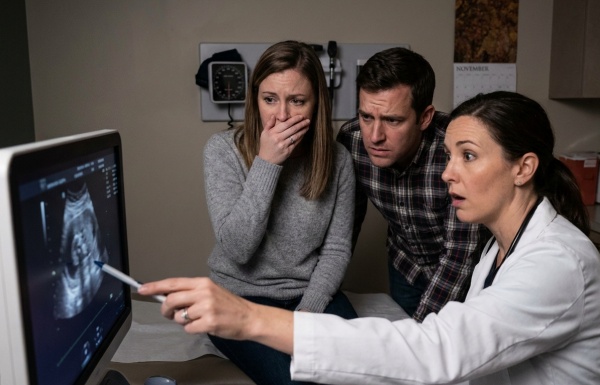
Two months after my husband’s vasectomy, I stared at a positive pregnancy test and thought we were facing a miracle together. Instead, he accused me of being unfaithful, moved in with another woman, and let his family believe I had betrayed him. Then we walked into the ultrasound room, and the doctor showed us something neither of us expected.
Part 1 — The Second Pink Line
When my husband, Nathan, had his vasectomy, he joked that we were finally “closing the factory.” We already had one daughter, Ava, who was six, bright, dramatic, and fully convinced she ran our house in Charlotte, North Carolina. Nathan said one child was enough, college was expensive, and we were almost forty. I agreed because I thought agreeing was what stable marriages did.
My name is Emma Caldwell, and I was thirty-seven when my entire life split open over a pregnancy test. I worked as an elementary school librarian, which meant I spent my days helping children find books and my nights convincing my own child that bedtime was not a negotiation. Nathan was thirty-nine, a commercial insurance broker with polished shoes, perfect hair, and a talent for making himself sound reasonable even when he was being cruel. That talent fooled a lot of people, including me.
The vasectomy happened in late January at a urology clinic near SouthPark. The doctor explained everything clearly. It was quick, routine, and not immediately effective. Nathan was told to use backup birth control until a follow-up semen analysis confirmed he was sterile.
I remember that part because I was sitting right there in the exam room, holding his jacket while he nodded like a man listening to safety instructions on an airplane. The nurse handed him papers that said the same thing in bold print. You are not considered sterile until cleared by your physician. Nathan tucked the packet into the glove compartment and later acted like the procedure had made him medically untouchable by dinner.
For a few weeks, life went on. Nathan complained about soreness more than the doctor said he would, mostly because Nathan believed discomfort should come with an audience. Ava made him a get-well card with a crooked drawing of him on the couch. I made soup, handled school drop-off, and pretended not to notice when he used the vasectomy as an excuse to avoid laundry.
By March, I was tired in a way that felt familiar. My coffee tasted strange. The smell of Ava’s peanut butter sandwich made my stomach flip. I was late, but my cycle had always been unpredictable when I was stressed, and we had been stressed. Nathan had been working late almost every night, taking calls in the garage, and guarding his phone like it contained government secrets.
Still, on a rainy Thursday afternoon, I bought a pregnancy test at CVS. I told myself I was being ridiculous. I told myself vasectomies worked. I told myself I was thirty-seven and tired because everyone was tired.
Then the second pink line appeared.
I sat on the closed toilet seat and stared at it until my vision blurred. My first emotion was not fear. It was wonder. Against all the planning, all the paperwork, all the assumptions, there it was: a tiny impossible announcement in my shaking hand.
I wrapped the test in tissue, put it in my purse, and waited until Ava was asleep before telling Nathan. He was in the kitchen, standing under the recessed lights, scrolling through his phone with a glass of bourbon beside him. I said his name softly. He looked annoyed before he even knew why I was speaking.
“I need to show you something,” I said.
He glanced at the pregnancy test and laughed once, like I had made a bad joke.
“That’s not funny.”
“It’s positive,” I whispered.
His expression changed slowly. Confusion came first, then disbelief, then something colder. He picked up the test as if it were contaminated. “That’s impossible.”
“It’s not impossible,” I said. “The doctor said—”
“The doctor said I had a vasectomy.”
“He also said you weren’t cleared until the follow-up test.”
Nathan set the test down on the counter. “I never needed the follow-up.”
I stared at him. “That is not how medicine works.”
His face hardened. “Don’t talk to me like I’m stupid.”
That was the moment the room shifted. Until then, I thought we were facing a shock together. Suddenly, I realized he was looking at me as if I had committed a crime.
“Nathan,” I said, “this is your baby.”
He gave me a smile I had never seen before, thin and ugly. “Do you know how pathetic that sounds?”
The air left my lungs.
“You think I cheated?”
“I think I had surgery to prevent this exact situation,” he said. “And two months later, you show up with a positive pregnancy test.”
I reached for the discharge papers from the drawer where I had put them after finding them in his car. “It says right here you had to do a semen analysis. You never did it.”
He shoved the papers away. “Don’t hide behind paperwork.”
I almost laughed because paperwork was the only honest thing in the room.
“I’m not hiding,” I said. “I’m pregnant, and you are the only person I have been with.”
He looked at me for a long second, then picked up his phone. “I can’t do this.”
“Do what?”
“Raise another man’s baby.”
The words hit harder than any shouting could have. I stood in our kitchen, beside Ava’s school artwork and a dishwasher full of plates, and realized my husband had decided I was guilty because that was easier than admitting he might be wrong. He walked out that night with a duffel bag and said he needed space.
Two days later, I found out where he had gone.
Her name was Brooke.
Part 2 — The Woman He Had Waiting
Brooke worked in Nathan’s office, though he had always called her “just a colleague.” She was thirty-one, recently divorced, and always seemed to appear in stories that were supposed to be about work. Brooke loved bourbon tastings, Panthers games, and commenting flame emojis under Nathan’s LinkedIn posts as if corporate announcements needed flirting. I had noticed, of course, but noticing is not the same as being ready to admit what it means.
Nathan moved into her townhouse in Ballantyne before the end of the week. He did not tell me himself. Ava told me after school because Brooke had posted a photo of Nathan’s hand holding a coffee mug on her Instagram story. Children notice everything, especially when adults think they are being discreet.
“Mom,” Ava asked from the back seat, “why is Daddy at that lady’s house?”
I pulled into a Harris Teeter parking lot because I could not keep driving.
“He’s staying somewhere else for a little while,” I said carefully.
“Because of the baby?”
My hands tightened on the steering wheel. “Who told you about the baby?”
Her eyes filled. “Daddy said you made a mistake.”
That was when anger finally broke through the shock.
Not loud anger.
Not wild anger.
The kind that becomes a spine.
I called a family law attorney the next morning. Her name was Monica Reyes, and her office was in Uptown Charlotte, with a view of traffic crawling along I-277. I sat across from her holding a folder that contained the positive test, Nathan’s discharge instructions, screenshots of Brooke’s posts, and a printed text from Nathan that said, I won’t be financially responsible for your affair.
Monica read everything without changing expression.
Then she looked up and said, “First, I’m sorry. Second, do not argue with him by text. Third, paternity can be legally established, but right now your priority is medical care, financial stability, and protecting your daughter from adult conflict.”
“I didn’t cheat,” I said.
“I believe you,” she replied. “But courts work with evidence, not outrage. We’ll keep records, avoid threats, and handle this properly.”
That became my lifeline.
Properly.
Not perfectly.
Properly.
Nathan did not want proper. He wanted public sympathy. He told his mother I had betrayed him. He told friends he was “devastated but trying to be strong.” He told Ava he loved her but needed to “process what Mommy did,” which earned him one very firm attorney letter about involving a child in marital conflict.
His mother, Diane, called me crying.
“How could you do this to him?” she asked.
I was standing in the laundry room, folding Ava’s unicorn pajamas, nauseous and exhausted. “Diane, he never did the follow-up test.”
“He said the procedure worked.”
“He never confirmed that.”
“Well,” she said, lowering her voice, “it is suspicious, Emma.”
I looked at the dryer turning Ava’s socks in circles and felt something in me close. “Then wait for the facts.”
But people rarely wait for facts when gossip offers a faster meal.
For three weeks, I became a villain in a story I did not write. Nathan’s family stopped inviting me to Sunday dinners. A friend from our church texted, Praying for truth and healing, which is Southern code for “I heard something awful.” Even my own sister, Hannah, asked whether there was “anything I needed to tell her,” and I hung up before I said something permanent.
The only person who never doubted me was my father. He drove from Asheville the day after I called him and sat at my kitchen table while I cried into a dish towel. My dad was a retired high school biology teacher, which made his reaction both emotional and scientifically offended. He read Nathan’s discharge instructions and shook his head.
“This man skipped the confirmation test and accused you of adultery?” he said.
“Yes.”
Dad took off his glasses. “That is not a vasectomy problem. That is a character problem.”
I laughed through tears because I needed to.
My first OB appointment was scheduled for early April at a women’s clinic affiliated with Novant Health. Nathan refused to come at first. Then he changed his mind, not because he cared, but because he said he wanted to “hear the timeline from a doctor.” He arrived ten minutes late wearing a navy suit and the expression of a man entering hostile territory.
He did not sit beside me.
He sat across the room.
The nurse called my name, and I stood on shaky legs. Nathan followed, scrolling on his phone until the ultrasound room door closed behind us. The technician, a kind woman named Lisa, asked routine questions. Date of last period. Positive test date. Prior pregnancies. Any pain or bleeding.
Then she dimmed the lights.
Nathan leaned back with his arms crossed.
I stared at the ceiling and tried not to cry before anything even appeared on the screen.
Lisa moved the wand gently and watched the monitor. Her face changed, but not in a bad way. More like surprise. She clicked a few measurements, then turned the screen slightly toward me.
“There’s the pregnancy,” she said.
Nathan exhaled sharply, as if the sight itself offended him.
Then Lisa paused.
“Oh,” she said softly.
My heart stopped.
“What?” I asked.
She smiled. “Well, this is not just one pregnancy.”
Nathan sat forward.
Lisa adjusted the image.
“There are two babies.”
The room went silent.
On the screen were two tiny shapes, two flickering heartbeats, two impossible answers pulsing in black and white.
Twins.
But that was only the first shock.
Part 3 — The Ultrasound That Changed Everything
The doctor came in a few minutes later, introduced herself as Dr. Patel, and reviewed the images. She was calm, warm, and very direct, which I appreciated because my life had become a swamp of accusation and rumor. She explained that I was measuring about nine weeks and five days pregnant, give or take a few days. She also explained that pregnancy dating begins from the last menstrual period, not the exact day of conception.
Nathan leaned forward. “So when did conception happen?”
Dr. Patel looked at him carefully. Doctors can hear accusation even when it wears a polite shirt.
“Most likely around seven to eight weeks ago,” she said. “Based on the measurements and the information Emma provided, that would place conception during the period shortly after your vasectomy.”
Nathan’s jaw tightened. “But I had a vasectomy.”
“Yes,” Dr. Patel said. “And vasectomy is highly effective after clearance. But patients are not considered sterile until a semen analysis confirms there are no sperm present. That often takes weeks or months and a certain number of ejaculations. It is medically possible to conceive after a vasectomy if clearance has not been confirmed.”
I looked at Nathan.
He looked away.
Dr. Patel continued, gently but firmly. “This is something urologists emphasize because it matters. A vasectomy is not immediate contraception.”
Nathan said nothing.
I said, “He never did the follow-up test.”
Dr. Patel nodded. “Then from a medical standpoint, pregnancy is not impossible or even inexplicable.”
There it was.
Not a confession.
Not an apology.
But reality, finally sitting in the room with us.
Nathan stared at the ultrasound screen. “Twins?”
“Yes,” Dr. Patel said. “It appears to be a twin pregnancy. We’ll monitor closely, but both heartbeats are present today.”
I could not stop looking at them. Two tiny pulses. Two lives I had not planned for and already loved with a terrified kind of awe. For weeks, Nathan had treated this pregnancy like evidence against me. Now the screen made it something else entirely.
A miracle he had almost abandoned.
Outside the clinic, Nathan followed me to my car. The spring air was warm, pollen dusted the windshield, and traffic moved steadily along the road as if the world had not just shifted under our feet. He looked pale. For one second, I thought he would apologize.
Instead, he said, “An ultrasound doesn’t prove paternity.”
I laughed because if I did not laugh, I would break.
“You heard her.”
“I heard that it’s possible,” he said. “Possible doesn’t mean certain.”
“No,” I said. “But your accusation wasn’t certain either. That didn’t stop you from moving in with Brooke.”
His face hardened at her name.
“That’s separate.”
“No,” I said. “That’s convenient.”
He rubbed his forehead. “Emma, I’m overwhelmed.”
I looked at him standing there in his suit, finally overwhelmed by consequences rather than suspicion. “I was overwhelmed too,” I said. “Pregnant, abandoned, called a cheater, and explaining to our daughter why her father left.”
He flinched when I mentioned Ava.
Good.
He needed to.
“I’ll do a paternity test,” he said.
“So will I,” I replied. “Through attorneys. Properly.”
He hated that word because it meant he no longer controlled the story.
Over the next few months, I learned what twin pregnancy does to a body and what betrayal does to a nervous system. I was sick constantly. I had extra appointments, extra scans, extra warnings about blood pressure, growth, rest, and stress. Every time someone told me to avoid stress, I wanted to mail them Nathan’s text messages.
Monica filed for temporary orders regarding household bills, parenting time for Ava, and communication boundaries. Nathan did not like seeing his words printed in legal filings. Men who accuse loudly often dislike documentation. His attorney advised him to stop discussing paternity with friends and family until testing could be completed.
By then, however, the damage was out.
Brooke had posted less. Diane had gone quiet. Friends who had avoided me began sending cautious messages like, Thinking of you. Hope you’re okay. No one said, “I’m sorry I believed the worst.” That would have required admitting they had.
My father came to every appointment Nathan missed. He held my purse, asked questions, and cried when he heard the heartbeats. Ava came to one ultrasound after we explained she was going to be a big sister twice. She stared at the screen, then asked if we could name one baby Sparkle.
“No,” I said.
“Maybe as a middle name?” Dad offered.
I told him he was not helping.
Nathan came to the anatomy scan at twenty weeks. He sat beside me this time, though not close enough for our shoulders to touch. The babies were girls. Baby A kicked constantly. Baby B kept hiding her face behind her hands.
Dr. Patel smiled. “They’re already very different.”
I glanced at Nathan. His eyes were wet.
That was the first time I saw grief on his face.
Not grief for me.
Maybe not even grief for the marriage.
Grief for the man he could have been if he had chosen trust before pride.
Afterward, in the parking lot, he said, “I made a mess.”
I opened my car door. “Yes.”
“I don’t know how to fix it.”
“You may not be able to.”
He looked at me then, and for once he did not argue.
Part 4 — The Test He Demanded
The twins were born in late September at thirty-six weeks and two days. I had a scheduled C-section because Baby B remained stubbornly sideways, which Ava later declared “very on brand.” My father, my sister, and my best friend were at the hospital. Nathan was there too, because despite everything, he was their father until proven otherwise, and I refused to make decisions out of spite.
The girls were tiny but healthy. We named them Nora Grace and Lily Mae. Ava cried when she saw them and immediately asked which one was Sparkle. I told her neither, and my father whispered that there was still time.
Nathan held Nora first. His hands shook. He looked down at her face, and something in him seemed to collapse. Then he held Lily, who yawned like she was already unimpressed with him.
For a brief moment, I saw the family we might have been.
Then I remembered the months of accusation.
Love can grieve without inviting someone back.
The DNA test happened through a court-approved process after the twins were born. Cheek swabs, identification, chain of custody, all the unromantic details that make results legally useful. Nathan insisted on it. I agreed because I wanted the truth officially established, not whispered about forever.
The results came two weeks later.
Nathan was the biological father of both girls with probability greater than 99.99%.
I read the report at my kitchen table while Nora slept in a swing and Lily fussed against my shoulder. I did not feel triumphant. I thought I would. Instead, I felt tired in a way that went deeper than postpartum exhaustion.
I forwarded the report to Monica.
Then I sent one text to Nathan.
The results are in. You are their father. Please communicate through counsel regarding next steps.
He called immediately.
I did not answer.
He texted.
Emma, please. I’m so sorry. I need to talk to you.
I looked at Lily’s tiny hand curled against my shirt and thought about all the nights I had needed him to talk to me like I was his wife, not his suspect. I thought about Ava asking whether Daddy left because of the baby. I thought about Brooke’s townhouse, Diane’s suspicious silence, and Nathan sitting across the ultrasound room as if I were on trial.
I did not reply.
The next day, Nathan came to the house without asking. He stood on the porch holding flowers, diapers, and the expression of a man who had rehearsed regret in the car. My father was there, making grilled cheese for Ava. He opened the door instead of me.
Nathan looked past him. “I need to see Emma.”
Dad crossed his arms. “You need to respect what she asked for.”
“She’s my wife.”
“She was your wife when you called her unfaithful.”
Nathan looked down.
Good.
Eventually, we met with attorneys and worked out temporary parenting arrangements. Nathan had supervised visits at first, not because he was dangerous, but because the twins were newborns, I was nursing, and stability mattered more than his guilt. Ava’s schedule stayed consistent. The court cared about the children, not punishing Nathan for being a terrible husband.
That distinction frustrated him.
It comforted me.
Brooke left him before Christmas. I heard through a mutual acquaintance that she was “not interested in being part of a complicated custody situation.” That almost made me laugh. She had enjoyed the romance of being chosen. She did not enjoy the reality of diapers, legal bills, and a man whose certainty had been publicly humiliated by biology.
Nathan moved into a two-bedroom apartment near Matthews. He started therapy, which he mentioned often enough that I suspected he wanted credit. He apologized in emails, in texts through the parenting app, and eventually in person during a mediation break. Some apologies were better than others.
The first one was awful.
“I’m sorry, but you have to understand how it looked.”
I stood up and left the room.
The better one came months later.
“I chose the explanation that protected my ego and destroyed you. I am sorry I made you carry my fear, my ignorance, and my betrayal while you were pregnant with our daughters.”
That one I accepted.
Acceptance is not reconciliation.
People confuse those things when they want a cleaner ending.
The divorce was finalized the following summer. North Carolina law handled property, custody, and support without caring about dramatic speeches. We divided what needed dividing. Nathan paid child support according to the guidelines and additional agreed expenses for the twins’ medical care. We moved forward with a parenting plan that required communication through a co-parenting app.
Diane apologized to me in a handwritten letter.
It was stiff, but real.
She wrote, I believed my son because I wanted to. You deserved better from all of us.
I kept that letter.
Not because it fixed everything.
Because truth matters when it finally arrives.
Part 5 — What the Ultrasound Really Showed
People think the biggest shock at that ultrasound was finding out I was having twins. It was shocking, yes. Two heartbeats where I expected one. Two little lives flickering on a screen while my husband sat in the corner waiting for proof of my guilt.
But that was not the biggest shock.
The biggest shock was realizing how quickly love disappears when trust was never as deep as you thought.
Nathan did not need evidence to condemn me. He needed fear, pride, and a medical procedure he did not fully understand. He heard “vasectomy” and turned it into a weapon. He ignored the follow-up instructions, skipped the semen analysis, and then made me pay for his ignorance.
I spent years believing our marriage was solid because it looked solid from the outside. We had a brick house, a sweet daughter, matching Christmas pajamas, and framed beach photos from Hilton Head. We hosted cookouts, paid our bills, and remembered people’s birthdays. But the ultrasound showed me something the photos never did.
It showed me who stood beside me when the room got hard.
And who sat across from me like a prosecutor.
The twins are two now. Nora is loud, fearless, and convinced every dog in the neighborhood belongs to her. Lily is quieter, observant, and likely plotting something at all times. Ava is the best big sister in Mecklenburg County, though she still insists Sparkle would have been a beautiful name.
Nathan is a decent father now.
I say that honestly.
He shows up. He keeps diapers in his car. He learned how to braid Ava’s hair badly but with effort. He knows which twin hates peas and which one likes to sleep with three pacifiers within reach.
But being a decent father now does not erase what he did to me then.
We co-parent.
We do not pretend.
Sometimes he looks at me during pickup like there is a question he still wants to ask. Whether we could try again. Whether enough time has passed. Whether apology, therapy, and DNA results can rebuild a bridge he burned while I was standing on it.
I do not answer questions he has not earned the right to ask.
My life is not what I planned. It is louder, messier, more expensive, and more beautiful than the life I imagined before that second pink line. I became a single mother of three after thinking I was done having babies. I learned how to assemble a double stroller while crying. I learned how to ask for help before I collapsed.
I also learned that being falsely accused can make you question yourself even when you know the truth.
That is the cruelest part.
There were nights when Nathan’s certainty echoed in my head. Not because he was right, but because betrayal has a way of making the innocent person feel responsible for proving reality. The DNA test gave me legal proof. Healing gave me something better.
I stopped needing him to believe me in order to believe myself.
Last month, Ava had a school family night. Nathan and I both went. He arrived with the twins in matching yellow dresses, one on each hip, looking exhausted and slightly sticky. I arrived from work with library stickers on my sleeve and a granola bar in my purse that had become mostly crumbs.
Ava ran toward us waving a paper about her family tree.
“My family is complicated,” she announced proudly.
Nathan and I looked at each other.
Then we both laughed.
Not because it was funny exactly.
Because it was true, and because our children deserved adults who could survive the truth without turning it into war.
Later that night, after the girls were asleep, I found the old vasectomy instruction sheet in a folder while organizing legal papers. The bold sentence was still there: You are not considered sterile until cleared by your physician. I stared at it for a long time. One sentence could have saved so much pain if Nathan had respected it.
But maybe the paper only revealed what was already there.
A man who would rather accuse than learn.
A marriage that needed less image and more trust.
A woman who had to be abandoned before she understood she was strong enough to stand.
I do not tell this story because I want people to hate my ex-husband. Hate is heavy, and I have three children to carry. I tell it because medical facts matter. Follow-up appointments matter. And when someone you love is vulnerable, the first thing you owe them is not suspicion.
It is care.
Nathan had a vasectomy, and two months later, I got pregnant. He called me unfaithful. He left me for another woman. Then the ultrasound showed two heartbeats, a timeline that made medical sense, and the beginning of a truth he could not outrun.
The biggest shock was not that I was pregnant.
It was that the babies were his.
And the marriage, by then, was already gone.
