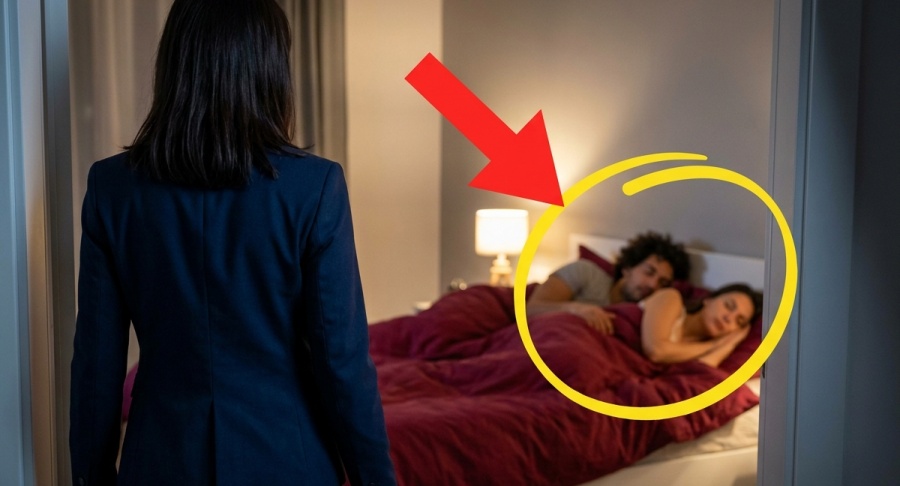
I Caught Them in Our Bed at 2 PM. By 4 PM, He Had Nowhere to Go. Here’s Why.
Part 1 — The Red Shoes by the Stairs
I landed at O’Hare a day earlier than planned, exhausted but happy. My business conference in Dallas had wrapped up sooner than expected, and for once, I decided not to tell my husband. I imagined surprising Mark with takeout from our favorite Italian place in Evanston, opening a bottle of wine, and spending a quiet night together after a week apart. After seven years of marriage, I still believed surprises could mean something sweet.
My name is Sarah Whitmore-Hayes, though after that day, I went back to Sarah Whitmore. I was thirty-five, a partner at a boutique investment advisory firm in Chicago, and the only daughter of a family people politely called “old North Shore money.” I never loved that phrase. It made my life sound easier than it felt.
My husband, Mark Hayes, had built his whole identity around not needing anyone. He liked to tell people he was self-made, a kid from Rockford who came to Chicago with two suits, a used laptop, and ambition sharp enough to cut glass. That story was partly true. The part he left out was me.
I was the one who introduced him to my father’s banking contacts. I was the one who used my inheritance to make the first seed investment in his consulting firm. I was the one who sat through dinners with men who ignored me until they realized my last name could open doors their résumés could not. Mark called me his “secret weapon” when we were dating.
Later, he called me “too sensitive” when I asked to be treated like a partner.
We lived in a renovated brick house in Winnetka, about half a mile from the lake. It had white hydrangeas along the front walk, a slate roof, and a kitchen Mark once bragged was “magazine-level.” He forgot to mention that the house had been purchased through my family trust before our wedding. Legally, he lived there because I wanted him there.
That mattered later.
The Uber dropped me off just after 2 p.m. on a gray Thursday in April. The rain had stopped, but the driveway was still wet, and the air smelled like lake wind and damp leaves. I dragged my carry-on up the front steps quietly, smiling to myself like a fool. I remember thinking Mark might be on a call, or maybe asleep after another late night at the office.
The house was too quiet.
Not peaceful quiet.
Wrong quiet.
I set my suitcase by the entry table and noticed the first thing that did not belong: a pair of red-soled heels near the staircase. Louboutins. Bright, glossy, careless. Not mine.
Beside them was Mark’s navy silk tie, the one I had bought him for our fifth anniversary in New York. It was lying on the floor like a dropped flag. For a second, my brain tried to protect me by inventing explanations. A client had come by. Someone spilled something. Maybe his assistant had dropped off samples for an event.
Then I heard a soft laugh from upstairs.
My body went cold before my mind caught up.
I walked up the stairs slowly, one hand on the banister. Every step felt louder than it was. The bedroom door was not locked. That offended me almost as much as the betrayal.
He had not even bothered to lock the door.
I pushed it open.
There are moments in life so ugly they become strangely clear. I remember the pale blue duvet twisted at the foot of our bed. I remember the afternoon light cutting across the floor. I remember the perfume in the room, sweet and expensive, layered over the familiar smell of Mark’s cologne.
And I remember them.
Mark was asleep on his back, one arm thrown over a woman I had never seen in person but recognized instantly from too many late-night texts. Vanessa Cole. Twenty-six, marketing consultant, always “looped in” on projects that did not need her. Her blonde hair was spread across my silk pillowcase.
My silk pillowcase.
For a few seconds, I did not breathe.
I expected myself to scream. I expected the kind of scene people describe later in whispers. I imagined throwing things, demanding answers, making them feel even a fraction of what I felt. But something colder and stronger moved through me instead.
I stepped backward without making a sound.
Downstairs, I went to the kitchen and poured a glass of ice water. My hands were shaking so badly that water splashed onto the marble counter. I drank the whole glass standing there, staring at the framed wedding photo on the wall. Mark was smiling in it like a man who had won something.
Maybe he had.
For a while.
Then I put the glass in the sink, picked up my phone, and called my attorney.
Her name was Ellen Park, and she had drafted our prenuptial agreement seven years earlier. She answered on the third ring. I said, “Ellen, I came home early and found Mark in our bed with another woman.” There was one second of silence, then her voice became calm enough for both of us.
“Do not confront them physically,” she said. “Do not threaten anyone. Take photos of what is visible from common areas if you can do so safely. Preserve messages if you have them. I’m calling the family office and litigation counsel now.”
I whispered, “I want him out.”
“I understand,” she said. “We will do this legally.”
That sentence saved me from becoming the version of myself he deserved.
I took photos of the shoes, the tie, the open bedroom door, and the two wineglasses on my nightstand. I did not take anything graphic. I did not touch them. Then I walked into the den, pulled over the velvet armchair Mark used when he pretended to read director reports, and dragged it into the bedroom.
I placed it six feet from the foot of the bed.
Then I sat down.
And waited.
Part 2 — The Quietest Two Hours of My Life
For two hours, I sat in that chair while my husband slept beside the woman he had brought into my home. The room was so quiet I could hear the furnace click on downstairs. Vanessa turned once in her sleep and pulled the duvet higher. Mark murmured something I could not understand.
I did not cry.
That surprised me.
Maybe shock is mercy in the beginning.
My phone stayed in my lap, screen dimmed, while my attorney and the family office moved quickly in the background. I was not “freezing his bank accounts” like some movie villain with a secret button. Real life is more boring and more powerful than that. Ellen began lawful steps to protect separate assets, notify banks about disputed access, suspend his authority on accounts tied to my trust, and preserve records for divorce proceedings.
Mark and I had one joint household account for monthly expenses. Most of the real money was not joint. The house belonged to the Whitmore Residential Trust. My inheritance remained separate property under the prenup. My sixty percent ownership stake in Hayes Strategic Partners was documented through shares I acquired before and during the early years of the company, with strict buy-sell provisions.
Mark had always hated paperwork.
I had always respected it.
That was one of the differences between us.
While he slept, I remembered the beginning. I remembered meeting him at a charity event in River North, where he looked handsome and hungry in a cheap charcoal suit. He made me laugh by saying everyone in the room was pretending not to want money. He was honest then, or at least honest enough to feel refreshing.
When we got engaged, my parents were cautious. My father liked Mark’s drive but not his appetite. My mother said ambition was attractive until it started eating the people around it. I accused them both of being elitist. I said they did not understand love.
Maybe they did.
Maybe I did not.
When Mark wanted to leave his consulting job and launch his own firm, I believed in him. I wired $250,000 from my inheritance as seed capital, structured as an investment because my father insisted on proper documentation. Mark called that insulting at first. Later, when the money helped him hire staff and rent office space in the Loop, he called it “our first big leap.”
Our.
That word did a lot of unpaid labor in our marriage.
The first big client came through my father’s golf partner. The second came through a family friend on a hospital board. The third came after I spent three weekends helping Mark rewrite a proposal he later presented alone. When the company landed a multimillion-dollar contract, Mark took the stage at a business luncheon and said, “I built this from nothing.”
I clapped.
That is one of the memories I hate most.
Not because he lied.
Because I helped the lie stand up.
At 3:05 p.m., my father called. I stepped into the hallway and answered in a whisper. His voice was not angry, which made it worse. “Ellen told me,” he said. “Are you safe?” I looked toward the bedroom and said yes.
“Do you want me there?” he asked.
“Not yet.”
“Then I’ll make the calls you authorized.”
My father’s private equity firm held a bridge loan Mark needed for a new expansion project in Milwaukee. The funds had not closed yet. The agreement allowed withdrawal before closing if there was a material leadership or governance concern. Apparently bringing your mistress into the majority owner’s trust-owned residence was not listed word for word, but fraud risk, reputational instability, and executive misconduct were close enough for lawyers to have a conversation.
At 3:22 p.m., Ellen texted me.
Separate credit lines secured. Corporate card authority under review. Board notified. Do not speak beyond necessary facts.
At 3:38 p.m., my phone buzzed again.
Evidence preservation letter sent. Locksmith scheduled pending lawful access plan. Personal items only. No self-help eviction.
That was important.
Mark was my husband, and even if the house was owned by my trust, I could not simply throw his belongings onto the lawn and change the locks without following the law. Facebook loves a revenge fantasy. Judges do not. Ellen made sure every step protected me instead of giving Mark a weapon.
So I waited.
Six feet away.
In silence.
At 3:55 p.m., the afternoon sun shifted across Mark’s face. He squinted and stirred. Vanessa moved closer to him. He reached for her without opening his eyes and mumbled, “Baby, what time is it?”
I looked at my watch.
“Almost four,” I said.
Mark’s eyes opened.
For one frozen second, he did not understand what he was seeing. Then he sat up so fast the headboard hit the wall. Vanessa woke with a gasp, clutching the sheet to her chest and staring at me like I was the intruder. Mark’s face drained of color.
“Sarah,” he said.
I crossed my legs.
“Good afternoon.”
Part 3 — The Moment He Remembered the Prenup
Mark scrambled for words the way drowning men grab at air. “Sarah, listen. This isn’t what it looks like.” I almost admired the stupidity of that sentence. There were shoes by the stairs, his tie on the floor, two glasses on my nightstand, and another woman in my bed. It was exactly what it looked like.
Vanessa whispered, “Mark, what is happening?”
I looked at her for the first time. She was younger than me, yes, but not a child, and not the real problem. She looked scared, embarrassed, and suddenly much less glamorous without the lighting of secrecy. I said, “You should get dressed.”
Mark reached toward me. “Honey, please.”
I held up one hand.
“Do not call me that.”
He froze.
I stood slowly, smoothing my dress because I needed something to do with my hands. “I have been sitting here for almost two hours,” I said. “That gave me plenty of time to be angry, plenty of time to be humiliated, and plenty of time to remember who owns what.”
Mark’s eyes flicked toward the dresser.
Then the closet.
Then the hallway.
I watched the calculation begin.
It was the most painful part of the day, more painful than the bed, more painful than the shoes, more painful than the perfume in my room. He was not thinking first about my heart. He was thinking about exposure. He was thinking about money.
“Sarah,” he said carefully, “we should talk privately.”
“We are past private,” I said. “But don’t worry. I’m not here to scream. I’m here to give you information.”
Vanessa got out of bed with the sheet wrapped around her and hurried toward the bathroom with her clothes. I did not stop her. I had no interest in punishing her in some theatrical way. Mark was the person who made vows to me. Mark was the person who brought betrayal into my home.
“First,” I said, “my attorney knows.”
He swallowed.
“Second, the family office knows.”
His face went pale.
“Third, the board has been notified of a governance issue involving you, company resources, and a personal relationship with a contractor.”
He looked toward the bathroom door. “Vanessa is not—”
“Do not lie to me in the room where I found you,” I said.
That shut him up.
Vanessa had billed Hayes Strategic Partners through a marketing vendor for six months. I had seen the invoices because I reviewed quarterly financials. They were larger than they should have been, but Mark always had explanations. Campaign repositioning. Brand strategy. Investor materials. Now those invoices looked different.
They looked like evidence.
Mark ran a hand through his hair. “You’re going to ruin the company over a mistake?”
“A mistake is sending the wrong attachment to a client,” I said. “This is a pattern.”
He got out of bed and pulled on his pants with shaking hands. “You don’t understand what you’re doing.”
That almost made me smile.
For years, that had been his favorite tone. Patient. Superior. Designed to make me feel like the emotional wife who did not understand business. But I understood enough to own sixty percent of his company. I understood enough to keep my inheritance separate.
And I understood the prenup.
“Do you remember Section 14?” I asked.
He stopped buttoning his shirt.
Of course he remembered.
Section 14 had been the paragraph he mocked during negotiations, calling it “your father’s medieval nonsense.” It did not punish anyone for being unhappy. It did not control feelings. It simply protected gifted assets, trust property, and certain business interests in the event of documented infidelity involving marital or trust-owned property.
Mark had signed it.
He had signed every page.
“You can’t enforce that,” he said.
“That’s for the attorneys to discuss,” I replied. “But the evidence is not subtle.”
His mouth opened, then closed.
I continued. “The house is trust property. The Tesla is leased through the company. The country club membership is paid through a corporate benefit package that is now under review. The bridge loan for the Milwaukee expansion is being paused before closing.”
He sat down on the edge of the bed like his legs had failed.
“You called your father?”
“Yes.”
“You always run to Daddy.”
I looked around the room, at the bed I had bought, in the house my trust owned, while he stood there half-dressed after using my absence as an opportunity.
“No, Mark,” I said. “This time I called the people who know how to read contracts.”
That landed.
He grabbed his phone from the nightstand. I watched his face change as the alerts loaded. Emails from board members. A message from the company’s outside counsel. A notice from the bank about account access review. A missed call from his CFO.
His voice rose. “You froze me out?”
“I secured what is legally mine,” I said. “There is a difference.”
He stood abruptly. “You can’t make me leave my own house.”
“You’re right,” I said.
That surprised him.
“I cannot illegally throw you out,” I continued. “So I won’t. Ellen is handling lawful notice regarding the trust property. But if you stay here tonight, you’ll be staying in the guest room under a roof owned by the woman you betrayed, while lawyers document every minute of it. Or you can pack a bag and leave voluntarily.”
His jaw tightened.
Vanessa came out of the bathroom fully dressed, eyes red, heels in one hand. She would not look at me. “I’m leaving,” she whispered.
“Good idea,” I said.
Mark turned to her. “Wait.”
She looked at him with sudden clarity. “Are you broke?”
The room went silent.
I almost laughed, but there was nothing funny left in me.
Mark stared at her.
Vanessa backed away. “You told me the house was yours.”
“It is complicated,” he said.
I looked at her. “It isn’t.”
She left without another word.
A few seconds later, the front door closed.
Mark and I stood in the wreckage of the life he thought he controlled.
Part 4 — By Four O’Clock, the Castle Had No Doors for Him
By 4:10 p.m., Mark was pacing the bedroom in bare feet, calling people who suddenly had less time for him than they did that morning. His CFO did not answer. His COO texted that all communication should go through counsel. His best friend from the club said he was “in a meeting,” though I could hear golf course wind in the background.
It is amazing how quickly power evaporates when people realize it was borrowed.
Mark tried anger first. “You’re acting insane,” he said. “People have problems. Couples work through things.” I watched him discover, sentence by sentence, that the language of reconciliation sounds different when it is spoken by someone who got caught instead of someone who is sorry. He did not say he had hurt me until every other argument failed.
Then came blame.
“You were gone all the time.”
“You cared more about the firm than the marriage.”
“You let your family look down on me.”
“You never understood what kind of pressure I was under.”
Each sentence was an old suitcase he had packed for emergencies. I had heard versions of them before, usually after I questioned a charge, a late night, or a woman’s name appearing too often in his messages. I used to open those suitcases and climb inside. That day, I let them sit there.
At 4:27 p.m., Ellen arrived with a second attorney, a calm man named Thomas Reid who handled business litigation. They did not storm in. They did not threaten. They entered through the front door after I opened it, introduced themselves, and asked Mark if he wanted to call counsel before any further conversation.
That is what real consequences look like.
Less screaming.
More paper.
Thomas handed Mark a folder. “Mr. Hayes, this is a notice preserving documents and communications relevant to Hayes Strategic Partners, its vendors, corporate benefits, and any personal relationships that may present conflicts of interest. You are instructed not to delete messages, alter records, or contact employees regarding this matter outside proper channels.”
Mark snatched the folder. “This is ridiculous.”
Thomas nodded slightly. “You are entitled to that view.”
Ellen handed him a second envelope. “This concerns the residence. The Whitmore Residential Trust owns the property. You are not being forcibly removed today. However, Sarah has requested that you leave voluntarily while domestic counsel addresses next steps. If you choose not to, we will proceed through lawful channels.”
Mark looked at me. “You really want me gone?”
The question was so absurd it almost made me dizzy.
“Yes,” I said.
For the first time, his face softened into something like fear. “Sarah, please. I made a terrible mistake. I’ll end it with her. I’ll go to therapy. We can fix this.”
Maybe another woman would have wanted that.
Maybe another version of me would have wanted it too.
But I had spent two hours six feet from the bed remembering every time he made me smaller so he could look self-made. I had remembered the meetings where he interrupted me, the dinners where he used my connections and mocked my family afterward, the nights he came home smelling like a place he refused to name. The affair was not the first crack. It was simply the one that let the whole wall fall.
“No,” I said. “We cannot fix a marriage you only value when it protects your lifestyle.”
He flinched.
Good.
He packed a suitcase while two attorneys waited downstairs and I stood in the hallway. I did not watch him choose shirts. I did not care which shoes he took. The things that mattered were no longer in that closet.
At 5:03 p.m., he came down the stairs with a rolling bag and a garment bag. He looked smaller without the house around him. He paused near the entry and glanced at the wedding photo on the wall. For one second, I thought he might say something human.
Instead, he said, “What am I supposed to do tonight?”
I stared at him.
“Call Vanessa.”
His mouth tightened.
“She blocked me.”
That was when I knew by “homeless,” I did not mean legally sleeping on a sidewalk. I meant something more accurate for a man like Mark. He had no home that wanted him, no mistress willing to catch him, no company eager to protect him, and no family fortune he could keep pretending was his. By four o’clock, the doors he counted on had begun closing one by one.
I took my house key off his ring.
He handed it over because Ellen was standing there.
Then he walked out into the damp evening air.
A black car arrived to take him to a hotel downtown, booked on his personal card, not mine. He looked back once from the driveway. I did not wave. I did not cry until the car turned the corner.
When I finally broke, it was quiet.
Not the dramatic kind of crying that belongs in movies.
Just the sound of a woman realizing she had been sleeping beside a stranger and calling it love.
Part 5 — The Woman Who Stayed With Herself
The next few months were not as clean as people want stories like this to be. There was no instant victory, no magical court order that made grief disappear, no single moment where I woke up feeling powerful and healed. There were attorney calls, bank reviews, board meetings, financial disclosures, and nights when I sat on the kitchen floor because the house felt too big. Betrayal is still betrayal, even when the contracts favor you.
Mark fought at first.
Of course he did.
He claimed the prenup was unfair, that he had signed under pressure, that the company only existed because of his genius, and that I was using my family to destroy him. His attorneys were aggressive until the records became inconvenient. Emails, invoices, hotel stays, vendor payments, and messages from Vanessa painted a picture that was hard to romanticize.
The board placed him on administrative leave first.
Then, after an internal review, they removed him from his executive role for misconduct and failure to disclose conflicts involving a company vendor. He kept a minority equity interest subject to the shareholder agreement, but he lost control. The Tesla went back to the company fleet. The country club membership ended at the next billing cycle.
He called it cruelty.
My attorney called it governance.
I called it overdue.
The divorce took nearly a year. Illinois law did not care about punishing someone for being immoral, and honestly, that was probably healthy. But contracts mattered. Separate property mattered. Trust ownership mattered. Documentation mattered.
In the end, I kept the house because it had never been marital property. I kept my shares. I paid what the law and agreements required, no less and no more. Mark walked away with enough to start over if he stopped pretending he was entitled to my life.
Whether he did, I do not know.
Vanessa disappeared from the story faster than she entered it. She cooperated with the internal review, returned certain company property, and moved to a different agency in another city. I never contacted her. For a while, I hated her because it was easier than hating the years I had lost.
Then I stopped giving her space in my head.
That was one of the first signs I was healing.
My parents were careful with me afterward. My father wanted to be furious on my behalf, but I asked him not to make me a campaign. My mother came over one Sunday with soup and sat at the kitchen island without saying “I told you so,” which may have been the greatest act of restraint in Whitmore family history. She simply touched my hand and said, “I’m sorry you had to learn him this way.”
I said, “Me too.”
Therapy helped.
So did changing the bedroom.
I gave away the bed, the bedding, the nightstands, even the velvet chair. People told me not to make emotional decisions, but sometimes removing objects is not emotional chaos. Sometimes it is hygiene. I painted the room a soft green and moved my desk near the window where morning light comes in.
For months, I slept in the guest room anyway.
Then one night, I walked into the new bedroom, got under the new covers, and realized the room did not belong to the worst thing that happened there.
It belonged to me.
A year later, I hosted dinner in the backyard for six women who had carried me through the worst of it. We ordered Thai food, drank sparkling water and wine, and laughed too loudly for a neighborhood where people complain about leaf blowers. My friend Rachel raised her glass and said, “To Sarah, who learned the difference between being chosen and being used.”
That one stung.
Then it healed.
People online love the phrase “by 4 p.m., he was homeless.” It sounds dramatic. It sounds like revenge. But the truth is more complicated and more satisfying.
By 4 p.m., Mark had lost the illusion that everything around him belonged to him.
By 4 p.m., he had learned that a wife is not a ladder.
By 4 p.m., I had remembered that staying calm is sometimes more powerful than screaming.
I do not regret sitting in that chair.
Not because it was dignified.
Because it gave me time to choose myself before he started performing regret.
If I had screamed at 2:05, he would have made the story about my anger. He would have told people I was unstable, dramatic, impossible, spoiled. By waiting, by calling counsel, by preserving evidence, by following the law, I denied him the easiest lie.
That mattered.
I am thirty-seven now. I still live in the house in Winnetka, though it feels different. The hydrangeas bloom every summer, the lake wind still rattles the windows in winter, and the front stairs no longer make my stomach drop. I travel for work, come home when I want, and no longer announce my arrival like I need permission to enter my own life.
Sometimes people ask whether I will marry again.
Maybe.
Maybe not.
I am not against love.
I am against auditioning for loyalty in a home I paid for with my trust, labor, patience, and name.
Mark taught me one thing I will never forget: betrayal does not always arrive looking like hatred. Sometimes it wears your anniversary tie. Sometimes it sleeps peacefully on your pillow. Sometimes it assumes you will be too heartbroken to remember your own power.
I was heartbroken.
But I remembered.
So when I found them in my bed at 2 p.m., I did not burn my life down. I did not beg. I did not compete. I sat six feet away, made the calls, followed the law, and watched the man who thought he owned everything wake up to the truth.
He had never owned me.
And by 4 p.m., he finally knew it.
