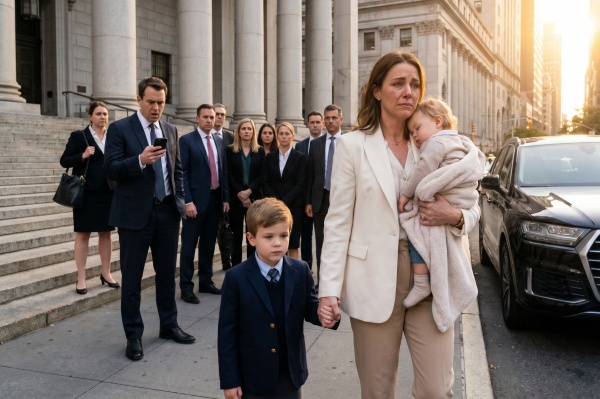
The ink on our divorce papers was barely dry when my ex-husband answered his mistress’s call and whispered that he was coming to see “their baby.” His family had already welcomed her like I had never existed, celebrating the pregnancy while my children tried to understand why their father had chosen a new life. So I took the court-approved relocation, boarded a flight to London, and started over. Months later, one sentence in an ultrasound room revealed the truth he never saw coming.
Part 1 — Five Minutes After the Divorce
It had not even been five minutes since I signed the divorce papers when my ex-husband answered his mistress’s call in front of me and told her, in the softest voice I had ever heard from him, that he was on his way to see “their baby.” We were still standing outside the family court building in Boston, the ink on our divorce decree barely dry. My attorney was beside me, holding a folder with my name on it, and our two children were with my sister two blocks away, eating pancakes like their world had not just legally changed forever. That was the moment I knew I had not lost my marriage that morning.
I had escaped it.
My name is Rachel Bennett, and I was thirty-nine when my marriage to Daniel Bennett ended in a beige courthouse hallway that smelled like old paper, coffee, and somebody else’s bad decisions. Daniel and I had been married for twelve years. We had two children: Sophie, ten, who read three books at once and corrected adults with terrifying confidence, and Miles, seven, who believed Band-Aids fixed everything, including feelings. For years, I thought protecting them meant holding the marriage together.
Then I realized the marriage was the storm.
Daniel came from one of those Boston families that never called themselves rich. They said “comfortable,” “established,” and “blessed,” while living in a brick house in Beacon Hill and spending summers in Nantucket. His mother, Margaret, wore pearls to breakfast and apology-proof perfume. His father, William, spoke to waiters and grandchildren with the same distant politeness.
I grew up in Worcester, raised by a nurse mother and a mechanic father who loved me loudly and saved coupons without shame. Daniel used to say he admired how “real” my family was. Later, when he was angry, he used the same word like an insult. Real became unsophisticated. Practical became small-minded. Loyal became boring.
Daniel worked in private wealth management, which suited him because he loved advising other people about money while treating emotional debt as something beneath him. I worked as an acquisitions editor for a children’s publishing imprint, a job I loved even when it underpaid me for the first decade. Three years before the divorce, my company opened a London office and offered me a senior role there. I turned it down because Daniel said moving would “destabilize the kids.”
Six months later, he destabilized us himself.
Her name was Chloe Hart. She was twenty-eight, worked in event planning, and had been hired to coordinate a charity gala for Daniel’s firm. At first, he said she was “efficient.” Then she became “brilliant.” Then she became the person whose name lit up his phone at 11:40 p.m. while he told me I was imagining things.
The affair came out the ugly way these things often do: not through honesty, but through carelessness. A hotel charge in Providence. A photo someone posted from a rooftop bar in Back Bay. A text preview on his phone that said, I hate sleeping without you. When I confronted him, Daniel did not deny it for long. He looked almost relieved, as if my discovery had saved him the inconvenience of confession.
“I didn’t plan for this,” he said.
I remember standing in our kitchen with a dish towel in my hand, staring at the father of my children while he tried to make betrayal sound like weather.
Then Chloe got pregnant.
That was when Daniel’s family stopped pretending neutrality.
Margaret called me two days after Daniel told them and said, in a voice polished smooth by generations of emotional avoidance, “Rachel, I know this is painful, but there is going to be a child.” I looked across the living room at Sophie helping Miles build a Lego spaceship and wondered when my children had become invisible. “There already are children,” I said. Margaret sighed like I was being difficult.
After that, the Bennett family rearranged reality around Chloe’s pregnancy. Daniel was not a husband who cheated. He was a man “starting a complicated new chapter.” Chloe was not his mistress. She was “the mother of his unborn child.” I was not betrayed. I was “struggling to accept change.”
That kind of language can make you feel crazy if you stay inside it long enough.
So I stopped staying.
During mediation, Daniel agreed to a parenting plan that gave me primary physical custody and allowed relocation to London for my job. He did not fight it the way I expected. At the time, I thought maybe guilt had softened him. Later, I understood the truth: he wanted fewer reminders of the family he had broken while he played expectant father with Chloe.
The relocation was not a midnight escape. It was court-approved, documented, and written into our divorce decree. Daniel had scheduled video calls, holiday parenting time, summer visits, and access to the children’s school records. I had their passports, certified copies of the custody order, and a stack of documents my attorney told me to keep in my carry-on. I did everything legally because I had learned that doing things properly is sometimes the only shield a woman has.
Still, when Daniel answered Chloe’s call outside the courthouse and said, “I’m on my way, baby. Tell our little guy Daddy’s coming,” something inside me went completely still.
Our little guy.
Sophie and Miles were two blocks away, waiting for me to take them to the airport.
Daniel hung up and looked at me with an expression that tried to be kind and failed. “I hope one day you can be happy for me,” he said. I stared at him for a long moment, this man who had mistaken my silence for defeat. Then I said, “I hope one day you understand what you gave up.”
He laughed softly, like I was being dramatic.
Four hours later, I boarded a British Airways flight from Logan Airport to Heathrow with my children, three suitcases, two backpacks, and a heart so broken it felt strangely weightless.
By morning, we were in London.
And back in Boston, the Bennett family began celebrating the baby they thought would replace us.
Part 2 — London Was Not an Escape. It Was a Beginning.
London did not welcome us gently. It rained the first six days, our rented flat in Chiswick had radiators that clanked like ghosts, and Miles cried the first night because the light switches looked different. Sophie pretended to be fine in the way oldest daughters learn too early. She unpacked her books in alphabetical order and asked me whether Dad would remember the time difference for calls.
I said yes because I wanted it to be true.
My new job was in a publishing office near Holborn, where people drank tea like it was structural support and used phrases like “shall we circle back?” with alarming sincerity. I worked longer hours than I expected and came home to homework, grocery deliveries, and children who needed me to be both brave and normal. Some nights, I cried in the bathroom with the shower running so they would not hear me. Other nights, I sat on the kitchen floor eating toast for dinner and called that survival.
Daniel called the children regularly at first. He gave them virtual tours of the nursery Chloe was decorating in pale blue and cream. He told Miles he was going to be a big brother again. He told Sophie that “families can grow in unexpected ways,” which made her shut down so completely that I had to spend the rest of the evening coaxing her back with hot chocolate and a chapter of The Secret Garden.
The Bennett family sent photos I did not ask for. Margaret standing beside Chloe at a baby boutique on Newbury Street. William smiling stiffly at a restaurant table while Daniel held Chloe’s hand. A cake with blue frosting and the words Baby Bennett written across the top. Nobody had ever ordered a cake for Sophie that said her last name like a family brand.
When I asked Daniel to stop sending pregnancy updates to the kids without checking with me first, he accused me of bitterness.
“You can’t erase their brother,” he said during one call.
“I’m not trying to erase anyone,” I replied. “I’m asking you to consider their feelings.”
“They need to adjust.”
That was Daniel’s favorite word for other people’s pain.
Adjust.
As if heartbreak were a thermostat.
Meanwhile, Chloe became a full member of the Bennett family before my side of the closet was probably cold. Margaret posted a photo from a private baby shower at the Hampshire House, captioned, Celebrating new beginnings and our growing family. Someone sent it to me, because divorce apparently makes people think screenshots are acts of public service. I stared at that photo for too long.
Chloe wore a white dress, one hand resting on her stomach, smiling like a woman who had been welcomed into a story without being told who had been written out.
I did not comment.
I did not call.
I did not post vague quotes about karma.
Instead, I took Sophie to a secondhand bookstore near Notting Hill and bought Miles a soccer ball from a shop where the cashier called him “mate,” which made him giggle for ten minutes. I opened a UK bank account, learned which grocery store delivered the best strawberries, and memorized the route from our flat to school. I built our life brick by brick because grief may be dramatic, but healing is mostly logistics.
Three months after we moved, Sophie asked if Dad loved Chloe’s baby more than he loved them.
I was folding laundry when she asked. A small sock fell from my hand.
“No,” I said carefully. “Your dad’s choices are confusing and hurtful, but his choices are not a measure of your worth.”
She looked at me with eyes too old for ten.
“Then why did he choose them?”
There are questions a mother cannot answer without bleeding on her child.
So I sat beside her and said, “Sometimes adults make choices because they are thinking about what they want, not what they already have. That does not mean what they already have is less valuable.”
She nodded, but I could tell she was filing the pain somewhere private.
That night, after both kids fell asleep, I opened my laptop and saw an email from Daniel. The subject line was: Ultrasound Appointment. I almost deleted it, but the first line caught my eye. He wrote that he and Chloe were going for a “detailed ultrasound” at twenty-one weeks and wanted to tell the kids afterward that the baby was healthy.
He added, Please don’t make this about you.
I closed the laptop.
Then I laughed.
Not because it was funny.
Because sometimes the only alternative is screaming.
The ultrasound was scheduled for a Friday morning in Boston. By then, London was five hours ahead, so while I was walking to pick Miles up from school, Daniel’s family was gathering around Chloe at a private clinic near Longwood. Margaret had apparently insisted on attending. Daniel’s sister, Allison, came too. They wanted to hear the heartbeat, see the profile, and confirm the little boy they were already calling “the Bennett heir.”
That phrase came from Allison, who had texted it to Daniel and accidentally included me in the group chat.
I did not respond.
I had learned that silence can be cleaner than defense.
At 4:12 p.m. London time, my phone rang.
Daniel.
I almost ignored it, but something in me answered.
His voice sounded strange.
Thin.
“Rachel,” he said. “Something happened.”
Part 3 — One Sentence in the Ultrasound Room
I stepped away from the school gate and stood under the awning of a bakery while rain tapped against the pavement. Children in uniforms rushed past me, laughing, dragging backpacks, living lives untouched by American divorce drama. I pressed the phone closer to my ear. “Is the baby okay?” I asked, because no matter what Daniel had done, I was not cruel enough to wish harm on a child.
“The baby is fine,” he said quickly.
Then he went silent.
“Daniel.”
He exhaled. “The doctor said Chloe is measuring farther along.”
I frowned. “How much farther?”
He did not answer right away.
“Daniel.”
“Almost thirty weeks.”
For a moment, I did not understand.
Then I did the math.
Chloe had told everyone she was twenty-one weeks pregnant. That timeline placed conception during the affair, after Daniel claimed their relationship had become physical, after he had emotionally checked out of our marriage but before we separated. It was awful, but possible. Thirty weeks was different.
Thirty weeks reached back before the gala.
Before the late nights.
Before Daniel said he and Chloe had crossed a line.
Before they were supposedly together at all.
“What exactly did the doctor say?” I asked.
His voice was almost a whisper. “She said, ‘This pregnancy is measuring much closer to thirty weeks than twenty-one.’”
There it was.
One ultrasound sentence.
Not dramatic on its own.
Not cruel.
Just medical information, spoken plainly in a room full of people who had built an entire new family on a timeline that no longer worked.
“What did Chloe say?” I asked.
“She said the doctor must be wrong.”
“Can they be wrong by nine weeks?”
“I don’t know.”
But he did know enough.
So did I.
Pregnancy dating is not perfect, especially early on, but by the second trimester, being off by a few days can happen. Nine weeks is not a rounding error. Nine weeks is a different story. Nine weeks is the difference between a man believing he is becoming a father and realizing he may have been chosen for convenience, status, or rescue.
I heard muffled voices in the background. Margaret’s voice, sharp and high. Chloe crying. Someone saying, “Daniel, do not do this here.” For once, it sounded like the Bennett family’s perfect manners had met a truth too large to host politely.
“Why are you calling me?” I asked.
He went quiet.
That silence told me more than his words could have.
He was not calling because I could help.
He was calling because the person he had discarded was the only one who knew what it felt like to have the floor vanish under a life.
“I don’t know,” he said finally.
I watched Sophie come out of school, scanning the crowd for me. Miles was behind her, waving a crumpled art project like a flag. I looked at my children and felt a door close inside me.
“I’m sorry you’re shocked,” I said. “But I’m not your emergency contact anymore.”
“Rachel—”
“No,” I said gently, but firmly. “You need to talk to your attorney, your doctor, and Chloe. Not me.”
He sounded wounded. “After everything, you can be that cold?”
That was when I almost laughed again.
After everything.
As if I had been the hurricane and not the house left standing.
“I am not being cold,” I said. “I am being unavailable.”
Then I hung up.
Sophie saw my face immediately. “Was that Dad?”
“Yes.”
“Is something wrong?”
I looked at her and made a decision. I would not make her carry adult secrets, but I would not lie either. “There are some grown-up complications happening in Boston,” I said. “The baby is okay. That’s all you need to know right now.”
She studied me.
“Are you okay?”
I wanted to say yes.
Instead, I said, “I’m getting there.”
That answer seemed to satisfy her more than a lie would have.
Back in Boston, the story began to unravel quickly. Chloe admitted first that she had been “uncertain” about her dates. Then uncertain became “scared.” Then scared became a confession that there had been someone before Daniel. Not a stranger. Not a scandalous mystery. Her ex-boyfriend, a bartender in Somerville she had supposedly stopped seeing before the charity gala.
Daniel did what men like him often do when humiliation replaces romance.
He demanded proof.
His attorney advised him to wait until the baby was born for a legally reliable paternity test, though noninvasive prenatal testing was discussed. Chloe agreed, then hesitated, then agreed again when Margaret insisted the family needed clarity. The Bennett family, who had been so comfortable calling Chloe “family” when I was the inconvenient ex-wife, suddenly discovered the importance of caution.
The baby shower photos disappeared from Facebook.
The blue cake post was deleted.
Margaret stopped using the phrase “our growing family.”
I should have felt satisfaction.
I did not.
What I felt was tired.
Not because Chloe’s lie hurt me directly, but because Daniel’s first instinct had been to call me when his new life cracked. Even after the divorce, even after London, even after everything, some part of him still believed I existed as emotional infrastructure. A bridge. A witness. A woman waiting somewhere to absorb the impact.
That night, after the kids were asleep, I sat by the window of our flat and watched double-decker buses move through wet streets. London glowed gold under the rain. My phone was face down on the table. For the first time since the divorce, I did not want Daniel to suffer.
I wanted him to stop reaching for me when he did.
Part 4 — The Family That Celebrated Too Soon
The paternity test happened after Chloe gave birth in November. I learned this through Daniel, not because I asked, but because he had not yet learned the difference between information and access. He emailed me under the subject line Update, as if I were still part of his family newsletter. I did not open it for three days.
When I finally did, the message was short.
The baby was a boy.
His name was Henry.
Daniel was not the biological father.
I sat at my desk in London, surrounded by manuscripts about dragons, lost dogs, and brave children, and stared at that sentence until the words blurred. Not because I was surprised. The ultrasound had made surprise difficult. But there was still something brutal about seeing the final proof in writing.
Daniel had left his wife and children for a woman pregnant with another man’s baby.
He had let his family celebrate her.
He had let them minimize Sophie and Miles.
He had let our children feel replaced by a child who was never his.
And yet, the baby was innocent.
That was the part nobody in a revenge story wants to sit with.
Henry had done nothing wrong. He had not lied about dates, broken vows, staged baby showers, or erased children from a family narrative. He was just a newborn, arriving into a mess adults had built around him. I closed the email and whispered, “Poor little thing.”
Daniel called that evening.
I did not answer.
He left a voicemail.
“Rachel, I know I have no right to ask, but I don’t know what to do. My parents are furious. Chloe is devastated. I held him at the hospital before the results came back. I thought he was mine.”
I listened once.
Then I deleted it.
Not because I lacked compassion.
Because compassion without boundaries is how I lost myself the first time.
Over the next few months, Daniel’s life became smaller. He moved out of the condo he and Chloe had rented in Brookline. His family quietly withdrew financial support they had offered for the baby. Margaret, who had once posted Chloe’s ultrasound photo with a heart emoji, suddenly spoke of “privacy” and “healing.”
I heard through Allison that Chloe moved in with her sister in Quincy and filed paperwork involving Henry’s biological father. Daniel considered staying in the baby’s life because he had bonded with him briefly, then backed away when the legal and emotional reality became too complicated. I do not judge that decision because it was not mine to make. But I did notice how quickly the Bennett family could detach when the child no longer carried their name.
That knowledge hardened something in me.
Not hatred.
Clarity.
Daniel asked to visit the children in London over winter break. The parenting plan allowed it with notice, and the kids wanted to see him, though Sophie pretended not to care. I agreed to supervised logistics, not supervised visitation, because Daniel was still their father and the court order was clear. He booked a hotel near Kensington and arrived with gifts that were too expensive and guilt wrapped in shiny paper.
Miles ran to him at the airport.
Sophie walked.
That broke my heart more than Miles running.
At dinner the first night, Daniel tried too hard. He asked about school, football, friends, museums, and whether they liked British candy. Miles talked with his mouth full. Sophie gave one-word answers until Daniel finally stopped performing and looked at her.
“I’m sorry,” he said.
She stared at her plate.
“For what?” she asked.
Daniel swallowed. “For making you feel like I was replacing you.”
Sophie’s eyes filled, but she did not cry.
“You did replace us,” she said.
I almost intervened. Every mothering instinct in me wanted to soften the room, protect her from her own honesty, protect him from the impact of it. But I stayed quiet. Sophie deserved one conversation where an adult did not edit the truth for comfort.
Daniel’s face crumpled.
“No,” he said. “I acted like I did. But I didn’t. And I will regret that forever.”
Sophie nodded once.
Not forgiveness.
Not rejection.
Just a receipt.
After the visit, Daniel asked if he could speak to me alone in the hotel lobby while the kids looked at the aquarium near the front desk. I said yes, but only for five minutes. That boundary came out of my mouth so naturally I almost smiled.
“You were right,” he said.
I waited.
“Outside the courthouse,” he continued. “You told me I would understand what I gave up.”
I looked toward the kids. Miles had his nose almost pressed to the glass. Sophie stood beside him with her arms crossed, pretending not to be fascinated by the fish.
“I wish you had understood before you gave it up,” I said.
He nodded. “I know.”
For once, he did not ask to come back.
Maybe he knew better.
Maybe London had made the distance visible.
Or maybe the ultrasound sentence had done what my tears, our children’s confusion, and twelve years of marriage could not do: it showed him that the story he had chosen was not the truth. It was just a prettier lie.
Part 5 — What I Really Took With Me
People hear that I left for London five minutes after my divorce and imagine something glamorous. They picture me walking through Heathrow in sunglasses, children beside me, leaving chaos behind like the final scene of a movie. The truth was less cinematic. Miles spilled orange juice on his hoodie before boarding, Sophie cried silently during takeoff, and I spent the first hour of the flight wondering if I had just ruined their lives in a different country.
But I had not ruined their lives.
I had changed the setting of our healing.
London did not erase the divorce, but it gave us room to become a family without standing in the shadow of Daniel’s new life. We learned the bus routes. We found a park with a crooked climbing tree. Sophie joined a book club at school and started saying “brilliant” when she approved of something. Miles developed a confusing half-British accent that appeared mostly when he wanted dessert.
I became someone I recognized again.
Not immediately.
Not perfectly.
But slowly.
I stopped checking Margaret’s social media. I stopped asking mutual friends what Daniel was doing. I stopped measuring my peace against whether his choices had punished him enough. That was important, because revenge keeps you tied to the person you think you are escaping.
The ultrasound sentence did not save me.
I had already saved myself.
That is the part I wish more women understood.
If Chloe’s baby had been Daniel’s, my leaving would still have been right. If the Bennett family had lived happily ever after with their blue cake and polished photos, my new life would still have mattered. My freedom could not depend on their collapse.
Still, I will not pretend the truth did not change things.
It changed Daniel.
Or at least it humbled him.
He became more consistent with the kids. He stopped referring to London as “your mother’s choice” and started saying “your home.” He flew over for school breaks, remembered birthdays without reminders, and learned to ask Sophie questions without demanding immediate warmth in return. He and Miles built model airplanes over video calls on Sunday mornings.
It was not the family I wanted.
But it became something less harmful than what we had before.
One spring afternoon, almost a year after the divorce, Sophie and I walked along the Thames after visiting the Tate Modern. She was eleven by then, taller, sharper, and still too observant. She asked, “Do you hate Dad?”
I watched the river move under the gray sky.
“No,” I said.
“Do you forgive him?”
“That’s more complicated.”
She nodded like she understood complicated better than most adults.
Then she asked, “Do you hate Chloe?”
I thought about that one longer.
“No,” I said finally. “I don’t trust what she did. I don’t respect the choices she made. But I don’t hate her.”
“Because of the baby?”
“Partly,” I said. “And partly because hating her would keep me living in a room I already left.”
Sophie took that in.
Then she said, “I like our life here.”
I had to look away because tears came fast.
“So do I,” I whispered.
That night, after the kids were asleep, I found the courthouse folder in a drawer. The divorce decree was still inside, along with the relocation order, passport copies, school paperwork, and the notes my attorney had written in blue ink. I thought about that morning in Boston. Daniel on the phone with Chloe. His soft voice. His hand covering the receiver like I was already background noise.
I used to replay that moment as humiliation.
Now I remember it differently.
That was the moment I stopped waiting for him to choose us.
That was the moment I chose us myself.
The Bennett family eventually adjusted to their own embarrassment. People like that usually do. Margaret sent the children Christmas gifts through an international shipping service and signed the card Grandmother Bennett, as if branding could restore closeness. William wrote me one stiff email thanking me for “facilitating Daniel’s continued relationship with the children.” I did not reply, but I did not block him either.
Peace is not always warm.
Sometimes it is simply clean.
Chloe raised Henry outside the Bennett family circle. I saw one photo of him years later through a mutual acquaintance: a bright-eyed toddler in a striped sweater, holding a toy truck. He looked happy. I hope he is. Children should not have to pay lifelong interest on adult lies.
As for Daniel, he never remarried while the kids were young. He dated occasionally, according to Sophie, who reported these things with the detached tone of a court stenographer. He became humbler, though humility did not look natural on him at first. It fit better with time.
Five years have passed.
Sophie is fifteen now and still reads like she is preparing for a national emergency. Miles is twelve, plays soccer in all weather, and has forgiven London for having different light switches. I am a senior editorial director now, with a small office full of books, a favorite coffee shop near Russell Square, and a life that feels earned rather than performed.
Sometimes, when I fly back to Boston for the children’s summer visit, I pass through Logan and remember the woman I was on that first flight out. I wish I could sit beside her and tell her she was not running away. She was carrying her children toward air they could breathe. She was not taking them from a father.
She was taking them from a fire.
The morning my divorce became final, Daniel answered his pregnant mistress’s call and told her he was coming to see “their baby.” His whole family celebrated her like she was the future and treated me like old paperwork. Then one sentence in an ultrasound room changed the story they had built.
But by then, I was already gone.
Not just from Boston.
Not just from the marriage.
Gone from the version of myself that begged to be valued by people committed to misunderstanding me.
I took my kids to London five minutes after the divorce because the law allowed it, my job supported it, and my heart knew we needed a new beginning. Daniel’s world collapsed later, when the pregnancy timeline told the truth. Mine began the moment I stopped confusing abandonment with defeat.
I did not lose my marriage that morning.
I escaped it.
And in the end, London was not the place I ran to.
It was the place where I finally learned to stay.
