At My 32nd Birthday Dinner, Grandpa Asked About My $3 Million Trust Fund—That Was the Night My Parents’ Lie Fell Apart
Part 1 — The Birthday Dinner That Split My Family Open
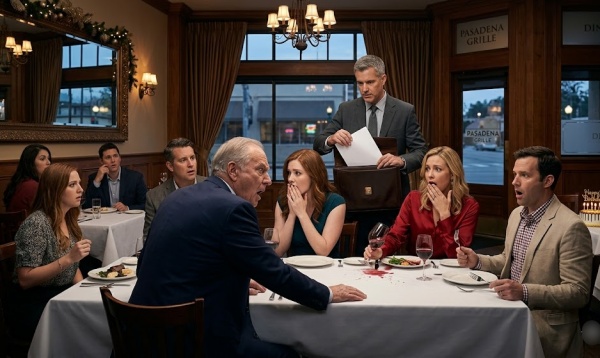
My thirty-second birthday dinner was supposed to be small, expensive, and forgettable. My mother had reserved the private room at a restaurant in Pasadena, the kind of place with white tablecloths, polished wine glasses, and waiters who refilled water before anyone noticed it was low. There were twelve of us around the table: my parents, my younger brother, two aunts, three cousins, my grandfather, his attorney, and me. I remember thinking the whole room smelled like lemon butter, old money, and family tension.
My name is Claire Bennett, and for most of my life, I believed I was the practical daughter. My brother, Ryan, was the charming one, the one who got rescued every time his plans fell apart. I was the one who worked two jobs through college, bought used furniture off Facebook Marketplace, and learned how to stretch a rotisserie chicken into four meals. In my family, that was called “character.”
My grandfather, Theodore Whitcomb, had built a commercial landscaping company in Southern California from three pickup trucks and a borrowed mower. By the time I was born, Whitcomb Grounds Management handled shopping centers, office parks, and city contracts from Pasadena to Irvine. Grandpa Theo still wore work boots with his suits and inspected rose bushes outside hotels like he was grading employees. He was eighty-four, sharp as a blade, and not nearly as fragile as my mother liked to pretend.
My parents, Martin and Elaine Bennett, had always described themselves as “comfortable but not flashy.” We lived in a nice house in San Marino when I was little, took vacations to Carmel, and belonged to a tennis club where my mother spoke in a voice she did not use at home. But money in our house was always wrapped in mystery. My father said business was complicated, my mother said children should not worry about adult problems, and somehow I grew up thinking asking questions was rude.
That night, I wore a navy dress I had bought on clearance and shoes that hurt after twenty minutes. My mother looked me up and down when I arrived and said, “You look tired, sweetheart,” which was her way of saying I had not made enough effort. My father kissed my cheek and checked his phone before I finished saying hello. Ryan arrived late, smiling like the room had been waiting for him.
Grandpa Theo sat at the head of the table with his attorney beside him. The lawyer’s name was Daniel Price, a quiet man in his sixties with silver hair, careful eyes, and a leather briefcase that looked older than some of my cousins. I had seen him at family events before but never socially. He always seemed like someone who listened more than he spoke.
Dinner was stiff but normal at first. My mother talked about a charity luncheon in La Cañada, my father complained about interest rates, and Ryan told a story about a “new venture” in Austin that sounded exactly like three old ventures he had already abandoned. I cut my salmon into tiny pieces and counted the minutes until cake. Then Grandpa Theo tapped his knife lightly against his glass, and the room quieted immediately.
“I have something I want to ask Claire,” he said. My mother’s smile froze. My father stopped moving. Daniel Price placed both hands on top of his briefcase, and I noticed because lawyers do not touch briefcases casually in birthday restaurants.
Grandpa turned toward me with the tired seriousness of a man who had rehearsed a sentence alone. “Claire,” he said, “you’re thirty-two now. I want you to explain something to me honestly. What did you do with the three-million-dollar trust fund I left you?” For a second, I thought I had misheard him. The restaurant noise outside the private room seemed to disappear.
My cousin Madison lowered her fork. Ryan looked down at his plate. My mother made a tiny sound, almost like a laugh that had lost its way. I stared at my grandfather and said, “What?”
He frowned, not angry yet, only confused. “The trust. The one I established for you after your grandmother died. It was supposed to help with college, housing, medical needs, and then full access after you turned twenty-five. I’ve been told for years you emptied most of it.”
My heartbeat became so loud I could hear it in my ears. “I never got one,” I whispered. My mother’s wine glass slipped from her hand and shattered against the white tablecloth. Red wine spread across the linen like something alive.
My father opened his mouth, but no words came out. For the first time in my life, Martin Bennett looked like a man who had forgotten how to speak. Grandpa Theo did not look at them. He kept looking at me.
“What do you mean you never got one?” he asked. “I mean exactly that,” I said, my voice shaking. “I paid for college with scholarships, loans, and a campus job. I rented rooms with strangers. I still owe forty-six thousand dollars in student loans. I have never received a trust fund, Grandpa. Not one dollar.”
No one moved. Then Daniel Price opened the briefcase. The sound of the latches clicking open was soft, but it felt like a door unlocking under the entire table. He removed a stack of documents bound with blue clips and placed them in front of my grandfather.
My mother’s face had gone pale beneath her makeup. My father reached for his water glass and missed it by an inch. Grandpa Theo looked down at the papers. Daniel spoke calmly, “Mr. Whitcomb, these are the annual trustee reports you asked me to review.”
“The reports indicate distributions were made to Claire Bennett beginning when she was eighteen,” Daniel continued. “They also include signed acknowledgments that appear to bear her name.” I looked at the papers. There, beneath lines of legal language and dollar amounts I had never seen, was my signature.
Except it was not my signature. It was a better version of it. Cleaner. Smoother. More confident than mine had ever been at eighteen. It looked like someone had practiced being me.
I felt cold all over. “That’s not mine,” I said. My mother stood so suddenly her chair scraped the floor. “This is not the time.”
Grandpa Theo finally turned toward her. “Sit down, Elaine.” I had never heard him use that voice with my mother before. She sat down. Daniel removed another document.
“The trust named Martin and Elaine Bennett as co-trustees until Claire reached twenty-five,” Daniel said. “After that, the remaining assets should have been transferred directly to her control unless she voluntarily extended the arrangement.” “I didn’t,” I said. “I didn’t even know it existed.”
My father rubbed both hands over his face. Ryan whispered, “Dad,” but my father did not look at him. My mother dabbed at the wine with a napkin as if cleaning the table could somehow clean the moment. My grandfather picked up the top page and read silently for a long time.
Then he looked at my parents. “What did you do?” My mother began crying before she answered. That was her gift.
Tears arrived whenever accountability entered the room, and for years those tears had trained the rest of us to stop asking questions. But that night, no one moved to comfort her. My father finally spoke. “The money was managed,” he said.
Daniel’s eyes narrowed slightly. “Managed by whom?” My father swallowed. “By us.” Grandpa Theo’s hand tightened around the paper.
“For Claire?” he asked. No one answered. And that silence told me more than any confession could have.
Part 2 — The Paper Trail Had My Name On It
We did not finish dinner. The cake arrived with thirty-two candles while everyone sat in ruins, and the waiter froze in the doorway like he had walked into a court hearing by mistake. My mother told him to take it away. Grandpa Theo said, “Leave it,” and the poor man set the cake down in the middle of the table beside the spilled wine and forged paperwork.
Nobody sang. I sat there staring at the candles, thinking about every apartment I had lived in after college. The one in Glendale with the broken heater, the one in Highland Park where the bathroom ceiling leaked every time it rained, and the studio in Alhambra where I cried after getting my student loan statement and told myself adulthood was supposed to feel impossible. Three million dollars had existed somewhere with my name on it while I was choosing between groceries and a dental cleaning.
Grandpa Theo asked Daniel to drive him home. Before he left, he touched my shoulder with a hand that trembled only slightly. “Claire,” he said, “I did not know.” I believed him immediately, which somehow made everything hurt more.
If he had known and ignored it, I could have made him a villain. Instead, he looked like a man watching his own family become strangers. My parents left separately. My mother rushed to the restroom, then out through a side door with my aunt following her.
My father tried to speak to me in the parking lot, but I stepped back before he got close. “Not tonight,” I said. He looked wounded. That almost made me laugh.
Ryan followed me to my car. He was twenty-nine, handsome, nervous, and always somehow both guilty and innocent depending on the lighting. “Claire, I swear I didn’t know everything,” he said. That was not the same as saying he knew nothing.
I looked at him across the hood of my ten-year-old Honda Civic. “Did you get money from it?” His face changed. “Claire—” he started. “Did you?” I asked again.
He looked toward the restaurant entrance, then back at me. “Dad said Grandpa had set money aside for all of us,” he said. “He helped with my USC tuition. Then with the Austin thing. I thought it was family money.”
I laughed once, sharp and ugly. “It was family money,” I said. “Apparently I was the family.” That night, I did not sleep. I sat on my couch in my Pasadena apartment with a glass of water untouched beside me and searched old emails, bank statements, tax records, and college financial aid documents.
I found nothing. No trust statements, no notices, no deposits, no wire transfers. Just years of paychecks, rent payments, loan bills, and overdraft warnings from my twenties. At 7:12 the next morning, Daniel Price called me.
“Claire, your grandfather has asked me to meet with you if you’re willing,” he said. “I need to be clear that I represent him, not you. But I can provide copies of documents related to the trust, and I strongly recommend you retain independent counsel.” That sentence made the whole thing feel real.
Independent counsel. Not family conversation. Not misunderstanding. Counsel.
By noon, I was sitting in Daniel’s office in downtown Los Angeles, on the thirty-second floor of a building with a view of the 110 freeway. Grandpa Theo was there, wearing a gray suit and work boots. He looked like he had aged five years since dinner. Daniel placed a binder in front of me and said, “Take your time.”
The trust had been created when I was twelve, after my grandmother, Lydia, died from ovarian cancer. She had left part of her estate to Grandpa, with instructions that each grandchild should be provided for. Grandpa had created separate trusts for me and Ryan, but mine was larger because Grandma had apparently left a specific portion “for Claire’s education and independence.” I had never known that phrase existed.
Education and independence. I had earned one while begging banks for the other. The trust began with $2.1 million and grew to a little over $3 million by the time I turned eighteen. My parents were named co-trustees because Grandpa believed they would act in my best interest.
They had authority to use the money for education, health, housing, and support until I turned twenty-five. After that, they were legally required to transfer control to me. Instead, according to the records, distributions had been made for expenses I never authorized. $180,000 for undergraduate tuition that my scholarships and loans had actually covered.
There was $420,000 for “housing support” during years I had rented a bedroom in a house with three other women. There was $275,000 for “medical and wellness needs,” though I was on student health insurance and once delayed getting a root canal because I could not afford the copay. Then there were larger transfers. $600,000 to a real estate LLC connected to my father.
There was $350,000 to a boutique retail business my mother had opened in South Pasadena and quietly closed two years later. There was $500,000 in “short-term family loans” with no repayment schedule. Several smaller amounts went to Ryan’s tuition, his business, and something listed as “emergency relocation assistance,” which I later learned was a luxury apartment in Austin after his first company failed. I felt sick.
Grandpa Theo sat beside me in silence as I turned the pages. “I thought you were angry with me,” he finally said. I looked up. “What?”
He rubbed his forehead. “Your mother told me you didn’t want help from me. She said you thought the trust was controlling. She said you used the money quickly because you wanted nothing tied to the family.” I stared at him.
“That sounds nothing like me,” I said. “I know that now,” he answered. His voice broke on the last word. Daniel showed me the acknowledgments.
Each year, a form claimed I had reviewed the trust accounting and accepted the distributions. Each form carried a signature that was close enough to mine to fool someone who wanted to believe it. Some had notary stamps from a woman I had never met in Orange County. “That is not my signature,” I said again.
Daniel nodded. “You’ll need a forensic document examiner. Your attorney will likely request bank records, trustee communications, tax filings, and notary journals. There may be civil claims for breach of fiduciary duty, conversion, fraud, and possibly elder financial abuse depending on what was misrepresented to your grandfather.”
The words stacked up like bricks. Breach. Fraud. Abuse. Family.
Grandpa reached into his jacket pocket and took out a folded paper. “Your grandmother wrote this before she died,” he said. “I should have given you a copy when you were old enough. I trusted your parents to do it.” He handed it to me.
It was a letter in blue ink, addressed to me in handwriting I barely remembered. My dearest Claire, if this money reaches you one day, I hope it gives you choices. Not luxury, not laziness, not distance from people who love you. Choices. A woman should have enough of her own to leave any room where she is not respected.
I read the last sentence three times. Then I cried in a lawyer’s office overlooking Los Angeles traffic. Grandpa cried too. Daniel looked away and pretended to review a file.
That was the first kindness anyone had given me since the candles went out.
Part 3 — The People Who Wanted Me To Stay Quiet
My mother called me twenty-three times in the first two days. She left voicemails that moved from tears to anger to spiritual language with impressive speed. “We need to talk as a family,” she said in one. “Your father and I made sacrifices you’ll never understand,” she said in another.
By the fifth message, she was warning me not to destroy my grandfather’s health over “old paperwork.” Old paperwork. That was what she called three million dollars and fourteen years of lies. My father sent one text: Do not speak to any attorney until we discuss this privately.
I forwarded it to the attorney I hired that afternoon. Her name was Marisol Vega, and she worked out of a firm in Pasadena that handled trust litigation and financial elder abuse cases. She was in her forties, direct, and completely unimpressed by family drama. During our first meeting, she listened without interrupting, reviewed Daniel’s preliminary documents, and asked me one question I was not ready for.
“What do you want?” she asked. I gave the answer people expect. “I want the truth.” She nodded.
“That’s a start,” Marisol said. “But truth can be expensive, slow, and incomplete. Do you want restitution? Court findings? A settlement? Criminal referral? Protection for your grandfather? Boundaries with your parents? All of those are different strategies.”
I sat there holding a paper cup of office coffee. “I don’t know yet,” I admitted. “Good,” she said. “Then don’t let anyone pressure you into deciding while you’re still bleeding.”
Marisol began with formal records requests and preservation letters. That meant my parents, their accountant, the banks, and anyone connected to the trust were notified not to destroy documents. She explained that California trust law takes fiduciary duties seriously, especially when trustees use beneficiary funds for themselves. She also warned me that family members who steal rarely describe it as stealing.
“They call it borrowing,” she said. “They call it managing. They call it doing what was best at the time.” She was right. At a family meeting my aunt begged me to attend, my father sat in my grandfather’s living room and used all three phrases in under ten minutes.
He claimed the money had stayed “within the family ecosystem.” He said the real estate investment was supposed to benefit everyone. He said my mother’s boutique had been “a passion project that could have become profitable with better timing.” My mother cried into a tissue.
“We never wanted you to become spoiled,” she said. I looked at her, stunned. “I was working the closing shift at a bookstore in college while you used my trust fund to open a store that sold $300 candles.” Her face hardened.
“You always exaggerate,” she said. That sentence took me back to childhood faster than anything else could have. Every hurt I named had been exaggerated. Every need was dramatic.
Every boundary was disrespect. I realized then that the trust fund had not created a new family problem; it had put a dollar amount on an old one. Ryan sat near the fireplace, quiet. When I asked him directly how much he had received, he said he did not know.
Marisol, who was present because I refused to attend without counsel, asked if he would consent to provide bank records for relevant transfers. He looked at our parents before answering. That told me enough. Grandpa Theo was the only person who seemed less interested in excuses than in facts.
He had hired a separate forensic accounting firm and asked Daniel to cooperate fully with my attorney. He also removed my parents from any remaining family roles connected to his estate planning. My mother acted as if he had slapped her. “You’re choosing Claire over your own daughter,” she said.
Grandpa looked exhausted. “No,” he said. “I am choosing the truth over the people who hid it from me.” The forensic accounting took months.
Money leaves trails, but wealthy families know how to scatter leaves over them. There were transfers through LLCs, cashier’s checks, tuition payments, credit lines, reimbursements, and personal expenses mislabeled as trust distributions. My parents had not been criminal masterminds. They had been confident, which is sometimes more dangerous.
By March, Marisol could show a timeline. When I was eighteen, my parents began withdrawing from the trust for “education expenses,” even though my tuition was mostly covered by scholarships and federal loans. When I was twenty-one, my father’s real estate partnership hit trouble after a bad office building purchase in Riverside. Around the same time, large “temporary” transfers from my trust began flowing into his LLC.
When I turned twenty-five, the trust should have been transferred to me. Instead, my parents signed documents claiming I had requested that they continue managing it because I was “financially inexperienced.” One acknowledgment said I was living in an apartment in West Hollywood. I had never lived in West Hollywood.
Another listed an email address that included my name but had been created by my mother. Seeing that email address made me angrier than the money. It was one thing to take from me. It was another to invent a quieter version of me who agreed to it.
Meanwhile, my family divided into predictable camps. One aunt said I should show mercy because my parents were “under pressure.” A cousin privately asked if I could lend her money if I won anything, which was so absurd I almost respected it. Ryan sent a long email apologizing for benefiting from something he “didn’t fully understand,” while carefully avoiding any commitment to pay anything back.
Megan, my best friend since college, told me to stop reading messages after 9 p.m. “You’re letting them hold court in your nervous system,” she said. She was right, so I started therapy. That is the part people leave out of family betrayal stories.
Legal strategy helps with documents, but it does not teach your body how to stop shaking when your mother’s name appears on your phone. I found a therapist in Eagle Rock who specialized in family systems and financial abuse. The first thing she told me was that betrayal by parents is not just a financial injury; it is an injury to reality. That made sense.
My parents had not only taken money. They had made me live inside a false story about myself. I had believed I struggled because I was not as smart with money as other people. I believed I was behind because I had chosen the wrong career path in nonprofit communications.
I believed my parents were disappointed in me for not doing better. Now I knew they had watched me climb out of a hole they were digging deeper. In April, Marisol filed a civil petition in Los Angeles County Superior Court. It alleged breach of fiduciary duty, fraud, conversion, unjust enrichment, and requested an accounting, restitution, removal of trustees, and damages.
Daniel filed related documents on my grandfather’s behalf regarding misrepresentations made to him and changes to his estate plan. The filings were public enough that one of my mother’s charity friends found them within forty-eight hours. That was when my mother stopped crying and started raging. “You have humiliated this family,” she said on a voicemail.
For the first time in my life, I did not call her back.
Part 4 — The Room Where Excuses Ran Out
The mediation took place in a conference room in downtown Los Angeles on a hot day in July. The windows overlooked traffic, construction cranes, and a city full of people having their own disasters at the same time. I sat on one side of the table with Marisol. My parents sat across from us with two attorneys who looked expensive enough to be paid with someone else’s money.
Ryan came with his own lawyer. That hurt more than I expected. Grandpa Theo attended for the first hour, against everyone’s advice, because he said he wanted to hear my parents explain themselves without a dining table between us. Daniel sat beside him.
My grandfather looked smaller than he had at my birthday dinner, but his eyes were clear. The mediator was a retired judge named Helen Crawford. She had the calm, unimpressed manner of someone who had spent thirty years watching people confuse emotion with evidence. She began by explaining that mediation was confidential, voluntary, and not a place for speeches.
My mother immediately tried to give one. Judge Crawford let her speak for exactly forty seconds. Then she said, “Mrs. Bennett, I understand you feel hurt. But today is about money taken from a trust and documents signed in your daughter’s name. Let’s stay there.”
My mother’s mouth closed. I almost loved the judge. My father’s attorney tried to frame the situation as “informal family borrowing.” Marisol opened a binder and walked through the transfers, the false acknowledgments, the fake email address, the notary issues, and the distributions made after I legally should have controlled the trust.
She did not raise her voice. She did not need to. Evidence has its own volume. When Marisol displayed a copy of my supposed signature from age twenty-five beside my actual driver’s license signature from the same year, even Ryan looked away.
The signatures were similar, but the rhythm was wrong. The forensic examiner’s report said there was strong evidence they were not written by the same person. The notary journal also showed inconsistencies that raised serious questions. My mother whispered, “I signed some things for convenience.”
The room went still. Her attorney leaned toward her quickly. Judge Crawford said, “Mrs. Bennett, I suggest you consult your counsel before continuing.” But the sentence had already landed.
For convenience. That was the phrase she used for erasing me. My father tried to take over. He said the recession had hurt his investments.
He said he always intended to repay the trust. He said I had benefited indirectly from family stability, the house, vacations, and opportunities. He said if the money had stayed untouched, it might have made me entitled. I looked at him and finally spoke.
“I had student loans, Dad.” He blinked. “I had panic attacks over rent. I skipped medical appointments. I worked weekends. You watched me do that while telling Grandpa I had spent millions.”
His jaw tightened. “You don’t understand the pressure I was under.” “No,” I said. “You don’t understand the pressure you put me under.” That was the first time I saw him look ashamed.
Not sorry. Ashamed. There is a difference. Grandpa Theo stood up slowly.
Daniel tried to steady him, but he waved him off. He looked at my father first. “Martin, I trusted you because my daughter loved you.” Then he looked at my mother. “Elaine, I trusted you because you were my child.”
My mother began to cry again. Grandpa did not soften. “You both used trust as currency,” he said. “And you spent it all.” He left after that.
The mediation continued for nine hours. By the end, we had the framework of a settlement, though it would take weeks to finalize. My parents agreed to a substantial restitution payment funded by selling their San Marino house, liquidating certain investments, and assigning proceeds from my father’s real estate interests. Ryan agreed to repay a portion of funds traced directly to his tuition and business transfers over time, though not as much as I believed he should.
There was also a formal written acknowledgment. My signature had been used without my authorization. I had not received the trust distributions described in the annual reports. My parents had breached their fiduciary duties.
Those sentences mattered to me almost as much as the money. Marisol also negotiated correction of tax issues, indemnity for liabilities caused by false filings, and payment of my attorney’s fees from my parents’ side. The court would supervise parts of the agreement, and if payments were missed, enforcement would not require another family conversation. Daniel separately referred certain notary and document issues to appropriate authorities.
I did not control what happened after that. People often imagine justice as a dramatic moment where someone is dragged away or publicly shamed. Mine looked like signatures on settlement papers and a migraine so bad I threw up in the courthouse bathroom. When everything was signed, my mother waited for me near the elevators.
She looked older, but not softer. “I hope you’re happy,” she said. “You got what you wanted.” I looked at her for a long time.
“No,” I said. “I got what you left.” The elevator doors opened. I stepped inside without her.
Part 5 — What My Grandmother Meant By Choices
The money did not fix me. I need to say that clearly because people hear “three-million-dollar trust fund” and imagine instant healing, as if betrayal can be paid off like a credit card. Yes, the restitution changed my life. I paid off my student loans, replaced my Honda, moved into a small craftsman house in Pasadena, and stopped calculating whether every grocery item was necessary.
But money did not make my mother safe. It did not make my father honest. It did not make my twenties return to me. For months after the settlement, I felt guilty buying anything.
A couch. New tires. A winter coat I did not technically need in Southern California but loved anyway. My therapist told me that when deprivation becomes part of your identity, relief can feel like theft. I wrote that sentence down and kept it on my fridge.
Grandpa Theo and I became close in a way we had never been before. Every Sunday, I drove to his house in South Pasadena and brought him coffee from a place on Mission Street. We sat on his porch while he told me stories about my grandmother. He admitted he had let my mother control too much because grief made him tired.
“I thought money would protect you,” he said one afternoon. “It tried,” I told him. “People got in the way.” He smiled sadly.
“That sounds like your grandmother,” he said. He gave me more of her letters. Not all at once, because he said grief should be served in portions. In one, she wrote about starting over after her first engagement ended.
In another, she wrote about how women in her generation were taught to be grateful for rooms they had no power to leave. Again and again, she returned to the same idea. Choices. Not luxury. Not revenge. Choices.
I used part of the recovered funds to start a scholarship at the community college I had attended for two years before transferring to UCLA. It was for women over twenty-five returning to school after family hardship, illness, divorce, or financial abuse. I named it the Lydia Whitcomb Second Door Scholarship. Grandpa cried when I showed him the paperwork.
“Second Door?” he asked. I nodded. “She wrote that a woman should be able to leave any room where she isn’t respected. I figured she would like helping someone find another door.” He covered his face with one hand.
For once, his silence was not heavy. It was full. My relationship with Ryan became complicated but not impossible. He made payments according to the settlement, sometimes late, but he made them.
He also started therapy, which he mentioned in the awkward tone men use when admitting they have emotions under supervision. We met for coffee six months after mediation, and he apologized without the careful language of his lawyer. “I liked being the rescued one,” he said. “I didn’t ask where the rope came from.”
That was honest enough for me to keep listening. Not enough to forget. But enough to begin somewhere. My father wrote me one letter.
It was four pages long, handwritten on legal paper, full of explanations, shame, and one sentence that sounded almost like accountability. “I convinced myself I was borrowing from your future because I believed I could replace it before you noticed.” I read that sentence several times. Before you noticed.
Not before you needed it. That distinction told me he still did not fully understand. I did not answer the letter. My mother sent birthday cards with Bible verses and no apology.
She moved to a condo in Arcadia after the house sold and told mutual relatives she was “downsizing after a family misunderstanding.” I stopped correcting the story because people who wanted the truth knew where to find the court records. People who wanted her version were not my responsibility. The first birthday after the settlement, I did not have dinner with my family.
I invited six friends to my backyard, ordered tacos, strung lights along the fence, and served grocery store cupcakes on a platter my grandmother had once owned. Megan gave a toast and said, “To Claire, who finally got her own name back.” I cried before she finished the sentence. Grandpa Theo came too, wearing a cardigan over a collared shirt and work boots polished for the occasion.
He brought a small box wrapped in brown paper. Inside was my grandmother’s gold watch, the one she wore in every photograph I remembered. The card said, “For the time they took, and the time still yours.” I had to sit down.
Later that night, after everyone left, I stood alone in my kitchen with the watch in my palm. It was delicate, scratched, and still ticking. I thought about the girl I had been at eighteen, signing loan documents, believing struggle was proof of worth. I thought about the woman at thirty-two, sitting at a birthday table while a briefcase opened and her life split into before and after.
I also thought about my mother’s wine spreading across the tablecloth. For a long time, that was the image I could not escape. Now I see something else. I see my grandfather asking a question because some part of him knew the story he had been told did not match the woman sitting in front of him.
I see a lawyer opening a briefcase not to destroy a family, but to let reality breathe. I see myself whispering the truth before I had any proof, and the truth being enough to begin. Family secrets survive by making the honest person feel impolite. That is what I learned.
They thrive in private rooms, behind phrases like “don’t upset your grandfather,” “your mother means well,” and “money isn’t everything.” Money is not everything. But stolen choices are not nothing. I am thirty-three now.
My life is quieter than people expect after a scandal. I work, garden badly, call my grandfather, meet friends for dinner, and volunteer with the scholarship committee twice a month. Sometimes I still wake up angry, but not every morning. That feels like progress.
I do not know whether I will ever fully forgive my parents. Some days, forgiveness feels like a door I may open later. Other days, it feels like a house I no longer want to visit. My therapist says I do not have to decide forever today.
So I don’t. What I know is this: at my thirty-second birthday dinner in Pasadena, my grandfather asked me what I had done with the $3 million trust fund he left me. I whispered, “I never got one.” My mother dropped her wine, my father forgot how to speak, and for the first time in my life, silence worked in my favor.
Because this time, the silence was not mine to carry.
It was theirs.
