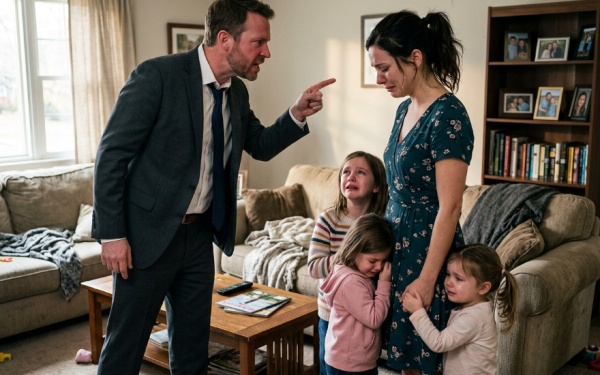
“I’m Finally Getting the Son I Deserve.”
Those were the last words my husband said before leaving me and our three daughters for a 24-year-old woman. Months later, in his mother’s living room, a single revelation turned his dream life into a nightmare.
Part 1: The Daughters He Forgot to Deserve
My name is Natalie Mercer, and for thirteen years, I thought I understood the shape of my marriage.
Not perfectly. No one understands another person completely, especially after mortgages, babies, bills, soccer schedules, school conferences, and the kind of exhaustion that makes romance feel like something you used to have time for. But I thought I knew the man sleeping beside me.
My husband, Ryan Mercer, was forty-one years old, a regional sales director for a building supply company outside Overland Park, Kansas. He wore quarter-zip pullovers, drove a black Chevy Tahoe, and had the easy smile of a man who knew people wanted to like him. At neighborhood barbecues, he was the dad flipping burgers and making everyone laugh before the smoke alarm inside the house started screaming.
We had three daughters.
Ava, thirteen, was sharp, artistic, and already taller than she wanted to be. She had Ryan’s dark eyes and my stubbornness, a combination that made her both breathtaking and difficult in ways I privately admired. She noticed everything and said very little until she had decided exactly how much truth a person deserved.
Sophie, ten, was our peacemaker. She made handmade cards for people after arguments, cried during animal rescue commercials, and believed every problem in the world could be helped by a snack and a blanket. She still left notes in Ryan’s work bag that said things like, Good luck today, Dad.
And Grace, six, was pure motion. She wore rain boots when there was no rain, asked questions during church at full volume, and thought every dandelion was a flower worth saving. She still climbed into our bed after nightmares and tucked her cold feet under my legs like she had paid rent there.
Those girls were my whole life.
They should have been enough for him.
For years, I did not understand how deeply Ryan wanted a son. Not wanted, exactly. Needed. The way some men need proof that the world still revolves around their version of legacy.
At first, it was small.
When I was pregnant with Ava, he told everyone he did not care whether the baby was a boy or a girl. Then the ultrasound tech smiled and said, “Looks like you’re having a daughter,” and I saw something flicker across Ryan’s face before he replaced it with joy. It was quick, almost invisible, and I told myself I had imagined it.
When Sophie was born, he joked with his father that he was “outnumbered.” People laughed because that is what people do when men act like daughters are a charming inconvenience. I laughed too, though something inside me didn’t.
By the time Grace arrived, Ryan’s jokes had edges.
“Maybe the dog can be a boy,” he told his brother in the hospital room, while I was still lying there with an IV in my hand and a newborn daughter against my chest. His brother laughed. I looked down at Grace’s tiny face and promised her silently that she would never have to earn a place in this family by being someone else.
For a while, Ryan seemed to settle into fatherhood. He coached Ava’s recreational soccer team for one season, helped Sophie build a volcano for the science fair, and let Grace paint his toenails bright purple during a snow day. There were moments when I believed his disappointment had been swallowed by love.
But disappointment does not disappear just because it learns to behave in public.
It grows in private.
The first real crack came after Ryan’s father died. Thomas Mercer had been the kind of man who believed sons carried names and daughters carried casseroles. He loved our girls, but he loved them in the limited way of a man who thought affection was generous enough without respect.
After the funeral, Ryan changed.
He started talking about “the Mercer name” like it was a family business about to go bankrupt. He grew impatient with Ava’s opinions, dismissed Sophie’s sensitivity as “dramatic,” and called Grace “wild” in a tone that made her shrink. I caught him staring at families with little boys at restaurants, especially fathers and sons in matching Chiefs jerseys.
Then he met Madison Cole.
She was twenty-four years old, worked part-time at a fitness studio and part-time doing promotional events for local businesses, and had the sort of polished social media presence that made her life look more expensive than it probably was. I did not know about her at first. Wives usually do not learn the name of the storm until the roof is already gone.
Ryan started staying late at work. He went to “client dinners” that somehow required new shirts and a different cologne. His phone began sleeping face down on the nightstand, which is one of those small details that tells a married woman more than a confession.
I asked him once if something was wrong.
He looked at me like I had inconvenienced him.
“You’re always looking for a problem, Natalie,” he said.
Maybe I was.
Or maybe problems become easier to see when the person causing them stops trying very hard to hide.
The end came on a Thursday evening in late September, while I was folding laundry in our bedroom. Ava was at volleyball practice, Sophie was reading on the couch, and Grace was sitting cross-legged on the hallway floor making a house for plastic horses out of Amazon boxes. It was an ordinary night, which made what happened feel even more unreal.
Ryan walked in carrying a duffel bag.
Not a suitcase. A duffel bag. The navy one he used for weekend golf trips.
I looked at it, then at him.
“Where are you going?”
He did not look guilty. That was the first thing I noticed. He looked relieved, like he had finally reached the part of the story where he got to stop pretending he was not the main character.
“I can’t do this anymore,” he said.
I set down a pair of Grace’s pajamas.
“Do what?”
“This,” he said, gesturing around the room as if our house, our life, and our daughters’ drawings taped crookedly to the wall were a disappointing hotel room. “The fighting. The pressure. The constant feeling like I’m trapped.”
I remember staring at him, waiting for the sentence to become less absurd.
“We barely fight,” I said.
“That’s because you don’t listen.”
I almost laughed. Not because it was funny, but because it was the kind of thing people say when they have rehearsed an exit and need the other person to be guilty enough to justify it.
Then he said her name.
Madison.
He said it softly, like it was something fragile. He told me she was pregnant. He told me she was having a boy. He told me he was moving in with her “for now,” though the phrase had the false gentleness of someone stepping over a body and calling it temporary.
I sat down on the edge of the bed.
“You’re leaving your daughters?”
His face hardened.
“I’m not leaving them. I’m choosing happiness.”
“They are your children.”
“I know that.”
“No,” I said. “I don’t think you do.”
He zipped the duffel bag with one sharp motion.
Then he looked at me with an expression I had never seen before, not fully. It was not anger. It was resentment, old and ugly and finally unmasked.
“I’m finally getting the son I deserve,” he said.
For a moment, the whole house went silent.
Or maybe I did.
Those were the last words my husband said before walking out of our bedroom, past Grace and her cardboard horse stable, past Sophie on the couch, past the framed photo of Ava’s fifth-grade graduation, and out the front door.
Grace called after him.
“Daddy?”
He did not turn around.
That was the moment I stopped being a wife trying to save a marriage.
I became a mother protecting her daughters from the man who had just told the truth by accident.
Part 2: The Life He Thought He Was Building
People expect women to fall apart when men leave.
They expect crying phone calls, late-night texts, messy social media posts, begging, bargaining, maybe a dramatic confrontation in a driveway. I understand why. Pain wants motion, and humiliation wants somewhere to go.
But I had three daughters watching me.
So I did not chase him.
I did not call Madison. I did not post vague quotes about betrayal. I did not throw his clothes onto the lawn or send angry messages his attorney could later print out and slide across a conference table.
I called my sister, Claire, and said, “Ryan left.”
She was at my house in twelve minutes.
Then I called a family law attorney named Rebecca Stanton, whose office was in downtown Overland Park, in a brick building across from a coffee shop that sold six-dollar lattes and gluten-free muffins. Rebecca had represented a friend of mine during a difficult divorce, and my friend had described her as “kind, but not soft.”
That sounded exactly right.
Rebecca told me to document everything. She told me not to make threats, not to restrict reasonable contact with the children without cause, not to empty accounts, and not to communicate emotionally when written communication would do. She told me Kansas courts cared about the best interests of the children, financial transparency, and stability.
“Do not give him chaos he can use,” she said.
So I gave him calm.
Ryan hated that more.
Within two weeks, he had moved into a two-bedroom rental townhouse in Lenexa with Madison. He told the girls it was “temporary” and “closer to work,” as if children could not feel the truth hiding under adult language. Ava stopped answering his texts. Sophie answered every one with one-word replies. Grace asked every night if Daddy had left because she spilled orange juice on his laptop in July.
I told her no every time.
“No, baby,” I said. “This is not because of you.”
But children are not convinced by one answer when the question lives in their chest.
Madison’s pregnancy became public in November. She posted a photo of a tiny pair of blue baby sneakers beside a letter board that read: Baby Mercer Coming This Spring. Ryan shared it with three heart emojis and a caption about “new beginnings.”
Ava saw it before I did.
She walked into the kitchen holding her phone, her face pale and still.
“Is this why he left?” she asked.
I looked at the screen. Blue shoes. Madison’s manicured hand resting on a small baby bump. Ryan smiling beside her like a man who had won something.
I took the phone gently.
“Yes,” I said. “Partly.”
Ava nodded once.
Then she said, “So we weren’t enough.”
That sentence cut through me so cleanly I almost could not breathe.
I wanted to say no immediately. I wanted to fill the room with motherly certainty and erase the wound before it formed. But thirteen-year-olds can smell false comfort, and Ava deserved better than a lie wrapped in good intentions.
“You were always enough,” I said. “Your father’s inability to see that is not a reflection of your worth. It is a failure in him.”
She looked away.
“Does he know that?”
“I don’t think he knows much right now.”
Ryan called that night, furious that Ava had not congratulated him.
“She’s thirteen,” I said. “She found out her father is having a baby with the woman he left her mother for. Give her time.”
“She needs to learn respect.”
I gripped the kitchen counter.
“She learned it,” I said. “That’s why she noticed when you didn’t show any.”
He hung up.
That became the pattern.
Ryan wanted the privileges of fatherhood without the inconvenience of consequences. He wanted the girls to visit his townhouse, smile at Madison, ask about the baby, and behave like supporting characters in his redemption story. He wanted me to encourage it, as if my job was to polish the image of the family he had cracked open.
Rebecca helped me file for temporary orders regarding custody, parenting time, child support, and household expenses. We did not ask for punishment. We asked for structure.
Ryan called it an attack.
I called it paperwork.
By December, he had begun complaining about money. He said the child support guidelines were unfair. He said rent was expensive, Madison had doctor’s appointments, and he needed to prepare for his son. He used the phrase “my son” with a reverence he had never used for our daughters.
Every time, I documented it.
Every text. Every email. Every missed pickup. Every late payment. Every time he told Sophie he could not come to her choir concert because Madison was tired, then posted pictures from a Kansas City steakhouse that same evening.
He thought I was cold.
I was not cold.
I was learning to stop bleeding in places he could see.
The person who surprised me most during those months was Ryan’s mother, Eleanor Mercer.
Eleanor was seventy, a retired school principal who lived in a ranch-style house in Prairie Village with white shutters, rose bushes, and a living room that smelled permanently of lemon furniture polish. She was proper, practical, and had spent most of her life managing difficult people by lowering her voice until they felt ashamed of being loud.
Ryan was her only child.
Our daughters were her only grandchildren.
When Ryan left, I expected Eleanor to defend him. Blood protects blood, especially in families where image matters. Instead, she came over the next morning with two pans of baked ziti, a bag of groceries, and red-rimmed eyes.
“I am so sorry,” she said.
I did not know what to do with that.
She hugged each of the girls longer than usual. Ava stood stiffly at first, then folded into her grandmother like she had been waiting for one adult from Ryan’s side of the family to prove she still belonged there.
Eleanor did not say much about Madison. She did not call names. She did not make threats. She simply continued showing up for the girls: school plays, volleyball games, library fundraisers, Saturday pancakes.
Ryan did not like that.
“She’s my mother,” he told me once. “You don’t get to keep her.”
“I’m not keeping anyone,” I said. “She is choosing her granddaughters.”
He did not answer.
By January, Madison was five months pregnant, and Ryan had turned the baby into a public relations campaign. He posted nursery updates, ultrasound photos, and quotes about fatherhood. People from his work commented things like, “Finally getting your boy!” and “Mercer legacy continues!”
I blocked most of them for my own peace.
But Ava saw enough.
One evening, she sat beside me on the couch and asked, “If the baby is a boy, will Grandma love him more?”
“No,” I said immediately.
She looked unconvinced.
“Your grandmother knows exactly who her grandchildren are,” I said. “No baby changes that.”
But deep down, I wondered if Ryan’s dream would become everyone else’s obligation.
A son. A new woman. A second chance. A rewritten story where the first family became a practice run.
I did not know then that the story Ryan was writing had a missing chapter.
And that chapter was sitting inside a sealed envelope.
Part 3: The Invitation to Eleanor’s Living Room
The invitation came in March, six months after Ryan walked out.
Eleanor called me on a Tuesday afternoon while I was sitting in the school pickup line, watching Grace hop from one painted sidewalk circle to another outside the elementary building. Her voice sounded composed, but strained in the careful way I had come to recognize.
“Natalie,” she said, “I would like you and the girls to come over Sunday afternoon.”
I hesitated.
“Is Ryan going to be there?”
“Yes.”
That one word carried more weight than it should have.
“Eleanor…”
“I know,” she said gently. “I would not ask if I did not think it mattered.”
I watched Grace wave at me with both hands, her backpack bouncing against her knees.
“What is this about?”
A pause.
“Ryan wants to discuss Easter plans. He also wants to speak to the girls about the baby.”
My stomach tightened.
“No.”
“I understand.”
“No, I don’t think you do,” I said, more sharply than I intended. “Ava is barely speaking to him. Sophie cries after every visit. Grace still asks if he left because she was too loud. They are not props for his baby announcement.”
“I agree with you,” Eleanor said.
That stopped me.
“Then why invite us?”
Another pause.
“Because Ryan has invited Madison. He believes this meeting will establish expectations for the family going forward.”
I closed my eyes.
Of course he did.
Ryan did not want a conversation. He wanted a stage. He wanted his mother’s blessing, his daughters’ acceptance, and my silent cooperation in one carefully arranged afternoon.
“I’m not interested in helping him perform,” I said.
“I am not asking you to.”
There was something in Eleanor’s voice then. Something quiet, almost steely.
“I am asking you to be present,” she said. “For the girls. And perhaps for the truth.”
I opened my eyes.
“What truth?”
“I cannot explain over the phone.”
If anyone else had said that, I would have refused immediately. But Eleanor was not dramatic. She did not manufacture mystery for attention. She had spent thirty-five years as an elementary school principal, which meant she could smell nonsense through a brick wall and had no patience for theatrics.
So I said yes.
On Sunday, I dressed carefully. Not beautifully, not aggressively, not like a woman trying to prove she was fine. I wore dark jeans, a cream sweater, small gold hoops, and the camel coat I bought myself after my first promotion years earlier.
Ava wore black, because thirteen-year-old girls understand symbolism better than most adults. Sophie wore a blue cardigan Eleanor had given her for Christmas. Grace insisted on sparkly red shoes, then asked if Daddy’s baby would be at Grandma’s house.
“No,” I said. “The baby has not been born yet.”
“Good,” she said.
I did not ask what she meant.
Eleanor’s house looked exactly the same when we arrived. Same rose bushes trimmed low for winter. Same brass door knocker shaped like a fox. Same wreath she changed every season with religious devotion.
But inside, the air was different.
Ryan was already there, standing near the fireplace in a navy sweater and jeans that looked new. He had trimmed his beard and whitened his teeth, and for one strange second I saw the man I had married: handsome, confident, convincing. Then Madison stepped out of the kitchen, one hand resting on her rounded stomach, and the illusion disappeared.
She was very young.
That was the first thing I thought, and not with cruelty. Twenty-four is adult, yes. Old enough to make choices. Old enough to know better than to help break a family. But still young enough to believe being chosen by a married man meant she had won something valuable.
Madison wore a pale blue maternity dress and a diamond pendant I recognized immediately.
Ryan had given me one almost exactly like it for our tenth anniversary.
Ava noticed too.
Her face went flat.
Eleanor came from the hallway and wrapped her arms around each girl. When she reached Ava, she whispered something I could not hear. Ava’s shoulders loosened just a little.
We gathered in the living room, the same room where our daughters had opened Christmas presents for most of their lives. There were framed photos on the mantel: Ryan as a boy in a Little League uniform, Ryan with his parents at his college graduation, Ryan and me on our wedding day, and dozens of the girls at different ages.
No photo of Madison.
No ultrasound picture.
I noticed that.
Ryan noticed it too.
“Mom,” he said, with forced brightness, “I thought you were going to put up the sonogram we gave you.”
Eleanor sat in her armchair.
“I decided the mantel was full.”
Madison’s smile tightened.
Ryan cleared his throat and looked at me.
“Thank you for coming,” he said, as though he had invited me to a business lunch instead of the emotional ambush of the season. “I think it’s important we all start moving forward.”
Ava crossed her arms.
Sophie looked down at her hands.
Grace climbed onto the couch beside me and pressed herself against my side.
Ryan continued.
“Madison and I are building a life together. The baby is coming in May, and whether anyone likes how this started or not, he is going to be part of this family.”
Eleanor said nothing.
Ryan looked at the girls.
“You’re going to have a little brother,” he said. “And I want you to be excited about that.”
Ava’s head snapped up.
“You want us to be excited?”
“Ava,” I said softly.
“No,” Ryan said. “Let her speak.”
That was a mistake.
Ava looked directly at him.
“You left us,” she said. “You walked out of our house and told Mom you were getting the son you deserved. Grace heard you.”
Ryan’s face changed.
Madison looked at him.
“You said that?” she asked.
Ryan’s jaw tightened.
“It was a private conversation.”
“I was in the hallway,” Grace said.
The room went still.
Sophie started crying silently, tears slipping down her cheeks without a sound. Eleanor closed her eyes for one second, and when she opened them, something in her expression had hardened.
Ryan rubbed his forehead.
“I said things in a difficult moment,” he said. “Adults say things when they’re upset.”
“You weren’t upset,” I said quietly. “You were honest.”
Madison shifted on the love seat.
“I don’t think this is healthy,” she said. “Stress isn’t good for the baby.”
Eleanor looked at her.
“No,” she said. “Lies are not good for babies. Or children. Or families.”
Ryan turned toward his mother.
“Mom, don’t start.”
“I did not start this,” Eleanor said.
Her voice was calm, but the room seemed to rearrange itself around it.
Then the doorbell rang.
Everyone looked toward the front hall.
Eleanor stood.
“That will be the mail.”
Ryan frowned.
“On Sunday?”
“Certified delivery,” Eleanor said. “They attempted Friday, and I arranged redelivery.”
Something passed across Ryan’s face.
Not fear yet.
Recognition.
Eleanor returned carrying a white cardboard envelope. It had a laboratory name printed in the upper left corner and Ryan’s name across the front. Under his name was Eleanor’s address.
Madison’s hand tightened over her stomach.
Ryan stood quickly.
“Give me that.”
Eleanor did.
“I did not open it,” she said. “It is addressed to you.”
He took the envelope, but for a moment he did not move.
Rebecca had once told me that people reveal themselves most clearly in the pause before consequences. Ryan stood in that pause like a man listening for an exit that was no longer there.
“Open it,” Madison said.
Her voice was thin.
Ryan looked at her.
“Not now.”
“Open it,” she repeated.
Ava sat very still beside me.
I suddenly understood that Eleanor had not invited us there for Ryan’s performance.
She had invited us for whatever was inside that envelope.
Ryan tore it open.
Part 4: The Son He Thought He Deserved
The sound of paper sliding from that envelope was small.
Almost ordinary.
But I have learned that life rarely announces itself with thunder. Sometimes it arrives as a folded document in a quiet living room while a six-year-old swings her red shoes above the carpet.
Ryan unfolded the pages.
His eyes moved once across the top, then stopped.
All the color left his face.
Madison stood slowly.
“What does it say?”
Ryan did not answer.
Eleanor remained standing near the fireplace, her hands folded in front of her. She looked sad, not surprised. That told me she had known something was coming, even if she had not known exactly what the paper would say.
“Ryan,” Madison said.
He swallowed.
“It says…”
His voice failed.
Ava leaned forward slightly.
I put one hand on Grace’s knee, not to restrain her, but to remind myself that she was there. That all three of them were there. That whatever was happening, my first job was not to watch Ryan fall apart.
It was to make sure his fall did not crush them.
Ryan looked at Madison.
“It says I’m excluded.”
Madison blinked.
“What?”
“The paternity test,” he said, each word dragged from him. “It says I’m excluded as the biological father.”
For a moment, no one moved.
Then Sophie whispered, “What does that mean?”
I turned to her immediately.
“It means the test says Daddy is not the baby’s biological father,” I said gently. “This is an adult issue, sweetheart. You did nothing wrong.”
Grace frowned.
“So the baby is not our brother?”
I took a breath.
“That is something the adults will have to figure out.”
Ryan stared at Madison like he had never seen her before.
“You told me he was mine.”
Madison’s eyes filled with tears.
“I thought he was.”
The sentence landed badly.
Even Grace understood that.
Ryan laughed once, a sharp, empty sound.
“You thought?”
Madison stepped back.
“Ryan, don’t do this here.”
“Here?” he said. “You wanted to do everything here. You wanted my mother’s blessing, my daughters’ excitement, Natalie sitting quietly while we all pretended this was normal.”
“Ryan,” Eleanor warned.
But he was no longer listening.
He looked down at the paper again, as if the words might change if he hated them hard enough.
The report had been from a non-invasive prenatal paternity test. Ryan had apparently agreed to it because Madison wanted his name on a lease, his financial commitment to a larger house, and proof before the baby was born. He had used Eleanor’s address because he did not want the results sent to Madison’s townhouse.
Even in his second life, he had been hiding paperwork.
There was almost poetry in that.
Madison began crying.
“I didn’t know for sure,” she said. “It was complicated.”
Ryan stared at her.
“Complicated?”
“I was seeing someone before you.”
“Before me?”
“And maybe a little after,” she whispered.
Ava made a sound under her breath that was not quite a laugh.
I looked at her sharply.
She looked away, but I saw the anger in her face. Not satisfaction. Anger. Because children do not enjoy watching a parent be humiliated as much as adults imagine they might. Even when that parent has hurt them, his pain still lands somewhere inside them.
Ryan turned toward me then.
For one wild second, I thought he might blame me.
He looked like he wanted to. Men who build their identities on control often search for the nearest woman when the structure collapses. But there were too many witnesses. Too much paper. Too much truth.
“Natalie,” he said.
“No,” I said.
It was only one word, but it stopped him.
He looked wounded, as if I had denied him comfort that still belonged to him.
“No,” I repeated, softer but firmer. “Do not turn to me right now. Do not ask me to help you process the consequences of choices you made while hurting our daughters.”
His mouth opened.
Then closed.
Eleanor finally spoke.
“Ryan, sit down.”
He looked at her like a boy again.
“Mom—”
“Sit down.”
He sat.
Madison remained standing, one hand over her stomach, crying quietly. I felt something unexpected then. Not sympathy exactly, but a recognition of youth, fear, and foolishness colliding with reality. She had made harmful choices, but there was still an unborn child in the middle of that room who had chosen none of it.
Eleanor looked at Madison.
“You need to call your mother or someone you trust,” she said. “You should not drive upset.”
Madison wiped her face.
“You hate me.”
“I do not hate you,” Eleanor said. “But I will not let you use my granddaughters as scenery for a lie.”
Madison flinched.
Ryan’s head dropped into his hands.
The room was so quiet I could hear the wall clock ticking near the hallway.
Then Ava stood.
Everyone looked at her.
She was trembling, but her voice was clear.
“So,” she said to Ryan, “you left us because you thought you were getting a son. And now he’s not yours.”
Ryan looked up.
Ava’s eyes were wet, but she did not cry.
“Were we ever enough?” she asked.
That question broke something in the room that the paternity test had not.
Ryan looked at his daughter, his first child, the girl who used to fall asleep on his chest during Sunday football games, the girl whose training wheels he had removed in the church parking lot, the girl who had spent six months trying not to let him see how badly he had hurt her.
He had no answer.
Or maybe he had one, and it was too late to matter.
“Ava,” he said.
She shook her head.
“No. Don’t say my name like that.”
Sophie stood too, wiping her cheeks with both hands.
“I want to go home,” she said.
Grace looked at me.
“Can we leave now?”
“Yes,” I said immediately.
Ryan stood.
“Natalie, wait.”
I turned to him.
“For what?”
His face crumpled in a way I had never seen before. Ryan had been angry, proud, charming, dismissive, defensive, and arrogant. But I had never seen him truly ashamed until that moment.
“I’m sorry,” he said.
The words were too small for the damage.
Maybe all apologies are, at first.
I looked at the man who had left our daughters for an idea. Not a baby, not even Madison, but an idea of himself as a father finally validated by a son. He had gambled a family on a fantasy and lost before the child was even born.
“I hope you mean that someday in a way that helps them,” I said.
Then I took my daughters home.
In the car, nobody spoke for ten minutes.
Grace fell asleep first, exhausted by adult pain she could not understand. Sophie leaned her forehead against the window. Ava stared straight ahead, jaw tight, tears slipping silently down her face.
Finally, she said, “I don’t feel happy.”
I glanced at her in the rearview mirror.
“About what?”
“That it happened to him.”
I nodded.
“That’s because you’re a good person.”
“He deserved it,” she said.
“Maybe,” I said. “But deserving consequences and enjoying someone’s pain are different things.”
She wiped her face.
“I still hate him a little.”
“That’s allowed,” I said. “Feelings are allowed. What we do with them is where we have to be careful.”
Ava looked out the window again.
After a while, she whispered, “We were enough, right?”
My throat tightened.
“Yes,” I said. “You were always more than enough.”
And this time, I think she believed me a little.
Part 5: What Was Left After the Nightmare
The story did not end in Eleanor’s living room.
Stories like this never do.
People love the dramatic moment: the envelope, the test result, the stunned silence, the mistress crying, the husband realizing the life he destroyed his family for was not what he thought. They want the clean ending where the wronged woman walks out victorious and never looks back.
But real life keeps going the next morning.
There are lunches to pack. Custody calendars to update. Therapy appointments to schedule. Children who wake up with questions the dramatic scene did not answer.
Ryan called me twelve times that night.
I did not answer.
He texted: I need to see the girls.
Then: Please, I know I messed up.
Then: Natalie, I lost everything today.
I read that last one three times.
Then I forwarded it to Rebecca.
She replied: Do not engage emotionally. We will address parenting time through proper channels.
So I did not respond.
Not because I wanted to punish him, but because I had finally learned that not every emergency in Ryan’s life required my immediate labor. For years, I had translated his moods, softened his edges, explained him to the girls, protected his image, and made his selfishness look like stress.
That job was over.
Madison moved out of the Lenexa townhouse two weeks later. I heard this from Eleanor, who heard it from Ryan, who had called her crying from his car in a grocery store parking lot. The baby’s biological father, according to what little Ryan knew, was someone Madison had dated before him and continued seeing briefly after their relationship began.
I did not ask for details.
Details can become hooks, and I did not want to be hooked into Madison’s life.
She eventually moved back to Wichita to stay with her parents before the baby was born. Eleanor sent a small gift through a mutual acquaintance: diapers, wipes, and a note that said, For the child, who is innocent.
When Eleanor told me, she seemed almost embarrassed.
“Was that wrong?” she asked.
“No,” I said. “That was decent.”
Because it was.
The baby had done nothing. He was not a symbol, not a prize, not a punishment, not the son Ryan deserved or did not deserve. He was simply a child entering a mess adults had made before he took his first breath.
Ryan did not handle the aftermath well.
For a month, he unraveled in stages. First came denial. He questioned the test, then ordered another after the baby was born. The second test said the same thing.
Then came anger. He blamed Madison, blamed stress, blamed me for “making the divorce hostile,” blamed his father’s death, blamed the pressure he had felt to carry on the Mercer name. He blamed everything except the sentence he had said while leaving: I’m finally getting the son I deserve.
Then came bargaining.
He asked if we could pause the divorce.
Not stop it, he said. Pause it. As if divorce were a movie and not the legal recognition of a life he had already abandoned.
He asked if we could try counseling.
I reminded him that I had suggested counseling two years earlier, when he started sleeping in the guest room and calling it back pain. He had told me then that therapy was for people who liked paying strangers to make problems worse.
Now he wanted the stranger.
Now he wanted the room.
Now he wanted the version of me who would sit beside him and help carry the shame.
I told him no.
Not cruelly. Not triumphantly. Just no.
The divorce proceeded.
Kansas is an equitable distribution state, so our marital assets were divided fairly, not necessarily exactly down the middle. We sold the house because keeping it would have required buying out Ryan’s equity, and I decided my daughters and I deserved a home that did not echo with the night he left.
We moved into a smaller house in Olathe, on a quiet street with a maple tree in the front yard and a kitchen that got morning light. The girls chose their own bedroom colors. Ava picked sage green, Sophie chose pale yellow, and Grace insisted on lavender because, in her words, “purple makes bad dreams leave faster.”
I did not argue.
Eleanor helped us move.
She arrived in jeans and gardening gloves, carrying a cooler full of sandwiches and lemonade. Ryan was supposed to come by to pick up the last of his things, but Eleanor told him to wait until we were gone. She said the girls did not need another goodbye in a house already full of them.
Ava hugged her grandmother that day without being asked.
That was something.
Ryan’s relationship with the girls became complicated, then quiet, then slowly more honest. The court ordered a standard parenting schedule at first, but Ava was old enough for her preferences to carry weight in practical terms. She did not want overnights for a while, and Rebecca helped us handle that carefully.
Sophie went to visits because she felt guilty if she did not.
Grace went because she missed him.
Each daughter had her own grief, and I had to learn not to make them grieve the same way.
Ryan started therapy in June. I know because he told me in a co-parenting message, not because I asked. He said he was beginning to understand how much of his identity had been tied to proving something to his father.
I read the message twice.
Then I wrote back: I hope therapy helps you become a healthier parent for the girls.
That was all.
He later apologized to Ava in a session with a family therapist. I was not in the room, but Ava told me about it afterward while we sat in the car outside a frozen yogurt shop. She said he cried.
“What did you do?” I asked.
“I cried too,” she said. “But I didn’t tell him it was okay.”
I nodded.
“You don’t have to.”
“Will I ever have to?”
“No.”
She looked relieved.
Forgiveness is not a tax children owe parents for finally feeling sorry.
That is something I believe with my whole heart.
Sophie forgave him first, or at least she wanted to. That was her nature. She made him a Father’s Day card with a drawing of a tree and wrote, I hope we can grow better. I cried in the laundry room after she showed it to me.
Grace remained Grace.
One night, months after the divorce was finalized, she asked Ryan during dinner if he still wished he had a son. He called me afterward, shaken, asking what he should say.
“The truth,” I told him. “But make sure it is the truth she needs, not the truth that makes you feel better.”
The next week, Grace came home and said, “Daddy told me he was wrong and girls are not less.”
Then she asked for macaroni and cheese.
Children absorb healing in small portions.
As for me, I rebuilt quietly.
I changed my last name back to Natalie Hayes. I bought my own tool kit and learned to hang curtain rods badly before learning to hang them well. I opened a savings account for the girls that Ryan could not touch, increased my retirement contributions, and started walking every evening around the neighborhood after dinner.
At first, I walked because I was angry.
Then because I was sad.
Then because the air felt good.
There is a freedom in discovering that your life can become smaller and more peaceful at the same time. Our new house did not have the big finished basement, the three-car garage, or the kitchen island I used to love. But nobody walked through it acting disappointed that daughters lived there.
That mattered more.
Eleanor remained in our lives. Every Sunday, she hosted dinner for whoever wanted to come. Sometimes Ryan was there, sometimes he was not. When he was, the girls decided how close to sit.
The first time Ryan came to one of Ava’s volleyball games after everything, she ignored him until the final whistle. Then she walked over and said, “Thanks for coming.” Not warm. Not cold. Just honest.
He looked like those three words meant more to him than applause.
Maybe they did.
A year after he left, Ryan asked if he could speak to me after dropping Grace off. We stood on my front porch while the girls went inside arguing about who had eaten the last granola bar. It was October again, cool enough for sweaters, with leaves collecting along the curb.
He looked older.
Not dramatically. Just less polished. Less certain that charm could pay debts character had created.
“I’ve been thinking about what I said that night,” he told me.
I did not ask which night.
We both knew.
“I don’t know how to live with it,” he said.
I watched a car pass slowly down the street.
“You live with it by becoming someone who never makes your daughters carry it again.”
He nodded.
“I am trying.”
“I hope so.”
He looked at me then, really looked at me, maybe for the first time in years without wanting something.
“I lost you,” he said.
“Yes,” I said.
“And I lost who they thought I was.”
I took a breath.
“That may be true. But you still have a chance to become someone they can know honestly.”
His eyes filled, but he did not ask me to comfort him.
That was progress.
Before he left, he said, “You deserved better.”
I thought about the woman I had been a year earlier, folding laundry while her husband packed a duffel bag and announced that another woman’s unborn son was the life he deserved. I thought about Ava’s face, Sophie’s tears, Grace calling “Daddy?” from the hallway. I thought about Eleanor’s living room, the envelope, the silence after Ryan read the truth.
Then I thought about our new house.
Lavender walls. Yellow curtains. Sage green bedding. Three daughters laughing in the kitchen, eating cereal at 8 p.m. because sometimes peace gets to make its own rules.
“Yes,” I said. “We did.”
Ryan nodded like the answer hurt, but he accepted it.
After he drove away, I stayed on the porch for a while.
The air smelled like cut grass and woodsmoke. Somewhere down the street, a dog barked. Inside, Grace was singing too loudly, Sophie was telling her to stop, and Ava was pretending not to laugh.
For the first time in a long time, my life did not feel like something I had failed to keep.
It felt like something I had saved.
Ryan once believed he was finally getting the son he deserved. He said it like our daughters were a consolation prize, like womanhood was a defect, like love could be measured by the gender of a baby not yet born.
But in his mother’s living room, a single revelation stripped that fantasy down to what it had always been.
Not destiny.
Not legacy.
Not a second chance.
Just selfishness wearing a blue ribbon.
He did not get the son he thought would complete him. He did not get to rewrite our daughters as the opening act before the real heir arrived. He did not get to walk out of one family and into another without carrying the truth with him.
And me?
I did not get the marriage I thought I had.
But I got something better than pretending.
I got clarity.
I got my daughters.
I got a home where nobody has to be a son to be treasured.
And every time Grace runs through the hallway in her red sparkly shoes, every time Sophie tapes another handmade note to the refrigerator, every time Ava laughs without checking whether anyone will punish her for being too much, I think about that sentence Ryan said before he left.
I’m finally getting the son I deserve.
Maybe he was right in one way.
People do get what they deserve eventually.
Just not always in the form they imagined.
