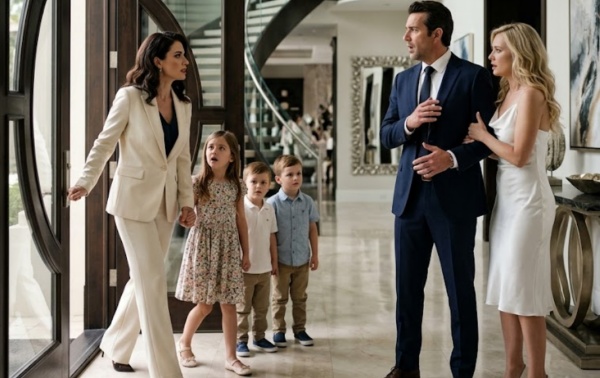
He Married His Mistress to Get an Heir. He Had No Idea He Already Had Three….
When Garrison Whitmore married Sabrina, every society column in Houston called it the wedding of the year. What none of them knew was that his ex-wife had quietly moved to Austin, built an entirely new life, and was raising three children — two boys and a girl — who carried his exact gray-green eyes and his stubborn jaw and the kind of calm certainty that runs in a bloodline whether anyone acknowledges it or not. I didn’t come back to cause a scene. I came back because…
PART ONE: The Wedding He Thought Was a Victory
The wedding of Garrison Cole Whitmore III and Sabrina Leigh Fontaine was covered by Town & Country magazine, The Knot, and three separate society columns in the Houston Chronicle. It took place on the first Saturday of October at the Whitmore family’s private ranch outside of Fredericksburg, Texas — six hundred acres of Texas Hill Country with a view of the Pedernales River that made every guest reach for their phone before they’d even found their seat. The ceremony was held under a canopy of white oak trees strung with Edison lights. The reception featured a twelve-piece orchestra, a raw bar flown in from the Gulf Coast, and a custom seven-tier cake that the wedding planner described, in a social media post that went modestly viral, as “the most beautiful thing I have ever been paid to oversee.”
Eight hundred guests attended. The governor of Texas sent a gift.
Garrison stood at the altar and watched Sabrina walk toward him in a Monique Lhuillier gown and told himself, with the practiced conviction of a man who had spent forty-three years believing his own narrative, that this was the right thing. The necessary thing. Whitmore Energy Holdings was the fourth-largest privately held energy company in the United States, with operations across Texas, New Mexico, and offshore platforms in the Gulf. His father had built the foundation. His grandfather had named the company. And Garrison, who had no children, no heir, and a board of directors that had begun, in recent quarterly meetings, to reference “succession planning” with the frequency and urgency of a recurring medical symptom — Garrison needed a son.
Sabrina had promised him one.
It was, he had told himself, a practical arrangement with genuine affection at its edges. He and Sabrina had been together for two years before the wedding — or rather, they had been in the particular arrangement that polite Texas society called “seeing each other” and that Garrison’s first wife, Eleanor, had called “the reason I stopped believing a single word out of your mouth.” He had met Sabrina at a fundraiser for the Houston Ballet. She was thirty-one, beautiful, ambitious, and clear-eyed about what a marriage to Garrison Whitmore could mean for her life. He respected that clarity. He found it easier than love.
What Garrison did not think about, on that October Saturday under the white oak trees, was Eleanor.
He had trained himself not to.
Eleanor Voss-Whitmore had left him fourteen months earlier, on a Tuesday morning in August, with two suitcases, her dog — a three-year-old golden retriever named Sullivan — and a restraint that he had found, at the time, more unsettling than anger would have been. She had not cried at the kitchen table or thrown anything or delivered the kind of speech that ends marriages in movies. She had simply looked at him across the kitchen of their home in River Oaks and said, “I know about Sabrina. I’ve known for four months. I’ve been waiting to see if you were going to tell me yourself.” Then she had picked up her suitcases and walked out the front door.
He had not told her himself.
The divorce was handled through attorneys and finalized in five months — faster than anyone expected, which Garrison’s attorney had described as “unusually clean” and which Garrison had interpreted as Eleanor simply wanting it over. She had accepted a cash settlement, waived any claim to the Whitmore Energy stock she could have contested given the length of the marriage, and moved, as far as anyone knew, out of Houston entirely.
No one in Garrison’s circle had seen or spoken to Eleanor Voss-Whitmore in over a year.
He assumed she had started over somewhere. He assumed she was fine. He assumed these things the way a man assumes things he prefers not to examine — at a distance, without looking directly.
He was, as it turned out, wrong about almost everything he had assumed.
PART TWO: What Eleanor Had Been Doing
Eleanor Anne Voss had grown up in Midland, Texas, the daughter of a petroleum engineer and a high school librarian. She had a bachelor’s degree in finance from the University of Texas at Austin and an MBA from Rice’s Jones School of Business in Houston. She had met Garrison at a dinner party in 2015 when she was thirty-two and working as a senior analyst at a private equity firm on Post Oak Boulevard. She had not been dazzled by his money — she had grown up around oil money and understood its texture too well to be dazzled by it. She had been dazzled, if she was honest, by his laugh, and by the way he had listened to her talk about an infrastructure deal she had been working on and asked real follow-up questions instead of the performative interest she was used to from men who held more power than curiosity.
They had married in 2016. It had been, for the first three years, genuinely good.
What changed was not dramatic. It was gradual — the way temperature changes in a room before you notice you’re cold. Garrison became more consumed by the company. He traveled more. He was present less. He stopped asking follow-up questions. She had watched the architecture of their intimacy slowly dismantle itself, brick by brick, until one afternoon she realized she was living in a house with a person she no longer recognized, who no longer seemed particularly interested in recognizing her.
Then there was Sabrina.
When Eleanor left on that August Tuesday, she was eight weeks pregnant. She had taken the test four days earlier, alone in the master bathroom of the River Oaks house while Garrison was in Midland for a board site visit. She had sat on the edge of the bathtub for a long time, looking at the result, thinking about what it meant and what it didn’t mean and what she was going to do.
She decided, with a clarity that surprised even her, that she was going to have this baby — these babies, as she would learn six weeks later at a prenatal ultrasound in the office of a maternal-fetal medicine specialist in Austin, where she had relocated quietly and without announcement. The specialist, Dr. Patricia Morales, had looked at the screen, looked at Eleanor, and said the words with the measured calm of someone who delivered extraordinary news as a professional matter: “Mrs. Voss — there are three.”
Eleanor had laughed. Not because it was funny, but because it was the only response she had left.
Three. Triplets. Spontaneous, monochorionic, no fertility treatment, no family history — just the universe deciding that whatever came next in Eleanor Voss’s life, it was going to arrive in triplicate.
She told no one in Houston. Her mother knew. Her best friend from college, Dana Okafor, who had moved to Austin years before and whose guest room Eleanor occupied for the first two months before she found an apartment on West 38th Street, knew. Her OB-GYN knew. Her attorney, Reginald Shaw of Shaw & Blackwell in Austin, whom she had retained six months before the divorce was finalized, knew.
No one else.
She had considered telling Garrison. She had written the text message twice and deleted it twice. And each time, she had thought about the same thing: Sabrina. The promise of an heir. The board meetings about succession. The particular way Garrison had of turning love into leverage when something he wanted was in the balance.
She did not want her children to be leverage.
She did not want them to enter a courtroom before they entered kindergarten. She did not want their existence to become a weapon in a war between two people who had failed each other, or a negotiating chip in a corporate succession battle, or the reason that three small people grew up understanding that they had been born, primarily, as heirs rather than as children who were simply, unconditionally wanted.
So she waited. She built a life. She took a consulting contract at an Austin-based energy infrastructure firm — remote, flexible, well-compensated. She found a four-bedroom house to rent in the Travis Heights neighborhood, with a backyard big enough for Sullivan to run in. She read every book she could find about raising multiples as a single parent. She got very good at sleeping in ninety-minute intervals.
Her children — two boys and a girl — were born on a Thursday morning in April at St. David’s Medical Center in Austin. Oliver Charles Voss. Emmett James Voss. Clara Anne Voss. Five pounds two ounces, four pounds fourteen ounces, five pounds one ounce. All three had Eleanor’s dark hair. All three had Garrison Cole Whitmore’s eyes — a specific shade of gray-green that she had once described, in the early years of their marriage, as the color of the Gulf Coast in November.
She held all three of them, one at a time, in the delivery room, and she made them a promise she intended to keep: You will always know exactly how much you were wanted.
PART THREE: The Board Meeting That Changed Everything
Fourteen months after the triplets were born, something shifted.
It began with a phone call from Reginald Shaw on a Wednesday morning while Eleanor was making oatmeal in the kitchen and Clara was attempting to feed Sullivan a Cheerio with the focused determination of someone who had been working on this project for twenty minutes. Oliver and Emmett were in the living room conducting what sounded like a formal investigation into whether a couch cushion could survive being stood on repeatedly.
“I need you to sit down,” Reginald said.
“I can’t,” Eleanor said. “I have three fourteen-month-olds.”
“Then lean against something sturdy.” He paused. “Garrison’s board has formally initiated succession planning proceedings. They’ve retained outside counsel and filed a notice with the Texas Secretary of State establishing a family trust structure tied to an identified biological heir.”
Eleanor set down the wooden spoon. “Sabrina?”
“Sabrina has not become pregnant.” A pause. “The board filing names ‘any biological child of Garrison Cole Whitmore III’ as the beneficiary class of the trust. The trust is currently valued at approximately $2.1 billion.” Another pause, longer. “Eleanor. Under Texas law, your children are his biological children. They are, as of this filing, the presumptive beneficiary class.”
The kitchen was very quiet. Sullivan looked up from his bowl. Clara offered Eleanor a Cheerio.
“He doesn’t know they exist,” Eleanor said.
“No,” Reginald agreed. “He doesn’t. But if that trust is funded and no other biological heirs are identified, there will eventually be legal proceedings that discover them. And I would far rather you control the terms of that discovery than have it happen through a court subpoena.”
Eleanor looked out the kitchen window at the backyard, where the October light was coming down golden and soft through the live oak trees. Oliver, Emmett, and Clara. Five pounds two ounces, four pounds fourteen, five pounds one.
“Set the meeting,” she said.
The meeting was held in Houston, at the offices of Shaw & Blackwell’s affiliate counsel on Louisiana Street, on a Friday morning in November. Garrison’s attorney had been contacted the previous week with a professional notice: “A matter of significant relevance to the Whitmore family trust proceedings has come to our attention. Our client requests a meeting with Mr. Whitmore and his counsel at the earliest mutual convenience. The matter involves biological heirs.”
Garrison had arrived early. Eleanor knew this because she had been told by the building’s reception staff — a small piece of information she had not requested but received anyway, because Garrison Whitmore arriving early to anything was, in the Houston legal community, genuinely notable.
She arrived at exactly the scheduled time, which was 10 a.m. She wore a charcoal blazer over a white silk blouse, her dark hair pulled back simply, the same way she had worn it every day of the five years they were married. She carried a leather portfolio and walked through the conference room door with Reginald beside her.
She did not bring the children. This was deliberate. This meeting was not about producing evidence — it was about establishing the terms under which everything that followed would happen. Children were not exhibits. They were people. Garrison would meet his children when Eleanor decided the conditions were right for them to be met, not before.
Garrison was sitting at the end of the conference table with two attorneys she didn’t recognize and a man she did — Thomas Carey, Whitmore Energy’s General Counsel, who had been with the company for fifteen years and who looked, when Eleanor walked in, as though he was doing complex mental arithmetic.
Garrison himself looked the way men look when the ground shifts under them without warning — controlled on the surface, uncertain underneath, trying to decide very quickly what expression was appropriate for a situation they hadn’t anticipated.
“Eleanor,” he said.
“Garrison,” she said.
She sat down. She placed her portfolio on the table. She looked at him directly — the same gray-green eyes she saw every morning across three small faces at a breakfast table in Austin — and said, with the steadiness of a woman who had spent fourteen months preparing for exactly this moment: “I think we should talk about your children.”
PART FOUR: The Terms
The silence lasted approximately four seconds. Then Thomas Carey, with the instinct of a General Counsel who had managed fifteen years of Whitmore Energy crises, said quietly, “Garrison. Let your attorneys handle the initial—”
“How?” Garrison said. He wasn’t speaking to Thomas. He was looking at Eleanor.
“I found out I was pregnant the week before I left,” she said. “I didn’t tell you because I needed to think. By the time I had thought, the divorce was in process, and I had decided that bringing children into that environment — into a custody battle, into the board’s succession calculations, into everything that would have happened — was not something I was willing to do to them.”
“They’re mine,” he said. It wasn’t a question.
“Yes,” she said simply. “Three of them.”
The room did a thing that rooms do when information of sufficient weight enters them — a particular, physical stillness, as if the air had rearranged itself.
“Triplets,” Reginald said, because it seemed relevant to say it out loud. “Two boys and a girl. Fourteen months old. Healthy, full-term — or very close to it. Born April 7th at St. David’s Medical Center in Austin.”
Garrison sat very still for a long moment. Then he put both hands flat on the conference table and looked at them, the way people look at their hands when they need something solid to focus on while the rest of the room spins.
“I want to meet them,” he said.
“I know,” Eleanor said. “And they will know you. I made that decision before I came here today — before I knew about the trust, before Reginald called me. I was always going to tell you. I was waiting until I could do it in a way that protected them first.” She opened her portfolio. “But there are terms.”
What followed was three hours of negotiation that Reginald would later describe, privately, as the most substantive family law proceeding he had conducted in twenty-two years of practice.
Eleanor’s terms were not punitive. They were structural. Joint legal custody, with primary physical residence in Austin, where the children’s lives — their pediatrician, their playgroups, their routines, the backyard where Sullivan ran, the live oak trees in the October light — were already established. A parenting agreement that prioritized stability and consistency over proximity to corporate schedules. A trust arrangement for the children that was independent of the Whitmore Energy succession structure — a separate, irrevocable educational and welfare trust, funded at Eleanor’s proposed level, administered by an independent trustee, and completely insulated from any future board decisions, company valuations, or changes in Garrison’s personal circumstances, including his current marriage.
That last clause was the one that took the longest to negotiate.
Sabrina’s attorneys — she had retained her own counsel by the second hour, which Eleanor had anticipated — argued that the trust structure would create a parallel inheritance class that complicated the marital estate. Eleanor’s response, delivered by Reginald with the calm of someone reading a weather report, was that the children existed regardless of how anyone felt about the complication, and that the trust was designed to protect them from exactly the kind of instrumentalization that had made Eleanor reluctant to disclose the pregnancy in the first place.
Thomas Carey, who had said almost nothing for two and a half hours, spoke for the first time near the end of the meeting. “The board,” he said carefully, “will need to be briefed.”
“Yes,” Eleanor agreed. “They will. And when they are, they’ll learn that there are three biological heirs, all healthy, all documented, and all represented by counsel who will be paying very close attention to how the company treats their interests.” She closed her portfolio. “I don’t want Whitmore Energy. I never did. My children deserve to know their father, and they deserve the financial security that comes from being his children. That’s all I’m here for.”
Garrison asked, before the meeting ended, for a photograph.
It was the first thing he had asked for that wasn’t filtered through an attorney, and it was the thing that cracked, briefly and visibly, the controlled surface he had maintained for three hours. He asked quietly, almost formally — “Do you have a photograph of them?” — and Eleanor reached into her portfolio and placed a single 4×6 print on the table between them.
Three children in a backyard. Late afternoon light. Oliver standing, arms out, mid-fall from a low step. Emmett sitting in the grass with an expression of profound philosophical consideration directed at a dandelion. Clara looking directly at the camera with Garrison’s eyes — those gray-green Gulf Coast November eyes — and a smile that was, unmistakably, her father’s.
Garrison picked up the photograph. He looked at it for a long time.
He did not say anything. But his hands, Eleanor noticed, were not entirely steady.
PART FIVE: What Happened After
The parenting agreement was finalized in January. Oliver, Emmett, and Clara Voss — Eleanor had given them her maiden name, and the agreement allowed them to carry it with a hyphen if they chose, when they were old enough to choose — met their father for the first time on a Saturday morning in February, at a neutral location that Eleanor and Garrison’s co-parenting counselor had recommended: a large, low-key park in the Austin suburb of Round Rock, with good weather, plenty of space to run, and no photographers.
Eleanor had prepared them the way you prepare fourteen-month-olds for anything new — with brief, simple language and the knowledge that they would understand almost none of it and feel almost all of it. She told them there was a man they were going to meet who loved them very much and wanted to know them. She told them his name. She told them Sullivan would be there, because Sullivan’s presence reliably made every situation better.
Garrison arrived alone. No attorneys, no assistants, no Thomas Carey. He drove himself from the airport in a rented Ford Explorer — not a detail Eleanor noticed at first, but one she registered later as meaningful. He was wearing jeans and a flannel shirt she had never seen before, which suggested he had, at some level, understood that the context required something different from his usual register.
When Oliver walked up to him, unprompted, and put both small hands on his knee and looked up at him with those shared gray-green eyes, Garrison sat down on the grass. Eleanor watched from a picnic blanket fifteen feet away, with Clara in her lap and Emmett investigating a nearby stick, and she watched a man she had spent years grieving the loss of become, in a single February morning, someone she thought she might one day forgive.
Not immediately. Not easily. But eventually.
The board of Whitmore Energy Holdings was briefed in March. The meeting was, by all accounts, brief. Thomas Carey presented the documentation. The board asked two questions and received two answers. The succession planning proceedings were formally amended to reflect the existence of three biological heirs. The independent children’s trust was funded at $180 million — a figure that Eleanor’s attorneys had negotiated not on the basis of what Garrison could afford, which was considerably more, but on the basis of what would provide genuine security without making the children’s childhood about money in a way she had always been determined to prevent.
Sabrina filed for divorce in April.
Eleanor heard about this from Dana, who had heard it from someone in Houston, who had read it in a society column that described the split as “amicable” in the way that society columns always describe the splits of powerful people as amicable, which is to say there was almost certainly nothing amicable about it. She felt, when she heard, approximately nothing — not vindication, not satisfaction, not sorrow. Just the clean, neutral space of someone who had long since closed an account and moved on to building something better.
Garrison and Eleanor found a rhythm, over the following year, that neither of them could have designed in advance. Shared parenting was not easy. It was not the seamless, mutually gracious co-existence that parenting books described in their optimistic middle chapters. It was logistically complicated, occasionally tense, and reliant on a level of ongoing communication between two people with considerable shared history and considerable unresolved grief.
But they managed it. More than that — they got better at it, in the gradual, incremental way that people get better at things they are committed to. Garrison flew to Austin every other weekend. Eleanor brought the children to Houston for holidays. They sat together at Oliver’s first birthday party and at Emmett’s ear tube surgery and at Clara’s nine-month pediatric appointment where the doctor said, unprompted, “She looks exactly like her father,” and both of them laughed at the same time, which was the first time Eleanor could remember them laughing at the same thing since before everything fell apart.
People ask me — and I know this is what people always want to know, at the end of a story like this — whether I’m angry. Whether I think I deserved better. Whether I would do anything differently.
Here is my honest answer:
Yes, I deserved better. So did my children, and so, in certain ways, did Garrison — not because he was blameless, but because nobody is well-served by a version of marriage that runs on performance and convenience instead of honesty. We failed each other in different ways and at different times, and I have done enough work in enough therapy sessions to understand that blame, in its pure form, is mostly just pain that hasn’t found a more useful direction yet.
What I would do differently is simpler: I would trust myself sooner. I would listen to the voice that told me, two years before I finally heard it, that something was wrong and that I had the capability to handle whatever came next. I wasted time I can’t get back waiting for a situation to improve that was never going to improve on its own.
But I do not regret Oliver, Emmett, and Clara. I do not regret Austin, or the house in Travis Heights, or Sullivan’s gray muzzle in the morning light, or the fourteen months I spent building a life that was entirely, completely mine before I shared any of it with anyone. I do not regret the portfolio I brought to the conference table, or Reginald’s steady voice reading terms into the record, or the look on Garrison’s face when he picked up the photograph of three children who had his eyes.
Some things you cannot plan. You can only build the kind of person who is ready to handle them when they arrive.
I built that person. She arrived on a Tuesday morning in August with two suitcases and a golden retriever. She took fourteen months and then she walked back into a conference room in Houston and said everything she needed to say.
And then she drove back to Austin, picked up her kids from Dana’s house, and made spaghetti for dinner, because it was a Thursday and Thursday had always been spaghetti night, and some things — the small, good, real things — are worth protecting more fiercely than anything else.
Oliver ate half of his and put the rest on the dog. Emmett asked for seconds and then fell asleep before they arrived. Clara looked at Eleanor from her high chair with those gray-green eyes and said, clearly and deliberately, the word she had been working on for three weeks: “More.”
More. Yes.
That was exactly the right word.
