My Millionaire Ex-Husband’s Family Invited Me to Humiliate Me at His Wedding. I Brought My Triplet Sons—And His Entire Family Went Silent When They Saw Their Faces
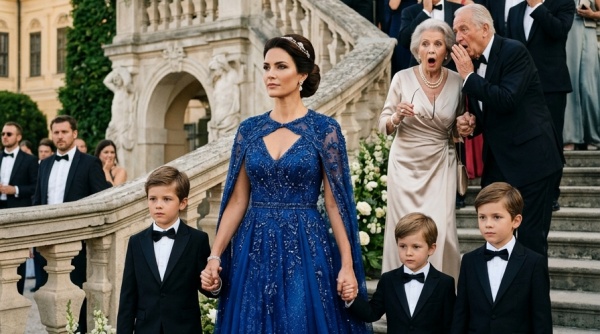
They invited me to my ex-husband’s wedding because they thought I would sit in the back and watch him replace me. What they didn’t expect was that I would arrive with our five-year-old triplet sons—three little boys his powerful family had spent years pretending did not exist. The moment we walked into that Lake Forest mansion, every whisper stopped, because my sons looked exactly like the man standing at the altar.
Part 1: The Invitation in Gold Ink
They thought I would arrive broken. That was exactly why the Whitcomb family sent me the invitation. It came in a thick cream envelope, my name written in gold calligraphy so perfect it looked less like handwriting and more like a warning.
The Whitcombs were Chicago old-money royalty. Their fortune came from railroads, banking, real estate, and three generations of marrying people whose last names belonged on hospital wings and university libraries. They lived in a limestone mansion in Lake Forest, drove quiet luxury cars, and had the kind of manners that could cut skin without raising a voice.
I had married into that family seven years earlier, back when I was still foolish enough to believe love could outrun class. My ex-husband, Grant Whitcomb, had been charming, handsome, and polished in the effortless way rich men are when nobody has ever let them fail publicly. He told me I was “real,” which I later learned meant I was charming as long as I stayed grateful.
I was not from their world. My mother was a nurse from Joliet, my father drove trucks before his back gave out, and I worked my way through Northwestern with scholarships, student loans, and weekend shifts at a restaurant in Evanston. To the Whitcombs, that made me ambitious at best and suspicious at worst.
Grant’s mother, Eleanor Whitcomb, never forgave me for existing near her family tree. She was elegant, controlled, and cold enough to make a Chicago January feel friendly. She could smile at you over a crystal glass of white wine and somehow make you feel like you had shown up barefoot.
When Grant and I divorced, Eleanor treated it like a stain being removed from silk. She did not shout, threaten, or beg. She simply arranged meetings, hired attorneys, and made sure every conversation reminded me that I was temporary.
What she did not arrange was the timing of my pregnancy. By the time the divorce papers were filed in Cook County, I was twelve weeks pregnant and too sick every morning to pretend I was fine. When the ultrasound showed three heartbeats, I sat in the exam room and laughed so hard I cried.
Triplets. Three sons. Three tiny, impossible lives arriving just when the Whitcombs thought they had erased me.
Grant knew. Despite what his family later told people, he knew from the beginning. My attorney sent the medical records through proper channels, paternity was established legally after the boys were born, and child support was set by the court.
But knowing is not the same as showing up. Grant paid because the law required it, and because men like him fear judges more than guilt. He visited twice in five years, both times with the emotional warmth of a board meeting.
My sons were named Oliver, Henry, and Miles. They were five years old when the invitation arrived, identical in the way triplets can be identical to strangers but completely different to their mother. Oliver was careful and observant, Henry was fearless, and Miles had a gentle seriousness that made adults lower their voices around him.
They had Grant’s eyes. Not similar eyes. His exact gray-blue eyes, the kind the Whitcomb family praised in oil portraits and Christmas cards. They also had his grandfather’s dimpled chin, his father’s dark blond hair, and the unmistakable Whitcomb habit of lifting one eyebrow when confused.
That was why Eleanor had never wanted them photographed publicly. She could deny legal documents to her friends if she spoke with enough confidence. She could not deny three little boys walking through a room with the Whitcomb face repeated like a family secret refusing to stay buried.
The wedding invitation was for Grant and his new bride, Caroline Mercer. She was twenty-nine, beautiful, and from a powerful political family in Illinois. Her father had served in the state senate, her uncle was a federal judge, and her mother chaired charity boards where people paid $5,000 a table to pretend they cared about the poor.
Grant was forty-one. He had inherited more money than most people earn in ten lifetimes, but he still liked calling himself self-made because he once started a private equity fund using only family connections and $12 million of seed capital. Caroline made sense for him in the way mergers make sense.
The ceremony would be held at the Whitcomb estate in Lake Forest. Black tie optional. Ceremony at five o’clock. Reception to follow. At the bottom, in smaller script, it said, “Adults preferred, except family.”
Except family.
I stared at those two words for a long time. Eleanor had probably included them for nieces, nephews, and flower girls from acceptable bloodlines. I doubt she imagined I would read them as permission.
But my sons were family. Legally, biologically, and in every way Eleanor had spent five years pretending they were not. If she wanted to invite me for humiliation, she should have read her own stationery more carefully.
I called my attorney, Denise Caldwell, the same woman who had handled my divorce and paternity proceedings with the calm precision of a surgeon. Denise listened while I read the invitation out loud. Then she asked the only question that mattered.
“Do you want to go because it will help you, or because it will hurt them?” she said.
I looked across the living room at my boys building a crooked Lego tower on the rug. They were laughing, all three heads bent together, unaware that an entire family had spent years treating them like an inconvenience. My answer came slowly, but clearly.
“I want them to stop pretending my children don’t exist,” I said.
Denise was quiet for a moment. Then she said, “Do not make a scene. Do not threaten anyone. Bring copies of documents only if you need to establish that the children have a right to be present as invited family. Stay calm, leave if necessary, and remember that your dignity is your strongest evidence.”
That was Denise. She could turn emotional devastation into bullet points.
I RSVP’d the next morning. “Natalie Brooks attending with Oliver Whitcomb, Henry Whitcomb, and Miles Whitcomb.” I used their legal last name because Grant had insisted on it during the paternity case, back when he thought giving them his name without his time was a generous compromise.
Three days later, Eleanor called me.
I knew it was her before I answered. No one else could make a phone ring sound expensive. Her voice came through smooth and sharp, like polished silver.
“Natalie,” she said, “there seems to have been a misunderstanding regarding your RSVP.”
“No misunderstanding,” I replied. “The invitation said family children were permitted.”
A pause followed. It was small, but I heard it. Eleanor Whitcomb was not used to being answered directly.
“This is a formal wedding,” she said. “It may not be suitable for young children.”
“My sons are well-behaved.”
“That is not the point.”
“Then what is the point, Eleanor?”
Another pause. Somewhere behind her, I could hear the faint clink of glass, as if she were standing in that enormous kitchen with marble counters and staff who knew better than to appear curious.
“The point,” she said carefully, “is that this day is about Grant and Caroline.”
“Then you probably should not have invited his ex-wife,” I said.
Her voice cooled further. “We invited you as a gesture of maturity.”
“No,” I replied. “You invited me as a display. I’m accepting as family.”
For the first time in all the years I had known her, Eleanor had no immediate response. That alone felt worth the price of dry cleaning.
Finally, she said, “I trust you will behave appropriately.”
I looked at my sons again. Oliver was placing a blue Lego piece carefully on top of the tower while Henry shouted instructions and Miles guarded the base with both hands.
“I always do,” I said. Then I ended the call.
Part 2: The Marriage They Tried to Rewrite
When I first met Grant, he did not seem cruel. That is the part people misunderstand about men who let their families destroy you. They are often warm in private, charming in public, and weak exactly where strength matters most.
We met at a fundraiser in Chicago, at a rooftop event overlooking the river. I was working for a nonprofit then, helping coordinate donor relations, and Grant was one of the young board members who arrived late and somehow made everyone grateful. He spilled champagne on his own sleeve while reaching for a program, and I laughed before I could stop myself.
He liked that. He told me later that most women in his circle treated him like a résumé with cufflinks. I treated him like a person, and at the time, I thought that was love.
For the first year, he was attentive in a way that felt almost cinematic. He sent flowers to my office, remembered my mother’s birthday, and once drove from the Gold Coast to Evanston in a snowstorm because I said I wanted Thai food from one specific place. He made me believe I had been chosen, not collected.
Eleanor noticed before anyone else. She invited me to lunch at the Peninsula Hotel and spent ninety minutes asking questions that sounded polite if you ignored the blade underneath. Where did my parents live? Did I have family money? Had I ever considered how difficult it was to adjust to a different social environment?
Grant told me not to take it personally. “She’s protective,” he said, kissing my forehead. “She’ll come around.”
That became the theme of our marriage. Eleanor was protective. Eleanor was traditional. Eleanor meant well. Eleanor had standards. Everyone had an explanation for her cruelty except the word cruelty.
Our wedding took place at a cathedral in Chicago with seven bridesmaids, two newspaper mentions, and flowers that cost more than my first car. My mother cried when she saw me in the dress. Eleanor cried only when the photographer asked for a picture of our families together.
After the honeymoon, Grant and I moved into a townhouse near Lincoln Park that his family owned through a trust. I tried to make it a home, but it always felt like a beautiful hotel room where I was expected to leave no trace. Eleanor had opinions about the curtains, the china, the guest list, and eventually, my womb.
“When you have children,” she once told me over brunch, “you’ll understand the importance of legacy.”
I remember smiling because I was newly married and still believed patience was a virtue. “I think children are more than legacy,” I said.
She looked at me as if I had mispronounced a word in French. “Of course,” she said. “But legacy matters.”
Grant changed slowly. That is how it happens in families like his. They do not rip love away from you at once. They sand it down little by little until you are holding something smooth, cold, and unfamiliar.
He started correcting me in public. Not loudly, never enough for anyone to call him rude. Just small things: the way I pronounced a donor’s name, the restaurant I suggested, the dress I wore to a charity luncheon. “My mother may be right,” he would say, as if that settled anything.
By our second anniversary, I was lonely in rooms full of people. I could stand beside my husband at a gala, wearing diamonds loaned by his mother, and feel more invisible than I had ever felt waiting tables in college. At least then, people looked at me when they asked for something.
The divorce began after a dinner at Eleanor’s house. Grant had been drinking bourbon, Caroline Mercer had been there with her parents, and I noticed the way Eleanor watched them speak. It was not romantic at the time. It was strategic.
On the drive home, Grant said he needed space. By the next week, he said we were different people. By the end of the month, his attorney had contacted mine.
I found out I was pregnant two days after Grant moved into a luxury apartment downtown.
When I told him, he sat across from me in a conference room at his lawyer’s office and looked more inconvenienced than shocked. Eleanor was not in the room, but her presence was everywhere, in his posture, in his silence, in the expensive pen he kept clicking open and shut.
“Are you sure?” he asked.
I stared at him. “That I’m pregnant?”
“That it’s mine.”
Something inside me broke so cleanly I almost did not feel it at first. I had been faithful to him through loneliness, humiliation, and the slow death of hope. He knew that, and still he chose the question that would please his mother.
My attorney placed a hand lightly on my folder. “Paternity can be addressed legally after birth,” she said. “For now, we will document the pregnancy and proceed appropriately.”
Grant looked relieved that someone had turned my pain into procedure.
The pregnancy was hard. Triplets are not a romantic complication. They are high-risk appointments, swollen feet, blood pressure checks, sleepless nights, and strangers telling you that you look ready to “pop” when you are only twenty-six weeks along.
My mother moved in with me. Friends brought casseroles, diapers, and the kind of loyalty money cannot buy. Eleanor sent nothing, though I later learned she told people I was “using the pregnancy to remain attached to the family.”
The boys were born early at Northwestern Memorial on a freezing morning in February. Oliver arrived first, furious and loud. Henry came next, tiny but determined. Miles was last, quiet enough that I held my breath until he cried.
Grant came to the hospital on the second day. He stood near the NICU window wearing a cashmere coat and an expression I could not read. When he saw the three incubators, his face shifted for one second into something like wonder.
Then his phone buzzed, and the moment disappeared.
The DNA test later confirmed what I already knew. Grant was their father. The court established child support, health insurance obligations, and his legal responsibility. He accepted all of it the way a man accepts a parking ticket he plans to complain about later.
But he did not become a father. Not in the ways that mattered. He sent checks, approved insurance forms, and occasionally mailed birthday gifts chosen by an assistant. He did not know which son hated carrots, which one had asthma, or which one needed to be sung to before sleep.
Eleanor saw them only once before the wedding. They were six months old, sitting in infant seats in my apartment in Evanston, all three dressed in soft blue pajamas my mother bought at Target. Eleanor looked down at them and went pale.
“They look like him,” she said.
“Yes,” I replied.
She did not touch them. She did not ask to hold them. She simply stared, as if biology had betrayed her personally.
Before leaving, she said, “It may be best for everyone if the boys are raised outside the public family narrative.”
I remember laughing, not because it was funny but because sleep deprivation had made me honest. “They are children, Eleanor. Not footnotes.”
Her mouth tightened. “You should think carefully about what kind of life you want for them.”
“I want a life where they are loved.”
She looked around my small apartment, at the folded laundry, the three bassinets, the diaper boxes stacked by the wall. “Love is not always enough.”
“No,” I said. “But it’s more than you brought.”
She left without saying goodbye.
For five years, I raised my sons in the space between Grant’s money and his absence. I worked remotely in nonprofit development, then moved into consulting for fundraising campaigns. I built a career during nap times, after bedtime, and in the quiet hours when other people slept.
We did not live like Whitcombs, but we lived well. We had a small house in Evanston with a backyard, a minivan with crumbs in every crevice, and a refrigerator covered in preschool art. My boys grew up knowing they were wanted, even if their father treated parenthood like a legal category.
Then the wedding invitation arrived.
And everything Eleanor had buried began walking toward her front door in matching navy blazers.
Part 3: Three Little Boys at the Mansion Door
The day of the wedding was bright, cold, and windy, the kind of October day Chicago uses to remind everyone winter is standing nearby with its arms crossed. I dressed the boys in navy blazers, white shirts, gray pants, and tiny leather loafers they hated immediately. Each wore a small silver tie clip shaped like a star, because Miles said weddings needed “something shiny.”
I wore a dark green dress, simple heels, and my mother’s pearl earrings. I did not dress to compete with the bride. I dressed like a woman who had survived the worst thing that family could do to her and still knew how to stand straight.
My mother came over before we left. She adjusted Oliver’s collar, smoothed Henry’s hair, and crouched in front of Miles. Her eyes were wet, but her voice stayed steady.
“You boys stay close to your mom,” she said. “Use your manners. And if anyone makes you uncomfortable, you tell her.”
Henry nodded seriously. “Are we seeing the mansion?”
“Yes,” I said.
“Does Daddy live there?”
“No,” I replied. “His family does.”
Oliver looked at me in the mirror near the front door. “Will Daddy be happy to see us?”
There are questions children ask that deserve better answers than adults have available. I could have lied. I could have said yes with the cheerful cruelty people use when they want children to stop asking.
Instead, I knelt in front of him. “I don’t know how he will feel,” I said. “But you have done nothing wrong. You are allowed to be there.”
Oliver thought about that, then nodded.
We drove from Evanston to Lake Forest in a black SUV I had hired because I refused to arrive at the Whitcomb estate frazzled from parking three children near a valet line. The boys pressed their faces to the windows as we passed tree-lined streets, iron gates, and houses set so far back from the road they looked like private museums.
When the Whitcomb mansion appeared, even Henry went quiet.
It sat behind a long driveway, all limestone, ivy, and enormous windows glowing with warm light. White tents stretched across the back lawn, and staff in black uniforms moved like shadows between floral arrangements, champagne trays, and guests wrapped in wool coats and diamonds.
The valet opened my door first. His eyes flicked to the boys, then back to me, professional but curious. I thanked him and helped each child out one by one.
Oliver took my left hand. Miles took my right. Henry walked slightly ahead, trying to look brave and failing in the sweetest possible way.
The first people to notice us were two older women near the entrance, both wearing pearls and expressions trained by decades of country club judgment. One leaned toward the other and whispered something behind her program. Then her whisper died halfway through.
She had seen the boys’ faces.
The silence spread strangely. Not all at once, but in ripples. A cousin stopped laughing near the coat check. A man in a tuxedo lowered his glass. A bridesmaid glanced over, smiled politely, then froze as her eyes moved from Oliver to Henry to Miles.
I had imagined this moment many times, but imagination had not prepared me for the sound of old money losing its breath.
The entrance hall was exactly as I remembered it. Black-and-white marble floor, sweeping staircase, portraits of dead Whitcomb men who all looked vaguely displeased. Above the fireplace hung a painting of Grant’s grandfather, Charles Whitcomb III, with his gray-blue eyes and dimpled chin.
Miles looked up at the portrait, then tugged my hand. “Mommy,” he whispered, “that man looks like us.”
Half the foyer heard him.
No one laughed.
Eleanor appeared at the top of the staircase as if summoned by discomfort. She wore a champagne-colored gown, diamonds at her throat, and the same controlled smile she had once used while telling me I did not understand legacy. Her eyes landed on me first with satisfaction.
Then she saw the boys.
I watched the color drain from her face.
For one beautiful second, Eleanor Whitcomb looked exactly like what she was: a woman who had planned a humiliation and accidentally invited the truth.
She descended the stairs slowly. Guests parted for her, not because she asked them to but because the room had been trained to respond to her movements. When she reached us, her smile returned, thinner than before.
“Natalie,” she said. “You came.”
“You invited me.”
Her eyes moved to the boys, and for a moment her mask slipped again. Oliver stood closest to her, solemn and watchful. Henry stared openly at the chandelier. Miles leaned against my leg, one hand wrapped around my fingers.
“I was not aware you intended to bring the children,” Eleanor said.
“I included them in the RSVP.”
“This is highly irregular.”
“They are Grant’s sons,” I said calmly. “The invitation allowed family children.”
Several guests heard that. I saw the words hit the room like dropped silverware.
Eleanor’s jaw tightened. “This may not be the appropriate setting.”
“You chose the setting.”
Her eyes sharpened, but her voice stayed low. “Do not do this today.”
I smiled, just slightly. “Do what? Attend a wedding I was invited to?”
Before she could answer, Henry pointed toward the portrait. “Is that our grandpa?”
The silence deepened.
Eleanor looked like she might shatter.
A younger woman I recognized as one of Grant’s cousins stepped forward, staring at the boys with open shock. “Aunt Eleanor,” she whispered, “they look exactly like Grant did.”
Eleanor did not turn around. “Not now, Claire.”
But it was too late. The guests were looking. Not glancing, not politely observing, but looking with the focused hunger of people realizing a scandal had entered through the front door wearing loafers.
Then Grant appeared.
He came from the hallway leading to the groom’s suite, adjusting his cufflinks, smiling at something a groomsman had said behind him. He looked handsome, expensive, and completely unprepared. His smile faded before he reached the bottom of the stairs.
The boys saw him at the same time.
Oliver tightened his hand around mine. Henry stopped moving. Miles whispered, “Daddy?”
Grant heard it.
Everyone heard it.
He stood ten feet away from us, frozen in his tailored tuxedo, staring at three small versions of himself. For once, he did not have Eleanor’s voice ready in his head. For once, he could not turn the truth into something tasteful.
Caroline Mercer entered behind him in a white silk robe, her hair half pinned for the ceremony. She was not supposed to be seen yet, but clearly someone had told her something was happening. Her eyes went from Grant to me, then to the boys.
The confusion on her face was not fake.
That was when I realized Grant had not told her everything.
Maybe he had mentioned children in some vague, minimized way. Maybe he had called it complicated. Maybe he had let her believe the boys were part of a distant past, not three living children with his eyes standing in his mother’s foyer.
Caroline looked at Grant. “Who are they?”
No one moved.
Grant opened his mouth, but nothing came out.
I answered because the boys deserved one adult in that room willing to say their names.
“This is Oliver, Henry, and Miles,” I said. “Grant’s sons.”
Caroline’s face changed.
Not dramatically. Not like in a movie. It changed the way a woman’s face changes when a missing piece slides into place and cuts her on the way in.
“Your sons?” she asked Grant.
He swallowed. “Caroline, I can explain.”
The old sentence. The favorite sentence of men who know explanation is the only thing left after honesty fails.
Caroline stepped back once. “Before or after the ceremony?”
No one spoke.
Outside, the string quartet began warming up, the soft notes floating through the open doors like they belonged to another world.
Part 4: The Seat Eleanor Chose
Eleanor recovered first because women like her practice recovery the way other people practice piano. She turned toward the nearest staff member and said, “Please escort Ms. Brooks and the children to their seats.” Her voice was controlled, but the tips of her fingers trembled against her clutch.
I knew about the seat already. Denise had warned me not to react when I saw it. Eleanor had placed me in the back row near the side exit, close enough to be visible but far enough to be diminished.
She had intended for me to sit alone while guests whispered about how easily Grant had upgraded. She wanted me framed as history. A cautionary tale in last season’s dress.
Instead, I walked into the ceremony space holding the hands of three five-year-old boys who looked like the groom had been copied and pasted.
The back row was marked with a small card: Natalie Brooks. One chair. Not four.
I looked at the staff member, a young woman with terrified eyes. “There seems to be a mistake,” I said gently. “We need four seats.”
She glanced toward Eleanor, who had followed us at a distance like a storm in pearls. Eleanor stepped forward before the poor woman could answer.
“The children may wait with staff inside,” Eleanor said.
“No.”
The word was quiet, but it stopped her.
Eleanor’s smile hardened. “Natalie, this is not a preschool recital.”
“No,” I said. “It’s their father’s wedding.”
A few guests nearby turned their heads. I could feel the room listening while pretending not to. The boys stood close to me, unusually quiet now, sensing adult tension in the way children always do.
Grant appeared behind Eleanor, with Caroline beside him now wearing a robe covered by a cashmere wrap. Her hair was still half-done, and there was a diamond clip in one hand. The wedding planner hovered nearby, pale and helpless.
Caroline looked at the single chair, then at the boys. Something like anger moved across her face, but it was not directed at me.
“You gave them one seat?” she asked Eleanor.
Eleanor lifted her chin. “This is an already delicate situation.”
Caroline laughed once, softly and without humor. “Delicate?”
Grant reached for her arm. “Caroline, please.”
She pulled away. “No. I asked you if there was anything about your divorce I needed to know before marrying you. You said there were no surprises.”
Grant looked at the boys, then at me. “I told you I had children.”
“You said you had ‘limited involvement’ because things were difficult with your ex,” Caroline said. “You did not say you had triplet sons who look like they walked out of your baby pictures.”
Henry raised his hand a little. “We’re five.”
Caroline blinked at him, and for one second, all the politics, money, and scandal fell away. She looked at a little boy correcting the record because that is what children do. Her face softened despite herself.
“Yes,” she said quietly. “I can see that.”
Grant rubbed his forehead. “This isn’t the time.”
I almost laughed. He had ignored them for five years, but suddenly timing mattered.
Caroline turned to me. “Did you come here to stop the wedding?”
“No,” I said. “I came because I was invited, and because my children are not a secret.”
That answer seemed to land somewhere she could respect.
Eleanor stepped in. “Caroline, this woman has always been difficult.”
I turned to her slowly. “Difficult means I kept records.”
Eleanor’s eyes flashed.
From my purse, I removed a slim folder. I had no intention of waving legal documents at a wedding, but Denise had insisted I bring them in case Eleanor tried to deny the boys’ right to be present. I held the folder at my side, visible but not theatrical.
“Paternity was legally established in Cook County,” I said. “Grant is their father. Child support and insurance obligations are court ordered. Their last name is Whitcomb because Grant requested it through counsel.”
The nearby guests heard every word. So did Caroline. So did Grant.
Eleanor’s face looked carved from ice. “This is vulgar.”
“No,” I said. “Pretending children don’t exist because they complicate a wedding program is vulgar.”
The words hung in the air.
For five years, I had imagined saying something like that to her. In my imagination, I shouted. I cried. I shook with rage.
In reality, I said it calmly while holding my son’s hand.
Caroline looked at Grant. “How often do you see them?”
Grant’s silence answered before he did.
“Natalie made it hard,” he said finally.
That was the moment I felt my last thread of pity for him snap.
I opened the folder, removed one page, and handed it not to Caroline, but to Grant. It was the parenting schedule from our original order, the one he had requested be “flexible” because of his business commitments. The one he had failed to use more than a handful of times.
“You had access,” I said. “You had phone numbers, addresses, school information, medical updates, and every opportunity Denise sent through your attorney. Do not lie about my children to protect yourself.”
Grant looked at the paper, then away.
Caroline closed her eyes briefly. When she opened them, they were wet but steady.
“My father needs to know,” she said.
Eleanor’s head snapped toward her. “Absolutely not.”
Caroline looked at her future mother-in-law with sudden clarity. “You don’t get to manage this.”
That sentence may have been the first honest thing anyone in that mansion had said all day.
Grant’s father, William Whitcomb, arrived then. He was quieter than Eleanor, but old money does not require volume. He had the same gray-blue eyes as Grant and my sons, and when he saw Oliver, Henry, and Miles standing together, he stopped as if he had walked into a wall.
For a long moment, he said nothing.
Then he looked at Grant. “Are these boys yours?”
Grant’s mouth tightened. “Yes.”
William inhaled slowly. His gaze moved to me, and for the first time since I had known him, he looked ashamed.
“Natalie,” he said. “I did not know they looked so much like him.”
It was such a strange apology, so inadequate and yet so revealing, that I almost felt sorry for him. Not for the ignorance. For the world he had allowed Eleanor to create around him.
“They have always looked like themselves,” I said.
Miles leaned against my leg. “Mommy, can we sit down now?”
His small voice broke the tension more effectively than any adult could have. Caroline looked at the wedding planner. “Add three chairs next to Ms. Brooks.”
Eleanor stared at her. “Caroline.”
“No,” Caroline said. “If I’m expected to join this family, I’d like to see it clearly.”
The chairs were added.
We sat in the back row, but not hidden anymore. Guests turned to look at us throughout the ceremony preparations, whispering behind programs, pretending to adjust their seats. The boys behaved beautifully, though Henry kept asking when the cake would happen.
Twenty minutes later, the ceremony still had not begun.
Then Caroline’s father arrived, followed by her mother and two men I assumed were family advisors or attorneys. There was a conversation behind closed doors that lasted forty-five minutes. The string quartet stopped playing. Guests began checking watches and phones.
At 5:52 p.m., the wedding planner stepped out and announced that the ceremony would be delayed.
At 6:18 p.m., she announced that the ceremony would not take place that evening.
A gasp moved through the tent.
I did not smile.
This was not victory in the way people imagine victory. My children were tired, confused, and hungry. A woman in a wedding dress somewhere upstairs was learning that the man she planned to marry had edited his life before handing it to her.
Grant approached us as guests began standing. His tuxedo looked less perfect now. His face was pale, and for once Eleanor was not beside him.
“Natalie,” he said.
I stood, keeping myself between him and the boys.
“Not here,” I said.
His eyes moved to them. “Can I talk to them?”
Oliver looked up at me. Henry stared at Grant’s shoes. Miles hid half behind my dress.
“No,” I said. “Not as damage control.”
He flinched.
“I’m their father,” he said, but the words sounded weak even to him.
“You are their legal father,” I replied. “Being anything more will require consistency, patience, and therapy. Not a speech in a hallway because your fiancée found out the truth.”
Grant looked down.
For the first time in years, I saw something close to regret on his face. But regret is not parenting. Regret is not bedtime. Regret is not showing up when a child has a fever, a nightmare, or a school concert.
Eleanor appeared again near the staircase, watching us with hatred polished into composure.
I bent down to the boys. “Time to go.”
Henry looked disappointed. “No cake?”
Despite everything, I laughed. “We’ll get cupcakes on the way home.”
That was when William Whitcomb stepped forward. “Natalie,” he said quietly, “please wait.”
I straightened.
He looked at the boys, then back at me. “I would like to know them.”
Eleanor made a sharp sound behind him. “William.”
He did not look at her. “Enough.”
One word. Quiet. Final.
The foyer went still again, but this silence was different. It was not shock. It was the sound of a man who had been silent too long finally choosing the wrong moment to develop a conscience.
I studied him carefully. “My children are not a family restoration project.”
“I understand,” he said.
“No,” I replied. “You don’t. But if you want to begin understanding, you can contact my attorney. Any relationship with them will be slow, supervised, and based on what is healthy for them, not what repairs your reputation.”
William nodded. “Fair.”
Eleanor looked like she might faint from the humiliation of hearing fairness spoken in her house.
I took my sons’ hands and walked out through the front doors. The valet line was chaos, guests whispering under the portico while staff pretended not to hear. The cold air hit my face, sharp and clean.
Behind us, the mansion glowed like a museum full of things too expensive to touch.
Oliver looked up at me. “Did we do something bad?”
My heart twisted.
I knelt on the stone driveway in my green dress and took his small face in my hands. “No, sweetheart. You did nothing bad. Sometimes adults make mistakes, and sometimes truth makes a room very quiet.”
Henry frowned. “Can truth get cupcakes?”
I laughed then, really laughed, and Miles smiled because he loved when his brothers were ridiculous.
“Yes,” I said. “Truth can absolutely get cupcakes.”
Part 5: What Silence Finally Said
The wedding did not happen that night. By the next morning, Chicago society knew something had gone wrong at the Whitcomb-Mercer ceremony, though the official statement used words like “postponed” and “private family matter.” Rich people never cancel scandals; they rebrand them.
Caroline did not marry Grant.
I learned that two weeks later through Denise, who received a formal letter from Caroline’s attorney requesting confirmation of certain facts regarding the boys. Denise responded professionally, with documentation and no gossip. Caroline sent me one handwritten note afterward.
It said, “I’m sorry for what you and your sons were put through. I wish I had known enough to ask better questions.”
I respected that more than any apology I ever received from a Whitcomb.
Grant began asking to see the boys regularly after the wedding. At first, I did not trust it. A man embarrassed in public can look a lot like a man transformed, and I had learned not to confuse shame with growth.
Denise helped me set boundaries. Supervised visits first. A parenting counselor. No sudden introductions to extended family. No photos posted online, no family PR, no turning my sons into proof that Grant had become a better man.
The first visit happened at a family therapy office in Skokie. Grant arrived early with three identical toy trucks, still in gift bags from a boutique toy store. The boys were polite, curious, and cautious.
Henry asked him why he did not come to their preschool graduation.
Grant’s face folded in on itself. “I should have,” he said. “I’m sorry.”
Oliver asked if he knew their birthdays.
Grant answered correctly, but only because all three shared one. Miles asked if Grant liked pancakes, and that was the question that finally made him cry.
Not loudly. Not dramatically. Just tears he tried and failed to hide while sitting on a small couch across from three children who wanted a father and had been given a stranger.
I did not comfort him.
That may sound harsh, but I had spent too many years making room for Grant’s feelings while carrying the consequences of his choices. His regret belonged to him. My job was to watch my children and make sure his regret did not become another burden placed on their small shoulders.
William Whitcomb contacted Denise exactly as instructed. He requested permission to send birthday gifts, then asked about supervised introductions. Eleanor did not contact anyone.
For months, William met the boys in structured settings: a park in Evanston, a children’s museum, a breakfast place where Henry ordered chocolate chip pancakes bigger than his face. He was awkward with them at first, stiff and overly formal, but he learned.
He learned Oliver liked dinosaurs but hated loud rooms. He learned Henry could charm extra stickers out of any receptionist in Illinois. He learned Miles asked questions so thoughtful they made adults nervous.
One afternoon, after a supervised visit at a park, William stood beside me watching the boys chase each other near the swings. He looked older than he had at the wedding, less preserved by wealth. Maybe truth ages people faster than time.
“I failed them,” he said.
I did not rush to disagree.
“Yes,” I said. “You did.”
He nodded slowly. “I let Eleanor decide what was convenient to believe.”
“That was a choice.”
“I know.”
We stood in silence for a while. The boys were laughing, their cheeks red from cold, their coats unzipped despite my repeated warnings. In that ordinary moment, they looked like exactly what they were: children, not heirs, not scandals, not proof.
William cleared his throat. “I’m changing my estate documents.”
I looked at him sharply. “Do not tell me that as leverage.”
“It isn’t.”
“Good,” I said. “Because they don’t need money more than they need consistency.”
He looked at the boys. “I’m beginning to understand that.”
Eleanor eventually tried to see them. Not through me, of course. She sent a message through William, written in the language of people who believe apology is something staff can arrange. She said she hoped to “move forward as a family.”
I told Denise to respond that any contact would require a written acknowledgment of past harm, participation in family therapy, and clear respect for my parental boundaries.
Eleanor never replied.
I was not surprised.
People like Eleanor can survive embarrassment. Accountability is what they cannot breathe through.
Grant did improve, slowly and imperfectly. He showed up for visits. He learned the boys’ teachers’ names. He attended a pediatric appointment and looked shocked by how much information parenting required when assistants were not involved.
The boys did not run into his arms like a movie ending. Children are more complicated than that. Oliver watched him carefully, Henry tested him constantly, and Miles loved him with a softness that made me protective and afraid.
But Grant kept showing up.
That mattered.
One year after the wedding that wasn’t, I drove the boys past Lake Forest on the way to a fall festival. Henry saw a large mansion behind a gate and asked if that was “the quiet house.” That was what he called the Whitcomb estate.
“No,” I said. “Different house.”
“Do we have to go back there?” Oliver asked.
“Not unless you want to someday.”
Miles looked out the window. “It was weird.”
“Yes,” I said. “It was.”
Henry kicked his feet against the booster seat. “But the cupcakes after were good.”
That made all of us laugh.
The truth is, I never intended to become the woman who walked into a millionaire’s wedding with triplets and stopped a mansion cold. I wanted a simpler life than that. I wanted a husband who loved me loudly enough that his mother’s disapproval could not drown it out.
I wanted my sons to know their father from the beginning. I wanted baby pictures with two exhausted parents, not court documents in a folder. I wanted birthday parties where no one had to explain why one side of the family was missing.
But life does not always give you the story you deserve. Sometimes it gives you the one you must survive. Sometimes it hands you an invitation meant to humiliate you and waits to see whether you understand your own worth.
Eleanor thought she was inviting the woman Grant had left behind.
She did not understand that the woman she remembered no longer existed.
That woman had cried in hospital bathrooms, learned custody language before her sons could say full sentences, worked during nap times, stretched child support across three growing bodies, and built a home where love did not depend on a last name. That woman had become someone Eleanor could not seat in the back and diminish.
The mansion went silent because my sons looked like Grant.
But the deeper silence came from something else.
They looked loved.
They looked cared for, protected, and whole. They walked into that house not as secrets, not as mistakes, not as inconvenient proof of a marriage the Whitcombs wanted erased. They walked in as children whose mother had refused to let wealth decide their worth.
Grant lost a wedding that day. Eleanor lost control of the story. William lost the comfort of pretending he had not known better.
And me?
I lost the last bit of fear I had carried from that family.
I used to think power looked like mansions, money, famous last names, and rooms full of people lowering their voices when you entered. Now I know power can look like a mother holding three small hands and walking through a door she was never supposed to enter with her head held high.
They invited me to witness my replacement.
Instead, they witnessed my sons.
And when the entire mansion went silent, I finally heard what that silence really meant.
It meant they could not erase us anymore.
