He Humiliated His Wife at Their Son’s Birthday Party — Then the Ballroom Doors Opened and Her Trillionaire Father Walked In and Froze the Entire Room
Part 1: The Birthday Party He Turned Into a Trial
My name is Evelyn Hart Bennett, and for eight years, I let my husband believe I was ordinary. Not poor, not helpless, not without options, but ordinary enough that he thought he could measure my worth by how quietly I served his life. I was thirty-four, living in Dallas, Texas, married to a man everyone called brilliant and generous. Behind closed doors, Grant Bennett was only generous when people were watching.
Grant was the founder of Bennett Meridian Group, a luxury real estate development company that built glass towers, golf communities, private medical suites, and branded residences across Texas, Florida, Arizona, and Nevada. He was not a billionaire, though he liked people to think he was close. He wore Italian suits, drove a black Range Rover, and corrected waiters with the confidence of a man who believed money made him taller. To the public, he was a self-made American success story.
To me, he was the man who had slowly turned marriage into a room with no doors. He never started that way, of course. Men like Grant rarely begin with cruelty; they begin with charm, attention, and the kind of confidence that feels like safety when you are young enough to mistake control for certainty. By the time you realize the difference, you have already learned how to lower your voice.
I met Grant when I was twenty-six and working under my middle name, Eve Hart, as an event designer in Austin. He came to a charity gala I helped coordinate, complimented the lighting, and asked if I always made rich people feel more elegant than they really were. I laughed because he was charming then. He listened carefully, remembered tiny details, and made me feel seen without making me feel studied.
When he proposed eighteen months later, I said yes because I believed he loved my quiet life. He knew I liked old bookstores, breakfast tacos, handwritten thank-you notes, and taking long walks even when it was ninety-five degrees outside. He told me I was peaceful. I did not yet understand that some men call a woman peaceful when they really mean easy to control.
My father warned me gently before the wedding. Nathaniel Hart was not the kind of man who raised his voice. He was calm, private, precise, and almost impossible to read unless you knew him well. The world knew him as the founder of Hartwell Global, a privately held infrastructure, energy, logistics, AI, and aerospace conglomerate worth around $1.2 trillion.
I knew him as Dad, the man who made pancakes in dress shirts and kept every birthday card I had ever made him. I was his only child, and almost nobody knew. That was not an accident. After my mother died when I was seventeen, Dad became fiercely protective of my privacy.
We had watched relatives, executives, journalists, opportunists, and strangers suddenly become affectionate when they realized what proximity to our name could mean. So when I became an adult, I chose to live quietly under my mother’s maiden name. I wanted to know who loved me before they knew what my last name could buy. Grant knew my father was “in business,” but he did not know Nathaniel Hart was my father.
At first, that omission felt like protection. Later, it became the only piece of myself Grant had not managed to touch. I told myself I was being cautious, not secretive. I told myself that if Grant loved me as Eve Hart, then I had found something real.
Our son, Oliver, turned seven on a Saturday in May. He loved dinosaurs, magic tricks, chocolate cake, and telling adults facts they had not asked for. For his birthday, he wanted a “dinosaur museum party with fancy lights.” Somehow, Grant turned that into a ballroom event at the Adolphus Hotel in downtown Dallas because nothing involving his son could be allowed to look simple.
Grant said the party needed to “reflect the Bennett brand.” I told him Oliver wanted fossil cupcakes and a magician. He hired a photographer, a string quartet, two balloon artists, a custom dessert table, and a PR assistant to make sure photos looked “family-forward.” My son’s birthday became another room where Grant could perform fatherhood.
Still, I made sure Oliver had what he wanted. There were dinosaur footprints on the floor, a fossil-dig station, and a chocolate volcano cake with tiny sugar pterodactyls flying over red frosting lava. I wrote the cake message myself: Happy 7th Birthday, Oliver — You Are Our Greatest Adventure. When the baker showed me the finished design, I cried in the walk-in pantry because it looked like childhood, not branding.
Grant hated the cake the moment he saw it. “This looks childish,” he said, standing beside the dessert table in his navy suit. “It’s a child’s birthday cake,” I answered. He gave me the look I had come to fear: not anger yet, but the gathering of it.
“There are investors here,” he said quietly. “This party is being photographed.” I looked across the ballroom at Oliver, who was wearing a little khaki explorer vest and showing another child how a triceratops lowered its head. “Then they’ll see a happy seven-year-old,” I said. “That should be enough.”
Grant smiled tightly, and I knew the punishment would not come right away. With Grant, punishment came after he had chosen the audience that would make it hurt the most. That afternoon, the audience was perfect: wealthy guests, business associates, family friends, hotel staff, cameras, and one little boy who still believed his father was the strongest man in the room. I tried to keep smiling for Oliver.
The party began beautifully. Oliver laughed through the magic show, roared at the dinosaur mascot, and hugged me so hard his explorer hat fell off. I let myself relax for almost twenty minutes. Then Grant tapped his champagne glass with a fork and called everyone’s attention to the cake.
He made a speech about legacy, family, ambition, and “building something worth inheriting.” He said Oliver had Bennett blood, Bennett discipline, and Bennett expectations. I watched my son’s smile fade slightly, though he tried to keep standing tall. Seven-year-olds should not have expectations placed on them like stock options.
Then Grant turned to me. “And of course,” he said, with the room listening, “we thank Evelyn for handling the cute little details.” A few people laughed politely. I smiled because I had learned that public survival sometimes looked like grace.
Grant continued, “Even if she occasionally forgets that our family has a standard.” The laughter thinned. My stomach tightened. I stepped closer and said softly, “Grant, not today.”
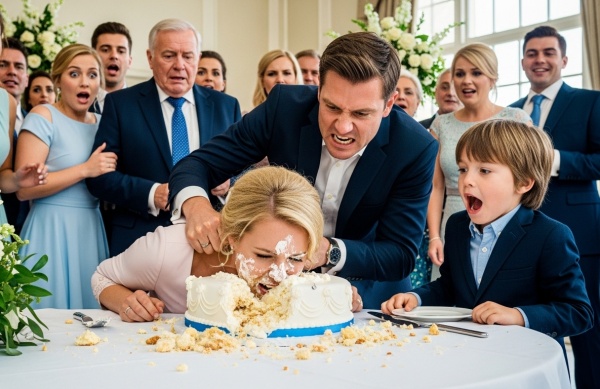
That was the wrong thing to say to a man who wanted obedience more than peace. His jaw shifted, and he looked at the cake, then at me, then at the room. “Actually,” he said, voice bright and cruel, “today seems like the perfect day to remind everyone that presentation matters.” Before I fully understood what he meant, his hand was on the back of my neck.
He pushed my face down into Oliver’s birthday cake. It lasted only a second, but some seconds split a life in half. There was frosting in my hair, chocolate against my cheek, and silence so sudden it felt like the whole ballroom had stopped breathing. Then I heard my son’s small, terrified voice say, “Daddy, why did you do that?”
Grant released me as if the scene were a joke that had simply landed badly. “Oh, come on,” he said, forcing a laugh. “It’s cake. Everyone relax.” No one relaxed. Even the string quartet had stopped playing.
I lifted my head slowly. Frosting slid from my chin onto my pale blue dress, the one Oliver had chosen because he said it made me look like “sky.” My hands trembled, but I did not scream or slap Grant. I did not give him the chaos he could later use against me. I looked only at Oliver.
My son stood beside the cake table, eyes wide, lower lip shaking, dinosaur hat crooked on his head. In that moment, all the years I had minimized, excused, softened, translated, and survived became unforgivable. Not because Grant had humiliated me. Because he had taught our son what humiliation looked like and called it family.
I wiped frosting from my eyes with a napkin. Then the ballroom doors opened. At first, I thought another guest had arrived late. But the room shifted before I even turned around.
The photographer lowered his camera. The hotel staff froze near the service doors. Grant’s face changed from irritation to confusion, then to something close to fear. Standing in the open doorway was my father, Nathaniel Hart.
Behind him were two attorneys, a hotel security manager, and Marian Cole, Hartwell Global’s chief legal officer. My father wore a charcoal suit, no tie, and the expression he reserved for hostile boardrooms and men who mistook silence for weakness. He looked at me, at the frosting on my face, then at Oliver. His voice was calm enough to chill the room.
“Evelyn,” he said, “come to me.” For the first time in years, I did.
Part 2: The Name Grant Never Bothered to Learn
The walk across that ballroom felt longer than any aisle I had ever walked. People moved out of my way without being asked. My heels stuck slightly where frosting had fallen, and my hands shook so badly I pressed them together. I kept my eyes on my father because if I looked at Grant, I was afraid I would see the last eight years all at once.
Oliver ran before I reached the doorway. He threw himself against my legs, crying hard now, asking if I was hurt. I knelt carefully and pulled him into my arms, even though frosting smeared across his explorer vest. “I’m okay, sweetheart,” I whispered. “You did nothing wrong.”
My father crouched beside us. He did not touch Oliver immediately because my father understood frightened children better than many cheerful adults. “Oliver,” he said gently, “I’m your mom’s dad.” Oliver sniffed and looked up. “Grandpa Nathan?”
Dad’s face softened. “Yes,” he said. “Grandpa Nathan.” Grant had reached us by then, moving quickly but trying not to look like he was rushing. “Evelyn,” he said, voice low and sharp, “what is this?”
My father stood, and the room seemed to grow smaller around him. Grant looked from Dad to Marian Cole, then to the attorneys, then back to me. “Who are these people?” he asked. Marian stepped forward with the calm of a woman who had dismantled billion-dollar disputes without raising her voice.
“Marian Cole,” she said. “Chief legal officer of Hartwell Global.” Grant blinked. I watched the name land. Hartwell Global was not just a company; it was a private empire woven through shipping ports, energy grids, logistics corridors, satellites, AI systems, aerospace supply chains, water technology, and data networks.
Grant had spent years trying to get Hartwell executives to return his calls. He had once called Nathaniel Hart “the most disciplined capital allocator alive” at a dinner party. He had not known he was praising my father while ignoring his daughter. Now his face went pale.
“Why is Hartwell Global here?” Grant asked. My father looked at him. “Because my daughter is here.” A murmur moved through the ballroom. Grant’s eyes snapped to me.
“Your daughter?” he said. I wiped frosting from my cheek with the back of my hand. “I told you my father’s name was Nathaniel.” Grant stared at me as if I had tricked him. “You never said Nathaniel Hart.”
“You never asked what kind of man raised me,” I said. “You only asked what I could do for you.” His mouth opened, then closed. For years, Grant had believed my quietness came from lack of power. He had mistaken my privacy for emptiness, my patience for permission, and my last name for my whole story.
Dad looked at Marian. She nodded and turned to the hotel security manager. “We will need the incident footage preserved, including ballroom cameras, hallway cameras, and any service-area angles,” she said. “Please ensure no recordings are deleted or overwritten.” The security manager nodded quickly.
Grant’s expression hardened. “This is ridiculous. It was a joke.” No one laughed. My father’s voice stayed calm. “A joke does not make a child cry like that.”
Grant glanced toward Oliver, but not like a father. Like a man suddenly remembering witnesses mattered. “Oliver knows I was playing,” he said. Oliver buried his face against my dress. That was answer enough.
I looked at Dad. “I want to leave.” “Then we leave,” he said. Grant stepped forward. “You are not taking my son.” His voice carried just enough authority to remind everyone that he was used to being obeyed.
“No one is kidnapping anyone, Mr. Bennett,” Marian said before Dad could answer. “Evelyn is Oliver’s mother. She is leaving a public event after an incident witnessed by dozens of people. Any custody issues will be handled through appropriate legal channels.” Grant’s jaw clenched. “I have rights.”
“Yes,” Marian said. “And so do they.” That sentence, more than the attorneys or the cameras or my father’s name, seemed to frighten him. Grant had built his life around rights that belonged to him and obligations that belonged to everyone else. For the first time, someone said the quiet part out loud.
One of the attorneys, Leah Donnelly, handed me a clean white shawl. I wrapped it around my shoulders while a hotel employee quietly brought warm towels. I cleaned my face as well as I could without looking in a mirror. I did not want the image of myself in that moment burned into my memory more than it already was.
Dad removed his suit jacket and draped it over me anyway. I almost cried then. Not when Grant pushed me into the cake. Not when the room stared. But when my father covered my ruined dress the way he used to cover me with blankets after I fell asleep reading on the couch.
Grant watched the gesture, and something desperate flashed across his face. “Evelyn,” he said, softer now. “Let’s not make this bigger than it is.” I looked at him and understood he still thought the problem was exposure, not harm. He wanted damage control, not accountability.
“You did that in front of our son,” I said. His eyes flicked around the room. “I made a mistake.” “No,” I said. “You made a choice with an audience.”
My father’s hand rested lightly on my shoulder. Grant lowered his voice. “You should have told me who you were.” The sentence was so honest in its ugliness that I almost smiled. “There it is,” I said.
“What?” Grant asked. “You’re not sorry you hurt me,” I answered. “You’re angry you didn’t know I was expensive.” A few people in the ballroom looked down. Grant’s face darkened, but he said nothing.
Dad looked at him with quiet contempt. “My daughter is not expensive, Mr. Bennett. She is priceless. The difference explains why you never deserved her.” Then he turned to me. “Ready?”
I nodded. With Oliver in my arms, my father beside me, and legal counsel behind us, I walked out of the ballroom. Behind me, Grant Bennett stood beside a destroyed birthday cake, surrounded by investors, cameras, and the ruins of the reputation he had spent years polishing. The ballroom doors closed softly behind us, and this time, the silence belonged to him.
Part 3: The Empire Built on Borrowed Respect
My father had a suite upstairs. Of course he did. Not because he wanted drama, but because he had planned to attend Oliver’s party quietly after landing from New York. He had told me earlier that week he might not make it in time, and I told him not to worry because Grant hated surprises.
Dad had replied, “Sometimes surprises are useful.” I did not understand then. In the suite, Oliver sat on the couch wrapped in a hotel robe, eating plain crackers and refusing to take off his frosting-stained explorer vest. Dad ordered warm milk, chamomile tea, and grilled cheese cut into triangles because he remembered I preferred triangles when I was upset.
That nearly broke me again. Grief does not always arrive as sadness; sometimes it arrives as proof that someone paid attention. Marian and Leah spoke quietly near the dining table about documentation, incident reports, witness lists, preservation letters, and possible legal protections if Grant escalated. No one promised revenge.
No one said my father could simply take my child or erase my marriage with money. They spoke in careful legal language, and that made me feel safer than any dramatic threat could have. Oliver eventually fell asleep against my side. Only then did I let myself shake.
Dad sat across from me, his hands folded, eyes heavy with guilt. “I should have insisted sooner,” he said. “No,” I whispered. “I told you I was fine.” He looked at me with the sadness of a father who had known better but respected my choices anyway.
“You sounded like your mother when she was trying not to worry me,” he said. My throat closed. My mother, Clara Hart, had been kind, brilliant, and allergic to spectacle. She believed money should solve problems quietly and never become a personality.
She had also believed people revealed themselves by how they treated service workers, children, and anyone they did not need. Grant had failed all three tests, and I had kept changing the grade. Dad leaned forward. “Has he hurt you before?”
I looked toward Oliver. “Not like today,” I said. Dad did not interrupt. That was why I told him the truth.
I told him about Grant mocking my clothes before investor dinners, then praising my taste when guests complimented me. I told him how he tracked spending even though I paid many household expenses myself, because control mattered more to him than money. I told him how he called me sensitive, ungrateful, dramatic, and cold depending on which word would make me doubt myself fastest. I told him he had never struck me with a closed fist.
That sentence sounded like a defense until I heard it out loud. Dad closed his eyes briefly. “Evelyn,” he said, “you do not need a broken bone to justify leaving.” I cried then because part of me had been waiting for permission no wife should need.
At 8:12 p.m., Grant began calling. First my phone, then Dad’s assistant, then Marian’s office line. He left messages that moved from anger to panic to apology in less than an hour. By 9:30, a statement drafted by Bennett Meridian’s PR consultant had reached Marian.
It described the incident as “an unfortunate family prank misunderstood during an emotionally charged celebration.” Marian read it once and said, “Absolutely not.” Dad did not raise his voice. “He is not using my daughter’s silence to protect his company.”
That was when I learned how entangled Grant had tried to become with Hartwell without knowing it. For the past eighteen months, Bennett Meridian had been courting investment from a private infrastructure fund connected to Hartwell Global. Grant wanted capital for a massive mixed-use development outside Frisco, including luxury apartments, medical offices, a data campus, retail space, and a private school partnership. He called it “the deal that would put Bennett Meridian on the national map.”
He did not know Hartwell’s investment committee had already flagged concerns. Aggressive debt, inflated projections, contractor complaints, employee turnover, a pending wage dispute, and now a public incident involving the founder humiliating his wife at his child’s birthday party. Grant thought the ballroom doors opened because my father was angry. They opened because my father had arrived with receipts.
The next morning, Bennett Meridian’s proposed financing review was formally suspended. Not canceled in revenge, but suspended pending governance review, reputational risk assessment, and examination of leadership conduct. Every word was legal, boring, and devastating. Men like Grant fear boring documents because boring documents cannot be charmed.
By noon, three investors had called him. By two, a lender requested updated disclosures. By four, a local business reporter emailed asking for comment on “an incident at a private family event involving Mr. Bennett.” Grant called me thirteen times.
I answered none of them. Instead, I sat with Leah and discussed next steps. We filed a police report documenting the incident without dramatizing it. We requested copies of available footage and began preparing for divorce and custody proceedings in Dallas County.
I hated every minute of it. Not because I wanted to stay married, but because legal endings make emotional failure feel concrete. Every form asked for dates, addresses, assets, accounts, and facts. No form asked how many times you swallowed humiliation because your child loved his father.
No line item asked what it costs to realize your home has become a stage. Oliver woke up that morning and asked if his birthday was ruined. I told him no. He looked doubtful.
“Your birthday is not what someone else did,” I said. “Your birthday is the day you came into the world, and that will always be good.” He thought about that. Then he asked, “Can I still have cake?”
I smiled for the first time in almost twenty-four hours. “Yes,” I said. “But maybe cupcakes.” Dad arranged a small second birthday in his suite that evening. Just me, Oliver, Dad, Marian, Leah, and two hotel staff members who somehow produced dinosaur cupcakes with green frosting and tiny chocolate fossils.
Oliver blew out one candle and made a wish. When I asked what he wished for, he said, “No more yelling parties.” That was the moment I knew I would never go back. Some truths arrive softly, but they close doors forever.
Part 4: The Man Who Finally Saw the Price
Grant asked for an in-person meeting four days later. My attorneys advised against anything private, and I agreed. We met in a conference room at Leah Donnelly’s office in downtown Dallas. Present were my attorney, Grant’s attorney, Marian as corporate counsel for Hartwell-related matters, and a family mediator serving as neutral observer.
My father did not attend because I asked him not to. I needed Grant to see me without my father standing behind me. Not because I was unprotected, but because I was done being misunderstood as someone else’s extension. I wanted my voice to be the one he had to answer.
Grant arrived in a gray suit, no tie, wedding ring still on, face drawn and pale. He looked like a man who had not slept, or a man who had been introduced to consequences for the first time. For one foolish second, I remembered dancing with him barefoot in our first apartment while rain hit the balcony. Memory is cruel that way.
He sat across from me and said, “Eve.” I said, “My name is Evelyn.” He flinched. Good.
For years, he had used “Eve” when he wanted me soft and “Evelyn” when he wanted me ashamed. That day, I took my name back and placed it between us like a locked gate. Grant folded his hands. “I am sorry,” he said.
I waited. He looked toward his attorney, then back at me. “What happened at the party was unacceptable. I embarrassed you. I scared Oliver. I acted like a man I don’t want to be.”
“That is the first true thing you’ve said,” I replied. His eyes reddened. “I panicked,” he said. “The investors, the pressure, the project, the photographs—” I interrupted him before the excuse could grow legs.
“No,” I said. “You performed.” The room went quiet. “You wanted people to see you correct me,” I continued. “You wanted me small in front of them. You just did not know the room would change.”
Grant looked down. His attorney shifted uncomfortably. I kept going because once truth starts breathing, it does not like being buried again. “You keep saying you made a mistake. A mistake is forgetting candles. A mistake is ordering the wrong flavor.”
“What you did,” I said, “was put your hand on me in front of our child because I did not reflect the image you wanted.” Grant swallowed. “I know.” I looked at him for a long moment.
“Do you?” I asked. “Yes,” he said. “No,” I answered quietly. “You know it was costly. I’m not sure you know it was wrong.”
That broke something in his face. Maybe pride, maybe denial, or maybe just the exhaustion of being finally seen without lighting, music, or applause. He said, “When I found out who your father was, I was angry.” I asked, “At me?”
“Yes,” he admitted. “Because I hid it?” “Because I realized I had no leverage.” There it was again. A truth so ugly it almost sounded clean.
I nodded slowly. “Thank you for saying that.” Grant looked surprised. “I don’t mean it kindly,” I added. “I mean now I know exactly what kind of marriage we had.” He had no answer.
Leah began outlining the separation terms. Temporary custody arrangements, parenting classes, no disparaging remarks in front of Oliver, communication only through a co-parenting app, and no unapproved media statements involving me or our son. There would be financial disclosures, evaluation of marital assets, and temporary orders through proper legal channels. Nothing was dramatic, but everything was firm.
Grant objected to the house. I did not. “I don’t want it,” I said. Everyone looked at me. Grant frowned as if he had misheard.
“I don’t want the house,” I repeated. “Keep it, sell it, stage it for one of your magazines. I don’t care.” His confusion was almost sad. That house had been his trophy, not my home.
It had glass walls, limestone floors, a catering kitchen, and a closet bigger than my first apartment. But it had no warmth. It was the kind of place where every room echoed because no one felt safe enough to be loud with joy. I wanted none of it.
“I want Oliver’s dinosaur books, his school things, his medical records, his stuffed stegosaurus, and the framed watercolor my mother painted,” I said. “Everything else can be handled by counsel.” Grant stared at me as if I had slipped out of a cage he had not realized was unlocked. Maybe that was exactly what had happened.
Marian then addressed Bennett Meridian’s business matters. She made it clear Hartwell was not making decisions based on family revenge. However, Hartwell would not proceed with any investment while leadership risk, disclosure concerns, and governance issues remained unresolved. She recommended Grant appoint an independent chief operating officer and submit to board oversight if he hoped to restore confidence.
Grant’s face hardened. “So I lose my wife and my company?” “No,” I said. “You are being asked to stop treating both like possessions.” He looked at me then, really looked. For years, I had wanted that.
Now it came too late to feel like a gift. The meeting ended without screaming, threats, or table pounding. Just signatures, schedules, and the quiet machinery of a life being legally separated. Sometimes the loudest endings happen in rooms where everyone speaks softly.
As Grant stood to leave, he said, “Did you ever love me?” The question surprised me. “Yes,” I said. “Very much.” His eyes filled.
“Then why didn’t you tell me who you were?” I held his gaze. “Because I wanted to know what you would do with a woman you thought had no power.” He had no answer. That was answer enough.
Part 5: The Door I Walked Through
The divorce took eleven months. In Texas, endings can move quickly when both sides understand the alternative is worse. Grant fought in small ways at first: delays, emotional emails, attempts to speak directly, and complaints that I was being influenced by my father. But every time he tried to turn the story into money, Leah brought it back to conduct.
Every time Grant tried to make himself the victim, Oliver’s therapist brought the focus back to the child. Oliver started therapy two weeks after the party, not because he was broken, but because I refused to let one awful afternoon become a secret that grew roots in him. His therapist, Dr. Melissa Grant, had a room full of sand trays, puppets, toy animals, and soft lamps. Oliver told her the cake “got sad” and Daddy “forgot how to be gentle.”
When Dr. Grant told me that, I cried in the parking lot for twenty minutes. Children soften truths because adults keep proving they cannot handle them. Grant attended court-ordered parenting classes. To his credit, he completed them.
To his greater credit, he did not ask for applause. His visitation began supervised, then gradually expanded as recommended by professionals and approved through legal channels. He learned to speak to Oliver without turning every moment into a lesson about winning. He learned that a seven-year-old does not need a legacy speech; he needs someone to sit on the floor and build a Lego volcano.
Bennett Meridian survived, but not unchanged. The Frisco project was restructured under independent oversight, and Grant stepped back from day-to-day leadership for a period of time. Hartwell never invested directly. Another group came in later under stricter terms, lower valuation, and far less admiration.
Grant remained wealthy, but he was no longer untouchable. As for me, I finally stopped hiding completely. Not in a flashy way. I did not do magazine covers or sit for interviews titled “The Trillionaire Heiress Speaks.”
But I began using my full name again: Evelyn Hart Bennett, and later, after the divorce, Evelyn Hart. Seeing it on legal documents felt like opening a window in a room I had forgotten was airless. Dad asked me to join the board of the Hartwell Family Foundation. At first, I said no.
I thought people would say I had only gotten the role because I was his daughter. Dad replied, “They will say that whether you do the work or not. You may as well do the work.” That was annoyingly persuasive. So I did the work.
We expanded funding for family legal aid, child counseling services, domestic violence prevention programs, and emergency housing for women leaving unsafe relationships. We partnered with Texas nonprofits, clinics, shelters, and school districts. I insisted the programs support women with and without visible injuries. I knew how long I had stayed by telling myself it was not bad enough.
The foundation’s new initiative was called The Open Door Fund. Dad wanted to name it after me, but I refused. The door mattered more than the name. It represented every person who needed a way out before the world agreed they had suffered enough.
A year after the birthday party, Oliver turned eight. This time, we held the party in my backyard under oak trees in Highland Park, with folding tables, paper plates, water balloons, a backyard magician, and a cake from the same baker who made the first one. The cake was chocolate again, with a volcano again, and tiny sugar dinosaurs again. Oliver insisted on the same message: You Are Our Greatest Adventure.
Grant came for the last hour. That was Oliver’s request, approved by the therapist and written into the parenting plan. Grant arrived with a gift, greeted me respectfully, and did not bring a photographer. He wore jeans and a button-down shirt, looking uncomfortable in a way that made him seem almost human.
When Oliver asked him to help with the fossil dig, Grant got dirt under his fingernails and did not complain. Before cake, Grant approached me near the porch. “I know today might be hard,” he said. “It is,” I answered.
He nodded. “I’m sorry.” This time, he did not add an excuse. That mattered. It did not fix the past, but it meant he had finally learned not to decorate an apology with self-pity.
When we brought out the cake, Oliver watched both of us carefully. Children remember more than adults hope. Grant noticed, too. He stepped back, put both hands in his pockets, and let me stand beside Oliver alone.
Oliver blew out the candles. Everyone clapped. Nothing terrible happened. That sounds small unless you have lived through the opposite.
Later that evening, after the guests left and Oliver fell asleep holding a new dinosaur encyclopedia, Dad and I sat on the back porch with iced tea. He had come early to help hang string lights and had somehow managed to burn one tray of hot dogs despite being able to negotiate international shipping agreements. Money, it turns out, does not teach a man grill timing. Dad looked out at the yard and said, “You seem lighter.”
“I am,” I said. “Do you regret not telling him sooner?” he asked. I thought about that for a long time. “Yes and no,” I answered.
“Maybe if I had told him, he would have behaved better,” I said. Dad looked at me. I finished the thought myself. “But that would only mean he knew the price of mistreating me.”
Dad nodded. I watched fireflies blink above the grass. “For a long time, I thought hiding who I was helped me find real love,” I said. “But maybe I confused secrecy with safety.”
“Maybe,” Dad said gently. “Or maybe you were young and trying to survive being wanted for the wrong reasons.” That was the kindest version. I accepted it. Sometimes healing begins when you stop punishing your younger self for not knowing what pain would teach you later.
People online later turned the story into something simple. They said my trillionaire father destroyed my arrogant husband after he humiliated me at our son’s birthday party. They imagined private jets, screaming threats, and a billionaire being crushed by a bigger billionaire. They liked the fantasy of revenge because revenge is easier to understand than recovery.
But that is not what happened. My father did not save me by being rich. He saved me by believing me. The lawyers did not save me by frightening Grant; they saved me by documenting the truth.
The money did not save Oliver. The boundaries did. And I did not save myself by revealing I was Nathaniel Hart’s daughter. I saved myself by finally deciding that my son would not grow up thinking love meant watching one parent shrink so the other could feel tall.
Grant once believed power was the ability to control the room. He learned, painfully and publicly, that real power is often the person who can leave the room with dignity intact. He learned that a woman can be quiet without being weak. He learned that the wife he underestimated had a name, a family, a history, and a door he could not close.
As for me, I still love ordinary things. Bookstores, breakfast tacos, handwritten notes, walks in hot weather, backyard birthdays with paper plates, and too much frosting. The difference is that now ordinary is a choice, not a disguise. I no longer have to hide to feel safe.
Oliver is nine now. He still loves dinosaurs, though he has added space rockets, chess, and a strong opinion about barbecue sauce. He sees his father regularly, and Grant is careful with him in a way I hope becomes natural over time. I do not poison their relationship, but I do not rewrite history either.
When Oliver asks about that birthday, I answer honestly and gently. “Dad made a very wrong choice,” I tell him. “Adults are responsible for their choices. And when someone hurts or scares you, you are allowed to get help.”
That is the inheritance I care about most. Not the trust, not the company, and not the last name that opens doors before I touch the handle. The inheritance I want my son to carry is this: love should never require fear, respect should never depend on status, and no one has the right to make another person small for an audience. That lesson is worth more than any empire.
Sometimes I still remember the ballroom. The cold frosting on my face, the silence, and my son’s frightened voice. Then I remember the doors opening. Not because my father entered like a king, but because I finally walked out like a woman who knew she did not have to stay.
Grant did not know I was a trillionaire’s daughter when he humiliated me in front of everyone. But the truth that destroyed him was not my father’s fortune. It was the simple fact that I was never powerless. I had only forgotten, and when those ballroom doors opened, I remembered.
