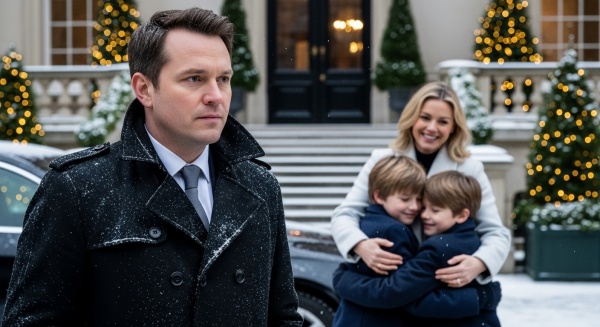
Billionaire Freezes on Christmas After Seeing His Ex With Twin Boys Who Had His Face — Then He Learned Why She Hid Them for 7 Years
Alexander Whitmore thought Christmas Eve in Aspen would be just another polished investor event under holiday lights. Then he saw his ex, Emma, standing in the snow with two little boys who had his eyes, his dimples, and his face. When one of them asked why a stranger looked just like him, Alexander’s entire world stopped. But the truth was worse than he imagined…
Part 1: The Christmas Market in Aspen
Alexander Whitmore had spent seven years proving to the world that nothing could surprise him anymore. At thirty-eight, he was the founder and CEO of Whitmore Aerospace, a private defense and satellite communications company valued at nearly $18 billion. He negotiated with senators, stared down hostile investors, and made decisions that moved markets before breakfast. But on Christmas Eve in Aspen, Colorado, two little boys holding cups of hot chocolate stopped him cold.
He had come to Aspen for work, not nostalgia. Whitmore Aerospace was hosting a private holiday reception for investors, engineers, and government partners near the base of Aspen Mountain. Alexander hated holiday events, but his board insisted billionaires looked more human under string lights. So he put on a charcoal overcoat, walked through the downtown Christmas market, and tried to look like a man who enjoyed carolers.
Snow fell softly over the brick sidewalks. Families moved between wooden booths selling ornaments, roasted almonds, handmade scarves, and mugs of apple cider. Children lined up to meet Santa near a towering Christmas tree wrapped in white lights. Alexander was halfway past a gingerbread booth when he heard a boy laugh.
It was not the laugh that made him turn. It was the face. Two boys, maybe six or seven years old, stood beside a woman in a cream wool coat. They had dark hair, gray-blue eyes, sharp little chins, and identical dimples that appeared only on the left side when they smiled.
Alexander knew those dimples because he saw them in the mirror every morning. One boy was trying to balance a marshmallow on his nose. The other was lecturing him about “gravity being undefeated.” Their voices overlapped in the chaotic rhythm of twins, and then the woman turned slightly to brush snow from one boy’s hair.
Emma Bennett.
Seven years had passed, but Alexander knew her instantly. She was older now, softer around the eyes, stronger in the posture, and somehow even more beautiful than the woman who used to fall asleep reading legal briefs in his old Manhattan apartment. Her brown hair was tucked into a knit hat, and she wore no visible jewelry except a small silver necklace. She looked peaceful in a way that made something inside him ache.
Alexander had not seen Emma since the morning she left him. Back then, he was thirty-one, newly wealthy, newly arrogant, and convinced that love could survive being scheduled between acquisitions. Emma had been a public-interest attorney in New York City, stubborn, brilliant, and allergic to rich men who thought generosity meant control. They had loved each other fiercely for almost two years before everything collapsed in one brutal week.
His mother, Victoria Whitmore, had never approved of Emma. Victoria came from old Boston money and believed family names were investments. Emma came from a middle-class family in Queens, worked for tenants facing eviction, and once told Victoria that inherited manners did not count as character. Alexander had laughed when Emma said it, but Victoria had not.
The official ending had been simple. Emma left a note saying she could not marry a man who would never defend her from his family. The unofficial ending was worse. Alexander believed Emma had chosen a fellowship in California over him because that was what everyone around him had carefully allowed him to believe.
Victoria told him Emma had accepted money to disappear. His attorney said Emma refused all calls. His assistant said every message had been forwarded. Alexander was wounded, furious, and too proud to look harder. So he let Emma become a scar.
Now she was standing fifteen feet away with two boys who looked like him.
One of the twins glanced up and noticed Alexander staring. The boy’s smile faded, and he nudged his brother. Emma followed their gaze, and her face changed. Not dramatically, because Emma had always been too disciplined for obvious panic, but Alexander saw the color drain from her cheeks.
Her hand tightened around the paper cup, and her body shifted instinctively between him and the boys. That small movement hit him harder than any accusation could have. She was protecting them from him. Alexander heard himself say her name before he had decided what to do.
“Emma.”
His voice came out rough. The boys looked between them, confused. The one with the marshmallow asked, “Mom, do you know him?” Mom. The word entered Alexander’s chest like ice water.
Emma swallowed. “Yes, Noah.” The other twin frowned and asked, “Is he from New York?” Alexander took one step forward, then stopped because Emma’s eyes warned him not to come closer. Around them, holiday music played from hidden speakers, and the world continued being bright while his life rearranged itself.
His security chief, Daniel Ross, murmured, “Sir?” Alexander raised one hand without looking back. Emma glanced at Daniel, then at the crowd. “Not here,” she said quietly.
He almost laughed from the shock of it. Not here, as if this were merely an inconvenient meeting between old friends. “Are they mine?” he asked. The words were too blunt, too public, and too late to take back.
Emma closed her eyes for half a second. The twins went completely still. “Alexander,” she said, voice low and controlled, “not in front of them.” That answer was not an answer, and somehow it was worse.
It was confirmation wrapped in mercy. Alexander looked at the boys again, forcing himself to remember they were children, not evidence. One stood slightly in front of the other, trying to be brave. The other held his hot chocolate with both hands, eyes wide and uncertain.
“What are their names?” he asked. Emma hesitated before answering, “Noah and Liam.” The names landed like something stolen from him and something sacred at the same time. Noah studied him with unsettling focus and asked, “Why do you look like us?”
Emma’s face crumpled for one second before she recovered. Alexander could not answer. For years, he had imagined many Christmas Eve scenarios: lonely hotel suites, forced investor dinners, maybe regret after too much scotch. He had never imagined standing under Christmas lights while his son asked why a stranger had his face.
Emma knelt between the boys. “Listen to me,” she said gently. “We’re going to go back to the hotel now, okay?” Liam’s lower lip trembled as he asked if they were in trouble. Emma answered immediately, “No. You did nothing wrong.”
Alexander flinched because the sentence sounded practiced. Children only need that kind of reassurance when adults have already failed them. Emma stood and looked at him. “I’m staying at the Hotel Jerome. If you need to talk, you can send a message through the front desk. But not tonight with them scared.”
Alexander wanted to demand answers. He wanted to ask how, why, when, and who else knew. He wanted to be angry because anger was easier than grief. But the boys were watching him, and some instinct deeper than pride stopped him.
“Tomorrow,” he said. Emma shook her head. “It’s Christmas.” He swallowed hard. “Then the day after.” She nodded once, took each boy by the hand, and walked away.
Alexander stood frozen as they disappeared into the snow-lit crowd. His security chief remained silent, which was wise. Around him, the market kept glowing, the choir kept singing, and somewhere a bell rang for Christmas Eve. Alexander Whitmore, billionaire and man impossible to surprise, stood alone beneath the lights.
For the first time in seven years, he understood that the worst thing Emma had ever done to him might not have been leaving. It might have been surviving him. And somewhere inside that terrible realization, another truth began to form. If those boys were his, then he had not lost Emma once — he had been missing an entire life.
Part 2: The Woman Who Disappeared
Alexander did not attend the investor reception. His chief operating officer covered for him with a vague explanation about altitude sickness, and technically, it was not a lie. Alexander did feel like the air had vanished from Colorado. He returned to his suite at the Little Nell, closed the door, and watched snow move past the windows while his phone sat untouched on the desk.
At midnight, he finally called his mother. Victoria Whitmore answered from Boston, where she was hosting her annual Christmas Eve dinner for people who used charity as social architecture. “Alexander,” she said, pleased. “You remembered the time difference.”
“I saw Emma tonight,” he said. There was a small silence on the other end. Alexander had negotiated enough hostile deals to know when silence contained information. Victoria recovered quickly and asked, “Emma Bennett?”
“Don’t play games,” he said. His voice was quiet, but something in it made the room feel colder. Victoria exhaled. “It has been seven years. Why would seeing that woman upset you on Christmas Eve?”
“Because she was with two boys.”
This silence lasted longer. Alexander stood by the window, staring down at snow-covered rooftops. “They looked exactly like me,” he said. Victoria said nothing.
The blood in his body seemed to cool. “Mother,” he said, “what did you do?” Victoria’s voice sharpened immediately. “Be careful how you speak to me.” Alexander did not move. “What did you do?”
“I protected you,” she said.
The sentence should have shocked him, but it did not. Some part of him had always known his mother considered interference a form of love. He just had not known the scale of it. Alexander closed his eyes and said, “Tell me everything.”
Victoria refused at first. She called Emma unstable, opportunistic, dramatic, and unsuitable. She said Emma had been wrong for the family, wrong for his ambitions, and wrong for the Whitmore name. Alexander listened with growing horror because none of those words answered the question that mattered.
Finally, he said, “If you lie to me one more time, I will have my attorneys review every trust, board seat, and voting arrangement tied to you by morning.” Victoria inhaled sharply. For the first time in his life, Alexander heard his mother understand that he was not asking as a son. He was asking as a man with power of his own.
“She came to me,” Victoria said at last. Alexander gripped the edge of the desk. “When?” Victoria replied, “After she left your apartment.” His jaw tightened. “She left because of you?”
“She left because she finally understood she did not belong,” Victoria said. Alexander felt the old anger rise, but this time it turned toward the right person. Victoria continued, “She claimed she was pregnant.” The room tilted around him.
“She claimed?” he repeated. Victoria’s voice remained cold. “She had no proof at the time.” Alexander’s fingers tightened on the desk until his knuckles went pale. “Did she try to reach me?”
“She said she did,” Victoria answered.
“Did she?” he asked. Victoria’s pause was enough. “She sent letters,” she admitted. “And some emails. Perhaps calls.” Alexander laughed once, but there was no humor in it.
“Perhaps?” he said. Victoria pressed forward as if the details were inconveniences. “I instructed staff to redirect certain communications until we could determine whether she was attempting manipulation.” Alexander stared at his reflection in the dark window. He looked like a stranger.
“She was carrying my children,” he said. Victoria replied, “You did not know that.” His voice dropped. “Because you made sure I didn’t.” Victoria’s tone hardened. “She took the settlement.”
Alexander went still. “What settlement?” Victoria answered, “A private support arrangement.” His stomach turned. “I never authorized that.”
“No,” Victoria said. “I did.”
She explained it with the cold clarity of a woman who had spent years justifying herself. Emma had gone to the Whitmore townhouse in Boston after leaving New York. She had been eight weeks pregnant, frightened, and desperate to reach Alexander. Victoria met her privately, accused her of trying to trap him, and offered a fund for medical expenses if she disappeared quietly.
“And she accepted?” Alexander asked. Victoria sounded irritated by the memory. “Not at first.” Emma had refused the money, demanded that Alexander be told, and threatened to contact him directly. Victoria then showed her copies of messages Alexander had supposedly written, saying he wanted no contact and would pursue legal action if she tried to damage his reputation.
Alexander had never written them. His mother had used his legal letterhead. “Forgery,” he said. Victoria snapped back, “Protection.”
“Forgery,” he repeated.
Victoria’s voice trembled with anger. “You were building something extraordinary. I would not let some girl from Queens chain you to a life you did not choose.” Alexander sat down because his legs no longer felt steady. “And when the boys were born?” he asked.
“She sent notice through an attorney,” Victoria said. “I handled it.” Alexander’s voice was barely there. “How?” Victoria replied, “A trust was established. For the children’s benefit.”
“You knew there were children,” he said. “I knew she had delivered twins,” Victoria answered. Twins. His sons. Noah and Liam.
Seven Christmases. Seven birthdays. First words, first steps, scraped knees, school pictures, lost teeth, bedtime stories. All of it had happened while he built satellites, gave keynote speeches, and believed Emma had betrayed him. Alexander covered his face with one hand.
“What did Emma think?” he asked. Victoria sounded annoyed. “She thought you had rejected them.” Alexander felt something inside him tear. “She believed you knew?” he asked. Victoria answered, “That was necessary.”
“Necessary for what?”
“For stability.”
The word disgusted him. Stability had cost him seven years of fatherhood and cost two boys the truth about their father. Alexander hung up without saying goodbye. Then he called Rachel Stein, his personal attorney in New York.
Rachel answered even though it was Christmas Eve because people like Alexander paid for impossible availability. He told her enough to make her fully awake within thirty seconds. By 1:00 a.m., she had assembled a quiet legal team to review records, communications, family office accounts, and anything involving Emma Bennett. “Do not contact Ms. Bennett directly tonight,” Rachel advised.
“I’m their father,” Alexander said. Rachel paused. “Biologically, likely. Legally, we need documents. Emotionally, you are a stranger.” The word hurt because it was true. Alexander spent the rest of Christmas Eve reading old emails.
There were gaps he had never noticed before. Emma’s name had been filtered. Her number had been blocked through an assistant’s system. A physical mail log from seven years earlier showed several letters received and rerouted to the family office.
He found one scanned envelope marked Return to Sender. The handwriting was Emma’s. His hands shook. At 4:26 a.m., Rachel sent him a summary.
There appeared to have been a private trust funded by Victoria Whitmore for two minors identified as N.B. and L.B., administered through a Boston law firm with strict nondisclosure provisions. No direct acknowledgment of paternity had been filed. No notice had been sent to Alexander personally. The documents were clean, legal-looking, and morally rotten.
At 5:10 a.m., Alexander walked out onto the balcony in his coat. Aspen was silent under fresh snow. For seven years, he had told himself Emma had chosen a life without him. Now he understood the truth might be worse.
Emma had not hidden his sons because she wanted to punish him. She had hidden them because she believed he had already abandoned them. And that belief had not come from nowhere. It had come from his world, his family, and the man he had failed to be when she needed him most.
Part 3: The Truth Under the Christmas Lights
Alexander waited until December 26. It was the hardest respectable thing he had ever done. On Christmas morning, he imagined Noah and Liam opening presents, wearing pajamas, arguing over batteries, and asking Emma questions she should not have to answer alone. He wanted to send gifts, apologies, explanations, anything.
Rachel told him to send nothing until Emma agreed to contact. So he wrote instead. He wrote twelve versions of a message and deleted eleven. The final one was short.
Emma, I know I have no right to demand anything. I learned enough to understand you may have believed I knew about the boys and rejected them. I did not know. I would like to speak when you are ready, with whatever boundaries make you feel safe. — Alexander
He sent it through the Hotel Jerome front desk at 9:00 a.m. Emma replied at 11:37. Lobby café. 2:00 p.m. No lawyers in the room. Your attorney may wait nearby. Mine will too. Do not approach the boys unless I say so.
Alexander read the message three times. Then he replied, Agreed. At 2:00 p.m., Emma was already seated in the back corner of the café. She wore a dark green sweater, no makeup, and the expression of someone who had slept badly but refused to be seen as weak.
A paper folder rested beside her coffee. Alexander noticed her hands first. They were steady. He sat across from her slowly and said, “Thank you for meeting me.” Emma gave a small nod.
“Where is your security?” she asked. “Outside,” he answered. “Your lawyer?” “Across the lobby.” She nodded once. “Good.”
There was no embrace. No dramatic reunion. No soft music, no falling into old love. Just two people sitting across a small table with seven years of damage between them. Alexander started with the only sentence that mattered.
“I didn’t know.”
Emma’s face changed, but only slightly. “I know that now,” she said. His chest tightened. “When did you find out?” She looked down at her coffee. “Last night. My attorney received a call from yours. Then I spent Christmas reading documents instead of sleeping.”
“I’m sorry,” he said. Emma’s laugh was quiet and painful. “That sentence is too small for this.” Alexander nodded. “I know.”
“Do you?” she asked. He looked at her directly. “I know it can’t give back seven years.” Her eyes shone, but she did not cry. “No,” she said. “It can’t.”
For a moment, neither of them spoke. Then Emma opened the folder and slid a photograph across the table. It showed two newborn babies wrapped in hospital blankets, red-faced and sleeping. Alexander stared until the image blurred.
“Noah was born first,” Emma said. “Four minutes before Liam. He still mentions that when he wants authority.” Alexander laughed once through tears he had not realized were falling. “Liam was smaller,” she continued. “The nurses called him Mighty Mouse because he screamed louder than every baby in the NICU.”
“They were early by three weeks, but healthy,” Emma said. “I was terrified every second.” Alexander’s voice broke. “I should have been there.” Emma did not soften the truth. “Yes. You should have.”
The honesty landed like a sentence, not an attack. Emma told him the story from her side. After their final argument in New York, she discovered she was pregnant. She tried calling him, but her calls went unanswered.
Emails bounced or received automated replies. She sent letters to his apartment and office. Then she went to Boston because she believed even Victoria Whitmore would not keep a man from his child. Emma’s mouth tightened when she said his mother’s name.
“She told me you knew,” Emma said. Alexander’s jaw tightened. “She showed me legal letters saying you wanted no contact unless I agreed to confidentiality. She said you believed I had planned the pregnancy. She said if I went public, your attorneys would bury me in litigation until the boys were grown.”
Alexander closed his eyes. Emma continued, voice steady but wounded. “I was twenty-nine, pregnant, sick every morning, and alone. I had my law degree, but I was not stupid enough to think that made me equal to the Whitmore machine.”
“Your mother offered money,” Emma said. “I refused.” Alexander whispered, “I know.” Emma looked away. “She told me refusing would not make you love the babies.” He flinched like the sentence had struck him.
“She said the kindest thing I could do was give them a life without chasing a father who did not want them,” Emma continued. “I hated her for that. Then I hated you because I believed her.” Alexander could barely breathe. “What changed?” he asked.
“I moved to Portland, Maine,” Emma said. “My aunt had a house there. I took legal aid work, then family court cases. I raised them quietly.” She folded her hands around the coffee cup. “The trust money existed, but I barely touched it except for medical bills and school savings because I did not want my sons growing up funded by rejection.”
“They were never rejection,” Alexander said. Emma looked at him sadly. “They were to me.” The words were not cruel, and that made them worse. Then she slid more photos across the table.
There were first birthdays, Halloween costumes, two toddlers covered in spaghetti sauce, kindergarten backpacks, missing teeth, snowmen, baseball uniforms, and a Christmas card from the year before. Alexander touched one photo carefully. Noah and Liam stood on a beach in Maine, holding plastic buckets while wind blew their hair sideways. They looked happy, loved, and like a life that had not waited for him.
“Do they know about me?” he asked. Emma nodded. “Some.” He swallowed. “What did you tell them?” She answered, “That their father and I loved each other once, but adults made painful choices.”
“I told them you were not part of our everyday life,” Emma said. “I did not tell them you hated them, even when I believed you did.” Alexander’s throat closed. “Thank you,” he whispered. Emma’s eyes sharpened. “Don’t thank me yet. I did not do it for you.”
“I did it because children should not have to carry adult bitterness,” she said. Alexander sat back, absorbing the woman in front of him. She was not the girl from Manhattan anymore. She was a mother, a lawyer, and a woman who had learned to build shelter from wreckage.
“What happens now?” he asked. Emma folded her hands. “Slowly.” He nodded immediately. “Anything.” She held up a hand. “Do not say anything unless you mean it.”
“They are not a merger,” Emma warned. “They are not a crisis to solve. They are two boys with routines, fears, friendships, school projects, favorite cereals, and a mother who has been their whole world.” Alexander answered, “I understand.” Emma shook her head slightly. “No. You are beginning to.”
He accepted that. Emma laid out her terms: paternity testing through proper legal channels, no media, no public statements, no gifts beyond what she approved, no sudden trips, no private security hovering near the boys, and no introducing them to the Whitmore family until trust had been built. Any contact would begin with supervised meetings led by a family therapist. Alexander agreed to every condition.
Then he added one of his own. “My mother will not come near them.” Emma looked at him carefully. “For how long?” He answered, “Until you decide otherwise. And if that is never, then never.”
For the first time, Emma looked genuinely surprised. Before leaving, she hesitated. “They asked about you this morning,” she said. Alexander’s heart lurched. “What did they ask?”
“Liam asked if you were famous,” Emma said. “Noah asked if you were the reason he likes rockets.” Despite everything, Alexander smiled. “What did you say?” Emma picked up her folder. “I said liking rockets can happen for many reasons.”
She stood. “They are having pancakes upstairs with my aunt. I’m not introducing you today.” Alexander nodded. “I know.” She studied him one last time. “If you want a place in their lives, Alexander, you will have to earn it without punishing them for the years you lost.”
“I won’t punish them,” he said. Emma’s eyes held his. “Or me.” That was harder, not because he wanted to hurt her, but because grief often searches for someone to blame. He forced himself to answer honestly. “I won’t.”
Emma nodded and walked away. Alexander remained at the table with seven years of photographs in front of him. For the first time, he had not been given control, access, or forgiveness. He had been given a chance, and it was smaller, harder, and more precious than anything money had ever bought him.
Part 4: Learning to Be a Stranger
The paternity results came in January. Not that anyone needed them. The lab confirmed what faces, dimples, and instinct had already shouted across a Christmas market: Alexander Whitmore was the biological father of Noah Bennett and Liam Bennett. The report was clinical, neutral, and devastating.
Alexander read the report alone in his New York office. Outside his windows, Manhattan moved below in steel, glass, and winter traffic. On his desk sat satellite contracts, congressional briefing notes, and a proposed acquisition in Texas. None of it mattered as much as the two boys whose school photos were now taped inside his top drawer.
Emma’s attorney filed the necessary documents in Maine family court to establish paternity and begin a structured parenting process. Alexander’s attorney cooperated fully. There were no press leaks, no aggressive filings, and no attempts to overwhelm Emma with legal force. Rachel Stein made one thing clear to every lawyer involved: “Mr. Whitmore is not here to punish Ms. Bennett for protecting children she believed were unwanted.”
The first meeting happened in Portland at a family therapist’s office. Dr. Janet Keller specialized in reunification and high-conflict family transitions. Her office had soft blue walls, shelves of board games, and a rug with roads printed on it for toy cars. Alexander arrived twenty minutes early and sat in his rental SUV breathing like he was about to testify before Congress.
Emma brought the boys in at 4:00 p.m. Noah entered first, cautious and observant. Liam followed with more visible curiosity, holding a small model rocket in one hand. They both wore winter coats and sneakers with untied laces, and Alexander had to stop himself from kneeling immediately.
Dr. Keller introduced him simply. “This is Alexander,” she said. “He is someone important from your family story, and today is just a hello.” Noah stared at him. “Are you our dad?” Emma closed her eyes briefly.
Alexander looked at Dr. Keller, who nodded. “Yes,” he said, voice rough. “I am.” Liam tilted his head. “But not like a regular dad.” The sentence went through him cleanly.
“No,” Alexander said. “Not yet.” Noah crossed his arms. “Why not?” There were adult answers, legal answers, bitter answers, and defensive answers. Alexander chose the only one that belonged in a room with children.
“Because grown-ups made mistakes, and I did not know how to find you,” he said. “But I am very sorry I was not there.” Noah watched him like a judge. Liam asked, “Do you really build rockets?” Alexander smiled carefully. “Satellites mostly, but rockets help them get where they need to go.”
That was the first door. Small, but open. For forty-five minutes, they talked about school, planets, Maine winters, and whether Pluto had been treated unfairly. Liam firmly believed Pluto deserved an apology from the scientific community.
Noah wanted to know how satellites avoided crashing into each other. Alexander answered carefully, resisting the urge to impress them. At the end, Liam handed him the model rocket. “You can look at it,” he said. “But don’t keep it.”
“I won’t,” Alexander promised. Noah said nothing, but he did not look away anymore. That night, Alexander cried in his hotel bathroom with the shower running. Not because he was ashamed of tears, but because he did not want his security detail to hear him break.
The next months were slow by design. Weekly video calls became Saturday afternoon visits. Saturday visits became supervised outings to museums, parks, and science centers. Alexander learned that Noah hated mushy bananas, Liam talked in his sleep, both boys loved clam chowder, and neither liked being called “the twins” by strangers.
They were not a matched set. They were two separate miracles. Emma stayed nearby for every visit at first, and Alexander did not resent it. He saw how the boys checked for her before relaxing, and he understood what it meant that she had been their safe place for seven years.
She carried tissues, snacks, extra gloves, and emotional weather reports without complaint. She knew which child needed quiet and which needed movement. She could stop a meltdown with one raised eyebrow and make two boys feel safe by simply entering a room. Watching her mother them hurt because she had done it beautifully without him.
Alexander also began cleaning his own house. Not literally, though his mother would have considered that character-building. He removed Victoria from several family office roles pending legal review. He separated his personal staff from the old Whitmore household structure and gave Rachel authority to investigate every forged communication and buried message.
Victoria reacted as expected. She called him ungrateful, said Emma was manipulating him, and claimed the boys would be used to access his fortune. She cried once, which he might have believed if she had not paused afterward to see whether it worked. Alexander met her in Boston in March.
The Whitmore townhouse looked exactly as it had when he was a child: polished floors, oil portraits, fresh flowers, and emotional frost in every room. Victoria sat in the drawing room with tea untouched beside her. She looked older than she had at Christmas, but not smaller. “You are destroying this family,” she said.
“No,” Alexander replied. “You did that quietly seven years ago.” Victoria’s mouth tightened. “They would have ruined you.” Alexander’s voice did not change. “They are children.”
“She would have ruined you,” Victoria insisted. “She was pregnant and alone,” Alexander answered. Victoria’s eyes narrowed. “You think she is innocent?” He leaned forward. “I think you forged documents and kept my sons from me.”
“I protected the Whitmore legacy,” she said. Alexander looked at the portraits on the wall, generations of men who had mistaken wealth for virtue. For the first time, the legacy looked less like inheritance and more like infection. “You are not to contact Emma,” he said.
“You are not to contact the boys,” he continued. “You are not to send gifts, letters, messages, staff, lawyers, or friends. If you do, I will seek every protective measure available.” Victoria stared at him. “You would take her side over mine?”
“I am taking my sons’ side,” Alexander said. Victoria laughed bitterly. “Blood matters to you now?” He stood. “Yes, but not the way you mean.”
By spring, the boys knew him as Alexander, sometimes Dad when they forgot, then quickly corrected themselves and looked embarrassed. He never corrected them first. Dr. Keller said children needed control over names because names carried trust. So he waited.
On Father’s Day, Liam handed him a card. It had a drawing of a satellite, a rocket, and three stick figures standing beside a fourth figure labeled Mom Nearby. Inside, in careful handwriting, it said: Happy Maybe-Dad Day. Alexander laughed and cried at the same time.
Noah gave him a card too, less sentimental and more direct. You are getting better at showing up. Keep doing that. Alexander framed both cards. Emma saw them months later in his apartment and looked away quickly.
By summer, Alexander understood something he should have known from the beginning. Fatherhood was not biology arriving late with expensive apologies. Fatherhood was repetition. Showing up when inconvenient, listening without defending, learning the soccer schedule, and remembering which kid hated blueberries.
Fatherhood was not a grand gesture. It was a calendar kept faithfully. Love, he learned, was similar. That realization made Emma harder to face.
He had loved her once in a way that depended on intensity, attraction, and the belief that the future would organize itself around them. But Emma had needed steadiness, defense, truth, and a man willing to stand between her and his mother before damage became history. He had not been that man then. The question was whether he could become one now without asking Emma to pay for the education.
Part 5: The Christmas They Chose
One year after the Aspen Christmas market, Alexander returned to Maine instead of Colorado. He rented a house near Cape Elizabeth, close enough to Emma’s home for scheduled visits but far enough not to crowd her. Snow came early that December, coating the rocky coastline and turning pine trees white. The boys insisted he had not truly experienced Christmas until he had eaten burned gingerbread and watched Liam over-decorate a tree.
Emma invited him to their school holiday concert. Not as a guest of honor, not as a restored husband, and not as proof everything was healed. Just as the boys’ father. Alexander sat three rows behind her with other parents in folding chairs, holding a program printed on green paper.
Noah played a very serious elf in a class skit about recycling. Liam sang louder than everyone else and bowed at the wrong time. Alexander applauded like they had won the Kennedy Center Honors. After the concert, Liam ran to him first.
“Dad, did you see me bow?” Alexander froze. Emma heard it too, and so did Noah. Liam realized what he had said and turned red. “I mean—”
Alexander crouched. “I saw you bow. It was excellent.” Liam studied him. “You’re not going to make it weird?” Alexander answered honestly, “I am trying very hard not to.” Noah sighed. “Adults always make things weird.”
Emma laughed. It was small, surprised, and real. Alexander held onto that sound all night. By Christmas Eve, the parenting plan allowed a shared dinner at Emma’s house.
Her aunt Margaret came, along with two neighbors, one school friend each for the boys, and Alexander. He arrived with approved gifts: science kits, books, warm gloves, and one telescope for both boys to share because Emma said separate telescopes were “capitalism with lenses.” The house was nothing like the places Alexander had grown up in. It was warm, cluttered, and alive.
Boots crowded the entryway. School art covered the refrigerator. A pine-scented candle burned on the mantel beside stockings labeled Noah, Liam, Mom, and, to his surprise, Alexander. Not Dad. Not yet. But not stranger either.
He stared at the stocking too long. Emma noticed and said, “The boys insisted.” Alexander swallowed. “Thank you.” She smiled faintly. “They also insisted yours needed a satellite sticker.”
“I saw,” he said. From the living room, Liam yelled, “Because branding matters!” Emma and Alexander looked at each other, then both laughed. For one second, the past did not vanish, but it stopped standing between them.
Dinner was chaotic in the best way. Noah argued that mashed potatoes were structurally superior to stuffing. Liam tried to convince everyone Santa could use satellite navigation if reindeer visibility was low. Aunt Margaret asked Alexander if billionaires knew how to load a dishwasher or if that required congressional approval.
“I can learn,” he said. Margaret pointed toward the sink. “Good. Start tonight.” So he did.
After dinner, the boys opened one gift each. Noah received a book about Mars rovers. Liam got a build-your-own weather station and immediately announced he would predict snow better than local news. Emma sat on the floor with them, wearing thick socks and smiling like the room had finally given something back instead of taking.
Alexander watched from the kitchen doorway. He did not belong fully. Not yet. But he had been invited inside, and that was more than he deserved.
Later, after the boys went upstairs to brush their teeth with the dramatic exhaustion of children trying to stay awake, Emma stepped onto the back porch. Alexander followed only after she nodded. The air smelled like snow and ocean salt. Christmas lights reflected in the dark windows behind them.
“She would have liked them,” Emma said. Alexander looked at her. “Who?” Emma answered, “Your father. You told me once he was kinder than your mother.” Alexander swallowed.
His father, Thomas Whitmore, had died when Alexander was twenty-four. He had been quiet, bookish, and often overruled by Victoria’s force. Alexander had spent years resenting him for not being stronger. Now he wondered how many men in his family had mistaken peacekeeping for love.
“Yes,” Alexander said. “He would have loved them.” Emma leaned against the porch railing. “I used to imagine this conversation differently.” He nodded. “So did I.” She smiled sadly. “In mine, I screamed more.”
“You still can,” he said. Emma’s smile deepened just a little. “I know.” Snow fell softly between them. Alexander took a breath because there was one apology he had not yet said fully.
“I’m sorry for the man I was before my mother lied,” he said. “That part matters too.” Emma looked at him. He continued, “It would be easier to blame everything on her, and she deserves blame. But I made it possible for you to believe I would abandon you.”
