The Last Text I Sent Before I Lost Consciousness on the Highway Was to My Husband. He Read It Eight Hours Later — in Bed With the Woman He’d Lied to Me About. What He Found When He Finally Came Home Changed Everything.
Part 1: The Life I Thought We Were Living
My name is Nora Callahan, and I want to start with the version of my life that existed before the night of October 3rd — because the woman I was before that night deserves more than a footnote to someone else’s betrayal.
I am thirty-four years old. I grew up in Naperville, Illinois, the middle daughter of a high school history teacher and a woman who ran a small catering business out of our kitchen on weekends and made everything from scratch because she believed, with the specific conviction of someone who had learned it young, that the things worth having required the most honest kind of effort. I absorbed that belief the way children absorb everything their parents model without explaining — not as a lesson, but as the architecture of how I understood the world.
I moved to Chicago at twenty-two with a communications degree from University of Illinois at Urbana-Champaign and a job offer from a mid-size public relations firm in the Loop. I was good at the work in the way that comes from genuinely caring about it — not performing enthusiasm, but actually feeling the specific satisfaction of shaping a narrative with precision and intention. I made Senior Account Manager by twenty-seven. I was promoted to Vice President of Client Strategy at thirty-one, which was the youngest VP in the firm’s twenty-year history and a fact I mention not out of vanity but because it matters to the rest of the story.
I met James Callahan at a rooftop fundraiser in River North when I was twenty-nine. He was thirty-three, a structural engineer at a firm that specialized in commercial high-rise development across the Midwest. He was tall, steady, and possessed of the specific quiet confidence of a man who does not need to fill every silence with his own voice — which is rarer than it should be and more attractive than almost anything else. He remembered things. He followed through. He was, in every observable way, the kind of man you build a life with.
We dated for two years. We married at a small ceremony at a venue in Geneva, Illinois, on a Saturday in May with the Fox River behind us and seventy guests who raised their glasses with the genuine warmth of people who believed in what they were celebrating. We bought a townhouse in Lincoln Square — three bedrooms, a rooftop deck, a neighborhood with good restaurants and a farmers market on Saturdays that we went to together every week for the first three years without missing once.
I want to be honest about the marriage, because honesty is the only currency I have left that is entirely my own.
The first four years were genuinely good. James was present, engaged, and kind in the specific ways that register daily — attentive at dinner, interested in my work, willing to be inconvenienced for the sake of the other person without making it a transaction. We had a life that felt, if not effortless, then at least genuinely shared — the kind of life where you still reach for each other’s hand in a movie theater after four years because it is still the natural thing to do.
Year five was different.
The changes arrived in the way changes always arrive in a marriage that is beginning to fail — individually explainable, collectively damning. James began working later. The Saturday farmers market became occasional, then rare, then something we had apparently stopped doing without ever formally deciding to stop. His phone, which had always lived on the kitchen counter when he was home, migrated to his pocket and then to the nightstand face-down. He became careful in the specific way of a person managing information — present in body, absent in attention, the way a radio signal is still technically receiving but has developed static you cannot tune out.
I noticed. I said something, once, carefully. James told me I was stressed from work and projecting. He said it with the specific gentleness of a man who has learned that naming the other person’s emotional state is an effective way of redirecting a conversation about his own behavior. I accepted it, because I had been raised by a woman who believed the things worth having required honest effort, and I confused sustained effort with willful blindness.
I was wrong to confuse them.
Part 2: The Night Everything Fractured
October 3rd was a Tuesday.
I had worked a full day at the firm, managing a client crisis that had required eleven hours of focused attention and left me with the specific exhaustion that comes not from physical labor but from sustained precision under pressure. I left the office at seven-fifteen, stopped at the Mariano’s on Western Avenue for groceries, and was home by eight.
James had texted at six-thirty: Running late. Don’t wait up. Client dinner in the West Loop. Love you.
I had texted back: Okay. I’ll leave something in the fridge. Be safe.
I made dinner for one, ate at the kitchen counter, and spent the evening on the couch with a glass of Pinot Grigio and the novel I had been trying to finish for three weeks. At ten o’clock, I went to bed. James had not come home, which was not unusual enough to alarm me.
At eleven-forty, I woke up to my phone buzzing on the nightstand.
Not a call. A notification — the kind that appears when a message comes through on a shared account. James and I had a shared family calendar and a shared streaming account, and occasionally notifications from his accounts crossed over to my phone when the settings drifted. It had happened before. It was usually irrelevant.
This time it was not irrelevant.
The notification was a message preview from a contact saved in James’s account as “M — work.” The preview was truncated, but what I could read was enough: …can’t wait to see you tomorrow. Tonight was everything. I—
The rest was cut off.
I sat up in bed.
I want to describe what I felt in that moment, because I think people expect rage and what I felt was something quieter and more final — a specific, cold stillness, the way the air goes before a storm that is going to be serious. Not surprise, exactly. The surprise had been happening slowly for five months, each time I explained away the face-down phone and the late nights and the careful gentleness of a man who was managing something he had not told me about.
What I felt in that moment was recognition.
I called James. It rang four times and went to voicemail. I called again. Voicemail. I sent a text: Where are you? I need to talk to you. The two blue check marks appeared immediately — he had read it — and then nothing.
I sat in our bedroom in Lincoln Square for twenty minutes, looking at the ceiling, and then I got up, put on my coat, and got in the car.
I know how this sounds. I know that getting in the car was not the rational decision, and I have had fourteen months to understand exactly what it cost me. But I want to be honest about what it felt like from the inside: I was not thinking about driving. I was thinking about the notification preview and the five months of static and the specific loneliness of lying in a bed that your husband has not come home to, and I needed to move because staying still felt like accepting something I was not ready to accept.
I pulled out of the garage onto Lawrence Avenue at twelve-fifteen in the morning.
It was raining — the specific October rain that Chicago produces when it has decided that summer is finished and it wants you to know it, cold and relentless, the kind that turns the highway into a blur of red taillights and slick asphalt. I was heading toward the West Loop, toward the restaurant district where James had said he was having dinner, without a clear plan beyond the need to see something with my own eyes rather than interpret it through a phone screen.
I was on I-90 westbound near the Morgan Street exit when my phone buzzed on the passenger seat.
A text from James.
I reached for it.
I looked down for two seconds. Maybe three.
The truck in the lane ahead had braked hard for a stalled vehicle. I saw the brake lights in my peripheral vision and yanked the wheel, but the road was wet and the tires lost their grip and the car fishtailed across the lane divider and hit the concrete median barrier at approximately forty miles per hour.
The airbag deployed. The sound was enormous — metal and glass and the explosive pressure of the bag against my face and chest simultaneously. Then a ringing silence, broken only by the rain on the crumpled hood and the distant sound of other cars slowing.
I could not move my right arm. My head was ringing with a high, sustained tone. I tasted blood — the specific copper taste that means something has broken somewhere. My phone had flown off the passenger seat and landed somewhere on the floor mat, screen cracked but glowing in the dark.
I reached for it with my left hand. My fingers were shaking badly enough that I had to try twice to unlock the screen.
I opened the message thread with James.
I typed with my left thumb, slowly, each word requiring more concentration than it should have:
James I was in an accident. I-90 near Morgan. Please come.
I hit send.
The screen blurred. The ringing in my ears was getting louder, which I understood distantly was not a good sign. I managed to dial 911 before the phone slipped from my hand, and I heard the dispatcher’s voice asking me to describe my location, and I said I-90 westbound near Morgan Street and then the darkness came in from the edges and I stopped being able to say anything at all.
Part 3: Eight Hours
The paramedics arrived in six minutes.
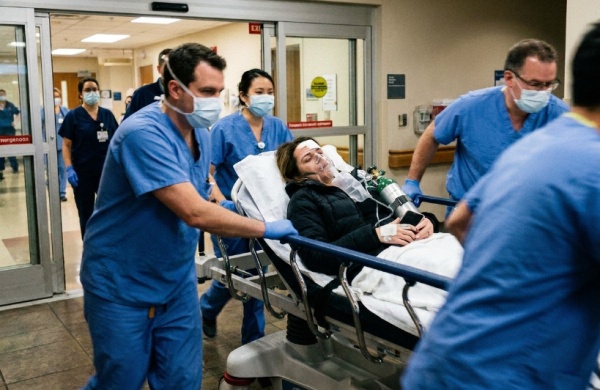
I know this because the Chicago Fire Department incident report, which I obtained later through my attorney, documented the dispatch time and the arrival time and the specific sequence of events that followed. I was unconscious when they reached the car. I had a severe concussion, a fractured right collarbone, two cracked ribs, and a laceration above my left eyebrow that required eleven stitches. I was transported to the Trauma Unit at Rush University Medical Center on West Harrison Street.
I was in surgery for the internal bleeding — a splenic laceration that the trauma team identified on the initial CT scan — by one-thirty in the morning.
James read my text at eight-fourteen the following morning.
I know this because the read receipt timestamp was captured in the phone records my attorney subpoenaed four months later. Eight-fourteen a.m. — seven hours and fifty-nine minutes after I sent it.
He was at the Kimpton Gray Hotel on West Monroe Street in the Loop. He was in a room registered under his name. He was not alone. The woman he was with — whose name I learned later was Melissa Tran, thirty years old, a project manager at an architecture firm that contracted with James’s company — was, according to James’s own account given to me weeks later in a hospital conference room with both our attorneys present, asleep beside him when he turned his phone on that morning.
He told me his first reaction when he saw my text was confusion. He said he thought, initially, that I had found out about Melissa and was being dramatic. He said — and I want to include this because it is the kind of thing that tells you everything about the specific moral failure of a person — that he considered waiting to respond until he had figured out how to manage the conversation.
He was about to set the phone down when he saw the missed calls.
Eleven missed calls from my number, between twelve-fifteen and twelve-twenty-two a.m.
Three missed calls from Rush University Medical Center.
Two missed calls from Chicago Police Department.
One voicemail from a trauma nurse named Angela, timestamped one-forty-seven a.m., asking him to call the hospital immediately regarding his wife.
James told me later that the room tilted when he heard the voicemail. That he did not shower, did not wake Melissa, pulled on the clothes from the night before, and ran out of the hotel room leaving the door open behind him. That the drive from the Loop to Rush on West Harrison took nine minutes at eight in the morning and felt like nine hours.
I believe all of that.
I believe that his fear in those nine minutes was genuine.
What I cannot reconcile — what I have spent fourteen months trying and failing to reconcile — is the seven hours and fifty-nine minutes before the fear arrived. The seven hours and fifty-nine minutes during which I was in surgery and in a recovery room and in a trauma unit bed with monitors and IV lines and a cracked phone on the bedside table, and James was asleep in a hotel room in the Loop with his phone face-down on the nightstand.
Seven hours and fifty-nine minutes.
I have done the arithmetic many times.
It does not improve with repetition.
Part 4: What He Found When He Came Home
I was discharged from Rush University Medical Center nine days after the accident.
My right arm was in a sling for the collarbone. My ribs required careful management for six weeks. The concussion protocols meant no screens, no work, no sustained reading for the first two weeks — which was its own particular cruelty for a woman whose entire professional identity was built on the ability to process information quickly and precisely.
James had been at the hospital every day. He sat in the chair beside my bed with the specific devastation of a man who has been confronted with the full cost of his choices and cannot look away from it. He brought coffee I did not drink and flowers I did not ask for and apologies that arrived in the broken, repetitive way of someone who has run out of new ways to say the same thing.
I listened. I did not respond with anger, because anger requires energy I did not have and because I had learned, in nine days of lying in a hospital bed with a concussion and cracked ribs and a great deal of time to think, that anger was not what I felt. What I felt was something quieter and more final — the specific clarity that arrives when you have been through something that strips away every non-essential thing and leaves only the truth of what is and what is not.
On the day of my discharge, James drove me home to the townhouse in Lincoln Square.
He helped me up the front steps. He unlocked the door. He carried my bag inside.
And then he stopped.
The living room was different.
Not dramatically — not emptied or ransacked or rearranged in the way of a confrontation. But different in the specific, deliberate way of a woman who has had nine days to think and has spent some of that time on the phone with people who could help her act.
On the coffee table was a manila envelope.
James set down my bag and picked it up.
Inside were three things.
The first was a printed copy of the hotel receipt from the Kimpton Gray — obtained legally, through my attorney Sandra Park of Park & Associates Family Law in Chicago, as part of the discovery process in the divorce filing she had initiated on my behalf four days after my admission to Rush, when I had been coherent enough to make the call from my hospital bed and clear enough in my intention that Sandra had not asked me twice whether I was sure.
The second was a printed copy of the phone records showing the read receipt timestamp — eight-fourteen a.m. — alongside the timestamp of my text — twelve-sixteen a.m. — and the surgical record from Rush showing I had been in the operating room from one-thirty to three-forty-seven a.m.
The third was the divorce petition, already filed in Cook County Circuit Court, with a cover note from Sandra’s office confirming the filing date and the case number.
James stood in our living room in Lincoln Square holding those three documents for a long time.
I sat down on the couch — carefully, because of the ribs — and watched him.
He did not perform. I will give him that. He did not argue or deflect or attempt to reframe what the documents said. He sat down in the chair across from me and put his face in his hands and stayed there for a while.
“I don’t know what to say,” he said finally.
“I know,” I said.
“I’m sorry doesn’t cover it.”
“No,” I said. “It doesn’t.”
He looked up. His eyes were red. “Is there anything—”
“No,” I said. Not harshly. Just clearly. The specific clarity of a woman who has made a decision from a hospital bed and has not changed her mind in nine days of lying still with nothing to do but think. “There isn’t.”
He nodded.
He stayed in the townhouse that night, in the guest room, because I was not physically capable of managing alone and because my mother — who had driven up from Naperville the morning after the accident and had been at the hospital every day — was arriving the following morning to stay for two weeks. After that, James moved to a short-term rental in Wicker Park. He was out of the townhouse within three weeks of my discharge.
The divorce was uncontested on the grounds of irreconcilable differences — Illinois is a no-fault divorce state, and neither party was required to prove wrongdoing for the court to grant the dissolution. The marital assets were divided equitably under Illinois law: the townhouse was sold, the proceeds split, the joint accounts divided, the retirement funds addressed through a Qualified Domestic Relations Order filed with the court. Sandra was thorough and strategic. The settlement was finalized four months after the filing.
I want to be precise about one thing, because I think it matters: I did not use the hotel receipt or the phone records to punish James in the settlement. I used them to establish the factual record — not for leverage, but because I had spent five months explaining away my own instincts, and I needed the truth to exist somewhere outside my own head in a form that could not be revised or reframed.
The truth existed.
In Cook County Circuit Court case records.
In the timestamp on a read receipt.
In the surgical log at Rush University Medical Center.
It existed, and it was mine, and no amount of apology or negotiation could change what it said.
Part 5: What Fourteen Months Builds
I am writing this from the kitchen table of my apartment in Andersonville — a two-bedroom on the third floor of a greystone building on North Clark Street, with windows that face east and get the morning light in a way that makes the kitchen feel, on good days, like the most honest room I have ever lived in.
I moved here eight months ago, after the townhouse sold and the settlement was finalized and I had spent two months in the Naperville house with my mother, recovering from the physical injuries and the specific, slower-healing injury of understanding that the life you thought you were living was not entirely the life that was actually happening.
The collarbone healed in six weeks. The ribs took eight. The concussion protocols lifted at ten weeks, and the morning I was cleared to go back to full-time work was one of the best mornings I can remember — not because work was an escape, but because it was mine. Entirely, unambiguously mine. The VP title, the client relationships, the fourteen years of precision and intention I had brought to a career that had never once required me to question whether it was real.
I went back to the firm on a Monday in January. My team had sent flowers to the hospital. My managing director had held my accounts without reassigning them, which was both professionally generous and personally significant in a way I did not fully articulate until I was sitting at my desk again with a cup of coffee and the specific, grounding familiarity of work that I was genuinely good at.
I want to talk about the months after the accident honestly, because I think people expect a story like this to be primarily about the dramatic elements — the text, the hotel receipt, the documents on the coffee table — and those elements are real and they matter. But the months after were where the actual work happened, and the actual work was quieter and harder and more important than any single dramatic moment.
I saw a therapist — Dr. Patricia Osei, a licensed clinical psychologist in Lincoln Park — every Thursday evening for seven months. I want to say this plainly and without qualification, because I think there is still a tendency to treat therapy as something that requires explanation or justification, and I do not believe it does. Dr. Osei helped me understand the specific architecture of how I had learned to explain away my own instincts, where that pattern came from, and what it would cost me to dismantle it. That work was the most valuable thing I did in the fourteen months since October 3rd, and I did it deliberately and without apology.
I also, in the quieter moments of those months, thought a great deal about the text I had sent from the floor of a crumpled car on I-90 at twelve-sixteen in the morning.
James I was in an accident. I-90 near Morgan. Please come.
Eleven words. Sent with a left hand that was shaking badly enough that I had to try twice to unlock the screen. Sent in the specific, focused urgency of a person who is hurt and frightened and reaching, instinctively, for the person who is supposed to be the one you reach for.
He read it seven hours and fifty-nine minutes later.
I have thought about those eleven words many times. I have thought about what it means that my last conscious act before the darkness came in was to reach for a man who was not reachable — not because he was unavailable, but because he had made himself unavailable, in a hotel room six miles away, with his phone face-down on the nightstand.
I have thought about what it means that I survived.
Not in the dramatic sense — though the trauma surgeon at Rush told me, plainly and without softening it, that the splenic laceration would have been fatal without intervention within the hour, and that the six-minute paramedic response time was the specific margin between the life I am living now and a different outcome entirely. I think about that sometimes. I think about six minutes.
But I mean survived in the larger sense. The sense that encompasses the nine days in the hospital and the months of recovery and the Thursday evenings with Dr. Osei and the morning I went back to my desk and the afternoon I signed the lease on the apartment in Andersonville and the first Saturday I walked to the farmers market on Argyle Street alone and bought flowers for my own kitchen table because I wanted them there.
I survived in the sense that the woman who got in the car on October 3rd — the woman who had spent five months explaining away her own instincts, who had confused sustained effort with willful blindness, who had reached for her phone on a wet highway because she needed to see something with her own eyes rather than interpret it through a screen — that woman did not come home from Rush University Medical Center.
A different woman came home.
One who had read the phone records and understood the timestamp.
One who had called Sandra Park from a hospital bed and been clear enough in her intention that Sandra had not asked twice.
One who had placed three documents on a coffee table in Lincoln Square and sat on the couch with cracked ribs and a sling and the specific, unshakeable calm of a person who has decided that the truth does not require her to perform anything for anyone.
James and I have not spoken since the settlement was finalized. He sent a text on my birthday in March — Hope you’re doing well. I’m sorry for everything. I read it. I did not respond. Not out of cruelty, but because there was nothing I needed to say that had not already been said in a Cook County Circuit Court filing, in the timestamp on a read receipt, in eleven words sent from the floor of a crumpled car to a man who did not read them for seven hours and fifty-nine minutes.
The record exists.
It does not require my ongoing participation to remain true.
I am sitting at my kitchen table in Andersonville on a Sunday morning in December. The east-facing windows are doing what they do on clear winter mornings in Chicago — filling the room with the specific, clean, horizontal light that arrives when the sun is still low and the air is cold and the city is quiet in the particular way it is quiet before it wakes up fully.
I have coffee. I have the novel I have been trying to finish — a different one now, the October one long since finished in the hospital. I have the farmers market flowers on the table, yellow and white, because I wanted them there.
I have, it turns out, quite a lot.
Not everything I thought I had a year ago. Not the townhouse in Lincoln Square or the Saturday mornings at the farmers market with someone whose hand I reached for in movie theaters. Not the version of the future I had been building in my head for five years.
But everything I actually have is real.
Entirely, unambiguously, documentably real.
And I have learned — at significant cost, on a wet highway on I-90 at twelve-sixteen in the morning — that real is the only kind of thing worth having.
