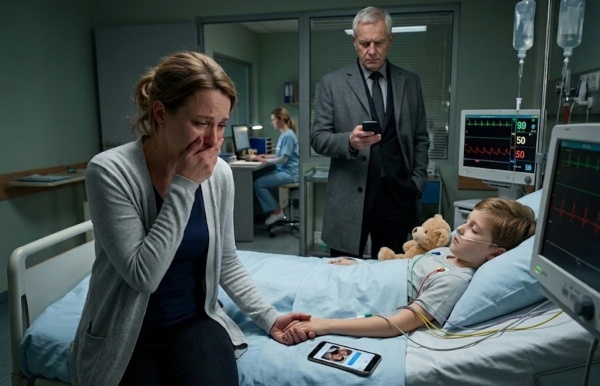
My son was dying in the ICU while my husband was at dinner with his mistress, pretending his real family didn’t exist. When my father-in-law discovered the truth, he didn’t just confront his son. He made a decision so ruthless and so public that it destroyed everything my husband had built. And I watched it happen in real time.
PART 1: The Night Everything Fell Apart
At 2:13 AM, while the ICU monitors clicked and hissed around my son’s bed, I realized my husband was not coming. My name is Rachel Mitchell, and I was standing in the pediatric intensive care unit at Northwestern Memorial Hospital in Chicago, one hand wrapped around the rail of my twelve-year-old son’s bed and the other gripping my phone so tightly my fingers had gone numb. My son, Tyler, looked impossibly small beneath the oxygen mask. His skin was pale under the bluish hospital lighting. An IV line ran into his arm. Another monitor tracked his heart in bright green pulses that I had begun to dread every time the rhythm changed.
Six hours earlier, Tyler had collapsed at basketball practice. At first the coaches thought it was dehydration. Then came the seizure. Then the ambulance. Then the CT scan that showed a severe viral meningitis spreading fast enough to make the doctors use words like “critical,” “pressure,” and “next twelve hours are crucial.” I had called my husband, James, four times. No answer. I called again from the ICU hallway after the attending physician said Tyler might need emergency surgery if the swelling worsened. This time James answered, and I felt relief so sharp it almost made me weak. Then I heard music in the background. Laughter. A woman’s voice.
“James,” I said, already knowing. “Where are you?” There was a pause—tiny, cowardly. “At a business dinner,” he said. I shut my eyes. “Tyler is in intensive care. He might need surgery.” Another pause. Then James said, too quickly, “I know, I got your texts. I’m trying to wrap something up.” That was when the woman in the background laughed again, closer this time, and said, not softly enough, “Tell her not to be so dramatic. He’s probably fine.”
I went completely still. For a full second I said nothing. Not because I lacked words. Because there were too many, and all of them would have changed my life if spoken in the order I felt them. “Are you with someone?” I asked. James exhaled like an annoyed executive trapped in an inefficient meeting. “This is not the time.” I looked through the ICU glass at my son, unconscious under hospital machines, and felt something inside me go cold and final. “No,” I said quietly. “This was exactly the time. You just chose wrong.” I ended the call.
PART 2: The Abandonment
The nurse, Maria Delgado, came out of Tyler’s room a minute later holding a chart and took one look at my face. “Do you need someone to sit with you?” she asked gently. I almost laughed. What I needed was the husband I married ten years earlier—the one who had once driven through a snowstorm because I mentioned over the phone that my tire pressure warning light came on. But that man had been disappearing for years, replaced by James Mitchell, forty-three, pharmaceutical executive, smooth liar, and lately a stranger who wore expensive guilt like cologne and came home reeking of perfume he claimed was from a female colleague.
By 3:00 AM, I had spoken to three doctors, signed two emergency consent forms, and learned that James still had not left his “business dinner.” The doctors kept asking if my husband was on his way. I kept lying and saying yes, he was just stuck in traffic. But we both knew the truth. By 4:30 AM, the neurosurgeon came to discuss the possibility of emergency surgery. Tyler’s intracranial pressure was rising. If it continued to rise, they would need to operate to relieve the pressure and prevent permanent brain damage. The surgery would be risky. There was a chance he could have complications. There was a chance he could die.
I called James again. This time he didn’t answer. I called his office. I called his cell phone. I called the hotel where he said he was having dinner. No one had seen him. I called his best friend, Marcus, and asked where James was. There was a long silence. Then Marcus said, “Rachel, I think you need to call James’s father.” That was the moment I understood that this wasn’t just infidelity. This was something worse. This was abandonment at the exact moment when my son needed his father most.
At 5:47 AM, just after dawn, the ICU doors opened again. A tall older man in a dark overcoat stepped inside with the stunned force of someone who had been told one terrible thing and then a worse one. Robert Mitchell. James’s father. Former real estate developer. Sixty-eight years old. Hard, disciplined, and not a man known for sentiment or patience. He looked from my exhausted face to Tyler in the bed and said, very quietly, “Where is my son?” I hesitated only once. Then I told him the truth. “He’s with his mistress. He’s been with her all night while Tyler has been here, possibly dying.”
PART 3: The Reckoning Begins
Robert Mitchell stood completely still. No shouting. No curse. No dramatic collapse. But something in his face changed so absolutely that even Nurse Delgado stepped back. Because I understood, in that instant, that whatever James had thought he was risking by abandoning his son in the ICU, he had not calculated his father. Robert pulled out his phone and made a single call. “Get my attorney,” he said. “And get him now. I don’t care if it’s Saturday morning. I want papers drawn up immediately.” He ended the call and looked at me. “What’s his name? The woman he’s with?”
“I don’t know,” I said. “I just know she exists.”
Robert nodded slowly. “That’s going to change.” He pulled up his phone and made another call. “It’s Robert Mitchell,” he said. “I need you to find out where my son is right now. I need his location, and I need it in the next thirty minutes.” He ended the call and sat down in the chair beside Tyler’s bed. “Tell me everything,” he said to me. “Everything you know about what he’s been doing.”
So I told him. I told him about the late nights at work that weren’t really work. I told him about the credit card statements I found hidden in his desk drawer showing charges at luxury hotels and restaurants. I told him about the perfume that wasn’t from a colleague. I told him about the way he had become distant and cold over the past two years. I told him about the prenuptial agreement James had insisted I sign before we got married—an agreement that gave me very little in the event of a divorce.
Robert listened to all of it without interrupting. When I finished, he said one thing: “He’s going to regret this.”
By 7:15 AM, Robert’s investigator had located James. He was at the Peninsula Hotel in downtown Chicago, in a suite registered under a false name. He was with a woman named Stephanie Chen, thirty-one years old, a pharmaceutical sales representative who worked for a competitor of James’s company. Robert drove to the hotel himself. I found out later what happened next from the hotel security footage that would eventually become part of the divorce proceedings.
Robert walked into the hotel suite without knocking. He found James and Stephanie in bed. He didn’t say anything. He just looked at his son with an expression of such profound disappointment that James immediately tried to explain, to justify, to minimize what was happening. Robert held up his hand. “Don’t,” he said. “I don’t want to hear it. Your son is in the ICU at Northwestern Memorial. He might die. And you’re here.” Then Robert did something that shocked everyone who heard about it later. He called the Chicago Police Department and reported James for child abandonment.
PART 4: The Consequences
James was arrested at the hotel. He was charged with child abandonment, a felony in Illinois. He was held for forty-eight hours before bail was set at $50,000. His mugshot was published in the Chicago Tribune. His company, learning about the arrest and the circumstances surrounding it, immediately terminated his employment. His professional reputation, built over twenty years, was destroyed in a single morning.
But Robert wasn’t finished. He filed a lawsuit against James for breach of fiduciary duty, claiming that James had violated his responsibilities as a father and as a member of the family. He filed to have James removed as a trustee from several family trusts. He filed to have James’s name removed from the deed of the family vacation home in Michigan. And most significantly, he hired the most aggressive family law attorney in Chicago and told me to file for divorce immediately.
“I’m going to help you,” Robert said to me at the hospital. “I’m going to pay for your attorney. I’m going to make sure you and Tyler are taken care of. And I’m going to make sure my son understands exactly what he’s lost.” The divorce was finalized six months later. Here’s what the court ordered:
Custody: I was awarded primary custody of Tyler. James received supervised visitation only, and only after he completed a parenting class and underwent psychological evaluation.
Child Support: James was ordered to pay $4,500 per month in child support, plus 100% of Tyler’s medical expenses, educational expenses, and extracurricular expenses.
Spousal Support: I was awarded $6,000 per month in spousal support for five years.
Asset Division: Despite the prenuptial agreement, the court found that James’s conduct was so egregious that it warranted a more equitable distribution. I received 45% of the marital assets, valued at approximately $1.2 million. James received 55%.
Attorney Fees: James was ordered to pay my attorney fees of $185,000.
Criminal Consequences: James pleaded guilty to child abandonment. He received two years of probation, 500 hours of community service, and was required to attend parenting classes and family counseling.
PART 5: The Aftermath and the New Beginning
Robert also did something that shocked the entire family. He cut James off financially. He removed James from all family trusts. He removed James from his will. He told James that he had one year to get his life together, and if he did—if he completed his probation, if he maintained consistent and responsible contact with Tyler, if he showed genuine remorse—then maybe, maybe, Robert would consider rebuilding their relationship. But until then, James was on his own.
James moved into a small apartment in a less expensive neighborhood. He got a job as a sales representative for a mid-level pharmaceutical company, making a fraction of what he used to make. He’s paying nearly $10,500 per month in combined child support and spousal support on an income that barely supports that. He’s living paycheck to paycheck. The mistress left him within three months of his arrest, unwilling to deal with the scandal or the financial consequences.
As for Tyler, he recovered completely from the meningitis. The doctors said it was miraculous—that he had been on the edge of permanent brain damage, but somehow his body fought off the infection just in time. He spent six weeks in physical therapy to regain his strength, and now, two years later, he’s back to playing basketball and doing everything a twelve-year-old should be doing.
And me? I’m rebuilding my life. I went back to work as a marketing consultant. I’m taking night classes to finish my bachelor’s degree, which I had abandoned when I got married. I’m in therapy, processing the betrayal and the abandonment. I’m learning to trust my instincts again. And I’m teaching Tyler that sometimes the people we love disappoint us, but that doesn’t mean we give up on ourselves.
The most important lesson I learned from this experience is that sometimes the people we think we can depend on will let us down. But there are also people—like Robert—who will step in and do what’s right, even when it costs them. Robert could have stayed out of it. He could have told me it was my problem to solve. Instead, he chose to protect his grandchild and hold his son accountable for his actions.
If you’re reading this and you’re in a situation where someone you love has abandoned you or your children, please know this: You have legal remedies available to you. You have protections under the law. You have the right to hold people accountable for their actions. And you have the right to rebuild your life, even when it feels impossible.
James thought he could have it all—his family, his career, his mistress, his comfortable life. He thought his wife was too dependent and too broken to fight back. He thought his father wouldn’t care. He was wrong about all of it. And now he’s living with the consequences of those choices every single day.
The night Tyler almost died was the night I finally understood my own strength. And the morning Robert walked into that hotel suite was the moment I understood that sometimes justice comes from the most unexpected places. All it takes is one person willing to do what’s right, no matter the cost.
