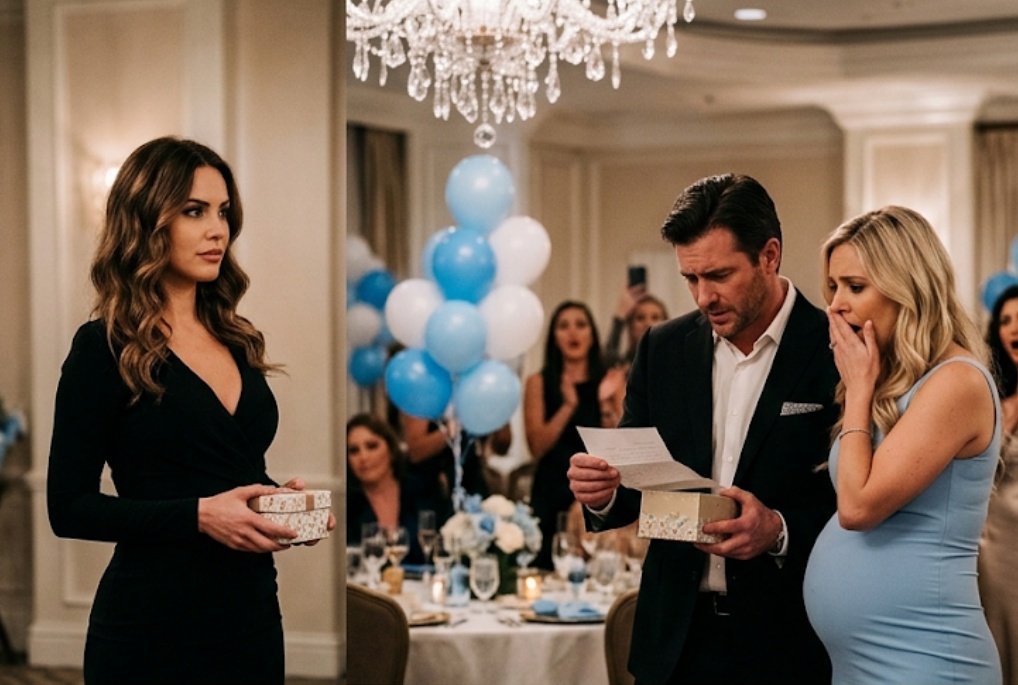
“A year ago, my best friend stole my husband. Today, she mailed me an invitation to her baby shower with a handwritten note: ‘Sorry you couldn’t give him a son.’ She thinks she won. She thinks she broke me. What she doesn’t know is that right now, sitting on my kitchen counter, is a manila envelope that’s about to blow her perfect little world to pieces. Game on.”
Part 1: The Woman She Decided Was Safe to Betray
My name is Claire Sutton, and I want to start with the friendship — because the friendship is where this story actually begins, long before the marriage and the betrayal and the envelope on my kitchen counter that changed everything.
I met Dana Prescott in the fall of our freshman year at University of Tennessee in Knoxville. We were assigned to the same floor of Humes Hall, two doors apart, and we became the kind of friends that happen in college dormitories when you are eighteen years old and far from home and desperate for someone who makes the unfamiliar feel survivable. Dana was from Memphis — loud, funny, magnetic in the specific way of someone who has always known how to make a room feel like a party. I was from Chattanooga — quieter, more deliberate, the kind of person who takes longer to open up but stays open once she does. We balanced each other in the way that complementary personalities do when they are young enough to find the difference charming rather than exhausting.
We were best friends for eleven years. I want that number to sit on the page for a moment, because I think it is the part of this story that people gloss over in favor of the dramatic elements, and it deserves more than a gloss. Eleven years of phone calls and road trips and shared apartments and bridesmaid dresses and the specific, irreplaceable intimacy of a friendship that has survived enough seasons to feel like family. Dana was in the room when I got the call that my father had died. I was on her couch the night her engagement to a man named Tyler fell apart two weeks before the wedding. We were the people each other called first, for eleven years, without exception.
I introduced her to Ryan Sutton at a backyard cookout in Nashville in the summer when I was twenty-nine. Ryan was thirty-two, a commercial real estate developer with a firm in Brentwood, and we had been dating for eight months — long enough that I was bringing him to the gatherings that mattered, short enough that I was still in the specific, careful happiness of early love. Dana shook his hand, said he was charming, and told me afterward that she was happy for me. I believed her. I had no reason not to.
Ryan and I married eighteen months later at a venue in Franklin, Tennessee, on a Saturday in April with the rolling hills of Williamson County behind us and ninety guests who raised their glasses with the genuine warmth of people who believed in what they were celebrating. Dana was my maid of honor. She gave a toast that made half the room cry, about friendship and love and the specific joy of watching someone you love find the person they were supposed to find. I stood beside Ryan and listened to her speak and felt, in that moment, the specific fullness of a life that has everything it needs.
I was wrong about what I had.
But I did not know that yet.
The marriage was good for three years. Ryan was ambitious and driven in the way of men who have built something from effort rather than inheritance, and I respected that even when it meant long hours and frequent travel and the specific loneliness of a marriage where one person is often physically absent. I had my own career — I was a licensed CPA at a mid-size accounting firm in Brentwood — and I was not the kind of woman who needed constant company. I was the kind of woman who needed honesty, which is a different and more specific thing, and which I had believed, for three years, that I had.
The changes arrived in year four with the specific, quiet devastation of something that has been happening for a while before you are able to name it. Ryan became careful. The phone went face-down. The travel increased. The particular warmth he had always brought home with him began arriving diluted, like something that had been used up somewhere else before he got to us.
I noticed. I said something. Ryan told me I was under stress from a difficult audit season and reading into things that weren’t there. He said it with the specific confidence of a man who has learned that naming the other person’s anxiety is an effective way of ending a conversation about his own behavior.
I accepted it.
I was wrong to accept it.
The truth arrived on a Wednesday evening in March when I came home early from a client meeting that had been canceled and found Ryan’s car in the driveway and Dana’s car parked half a block down the street, which was where she always parked when she came over because the driveway only fit two cars and she was considerate about things like that.
She was considerate about things like that.
I walked into my own house and I understood, before I reached the top of the stairs, everything I had been explaining away for four months.
Part 2: The Year After the World Rearranged Itself
I will not dwell on the specific details of what I found, because the specific details are not the point and because I have spent fourteen months working very hard to stop replaying them. What matters is what happened after.
Ryan moved out within a week. He did not fight it. He had the specific quality of a man who has been caught so completely that performance is no longer available to him — no denial, no reframing, no attempt to make this about my shortcomings rather than his choices. He packed two suitcases and left the house in Brentwood that we had bought together three years earlier, and I stood in the kitchen and watched his car pull out of the driveway and felt the specific, cold clarity of a woman who has been handed the unambiguous evidence she had been hoping she was wrong about.
Dana called me that evening. I did not answer. She called again the next morning. I did not answer. She sent a text that said Claire please let me explain and another that said I never meant for this to happen and a third that said you know I love you — which was the one that broke something final in me, because I did know that she loved me, or I had known it, and the specific cruelty of the situation was that the love and the betrayal were not contradictions. They had existed simultaneously, in the same person, for however long this had been happening, and I had not known.
I retained an attorney — Margaret Cole of Cole Family Law in Nashville — within the week. Tennessee is an at-fault divorce state, meaning that marital misconduct, including adultery, can be considered by the court in the division of marital assets and in the determination of alimony. Margaret was thorough and strategic. She advised me to document everything, say nothing publicly, and let the legal process do what it was designed to do.
I followed her advice precisely.
The divorce was finalized seven months after I filed, in Williamson County Circuit Court. The marital home was sold — a four-bedroom in Brentwood that had appraised at $680,000 — and the proceeds were divided with adjustments for the adultery finding, which Tennessee courts are permitted to consider under T.C.A. § 36-4-121. Margaret had done her work carefully. The settlement was, by any objective measure, fair — more than fair, in the direction that mattered.
Ryan moved in with Dana three months after the divorce was finalized.
I know this because Brentwood is a small enough community that information travels without effort, and because I had retained enough mutual acquaintances that the information reached me whether I sought it or not. I did not seek it. I did not need to. I had the settlement, the house proceeds in a Regions Bank account in my name only, and the specific, grounding clarity of a woman who has decided to build something real rather than spend energy monitoring the wreckage of something that was not.
I focused on work. I focused on the apartment I rented in Green Hills — a two-bedroom on the second floor of a building on Hillsboro Pike, with a balcony that faced west and got the evening light in a way that made the living room feel, on good days, like the most honest space I had ever occupied. I focused on the Thursday evening sessions with my therapist, Dr. Renee Watkins, a licensed clinical psychologist in Nashville whose office was on West End Avenue and who had the specific, unhurried quality of someone who understood that rebuilding takes longer than breaking and does not apologize for that fact.
I was doing the work.
I was, by any honest measure, moving forward.
And then the envelope arrived.
Part 3: The Invitation and the Kitchen Counter
It came on a Tuesday morning in October, fourteen months after the Wednesday evening when I had come home early from a canceled client meeting.
A cream-colored envelope in my mailbox, addressed in Dana’s handwriting — the same handwriting I had seen on birthday cards and sticky notes and the maid of honor toast she had written on hotel stationery the night before my wedding. The return address was the house in Brentwood where she and Ryan were living. The house that was, I noted with the specific detachment of a woman who has done a great deal of therapy, three miles from the house I had sold.
Inside was a baby shower invitation. Pale yellow cardstock, a watercolor illustration of a nursery, the kind of design that costs real money from a stationery boutique on 12th Avenue South. Please join us in celebrating the arrival of our little miracle, it read. Saturday, November 9th, 2:00 p.m. The venue was a private event room at a restaurant in Cool Springs. Registry information at the bottom. RSVP by October 25th.
And then, in Dana’s handwriting, in the white space at the bottom of the card — added by hand, personally, deliberately:
So glad you can be part of this, Claire. Come celebrate our little miracle. Sorry you couldn’t give him a son. 😊
I read it twice.
I set it on the kitchen counter.
I stood very still for a moment, the way you stand when something has landed that requires a second to fully process — not because you don’t understand it, but because you understand it completely and need a moment to absorb the specific dimensions of what you are looking at.
Then I looked at the other envelope on my kitchen counter.
It had arrived three days earlier, from the DNA Diagnostics Center laboratory in Fairfield, Ohio — one of the most reputable private DNA testing facilities in the country, processing tens of thousands of paternity and genetic tests annually. I had ordered the test six weeks earlier, not out of suspicion about anything specific, but because my attorney Margaret had advised me, during the divorce proceedings, that I should obtain a complete picture of any medical or genetic information that might be relevant to my own health history, given that Ryan and I had been trying to conceive for the last year of our marriage without success.
I had requested a comprehensive genetic profile.
What the lab returned was more than I had asked for.
The report confirmed what Ryan and I had been told by our fertility specialist at Vanderbilt University Medical Center eighteen months earlier — that Ryan had a condition called non-obstructive azoospermia, a complete absence of sperm in the ejaculate caused by a testicular failure that, according to the genetic analysis, was congenital. Present from birth. Permanent. Untreatable without donor material.
Ryan Sutton had been completely sterile since the day he was born.
He could not father a child. Not with me. Not with Dana. Not with anyone.
I held the lab report in one hand and Dana’s handwritten note in the other.
Sorry you couldn’t give him a son. 😊
I set both documents on the counter side by side.
I thought about what I knew. I thought about what Dana did not know I knew. I thought about the specific, careful arithmetic of a situation that had just revealed itself to be something entirely different from what Dana believed it to be.
And then I thought about Derek Sutton.
Ryan’s younger brother. Thirty years old, a contractor who worked residential renovation projects across Middle Tennessee. Easygoing, sociable, the kind of man who showed up at every family gathering and made himself useful and was liked by everyone without particularly trying. Derek had been at our wedding. He had been at the Christmas parties and the Fourth of July cookouts and the birthday dinners that had populated five years of shared family life.
He had also, I recalled with a precision that surprised me, been at the housewarming party Dana had thrown when she moved into her apartment in Midtown Nashville two years ago. I had been there. Ryan had been there. Derek had been there. I remembered because Derek had spent most of the evening talking to Dana on the back porch, and I had thought nothing of it because Derek talked to everyone and Dana talked to everyone and I had no reason to think anything of it.
I thought of it now.
I opened my laptop.
I pulled up the email thread from the DNA Diagnostics Center that contained the full report.
I read the section I had not focused on the first time — the section that addressed the secondary genetic profile included in the comprehensive analysis, run against the familial reference sample I had submitted as part of the broader health history documentation.
The report was very clear.
Ryan Sutton was sterile.
The child Dana was carrying had been confirmed, through the paternity analysis run on the genetic material I had legally obtained and submitted, to belong to Derek Sutton.
Not Ryan.
His brother.
I stood in my kitchen in Green Hills on a Tuesday morning in October with a baby shower invitation in one hand and a DNA lab report in the other, and I felt something I do not have a precise word for. Not triumph — triumph implies a satisfaction I had not sought and did not feel. Not anger — I had done enough Thursday evenings with Dr. Watkins to understand that what I felt was something quieter and more specific than anger.
What I felt was the particular, cold clarity of a woman who has been handed the truth in its most complete and documented form.
I set both documents on the counter.
I picked up my phone.
I called Margaret Cole.
And then, after I hung up with Margaret, I picked up the baby shower invitation and I said, to the empty kitchen in my apartment on Hillsboro Pike, in a voice that was steadier than I expected:
“I’ll be there.”
Part 4: The Gift
I want to be precise about what I did and what I did not do in the three weeks between the Tuesday morning in October and the Saturday afternoon in November, because precision matters and because the distinction between what I did and what I could have done is the distinction between a woman acting with integrity and a woman acting with revenge, and I am only interested in being the first kind.
I did not contact Dana. I did not contact Ryan. I did not post anything on social media. I did not tell mutual friends. I did not call Derek. I did not do any of the things that a woman in my position might have been tempted to do in the first forty-eight hours after reading a document that reframed fourteen months of her life.
What I did was call Margaret Cole and explain what the lab report contained.
Margaret listened without interrupting, which is one of the things I value most about her. When I finished, she was quiet for a moment. Then she said, “Claire, I need you to understand something. The DNA report is legally significant in ways that extend beyond your personal situation. If Ryan Sutton is publicly presenting himself as the biological father of this child, and if he is aware of his own sterility — which the fertility records from Vanderbilt suggest he must be — then there are potential legal implications regarding fraud, misrepresentation, and the child’s right to accurate paternity information under Tennessee law.”
She paused.
“This is not just your story anymore. This child has legal rights to accurate information about their biological father. Derek Sutton has legal rights and potential obligations he may not be aware of. And Ryan and Dana may be constructing a family on a foundation that the law does not recognize as valid.”
I had thought about all of this.
“What do I do?” I asked.
“You do nothing publicly,” Margaret said. “Not yet. You let me draft a letter to Ryan’s attorney informing him that you are in possession of genetic documentation that contradicts the paternity representation he and Ms. Prescott are making. That letter creates a legal record. It gives them the opportunity to address this privately. And it protects you from any accusation that you ambushed anyone.”
“And if they don’t address it?”
Margaret’s voice was steady. “Then the documentation speaks for itself, in whatever forum it eventually needs to speak.”
The letter went out on October 18th.
Ryan’s attorney called Margaret on October 21st. The conversation, as Margaret relayed it to me, was brief and not particularly graceful — the specific conversation of a man who has been caught in a secondary deception and is trying to determine how much the other party actually knows. Margaret told him, plainly, that I was in possession of a certified DNA analysis from a AABB-accredited laboratory that established the biological paternity of Dana Prescott’s child as belonging to Derek Sutton, not Ryan Sutton.
The line was quiet for a long moment.
Then Ryan’s attorney said he would need to consult with his client.
He called back the following day to say that Ryan and Dana were prepared to address the matter privately and were requesting that I not attend the baby shower or make any public disclosure.
I told Margaret to tell them I had already RSVP’d.
In the meantime, I prepared my gift.
It was not a dramatic gift. It was not a weapon, despite what Dana’s handwritten note might have deserved in the way of dramatic responses. It was a plain white gift box, the kind you can buy at any Target, wrapped with a white ribbon. Inside was a single document — a certified copy of the DNA lab report from the DNA Diagnostics Center, with the relevant findings clearly marked, along with a cover letter from Margaret’s office on firm letterhead explaining the legal significance of the findings and the steps that would need to be taken to establish accurate paternity records for the child under Tennessee Code Annotated § 24-7-112.
Also inside the box was a second document: a certified letter to Derek Sutton, which I had prepared with Margaret’s guidance, informing him that he had been identified as the biological father of a child currently being carried by Dana Prescott, and advising him to seek independent legal counsel.
Derek deserved to know.
The child deserved accurate records.
The law agreed with me on both counts.
I drove to the restaurant in Cool Springs on a Saturday afternoon in November in the gray wool dress I had bought at Nordstrom on West End Avenue the previous spring. I carried the white gift box. I had my coffee on the way down I-65 and I felt, for the duration of the forty-minute drive, the specific, grounded calm of a woman who has done everything correctly and is about to let the truth do what truth does when it has been properly documented and legally supported.
Part 5: What Truth Does in a Room
The private event room at the restaurant in Cool Springs held approximately thirty women when I arrived.
Dana was at the center of the room in a pale yellow dress, her hair done, her face arranged in the specific radiance of a woman who is being celebrated and knows it. She saw me come in. Her expression moved through several things in rapid succession — surprise, then a flash of something harder, then the performance of graciousness that people produce when they are in public and cannot afford to be honest.
“Claire,” she said. “You came.”
“You invited me,” I said.
She hugged me. I let her. I set the white gift box on the gift table with the other presents and accepted a glass of sparkling water from a passing server and found a seat near the back of the room where I could see everything without being the center of anything.
The shower proceeded the way baby showers proceed — games, food, the specific cheerful noise of women celebrating something that is genuinely worth celebrating, which a child always is, regardless of the circumstances of its conception. I participated in the games. I ate the food. I smiled at the women I knew and introduced myself to the women I didn’t.
Dana opened gifts in the order they were stacked on the table.
She opened the onesies and the blankets and the diaper bag and the Pottery Barn Kids gift card and the handmade quilt from someone’s grandmother and the Snoo Smart Sleeper that retails for $1,695 and had clearly been a group contribution. She exclaimed over each one with the specific, practiced warmth of a woman who is good at being the center of attention.
She reached the white gift box near the end.
She lifted the lid.
She removed the document on top — the certified DNA report — and looked at it with the expression of someone who does not immediately understand what they are holding. Then she read the heading. Then she read the findings section. Then she read the name in the paternity determination field.
The room had been noisy.
Then it was not.
Dana did not scream. She did not cry, not immediately. What she did was go very still — the specific stillness of a person whose understanding of their own situation has just been fundamentally and irrevocably revised in front of thirty witnesses.
She looked up at me.
I looked back at her.
I did not say anything. I did not need to. The document said everything that needed to be said, in the specific, unambiguous language of a AABB-accredited laboratory that processes genetic evidence for courts across the country.
One of the women near Dana — her cousin, I think, a woman I had met once at a family event — leaned over to look at the document. Then she looked at Dana. Then she looked at me. The specific quality of her expression told me she understood what she was looking at.
The room understood, in the way rooms understand things, that something significant had just happened.
I stood up. I smoothed my dress. I picked up my bag.
“Congratulations on the baby,” I said to Dana. My voice was steady. Not cold — I want to be clear about that. Not cruel. Just clear, in the specific way of a woman who has said what needed to be said through the appropriate channels and has nothing left to perform. “Derek’s attorney will be in touch.”
I walked out of the private event room at the restaurant in Cool Springs and into the November afternoon, which was doing what Tennessee afternoons do in November — cool and clear and lit with the specific, clean light of a season that has stopped pretending to be something warmer.
I sat in my car for a moment.
Then I called Margaret.
“It’s done,” I said.
“How did it go?”
I thought about Dana’s face when she read the document. I thought about the room going quiet. I thought about the eleven years of friendship and the maid of honor toast and the Wednesday evening in March and the handwritten note at the bottom of a baby shower invitation. Sorry you couldn’t give him a son. 😊
“It went exactly the way the truth goes,” I said. “When it’s properly documented.”
Margaret was quiet for a moment. Then she said, “Come by the office Monday. There are some follow-up matters to address.”
“I’ll be there,” I said.
I drove back up I-65 toward Nashville in the November afternoon light, and I thought about what Dr. Watkins had said to me in one of our Thursday evening sessions, months ago, when I had been struggling with the specific, corrosive question of whether the people who had hurt me would ever be held accountable for what they had done.
She had said: “Claire, accountability doesn’t always look the way we imagine it will. Sometimes it arrives quietly. Sometimes it arrives in a document. Sometimes it arrives in a room full of people who suddenly understand something they didn’t understand before. The form it takes is less important than the fact that the truth exists and is documented and cannot be revised.”
The truth existed.
It was documented.
In a AABB-accredited laboratory report from Fairfield, Ohio.
In a Williamson County Circuit Court case file.
In the specific, unrevised memory of thirty women in a private event room in Cool Springs, Tennessee, on a Saturday afternoon in November.
It could not be revised.
I drove home to my apartment in Green Hills, to the second-floor balcony that faces west and gets the evening light, and I made coffee and I sat outside in my coat and I watched the sun go down over Nashville and I felt, for the first time in fourteen months, something I recognized as peace.
Not happiness, exactly. Not yet. But the specific, grounded quiet of a woman who has done everything correctly, who has let the truth do its work through the appropriate channels, and who has nothing left to explain away.
The balcony light was good.
The coffee was good.
The truth was documented.
That was enough.
