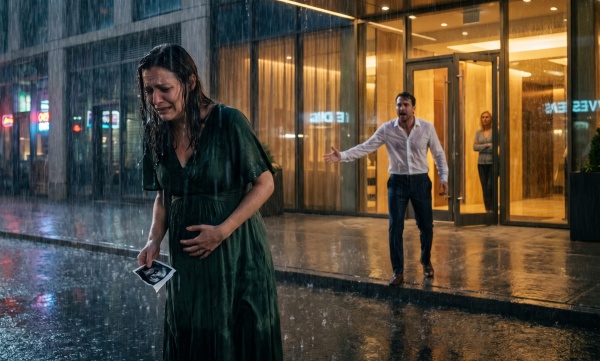
My Billionaire Fiancé Was With My Younger Sister Upstairs While 200 Guests Toasted Our Future Downstairs. I Left My Ring at a Hotel and Vanished — Until the Most Dangerous Man in New York Tracked Me Down With a Secret That Changed Everything.”
I built my entire future around one man’s promise. I lost it in thirty seconds. What came after was the life I never saw coming — and the man I could never outrun.
PART ONE: THE NIGHT EVERYTHING ENDED
8:15 PM. The Whitmore Estate, Greenwich, Connecticut.
The engagement party had been Ethan’s idea — or rather, it had been the idea of Ethan’s publicist, who had carefully explained that a formal celebration at the family estate in Greenwich, with the right guest list and the right photographer from Vogue and the right mention in the New York Times Styles section, would do more for the Whitmore brand than any press release his firm could draft.
Ethan Whitmore III was twenty-nine years old, heir to a private equity empire worth an estimated $4.2 billion, and he approached his personal life with the same strategic deliberateness he applied to portfolio acquisitions. He had proposed to me six months earlier at Eleven Madison Park — a reservation he’d made three months in advance, a ring he’d had designed by a jeweler on West 47th Street, a moment that had been, in every external detail, perfect. I had said yes with the full weight of a woman who believed she was stepping into the life she had earned.
My name is Vivian Cole. I was twenty-seven that October, a senior architectural designer at a firm in Midtown Manhattan, the daughter of a high school principal from Darien, Connecticut, and a woman who had worked for everything she had with the quiet, consistent determination of someone who grew up understanding that nothing was going to be handed to her.
I was not from Ethan’s world — not from the world of Greenwich estates and Vogue photographers and publicists who scheduled engagement parties. I had entered it carefully, on my own terms, and I had believed — I had genuinely, fully believed — that Ethan had chosen me not in spite of who I was but because of it. That was the story I had told myself. That was the story that ended on a Tuesday evening in October when I went upstairs to get my wrap from the guest room and took the wrong hallway by two doors.
The estate had fourteen bedrooms. I had been there enough times to know the layout, or I thought I had. The guest room where I’d left my wrap was the third door on the left off the east corridor. I took the second door instead. I realized my mistake the moment I opened it — and then I did not move for what felt like a very long time but was probably closer to four seconds, because the human brain, when it encounters something it does not want to be true, runs a rapid verification process before it allows understanding to fully arrive.
It arrived. Completely and without mercy.
My younger sister, Cassidy, was twenty-three years old, a yoga instructor and aspiring influencer who had moved to New York from Darien the previous year and who I had — with what I now understood was catastrophic naivety — introduced to Ethan at a family dinner in August. She had said he was “honestly so charming” and that I was “so lucky.” She had been a bridesmaid in our plans. She had asked me, two weeks prior, what she should wear to the engagement party.
Neither of them saw me. I closed the door with the particular care of someone who understands, instinctively, that the moment they make a sound, the situation will demand a response they are not yet equipped to give. I stood in the hallway of the Whitmore estate with my hand still on the doorknob and the sound of the party drifting up from the floor below — the clink of champagne flutes, a jazz quartet, the low murmur of two hundred people who had come to celebrate the beginning of my life with this man — and I breathed. Once. Twice. Then I walked, steadily and without running, back down the corridor, down the main staircase, through the foyer, and out the front door.
I did not get my wrap. It was forty-one degrees in Greenwich in October and I walked to my car in a sleeveless dress and I felt none of it. I sat in the driver’s seat of my Volkswagen GTI — the one I had bought with my own savings and maintained with my own money and which was, in this moment, the most solid and reliable thing in my world — and I looked at the steering wheel for approximately three minutes. Then I started the car.
I drove to the Marriott in Stamford, checked in with the credit card in my wallet, went to the room, sat on the edge of the bed, and took the engagement ring off my finger for the first time since Ethan had placed it there. I set it on the nightstand. I looked at it for a long time. Then I picked up my phone and called my closest friend, Margot, who lived in Chicago, because I could not call anyone in Connecticut without the information traveling in ways I was not ready to manage.
Margot answered on the second ring. I told her what I had seen. She was quiet for a moment — the specific quiet of someone absorbing something they cannot immediately fix — and then she said: “Okay. Tell me what you need.” I told her I needed to not be in Connecticut anymore. She said: “Then come to Chicago. Tonight if you want.
I have a couch and wine and I will not ask you a single question you don’t want to answer.” I booked a 6 AM flight to O’Hare on my phone before we hung up. I did not text Ethan. I did not text Cassidy. I did not text my mother, who was still at the engagement party, probably wondering where I had gone. I turned off my phone, set it on the nightstand next to the ring, and in the morning I left both of them there.
PART TWO: THE LIFE I BUILT IN THE DARK
Chicago received me the way cities receive people who arrive with nothing but a carry-on and a decision — indifferently, which is exactly what I needed. Margot lived in a two-bedroom apartment in Lincoln Park, and she gave me the second bedroom with the matter-of-fact generosity of a woman who has always understood that friendship is a verb.
I slept for fourteen hours the first night. I did not check the phone I had left in Stamford — I had left it intentionally, a clean severance, and I bought a new prepaid phone the following afternoon with a new number that I gave to exactly four people: Margot, my father, my best colleague at the firm, and my attorney.
Yes, I had an attorney. I had called her from Margot’s kitchen on day two — a woman named Patricia Huang, a Chicago-based family and civil law attorney whom Margot had used two years earlier for a contract dispute and described as “the most precise thinker I have ever paid by the hour.” Patricia and I had a one-hour consultation over the phone, during which I explained the situation and asked what my exposure was.
The answer was: minimal. Ethan and I were engaged, not married. We had no jointly held assets, no shared financial accounts, no cohabitation agreement. The ring was purchased by him and technically remained his property under Connecticut law, a fact I had already resolved by leaving it on a Marriott nightstand in Stamford, which Patricia noted with quiet approval. I was free to disappear. That was the legal answer. I took it.
I had been working remotely for my Manhattan firm since the pandemic had normalized it, and I contacted my creative director the week I arrived in Chicago and told her I needed to transfer to the Chicago satellite office permanently for personal reasons. She asked no questions she wasn’t entitled to ask, said she’d make the arrangements, and had my workspace set up in the River North office within three weeks.
I was good at my job — I had always been good at my job, in the specific way of someone who has built their competence as the primary stable thing in their life — and the work continued without interruption. The projects continued. The deadlines continued. The clean, honest logic of structural design, where a thing either holds weight or it doesn’t, was the most comforting environment I knew.
What I had not planned for, because there are things you cannot plan for, was the other development that made itself known approximately six weeks after I arrived in Chicago. I took three tests over the course of two days, in the bathroom of the Lincoln Park apartment, because taking one and believing it felt like insufficient verification.
All three said the same thing. I sat on the bathroom floor with the third test in my hand and looked at the ceiling for a long time. Then I got up, washed my face, went to the kitchen, made a cup of tea, and sat at Margot’s table and thought about what came next with the same methodical clarity I had applied to every significant decision of my adult life.
I want to be accurate here, because accuracy matters: Ethan Whitmore was not the father. We had not been together in the weeks before the engagement party in the way that would have made that possible — our relationship, in its final months, had contracted in the quiet way that relationships do when something essential is already gone, a fact I had been aware of without fully naming.
The father was a man I had met at a design conference in Boston four months earlier — a private equity investor named Dominic Rourke, whom I had spent an evening talking to at the hotel bar after a panel on sustainable architecture, a conversation that had turned into dinner and then into something I had not anticipated and had not repeated. He had given me his card. I had put it in the back of a drawer in my Manhattan apartment, which I no longer occupied. I had not contacted him. I had not planned to.
That plan changed.
PART THREE: DOMINIC
I will tell you what I knew about Dominic Rourke when I called the number on his card from a Chicago coffee shop on a Wednesday morning in December, two months after leaving Greenwich. I knew he was thirty-four. I knew he was in private equity, based in New York. I knew he was, in the way of a man who occupies a room without appearing to try, someone people paid attention to. I knew our conversation had been the most interesting one I’d had in longer than I wanted to admit.
What I did not know — what I would not learn until significantly later, when the information arrived in a way I was not prepared for — was the full scope of what “private equity” meant in Dominic Rourke’s specific case, and the specific networks his family’s business had operated within for three generations.
He answered on the third ring. There was a half-second pause when I said my name, the pause of someone rapidly accessing a memory and verifying its accuracy, and then he said: “Vivian. I wondered if I’d hear from you.” His voice was the same as I remembered — unhurried, precise, with a slight texture to it that I had found difficult to categorize at the time and found no easier to categorize now. I told him I had something to tell him.
He said: “Then tell me.” I did. There was a silence of approximately fifteen seconds, which I counted because counting is what I do when I am waiting for information that will determine what happens next. Then he said: “Where are you?” I told him Chicago. He said: “I’ll be there Friday.”
He arrived on Friday, as stated, and we sat across from each other at a table at a restaurant in the West Loop that Margot had recommended for being private without being pretentious. He listened. He asked questions — specific, practical questions, the kind that come from a man who processes information by understanding its structure rather than its emotional surface.
He asked about my health, about my timeline, about what I needed and what I wanted and whether those two things were currently the same. He did not perform feelings he wasn’t having, which I respected. He did not make promises he couldn’t verify yet, which I respected more. At the end of two hours, he said: “I want to be in this, Vivian. Whatever that looks like for you. I’m not going to tell you what it has to be, but I want you to know I’m not walking away from it.” I looked at him across the table. I believed him. I was not yet sure what to do with that belief.
The twins — a boy and a girl, Eli and Nora — were born the following June at Northwestern Memorial Hospital in Chicago. They were four weeks early and spent eleven days in the NICU, which was the most terrifying eleven days of my life by a significant margin, and during which Dominic flew to Chicago four times, including once from London where he had been for a deal that he left in the middle of without, as far as I could tell, hesitating. I noticed this. I filed it. He was not a man who announced his intentions; he demonstrated them through logistics, which is a love language I understand instuitively and respond to.
We were not together, in the formal sense, in those early months. We were two people who had created something together and were figuring out, with more goodwill than I had expected and more difficulty than either of us had anticipated, what that meant in practice. He kept his apartment in Tribeca. I kept mine in Lincoln Park, which had upgraded from Margot’s couch to a two-bedroom of my own by the time the twins were born. He came to Chicago every two weeks, reliably, without being asked twice. I took the twins to New York once a month. We built a rhythm that was, if not conventional, functional and honest, which I had come to value over convention by a considerable margin.
PART FOUR: WHAT CAME OUT OF THE DARK
It was Margot who told me, approximately eight months after I arrived in Chicago. She had been sitting on the information for a week, she said, because she was trying to decide whether knowing it would help me or simply complicate things that were already complicated enough. She decided, in the end, that I had always made better decisions with accurate information than without it, which was true, and so she sat me down at her kitchen table on a Sunday morning with coffee and told me what she’d found.
Dominic Rourke’s family business was not straightforwardly private equity. The Rourke family had operated in New York and Boston for two generations in a structure that moved between legitimate investment and less legitimate enterprise in ways that had been the subject of two federal investigations — both of which had concluded without indictment, a fact that, as Margot pointed out, could mean either that the Rourkes were clean or that they were very good.
The family patriarch, Connor Rourke, had died four years earlier, and Dominic had taken over the legitimate side of the portfolio — the private equity arm, the real estate holdings, the venture funds — while the other operations had, according to what Margot had gathered from a journalist friend who covered organized crime for a national publication, been gradually wound down or handed off. Dominic had, by all available accounts, spent four years systematically distancing the family enterprise from its more complicated history. Whether he had succeeded completely was a question the journalist had declined to answer definitively.
I sat with this information for three days before I said anything to Dominic. I want to be clear about what I was deciding in those three days, because it was not a simple calculation. I was not deciding whether to be frightened — I was already aware that fear, applied correctly, is a useful tool, and applied incorrectly, is a cage.
I was deciding whether the information changed the fundamental assessment I had made of this man over eight months of watching how he operated — how he treated the people around him, how he handled pressure, how he showed up for two small human beings who had arrived in his life without warning and whom he was clearly, genuinely, learning to love with the focused attention he applied to everything that mattered to him. The information was significant. It did not change the assessment.
I brought it up on a Wednesday evening when the twins were asleep and we were sitting on the couch in my Lincoln Park apartment with the particular quiet that descends on a space after children go to bed. I told him what Margot had told me. I told him I was not asking for a defense or a denial.
I was telling him I knew, and I was asking him to tell me his version of the truth, because I had built enough of a life with this man at the periphery of it that I believed I deserved his version. He looked at me for a moment — the same stillness he carried in every high-pressure situation, the quality that had first made me pay attention to him across a hotel bar in Boston. Then he talked for a long time. He told me about his father.
He told me about the years between twenty-two and twenty-eight when he had been inside the family business in ways he had not chosen but had not refused, and the years since when he had been systematically dismantling what could be dismantled and distancing himself from what could not.
He told me about the two federal investigations with the specificity of a man who has been through them and has nothing left to hide about them. He told me that the person I had been watching over eight months was the person he had been building for four years, and that the family history was real but that he was not his father’s business, and that he understood completely if that distinction was not sufficient.
I looked at him. The apartment was quiet. Down the hall, Eli and Nora were sleeping in the room with the white stars on the ceiling that I had painted myself on a Saturday afternoon in April because I had wanted them to have something handmade in their space. I thought about the eleven days in the NICU.
I thought about the Tuesday evenings and the Sunday mornings and the way he had learned, by careful observation, that Eli needed five minutes of quiet before sleep and Nora needed to be held a specific way that he had figured out through trial and a great deal of patient error. I thought about the man who had flown from London in the middle of a deal.
I told him that the distinction was sufficient, but that I needed one thing from him going forward: absolute honesty. Not reassurance — honesty. The difference being that reassurance is what you say to make someone feel better, and honesty is what you say because they have earned it. He said: “That I can do.” I believed him. I still do.
PART FIVE: NO TURNING BACK
Ethan Whitmore found me through a mutual contact in the Greenwich social circuit — someone who had seen a photo on an industry website, my firm’s website, which listed my name and the Chicago office. He called the office number and left a message with the receptionist. I received the message on a Tuesday morning and sat with it for a day before I decided what to do with it, which was: nothing, initially, and then eventually a single email through my attorney, which Patricia Huang composed with the measured, airtight brevity of someone who has written a great many letters designed to close doors permanently.
The email communicated that I had no interest in communication or contact, that there was no legal or financial matter outstanding between us, and that further contact attempts would be handled by her office rather than by me. I received no response. I did not expect one.
Cassidy called my father’s phone that same month and asked him to pass along a message. My father, who is a patient man but not an infinitely patient one, told her that he would relay the message if she had something specific to say and that he was not a switchboard. She apparently said that she was sorry and that nothing she could say would make it right but that she was saying it anyway.
My father passed this along. I thanked him. I did not call Cassidy. I have not called her. I do not know if I ever will — not from hatred, because hatred requires sustained energy I have directed elsewhere, but from the simple recognition that some losses are clean when you leave them alone, and I have chosen to leave this one alone.
Dominic and I moved in together in September — not in New York, not in Chicago, but in a house in Evanston, a twenty-minute drive north of the city, that we chose together on a Sunday afternoon with Eli on Dominic’s shoulders and Nora asleep in the carrier against my chest. It was a gray Victorian with a wide front porch and a yard that needed work and more square footage than we strictly needed, and when we walked through it the first time, Dominic looked at the yard and said: “There’s room for a swing set.”
That was the moment I knew. Not in the romantic, cinematic sense of a revelation — but in the quiet, structural sense of a woman who has spent her career understanding which foundations hold weight and which ones don’t. This one held.
He proposed on the porch of the Evanston house on an October evening, which I point out only because October had previously carried a specific and difficult set of associations and he managed, without planning to, to replace them. He did not have a ring ready, because he told me afterward that he had decided the ring was my choice to make this time, and that he wasn’t going to put something on my finger that I hadn’t selected myself. I found this so precisely correct that I laughed out loud, which he took as a yes, which it was.
We married in April, at a small ceremony at the Chicago Botanic Garden in Glencoe with forty people and no photographer from Vogue and no publicist and no press release. My father walked me down the aisle. Margot stood next to me. Eli, who was almost two by then, walked approximately six steps down the aisle before sitting down on the path and refusing to continue, which was the highlight of the ceremony for everyone present. Nora slept through the vows in the arms of Dominic’s aunt, who was seventy-three and had driven from South Boston and cried through the entire ceremony with the uninhibited emotion of a woman who has outlived enough to know which moments deserve tears.
I think about that October evening in Greenwich sometimes — not often, and not painfully, but the way you think about a road you almost took, with the specific gratitude of someone who understands that the wrong turn, navigated correctly, can become the right direction. I left a party in a sleeveless dress in forty-one-degree weather and drove to a Stamford Marriott and left a ring on a nightstand, and somewhere in that sequence of small, frightened decisions was the beginning of everything that came after. I did not know that at the time. You never do.
What I know now, sitting at the desk in the study of the Evanston house while the twins are in the backyard with their father, who is attempting, with more determination than expertise, to assemble a swing set from a box that contained twelve more pieces than the instructions accounted for — is that the life I have is not the life I planned.
It is not the Greenwich estate or the Vogue photographer or the name that opened rooms in Manhattan. It is a gray Victorian with a yard that needed work and still needs some, and a man who tells me the truth and shows up for the logistics and has been learning, with patient and consistent effort, how to be the person he chose to become rather than the one he was handed.
It is not the life I planned. It is better than anything I would have planned for myself, because I would not have known to plan for this. I would not have known that the thing I needed most was not a perfect story, but an honest one. I would not have known that the foundations I had spent my career learning to evaluate — load-bearing walls, structural integrity, the difference between what looks solid and what actually holds — applied to people just as clearly as they applied to buildings, if you were willing to look directly at them.
The swing set is not going together. I can hear this from the study window — the specific silence of a man re-reading instructions he has already decided are wrong, followed by the sound of Eli offering what I can only assume is enthusiastic and entirely unhelpful commentary. Nora, I can see through the window, has decided the situation is uninteresting and is sitting in the grass examining a stick with the focused concentration of a twenty-two-month-old to whom a stick is a remarkable object.
I’m going to close the laptop and go outside.
That is the whole story, and also the point of it: knowing when to stop looking back, and when to go outside.
If something in this story stayed with you, leave a comment — I’d love to know what resonated. And if you know someone who needs a reminder that the wrong door can lead to the right life, share this with them today.
