My husband kissed another woman in front of five hundred guests at the gala I had spent fourteen months building. It lasted approximately four seconds. Forty-three people had a direct line of sight. One security camera had an unobstructed angle. I know all of this because I counted, later, from the footage — not because the counting changed anything, but because I am the kind of person who works in specifics, and the specifics were all I needed.
His name is Richard. I had been married to him for eleven years. I had known about Vanessa for four months. And on the night he kissed her near the east terrace of the Grand Meridian Ballroom, in front of the board members and the city officials and the donors whose trust I had spent a decade earning, I was standing fifteen feet away with a glass of champagne that I had not yet tasted.
I did not walk over. I did not raise my voice. I did not do any of the things that women in my position are expected to do in a moment like that. I watched, and I thought, and I finished my champagne, and I went back to work. Because the work was mine, and the room was mine, and I was not going to let him take either of those things from me, not even for four seconds.
Part One: The Room She Built
I arrived at the Grand Meridian at six-fifteen, ninety minutes before the doors opened. I always arrive ninety minutes before the doors open. It is not anxiety — it is the discipline of someone who understands that the difference between a good event and a great one is almost entirely in the preparation that no guest ever sees. I walked the room with my event coordinator, checking sight lines from every table, adjusting the angle of two floor lights that had been set three degrees too warm, confirming that the centerpiece orchids had been delivered at the correct stage of bloom. White phalaenopsis, partially open. I had specified this eight weeks earlier because I know that Dr. Okafor, the board’s longest-serving member, keeps a greenhouse of orchids, and a host who notices what a guest loves before the guest arrives is a host who earns a kind of loyalty that no budget line can purchase.

The room was beautiful. It is always beautiful when you have built it yourself, and I had been building this particular room for nine years — not just this iteration of it, but the pattern of trust and standard and relationship that makes a room like this possible at all. The Grand Meridian doesn’t open its full ballroom to most events. I had earned that through eight years of flawless execution, through treating their staff with the same care I treated my board members, through returning calls promptly and honoring every commitment and never once asking for an exception I hadn’t already earned. You build a room like this over years. You build it in decisions that don’t announce themselves.
Richard arrived at seven-thirty with the particular energy of a man who is somewhere he has been invited rather than somewhere he belongs. He was wearing the navy suit I had selected — I had told him it would photograph well, and I was right, it did photograph well, the color reading as serious and warm simultaneously under the ballroom lighting I had approved three months ago. He kissed my cheek at the entrance and told me the room looked incredible. I thanked him. I introduced him to two board members he had met before but always forgot, because Richard retains the names of people he considers useful and releases everyone else. I watched him shake their hands with the warmth he performs so well. He was very good at this.
He was also the person who had charged $340 to our secondary credit card on a Tuesday in January at a restaurant called Côte d’Azur, where the reservation had been for two, and where he had told me he was eating alone at his desk.
I had not said anything that Tuesday. I had opened my laptop after he went to sleep, and I had begun to keep notes.
The note-keeping had lasted four months. By the time the gala arrived, I had documentation that my attorney described as unusually thorough. She did not say this as a compliment exactly — she said it the way professionals say things when they recognize a peer operating outside her field. I told her I run large events for a living and thoroughness is the only thing that prevents disaster. She said: in that case, you are very good at your job. I said: yes. I am.
Part Two: Camera Seven
At nine-fourteen, Mei opened the door of my event office without knocking, which she does only when something requires immediate attention. She looked at me with the expression I have learned to read over six years of working together: not alarm, but the careful question of a person deciding how much to say. I set down the auction summary I was reviewing. I looked at her. She said: camera seven. I said: pull it and save the footage. She nodded and turned back to the monitor. I put the auction summary in a folder, set the folder on the desk, and walked out of the office and back into the ballroom.
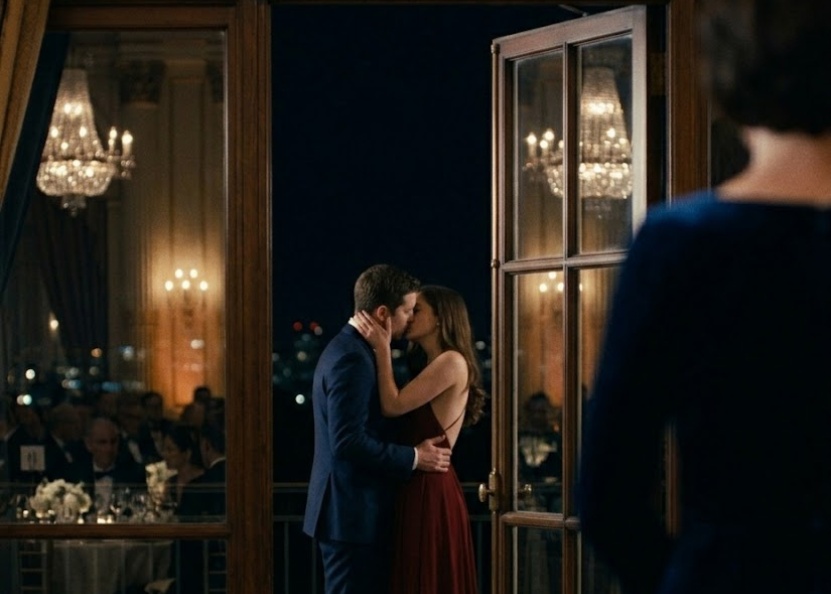
I took a route that kept me on the north side, behind the bar service station, moving parallel to the room rather than through it. I needed to see without being seen, which is a skill I have used in event management for sixteen years and which translated, that evening, to other purposes without any modification required. Near the east terrace, where the glass doors opened onto the outdoor area and the city lights were visible beyond, I found what Mei had not needed to describe. Richard had his hand on the small of her back. She was wearing a red dress with an open back. He turned his face toward hers, and the kiss lasted approximately four seconds, and it was not brief in the way of a moment’s carelessness but deliberate in the way of a man who has decided he is not going to be careful about this anymore.
Dr. Okafor was standing twelve feet from them with a champagne glass in his hand. He looked up and found my face across the room. His expression was the expression of a man of seventy-two who has seen enough of the world to know what he was watching and enough of me to know that I had probably already seen it too. I looked back at him for one second. I shook my head, almost imperceptibly. He gave me the smallest nod I have ever received from another person and went back to his champagne. That was the entirety of it. Nobody intervened. Nobody needed to.
I went back to my office. Mei had the footage saved to a secure folder on the event server. I confirmed the file name, the timestamp, the camera angle. I confirmed that Richard’s face was clearly identifiable in the footage, which it was — he had been standing in good light, the way you are when you have not thought to consider where the cameras are. I confirmed that Vanessa’s face was identifiable, which it also was. I noted the time: 9:14 PM. I wrote it in the notes document I had been keeping since January. Then I sent a text to my attorney that said: Event documentation added. Timestamp 9:14 PM. Camera seven, Grand Meridian. Advise on inclusion. Diana responded within four minutes: Include. We’re ready when you are.
I went back out into the ballroom. The auction was starting. The auctioneer was at the podium. Five hundred people were reaching for their paddles, their phones, their energy for the competitive generosity that good events generate. I circled the room and stopped at table four, where Richard was sitting with two city officials and a partner from his firm. He looked up when I approached. He said the room looked incredible, again — he sometimes says the same thing twice without noticing, a small habit I had observed over eleven years without ever mentioning. I agreed that it did. I said the auction was about to begin and suggested he pay attention because lot seven was the one I thought he would want — a private dining experience at a restaurant he had mentioned months ago. He smiled. He said I always remembered everything. I said: yes. I do.
He had kissed someone else nine minutes before that conversation. He sat at my table with that and showed no sign of it, because Richard has always been good at the performance of normalcy, and I have always been better at noticing what the performance is covering. That was the marriage, in miniature. That was what eleven years had looked like from the inside, and I had needed four months and a folder full of documentation to admit it clearly enough to act on it.
The room went quiet. The auctioneer called the first lot.
I reached for a champagne glass and drank it slowly and did not feel anything I had not already processed.
Part Three: The Last Dance
The announcement came at ten forty-five, after the final auction lot had closed and before the orchestra moved into the evening’s last hour. I returned to the podium for the formal close, which is always my responsibility — the chair opens and the chair closes, bookending the evening with the same voice, creating the sense of a room that has been held together from beginning to end by someone who knew what she was doing. I thanked the board by name, each one. I thanked the lead donors by name. I thanked the kitchen team and the event staff and the venue management and the orchestra, because the people who run a room deserve to be acknowledged in the room they ran. I said what I always say about the children — that the money raised tonight would make specific differences in specific lives, and that specificity is the most honest form of gratitude.
Then I said one additional thing. I said I had a personal announcement to make, and the room shifted in the way rooms shift when a speaker steps outside the prepared script. I said that effective at the close of tonight’s event, I would be stepping down as gala chair. I said it was a family matter requiring my full attention. I said I was grateful for eleven years of partnership with this organization. I said I would be in touch with the board directly. I said goodnight, and I handed the podium to the auctioneer’s assistant for the final remarks, and I stepped back.
The room was not silent — five hundred people produce a certain level of ambient sound that does not stop for a single announcement — but the immediate vicinity went quiet in the way that matters, the quiet of people who are looking at a person and trying to understand what they just heard. I did not help them understand it. I moved off the stage and toward the floor with the composure of someone who has just delivered information and has no obligation to contextualize it.
Richard found me in three minutes. He was moving quickly without appearing to, which is his social skill applied to urgency, and he took my arm near the edge of the dance floor and said quietly: what was that. I said: an announcement. He said: Caroline. I said: the orchestra is about to play the last number, and we should be on the floor for it, because people will notice if we’re not and tonight has already given people enough to notice. He looked at me for one second that contained a great deal of calculation. Then he took my hand and led me onto the floor.
The orchestra began something slow and familiar. The dance floor filled around us, and Richard put his hand on my back the way he always has — muscle memory accumulated over nine gala seasons, over nine years of standing in well-lit rooms looking like something worth being. He dances well, which I have always noticed and which I notice now for the last time, the way you notice the particular quality of something you are about to stop having. He said: tell me what’s happening. I said: I am dancing with my husband at our foundation’s gala. He said: Caroline. I said: Richard. He stopped trying to have the conversation, which was the right decision — there was nothing to say here that could be said here — and we danced.
Near the end of the number he dipped me, which he always does, which he has done at every gala for nine years, the particular choreography of a marriage that has always performed well in public. The room saw it. Several people smiled. The photographer was there, doing his job, and the shutter opened and closed and a moment was recorded that would appear in the foundation’s annual report — two people on a dance floor, beautifully lit, the room holding them in its warmth, all five hundred guests arranged behind them like a frame. It was a good photograph. I had made sure the lighting was right.
He was still holding me when the music ended. He did not know it was the last time. I did. That asymmetry is not something I manufactured — it was the natural result of one person spending four months paying attention while the other person stopped. I had not chosen it to be cruel. I had chosen it to be complete, because partial endings leave room for things to stay incompletely ended, and I was not interested in incompletion.
The evening began to close. Guests moved toward exits. Staff began the quiet, efficient work of a room being packed down, which I always find peaceful — the removal of the temporary architecture of an event, returning the space to what it was before. I completed my closing checklist. I thanked Mei by name, and my lead coordinator by name, and the venue manager by name. Richard stood near the entrance talking with a partner from his firm, his back to the room, doing the last of the evening’s networking. I watched him for one moment from across the marble lobby — his posture, his laugh, the ease with which he occupied a space he had done nothing to build.
I did not say goodbye. I got into my car. I told the driver to take me home. I looked out the window at the city going past, all its light and motion, alive and indifferent, moving through the night the way the night always moves — forward, without pause, without needing to explain itself to anyone.
In the morning I would send Diana a single text: Proceed. But that was morning. Tonight was still tonight, and the city was very beautiful, and the gala had exceeded its fundraising projection by eighteen percent, and somewhere in a pediatric ward across town a seven-year-old boy named Tommy was sleeping with his stuffed rabbit under one arm, recovering from a surgery that money raised in that room tonight had helped make possible. That was the thing that was always true, no matter what else was also true. I held on to it the way you hold on to the things that are simply, undeniably real.
Part Four: The Monday Morning
I had four days between the gala and the Monday morning. I have thought about those four days more than I have thought about any other stretch of time in the past two years, not because they were dramatic — they were not — but because of how ordinary they were, and what that ordinariness required of me.
Saturday night: I came home, hung up the midnight blue gown, showered, made tea, and called my mother for twelve minutes about nothing in particular. She asked how the gala went. I said the fundraising numbers were strong. She said she was proud of me. I thanked her and meant it. Richard arrived home forty minutes after I did, said the evening had been something else, kissed my cheek, and went to bed. I sat in the kitchen with my tea until it was cold, then went to bed too. I lay in the dark and thought about nothing I had not already thought about, because I had been preparing for this for four months and the preparation was complete and there was nothing left to process that had not already been processed.
Sunday morning, I went to the hospital. Not for work — for Tommy. He was seven years old and had undergone a procedure three days earlier that the surgical team had described as a success, which is the word they use when the outcome is the best available outcome and they want you to understand it without requiring you to celebrate it. I had stopped in to see him the night of the gala, briefly, before I went to change. I went back Sunday because I had told him I would, and I keep the things I tell children. He was sitting up in bed with his rabbit and a cartoon about a small bear who solved problems by being methodical and kind. He asked me if I had been to a party. I said yes. He asked if it was a good one. I said the food was excellent. He said that was the most important thing. I agreed that it was.
Sunday afternoon, Richard and I moved through the house in the comfortable parallel of a marriage that has settled into logistics. He watched something in the study. I reviewed the Q3 patient outcome reports I needed for a board meeting the following week. We ate dinner together, talked about a neighborhood issue his partner had raised, talked about nothing that mattered. He did not mention the gala announcement. I think he had decided to approach it Monday, when he had thought through his strategy. Richard was always at his best when he had prepared. So was I. The difference was that I had started preparing in January.
Sunday evening, my attorney Diana sent a text: Courier confirmed. Monday, nine AM. His office address, marked personal and urgent. I confirmed receipt. I set the phone face-down on my desk and went back to the outcome reports. There was a notation on page fourteen about a funding gap in the pediatric oncology ward that I wanted to flag for the board — a specific, solvable problem that required attention before the next quarterly cycle. I made a note in red. I marked it urgent. Then I closed the laptop and went to sleep.
The courier arrived at Richard’s office at nine-oh-seven. I know this because Diana confirmed it by text at nine-eleven, which I read in the parking garage of the hospital before I walked in to chair the board’s review meeting. I noted the time, put my phone in my bag, and walked into the building. The meeting began at nine-thirty. I presented the Q3 outcomes, flagged the oncology funding gap, proposed a timeline for resolution that the board accepted without significant revision. I answered four questions. I thanked the committee. The meeting ended at eleven-fifteen. By then, Richard had called three times.
I did not listen to the voicemails. I read the transcription on my phone while I walked to my car. The first message was his name for me and a request to call him. The second was longer — something about needing to talk, about the announcement, about can we just talk before anything else happens. The third was quieter. He said he had opened the documents. He said he needed to understand. He said please. The word please in Richard’s voice has always been a specific instrument — he uses it when charm has not worked, as a secondary approach, and I have always known the difference between please as feeling and please as tactic, and the please in the third voicemail was both, which meant the situation had surprised him enough to make him feel something real. I noted this. I texted Diana: He received. She responded: Confirmed per courier receipt. Next step at your direction.
He came to the hospital at two in the afternoon. I had told reception he was permitted in, which is something I do not do automatically — people come into my professional space on invitation, not by assumption. We used a small conference room on the second floor, the one with a window that looks out over the hospital garden rather than the parking structure. I had always preferred that room for difficult conversations because the garden was maintained by volunteers and it was always tidy and there was something useful about looking at something that people chose to tend without being required to.
He looked different. Not broken — Richard does not break visibly, it is not in his constitution — but altered in the specific way of someone who has had a version of himself disproved. He sat across from me and did not reach for his phone, which told me the situation had his full attention in a way that most situations did not. He asked how long I had known. I told him four months. He asked about the gala. I said yes. He was quiet for a moment, working through the timeline — January to April, the document folder, the attorney, the announcement from the podium, the last dance. I could see him reconstructing it, and I could see the reconstruction arriving at an accurate conclusion, and I did not help him or hinder him. I let him find the shape of it himself.
He asked if it could be different. I looked at him across the conference table — eleven years of history between us, the navy suit he was still wearing, the hands that had built a career using introductions I had made — and I said: tell me what would be different. He said he would end it. I said I know you would, now. He said that was unfair. I said: Richard, you kissed someone else at our foundation gala in front of forty-three people and one security camera, and I have been preparing for this conversation since January, and the question of what is fair is not the most useful question available to us right now. He looked at the table. He did not argue. That was the most honest moment we had shared in longer than I wanted to calculate.
I told him the terms were in the documents, and the terms were fair — I had instructed Diana to structure them without punishment, because punishment is not the same as accountability and I wanted the former without the theater of the latter. The house was mine and had always been mine, purchased before the marriage with money I had saved before I met him. The primary account had been restructured to reflect contributions accurately. The foundation was already operating under a single-director governance structure. Everything had been done carefully, over months, in a sequence that did not require a confrontation to execute. He could contest it, which Diana had told me was his legal right, but the documentation was thorough and the contest would cost more than the terms. I said all of this without raising my voice. There was no reason to raise my voice.
He said: you danced with me. I said: yes. He said: why. I said: because it was our event and we were going to do it right. He looked at the garden through the window for a long moment. Then he said: I didn’t know you were capable of this. I thought about that for a second, about whether he meant the planning or the composure or the patience or all of it together, and I decided it didn’t matter which, and I said: I know you didn’t. That is the most accurate thing you have said today. He looked back at me when I said it, and I think in that moment he finally, fully, saw me — not the version of me that was useful to his plans, not the version that managed his appearances and arranged his introductions and made his room look beautiful, but the actual person who had been doing all of that, and who had been doing other things he had not been paying attention to, for a very long time. It lasted approximately one second. Then the moment passed and he was Richard again, and I was Caroline again, and the garden was very tidy through the window, and that was the last real conversation we had as people who were still married.
Part Five: What She Kept
The divorce was finalized in September. It was clean, which was what I had intended, and fast, which was what Diana had predicted given the documentation. Richard did not contest the primary terms, which I had also predicted, because Richard is many things but he is not, at his core, someone who fights for things he knows he cannot win. His firm survived — I want to be clear about this, because some people assumed I would dismantle it and I did not. The introductions that had built his early contracts were mine to have given or not given, but they were given, and I do not take back what I have given. What had been done was done. What needed to be separated was being separated. Those were two different tasks and I treated them as such.
Vanessa did not know he was married. This was information that emerged through the legal process, specifically through a document Richard’s attorney submitted that included a timeline of the relationship, and which contained a detail that his attorney had perhaps not read carefully enough before including. She had believed they were separated — legally, formally separated, a situation Richard had apparently described with enough specificity to be credible. When Diana showed me the document, I read that section twice. I thought about Vanessa in the red dress, her hand against the terrace railing, the specific confidence of a woman who believes she is not doing anything wrong. I did not contact her. There was nothing to contact her about. The person who owed me something was not Vanessa. I have never found it useful to direct my attention at the wrong target.
The foundation continued. The board met in May and voted unanimously to retain me as sole director, which I had expected but was nonetheless grateful for — gratitude is not diminished by anticipation, if the thing being received is real. We began planning the following year’s gala in September, earlier than usual, because I wanted the timeline to have more space for the auction curation than the previous year’s schedule had allowed. Mei joined the permanent staff rather than the contractor roster, a change I had been meaning to make for two years and that I made now because there was no longer any reason not to do the things I had been meaning to do. She asked if she should update her email signature. I said yes. She sent me the new version for approval. I approved it. That was the whole conversation, which is how conversations go when you have worked with someone long enough to have nothing left to perform for each other.
Tommy was discharged in May. I received a card from his mother in June — a hand-drawn envelope, inside which was a piece of paper covered in crayon. There was a tall person and a small person and some stars and what might have been a hospital or might have been a castle, the distinction being less important in crayon than in other media. His mother had written: Tommy wanted you to have this. He says you smell like flowers and you are the one who fixed everything. I read it twice. I put it on my desk under the corner of my monitor where I would see it every day. I do not believe I fixed everything. I believe the surgery fixed everything, and the fundraising made the surgery possible, and the work made the fundraising possible, and the work is always where it starts and always where it ends. But Tommy is seven and the distinction is not one I need to make for him.
There was an article in the local paper in July. Not about me, not about Richard, not about any of the things that had made those months complicated — about the gala. Specifically, about the impact of the year’s fundraising: the number of children served, the procedures funded, the ward expansion that had become possible because of the auction’s final total. Tommy was in it, unnamed, described only as a seven-year-old patient who would return to first grade in September. I read the article in my office on a Tuesday afternoon, with the window open and the sound of the city coming through, and I thought: this is the thing that remains. Not the chandeliers. Not the champagne. Not the footage on camera seven, which had served its purpose and would now be archived along with everything else that had been necessary and was now complete. The work was what remained. It was always the work.
Epilogue: October
The conference room on the second floor has a particular quality of light in October. The garden below has gone gold at the edges, the volunteer-tended beds adjusting to the season without being asked, which is what well-tended things do. I have held three difficult conversations in that room this year. I expect to hold more. I have learned that the room itself has nothing to do with the difficulty — the difficulty is always in the material, never in the container, and a good container is simply one that holds without breaking.
I did not replace the gala chair title immediately. The board asked if I intended to continue in the role in a formal capacity or simply in an advisory one, and I told them I needed until November to answer that question, which they accepted because I have spent nine years building the kind of credibility that makes people willing to wait for my answer. I am not certain what the answer will be. This is new — I am a person who moves toward certainty, who builds until certainty is available, and I am learning that there are categories of question where certainty is not the goal and the sitting with the question is the thing itself. It is uncomfortable in the specific way of new practices. I am doing it anyway.
Mei brought me coffee at four o’clock on a Tuesday in October and set it on the corner of my desk nearest to Tommy’s drawing. She said: the venue wants to know if we’re doing the full ballroom again or considering the smaller space. I said: full ballroom. She said: I’ll confirm. She turned to leave. I said: Mei. She turned back. I said: thank you. She looked at me for a moment with the expression of someone who has worked alongside a person through a difficult year and knows that thank you means more than the word. She said: obviously. Then she went back to her desk and I heard her on the phone confirming the ballroom.
Five hundred and twelve people had been in that room in April. Forty-three had seen what I saw. One camera had an unobstructed angle. My attorney had used three pieces of evidence from that evening, two of which Richard’s attorney had contested and one of which they had not, because some things are simply clear. The gala had raised more money than any previous year. Tommy was back in first grade. The foundation was intact. The work was continuing. These are the facts of what happened, and the facts are what I have always trusted most, because they do not require interpretation and they do not change based on who is looking at them. They simply are.
I finished my coffee. I opened the Q4 planning file. The next gala was eight months away, which meant the work had already started, which meant I was already inside it, which is where I am most at home — not in the events themselves, glittering and temporary, but in the quiet accumulation of preparation that makes the events possible. You build a room over years. You build it in the decisions nobody watches. And when the night comes and the chandeliers are right and the orchids are at the correct stage of bloom and the room is full of people who trust you with something real, you stand at the podium and you know, with the particular certainty of someone who has done the work, that the room belongs to you because you built it — and that nobody, regardless of what they do in a corner of it for four seconds on a Tuesday in April, can take that from you.
