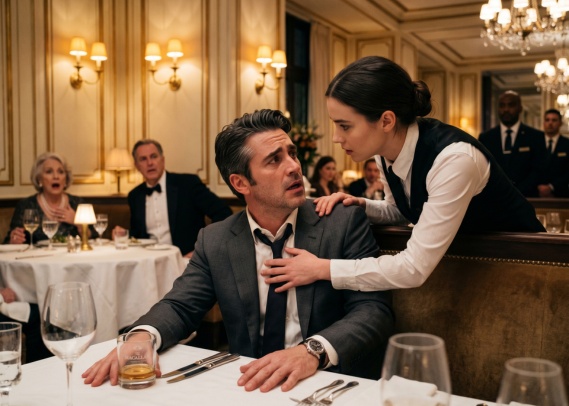
The Waitress Reacted in a Split Second — And Saved the Mafia Boss Before Anyone Else Could
Part 1: The Night She Was Not Supposed to Be There
She was not supposed to be in section 7. That was the fact Emma Walsh would return to, again and again, in the weeks that followed — when she was trying to reconstruct how a Thursday night double shift at a Tribeca restaurant had become the thing it became. Sarah was supposed to be there. Sarah had the section, had the regulars, had the particular understanding that came from three years of managing Côte d’Azur’s most private booths. But Sarah was at the front, dealing with something difficult that Michael would not fully explain, and Michael had come to Emma with that tight expression managers got when they needed a favor but did not want to call it that.
She said of course. Her mother’s medical bills did not care about section assignments, and tips in the private booths ran higher than anywhere else in the restaurant. She adjusted her vest, picked up her notepad, and walked toward booth 7 with the same professional composure she had spent 8 months building — the kind that let her be present without being intrusive, helpful without being hovering, visible only when visibility was required.
The dining room at Côte d’Azur had its own specific atmosphere on a November Thursday. It was not the loud money of a Friday, not the performative ease of a Saturday. Thursday was when the people who did not need to perform showed up — old families, quiet power, people for whom a Tribeca corner table with floor-to-ceiling windows was simply where one went when one wanted to eat without being bothered. The lighting was warm and low, reflected in polished mahogany and the crystal of the chandelier overhead. Outside, the rain had started around six and had not stopped — the kind of November drizzle that turned the streets below into rivers of neon and brake lights, beautiful in the way that things are beautiful when you are not the one standing in them.
Emma moved through the room the way she always did. She refilled table 12 on her way past, gave the couple at 15 a nod that meant she had seen them and would be back, and rounded the frosted glass partition that screened booth 7 from the rest of the dining room. She had been told his name. Michael had given her three facts and one warning: Macallan 25 neat, filet mignon medium rare, no small talk, and be professional but do not ask questions. She had understood the warning. Côte d’Azur attracted a certain kind of regular whose privacy was worth more than their order.
She rounded the partition with her professional smile in place, introduced herself, took his drink order without making it an event, and turned to go. He said, as she was turning, that she was new to this section. She said just for tonight and kept walking. She did not think about the comment again until much later, when she understood that it had not been an observation at all.

Part 2: Eight Months of Temporary
The restaurant job was supposed to be temporary. Emma had told herself this so many times and in so many variations that the word had lost most of its meaning, the way a word does when you repeat it past the point where it is still doing work. Temporary meant just until she finished her master’s degree in social work. Temporary meant just until her mother’s treatment was complete. Temporary meant just until she could breathe again, which was a thing she had been promising herself for so long that she had started to suspect breathing was something that happened to other people.
She had taken the year off from her degree program not because she wanted to but because her mother’s diagnosis had come in April of her second year, and by June it had become clear that the timing of cancer did not adjust itself to accommodate graduate school timelines. She had deferred her enrollment, sublet the apartment she shared with a friend in Astoria, and moved back into her childhood bedroom in Flushing — a room that still had the bookshelf she had arranged at fifteen and the desk where she had written the application essay that got her into college. She had lain in that bed on nights when her mother was in pain and made calculations: how much the copays would cost, how long her savings would last, what a full-time teaching load at the community college would pay versus the hourly rate at a restaurant in Tribeca. The restaurant won. It usually did.
Working doubles at Côte d’Azur was, by most metrics, a good job. The tips were real, the kitchen respected the servers, and Michael ran a clean operation. Emma had learned to be grateful for these things in the specific way that exhausted people learned gratitude — not as a feeling but as a discipline, a thing you practiced so that the alternative did not move in. She spent her shifts in a state of high-functioning autopilot: taking orders, reading the room, timing the courses, managing the section with the same methodical intelligence she would have brought to a social work caseload if she had been allowed to finish building one. Her professors had told her she had good instincts for people. She had thanked them and not mentioned that she had been reading people in self-defense for most of her life.
The year at Elmhurst Hospital had sharpened those instincts into something else. She had volunteered there during the months her mother was in remission the first time — not for clinical hours, not for her resume, but because she needed somewhere to put the particular anxiety that comes from watching a person you love be sick. The nurses had let her do small things: fetch things, sit with people, learn the rhythm of a ward in the way you can only learn it by being in it for long enough that it stops feeling strange. She had learned what a body looked like when it was managing pain versus hiding it. She had learned what a face looked like when it was performing fine for the benefit of the people watching. She had learned, most usefully, that asking someone if they were all right was almost always the wrong question, because the people who were not all right had already decided what they were going to say.
She was thinking about none of this when she came back with Vincent Moretti’s Macallan 25 and set it down at booth 7. She was thinking about table 15 and whether she had enough time to check on 12 before the kitchen called her order for 9. She set the glass down, asked if he was ready to order, and turned to refill her pitcher. She was not thinking about him at all. She was thinking about the things that were always running in the background — rent, the dosage her mother’s doctor had adjusted last week, the paper she needed to finish by the end of the month for the class she was auditing online because she could not afford the full enrollment fee.
She was not thinking about him. Which was why, when she looked up from across the room and saw something wrong, she saw it with the full, uncluttered attention of someone who had not been watching for it.
Part 3: What the Room Did Not See
His Macallan glass was untouched. That was the first thing — a detail so small that it would not have registered for anyone who was not trained to track a table the way Emma tracked hers. A man who had ordered a specific Scotch and specified neat had not touched it. His phone, which he had been scrolling when she first brought it out, was now face-down on the white tablecloth. His shoulders, which had been settled with the easy confidence of someone entirely at home in expensive rooms, had come slightly forward. His jaw was set in a way she recognized — the particular tension of a person who was managing something their body was trying to do without their permission.
She set down her water pitcher. She crossed the room without running, which mattered — running in a dining room like Côte d’Azur would have changed the temperature of the air before she arrived, and the last thing a man like Vincent Moretti would want was the temperature of the room changing on his behalf. She moved fast enough to matter and quiet enough that only the nearest table noticed, and she was already beside him when the nearest table was still deciding what they had seen.
She did not ask if he was all right. She said, in the low, even voice she had learned at Elmhurst, that she needed him to look at her. He looked at her. The dark eyes, which had been so controlled when she introduced herself — cataloguing her, assessing her with the unhurried confidence of a man accustomed to knowing exactly what he was dealing with — were different now. Not out of control. Not frightened. But effortful. There was something in them that cost him, and she understood the cost immediately because she had seen it before, on people who were determined not to be seen failing in the places where failing was not allowed.
She said, your left hand. Can you open it for me? He opened his left hand. It was trembling. She said, that is going to stop in a few minutes. I need you to eat something plain. He looked at her for a moment with an expression she catalogued without naming — something between suspicion and the specific exhaustion of a person who had just been found out — and then he nodded, barely, which was the only permission she needed.
One of his men had started moving from the bar. She held up one hand without breaking eye contact with Moretti, the gesture flat and certain, the gesture she had seen nurses use when they needed someone to stop without making a scene. The man stopped. She did not process this at the time; she noted it the way you note a detail during an emergency — accurately, without interpretation — and moved on. She was back from the kitchen in ninety seconds. Crackers, room-temperature water, a small ramekin of honey. She set the plate down, sat across from him in the booth, and waited.
He looked at the plate. He looked at her. He said he did not take instructions from his servers. She said that he also apparently did not notice when his blood sugar dropped until his hands stopped working, so they were both having a new experience tonight. Something moved in his face — not quite amusement, something more specific than that, the micro-expression of a man in the process of recalibrating — and then he picked up a cracker and ate it. The floor manager appeared at the edge of the partition, took in the tableau with practiced professional vision, and made the silent calculation that this was above his grade to interrupt. He stepped back. Emma watched him do it and felt nothing in particular. She had stopped being capable of performing normal about six hours into her shift.
The crackers helped. The trembling in his left hand slowed and stopped. The set of his jaw eased by some increment that was barely visible but that she tracked. The color came back into his face gradually, the way it did — not in a rush, but steadily, like water finding its level. Outside the rain ran down the floor-to-ceiling glass, and the dining room moved around them with its expensive, unselfconscious hum, and the two of them sat at booth 7 in a silence that was, strangely, not uncomfortable at all.
Part 4: A Waitress, Nothing More
He ate three crackers and drank half the water before he spoke again. When he did, his voice was the voice she had heard when she first introduced herself — smooth, controlled, the faint trace of a New York accent sitting underneath the polish like something that had been educated but not entirely trained out. He said he supposed the Macallan was going to go to waste. She said probably, and that he should not drink it tonight anyway. He looked at her for a moment. She did not look away.
The question he asked next was the one she had been expecting — not because she was psychic, but because she had been a server long enough to know that powerful men, when they felt that they had been seen doing something they had not intended to show, had one of two responses. They either became cold, which was a kind of closing of ranks, or they became curious, which was its own kind of danger. He asked how she had known. She said his hand had stopped moving, and that people who were fine kept moving. He was quiet for a moment. Then he said she had done this before.
She did not confirm or deny it. She said the crackers would help and asked him to eat another one. He did. His eyes did not leave her face while he ate, and she had the peculiar, specific sensation of being looked at by someone who was not used to looking at people the way she was not used to being looked at — not as a role, not as a function, but as a thing that had surprised them. She was aware that this was unusual. She was aware that the two men at the bar were watching the booth with the careful stillness of people who had been told to be patient and were being patient to the limit of their capacity for it. She was aware that she had four more hours on her shift and that table 15 had not been checked in twenty minutes.
She sat in the booth and did not stand up. That was the fact she would return to also, later, the way she returned to the question of section 7 — she had known she should go back to her section, had run the calculation automatically, had found all the correct reasons to stand up and give him his space and perform the professional invisibility she had spent 8 months perfecting. She had found all those reasons and stayed anyway. She was not sure why, exactly. She was too tired to analyze it. She told herself it was clinical — she did not leave a patient until she was confident the immediate risk had passed. She told herself this and almost believed it.
He said, quietly, that he was curious about something. He said he meant no offense, but that she did not seem like a waitress. She said she was exactly a waitress, and that she had a master’s degree she had not finished, a mother whose medical bills had made temporary into permanent, and four hours left on her shift, but that none of those things changed what she was right now, which was the person who brought him crackers and water. He looked at her for a long moment. He said, I’m not offering you a compliment. I’m asking you a question. She said she knew the difference, and that she was choosing to answer the compliment and not the question.
Something in his expression shifted. Not amusement — something quieter than that, something that looked like recognition, though she could not have said what he was recognizing. The restaurant moved around them. Someone at a nearby table laughed at something, and the sound was the ordinary sound of a restaurant functioning, and the whole of booth 7 existed slightly outside it — in the particular stillness of two people who have just navigated something together and have not yet agreed on what to do with the fact of it.
She should have stood up then. She knew it. She stayed.
There was a version of herself that would have stood up. Would have given him the professional nod, told him to drink the water slowly, and gone back to table 15 with the composed apology of a server who had been delayed by something she could not explain. That version of herself was not unavailable to her — she could feel her, close, the way you feel a decision you have not made yet. She simply did not choose her. She was not sure, sitting across from Vincent Moretti in booth 7 with the rain on the glass and the restaurant pretending nothing had happened, that she understood why. She had spent the last eight months making practical decisions. This one did not feel practical. It felt like the kind of decision that only makes sense later, when you can see what it was the start of.
Part 5: Her Name, Said the Wrong Way
He said her name the way someone says a word they have been holding for a long time. Not Emma, the way she had introduced herself at the start of the shift. Her full name — first and last, quietly, without inflection, with the faint New York accent that surfaced when his voice came down from its polished register into something underneath. Emma Walsh. He said it the way people say a name that belongs to them in some context she did not yet know.
She felt the blood leave her face. She was aware of it as a physical fact, the way you are aware of going cold — not gradually, but all at once, a systemic response that the body executes before the mind has finished understanding why. She said, how do you know my name. He picked up the third cracker and held it without eating it. He looked out through the floor-to-ceiling glass at the rain-soaked street — the neon blurring in the water, the brake lights, the November drizzle still coming down — and when he turned back, something in his expression had shifted into something she did not have a name for. Not threat. Not apology. Something that was neither.
He said he had known her name for a long time. He said it simply, without drama, in the way that people say things when they have thought about how to say them for a while and have decided that plainness is the only viable option. She said, how long. He said, since before tonight. She said, how long before tonight. He was quiet, and the quiet stretched in the way that quiet stretched when it was containing something. He picked up the Macallan glass and turned it once between his fingers — that small, habitual gesture of a man who thought with his hands when his face was not permitted to — and set it back down without drinking.
The crackers plate sat between them. Half empty. Very small and very ordinary in a restaurant where nothing else was ordinary. She was aware of the weight of her feet after six hours of standing. She was aware of Michael somewhere behind the partition, pretending not to be aware of her. She was aware of the two men at the bar who had not moved and were not going to move until they received some signal that did not come, and that their stillness was a kind of answer to a question she had not asked: that whatever this was, it was not simple, and it was not over.
He said — and the way he said it was careful, more careful than anything he had said all evening, with the specific care of someone handling a piece of information they know can cause damage — that her mother’s intake paperwork had been flagged at Lenox Hill. He said he did not usually pay attention to intake paperwork at Lenox Hill. But that this name he recognized. The room did not change. The chandelier still caught the light the same way. The rain was still running down the glass in the same lines it had been running for the last three hours. But something in the air between them shifted — some pressure changed, some thing that had been one kind of thing became a different kind — and she understood, in the cold clarity that arrives just before real fear, that this man had not come to Côte d’Azur on a rainy Thursday in November because of the filet mignon.
She said, you recognized my name from where. She said it slowly, in the voice she used when she needed to be certain she would remember every word of what came next.
He opened his mouth. He closed it. He looked at her in a way that was almost — she would think about this word later, would turn it over the way he had turned the glass — cautious. Which was not a thing she had expected to find in a man like Vincent Moretti, in a restaurant like this, in a booth like this, on an evening that had already stopped resembling any evening she had planned for. He looked at her with something that was caution, and that was not a thing powerful men usually needed, which meant that what he was about to say was something that required it.
He said her father’s name.
She had not heard it spoken — not in that tone, not attached to that particular weight — in eleven years. Eleven years of a specific absence, the kind of absence that does not feel like nothing because nothing would have been easier. The kind that feels like a door that is always there and always locked, so that eventually you build your life around it, arrange the furniture so the door is not in the way, and tell yourself this is the same as forgetting it exists. She had become, in eleven years, very good at the furniture arrangement. She had a master’s degree she was finishing, a mother she was caring for, a section she managed with the kind of quiet efficiency that her professors called instinct and she called necessity. She had constructed, out of those things, something that functioned. Something that did not require her to think about the door.
He said the name, and the door was there again. Not unlocked. Not open. But there — undeniable, back in the center of the room where she had stopped being able to pretend it was not, because a man she had met forty minutes ago in a Tribeca restaurant booth was looking at her with the eyes of someone who had a key and had not yet decided whether to use it. He said the name, and then he said nothing. He let it sit between them on the white tablecloth next to the half-empty plate of crackers and the untouched glass of Macallan 25, and he watched her face with the particular attention of someone who had been waiting a long time to see what this information would do when it landed.
The restaurant hummed around them. Someone near the front laughed. A waiter cleared a table two sections over with the practiced quiet of good service. The rain ran down the glass.
She did not ask what he knew. She did not ask how. She sat very still, in the booth she was not supposed to be in, in the section she had not been assigned, on the Thursday shift she had picked up because her mother’s medical bills did not care about her schedule — and she understood, with the cold and total clarity of a woman who had spent the last eight months teaching herself not to be surprised, that surprise had been waiting for her here all along.
She said, finally, how long have you known.
He looked at her. Not with the cataloguing glance from the beginning of the evening. Not with the careful assessment of a man accustomed to knowing what he was dealing with before he committed to any position. He looked at her with something that was older than any of that — something that had already made its decision and was only now getting around to showing her.
He said, long enough.
Outside, the rain continued. The city blurred behind the glass. In booth 7, at a corner table in a Tribeca restaurant where Emma Walsh was not supposed to be working that night, a man who had ordered a drink he had not touched picked up the last cracker on the plate and ate it — slowly, without looking away from her face — and said nothing else.
She thought about standing up.
She stayed.
