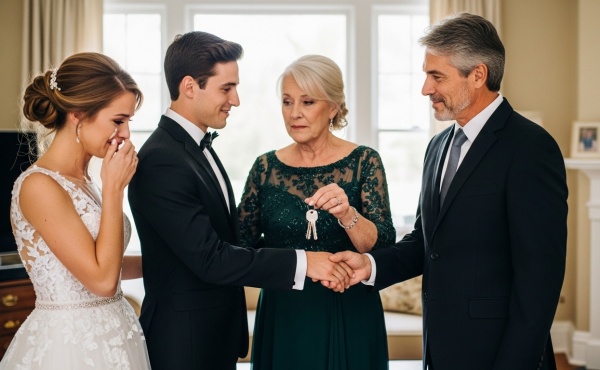
MY HUSBAND’S PARENTS GAVE US A HOUSE AS A WEDDING GIFT—BUT NEVER PUT MY NAME ON THE DEED. WHAT I DISCOVERED NEXT SHATTERED ME
PART I: THE PERFECT FIRST IMPRESSION
I was absolutely terrified the first time I met my future in-laws. I spent an entire night on Google researching how to make a good impression on your boyfriend’s parents, reading articles about conversation starters, appropriate dress codes, and cultural etiquette.
I ran through scenarios in my head a hundred times, practicing what I would say, how I would respond to their questions, what topics I should avoid. I even called my mother three times that day asking for advice. But nothing—absolutely nothing—could have prepared me for the reality of walking into their home in Westchester County, New York.
The house was stunning in a way that took my breath away. It was a three-story colonial mansion sitting on a manicured two-acre lot, with a circular driveway, a fountain, and landscaping that looked like it belonged in a magazine spread. The kind of place I’d only ever seen in movies or in the homes of celebrities on TV.
My heart sank a little as Michael pulled into the driveway. I knew immediately that his family was wealthy—much wealthier than I’d realized. I felt the pressure mounting as we approached the front door, my palms getting sweaty, my mind racing with anxious thoughts.
I was convinced they would judge me, find me lacking, see right through me as someone who didn’t belong in their world. I was a marketing manager at a tech startup in Manhattan, making decent money but nothing compared to what I assumed they had. My parents were middle-class—my father was a retired teacher, my mother a nurse. We didn’t have family money, family connections, or family property. I felt like an imposter, like I was about to be exposed as someone who wasn’t good enough for their son.
But then Michael’s mother, Catherine, opened the door with the warmest smile I’d ever seen. She didn’t look me up and down critically or shake my hand with a cold, formal grip. Instead, she pulled me into a genuine, warm hug, as if I were already part of the family. She asked about my family, my job, my dreams for the future.
His father, Robert, shook my hand and told me how happy he was to finally meet the woman who had made his son so happy. They were kind, gracious, and genuinely interested in getting to know me. I felt my anxiety melt away like snow in spring. Maybe this wouldn’t be so bad after all.
Over the next year, everything felt perfect. Michael and I got engaged at a romantic restaurant overlooking Central Park, and both families were thrilled. We planned a beautiful wedding at the Ritz-Carlton in Manhattan, with two hundred guests and a reception that lasted until midnight.
Catherine helped me with every detail—the flowers, the menu, the seating arrangements. She shared stories about her own wedding, gave me advice about marriage, and I found myself genuinely bonding with her. She felt like the mother I’d always wanted—supportive, wise, and genuinely loving. I couldn’t wait to officially become part of their family.
PART II: LIVING IN THE SHADOW OF EXPECTATIONS
After our wedding, Michael and I moved into a guest house on his parents’ property. It was a beautiful two-bedroom cottage with its own kitchen, living room, and yard. They said it was temporary—just until we got on our feet, bought our own place, had children.
They said it made sense financially, and they wanted to help us get started. At the time, it seemed like an incredible blessing. Free housing in Westchester County? That alone would have cost us $3,000 to $4,000 a month. I felt grateful, blessed even. I thought we were so lucky.
But living under their roof, even in a separate house, came with invisible strings attached. Catherine began criticizing everything I did, and I mean everything. The way I cleaned the house wasn’t thorough enough—I was missing dust on the baseboards. The way I cooked dinner wasn’t healthy enough—I was using too much butter and salt.
The way I dressed wasn’t appropriate enough for someone married into their family—my jeans were too casual, my dresses too trendy. She would stand in my kitchen, watching me prepare meals with her arms crossed, and offer constant, relentless commentary.
“That’s not how you’re supposed to cut vegetables,” she would say. “You’re supposed to cut them smaller so they cook evenly. That’s too much salt. You’re going to ruin that dish. Why are you using olive oil? That’s too expensive. Use vegetable oil instead. Your presentation is sloppy. A proper meal should look beautiful on the plate, not like you just threw it together.”
I was working full-time as a marketing manager at a tech company in Manhattan, commuting an hour each way on the Metro-North Railroad. I would wake up at 6 AM, take the train into the city, work until 6 PM, and then take the train back home, arriving around 7:30 PM. I was exhausted—the kind of exhausted where your bones ache and your mind feels foggy. I would come home wanting nothing more than to collapse on the couch and order takeout from the Thai restaurant down the street.
But Catherine expected me to cook a home-cooked meal every night, to keep the house immaculate, to be the perfect daughter-in-law. She would compare me to her neighbor’s daughter-in-law, praising how organized she was, how well she managed her household, how attentive she was to her husband’s needs.
“You know, the Hendersons’ daughter-in-law makes homemade pasta from scratch every week,” Catherine would say. “And she has a full-time job too. I don’t know how she does it. She’s so talented. You should ask her for recipes.”
One night, I came home after being yelled at by my boss for missing a deadline, with a pile of work still sitting on my desk that I’d have to finish after dinner. I was emotionally drained and physically exhausted. I just wanted to lie down and sleep, to escape into unconsciousness and forget about the day.
But Catherine was waiting for me in the kitchen, expecting me to help her prepare dinner for the family. She stood next to me, criticizing every move I made, talking constantly in my ear, and I felt something inside me snap.
I wanted to scream at her: “Please, just be quiet. I’m so tired. I can’t do this anymore. I can’t be perfect for you. I can’t meet your expectations. I’m doing my best and it’s not enough.” But I couldn’t. I was a daughter-in-law. I was supposed to respect her, listen to her, accept her guidance. So I bit my tongue and endured it, feeling my resentment build with each passing day, like water filling a cup until it overflows.
PART III: THE BREAKING POINT AND THE REVELATION
One evening, I broke down completely. I came home and just started crying—not the quiet, dignified kind of crying, but the kind where your whole body shakes and you can barely breathe. It was the kind of crying that comes from a place of complete despair, where you feel like you’re drowning and nobody can save you.
Michael found me in the bathroom and held me while I sobbed about how much I was struggling, how critical his mother was, how I felt like nothing I did was ever good enough. I told him that I felt like I was living in a prison, that I couldn’t breathe, that I was losing myself.
Michael listened to me, really listened, and then he went and had a serious conversation with his mother. I could hear them arguing in the living room—loud voices, tension, things being said that I couldn’t quite make out. It was intense, and I felt guilty for causing conflict between them. But I was also relieved that Michael was finally standing up for me, that he was finally telling his mother that her criticism was hurting me.
After that conversation, Catherine became distant. She stopped criticizing me, stopped offering advice, stopped coming over to the guest house. She was polite when we saw each other, but there was a coldness there that hadn’t existed before. She would greet me with a formal “Hello,” and then excuse herself to talk to Michael.
I knew she was angry with me, and I felt the weight of that anger every single day. I had caused a rift between a mother and son, and I couldn’t shake the guilt. I felt like I had destroyed something precious, like I had broken a relationship that could never be repaired.
Then, one weekend when the whole family was gathered at the main house for Sunday dinner, Robert announced that they had decided to give us the guest house as a wedding gift. They wanted us to have our own space, to build our life together without the constraints of living on their property. I was overjoyed—finally, we would have freedom from Catherine’s constant presence and criticism. Finally, we could be our own family, make our own decisions, live our own lives.
But then Robert said something that made my blood run cold: “We’re giving you the house, but we’re not putting your name on the deed. Just Michael’s. We want to make sure everything is protected in case something happens.”
I felt like I’d been punched in the stomach. Not putting my name on the deed? What did that mean? Did they not trust me? Did they think I was going to take advantage of them? Or worse—did they think I was going to manipulate Michael, turn him against them, and somehow steal their property?
The implication was crystal clear: they didn’t trust me. After everything I’d done to try to be the perfect daughter-in-law, after all my efforts to fit into their family, after all my sacrifices and compromises, they still saw me as an outsider, a potential threat to their son and their wealth.
I felt humiliated, betrayed, and angry. I wanted to scream at them: “How dare you! I’ve done everything you asked. I’ve tried to be perfect. I’ve endured your criticism. I’ve sacrificed my own wellbeing to fit into your family. And this is how you repay me? By refusing to put my name on the deed? By treating me like I’m some gold-digger who’s trying to steal from you?”
But I didn’t say anything. I just smiled and thanked them for the generous gift, while inside I was seething. That night, Michael and I had our first real fight as a married couple. I told him that his parents didn’t trust me, that they saw me as a threat, that I felt completely disrespected. Michael tried to defend his parents, saying they were just being cautious, that it didn’t mean anything personal. But I couldn’t let it go. I felt wounded in a way I’d never felt before.
PART IV: THE CRISIS AND THE TRUTH
Things got worse before they got better. Michael’s business—a men’s fashion boutique he’d opened in SoHo—started struggling. He had invested his entire savings into the business, had taken out loans, had worked eighty-hour weeks trying to make it succeed. But the market was saturated, and his business model wasn’t sustainable.
Then the COVID-19 pandemic hit, and retail was devastated. Foot traffic dried up, stores were forced to close, and people stopped shopping for non-essential items. His boutique was empty most days.
Rent payments became impossible. He was paying $8,000 a month for a 1,500-square-foot space in SoHo, and he was lucky if he made $5,000 in sales on a good day. His inventory sat unsold, gathering dust, becoming obsolete. Within six months, he’d accumulated nearly $500,000 in debt.
We liquidated our savings trying to keep the business afloat, but it wasn’t enough. We drained our emergency fund, our retirement accounts, everything. We were hemorrhaging money and there was nothing we could do to stop it.
Desperate and drowning, Michael approached his parents and asked if they could help us. He wasn’t asking for a gift—he was asking for a loan. He was willing to sign a promissory note, to pay them back with interest, to do whatever it took. Surely, I thought, they would help their own son in his time of need. They were his parents. They loved him. They had more money than they could ever spend. How could they turn him away?
But Robert and Catherine looked at us with cold indifference and said they didn’t have the money to spare. They said they had their own financial obligations, their own retirement to think about, their own investments to protect. I couldn’t believe it.
They lived in a mansion, drove luxury cars—Catherine drove a Mercedes, Robert drove a BMW—took vacations to Europe and the Caribbean. How could they not have money? But more than that, how could they turn their own son away in his darkest moment? Michael was devastated. I was furious. We felt completely abandoned, betrayed by the people who were supposed to love us unconditionally.
With nowhere else to turn, Michael took out predatory loans from private lenders—the kind with interest rates that would make your head spin. Forty percent annual interest. Fifty percent. The kind of loans that are designed to trap you, to make it impossible to ever pay them back. The debt spiraled out of control like a tornado, destroying everything in its path. We were trapped in a nightmare with no way out, no light at the end of the tunnel.
The loan sharks started showing up at our door, threatening us, going through our belongings, demanding payment we didn’t have. They were violent, aggressive, and absolutely terrifying. I remember one night when they came to the house, and I genuinely thought we might not survive the night.
They threw things around, broke furniture, threatened to hurt us if we didn’t pay. I held Michael’s hand and we both thought about ending it all, about how much easier it would be to just disappear, to just give up. We were at our absolute lowest point, completely hopeless, completely broken.
And then, just as we were about to make a decision we couldn’t take back, Robert and Catherine showed up at our door.
Michael was furious. “What are you doing here? Do you want to watch me humiliate myself? Do you want to see how far I’ve fallen?”
But the loan sharks immediately bowed their heads respectfully to Michael’s parents and quietly left. I was confused, shocked, completely bewildered. What was happening? How did Michael’s parents have this kind of power over dangerous criminals? What was going on?
That’s when Robert and Catherine explained everything. They had been helping us all along—they’d sold off a significant piece of their real estate portfolio to pay off our debt. They’d been working behind the scenes with people they knew to make sure we were protected. But they hadn’t told us because they wanted to teach Michael a lesson about making careful business decisions, about listening to advice, about not being reckless with money.
They explained that when Michael’s business first started struggling, they had warned him to get out before it was too late. They’d seen the warning signs, understood the market, and tried to guide him away from disaster. But Michael, confident in his own judgment, had refused to listen.
He’d made the decision to keep investing in a failing business, and they wanted him to experience the natural consequences of that choice. They wanted him to learn that actions have consequences, that you can’t just make reckless decisions and expect other people to bail you out.
The reason they hadn’t put my name on the deed wasn’t because they didn’t trust me—it was because they were afraid that if something catastrophic happened financially, I might convince Michael to sell the house to cover the debt. They were protecting both of us, even though it looked like betrayal. They were protecting our family’s future.
PART V: UNDERSTANDING AND FORGIVENESS
I sat in their living room, listening to this explanation, and I felt my entire perspective shift. It was like someone had turned on a light in a dark room, and suddenly I could see everything clearly. I had been so angry at Catherine for her criticism, so hurt by what I perceived as her rejection of me.
But now I understood—she hadn’t been criticizing me out of cruelty or judgment. She had been trying to teach me, to prepare me for the realities of adult life, to help me become the kind of woman who could handle whatever challenges came our way.
When she’d stood in my kitchen criticizing how I cut vegetables, she wasn’t trying to make me feel inadequate. She was trying to teach me that details matter, that how you do small things is how you do everything. When she’d compared me to her neighbor’s daughter-in-law, she wasn’t trying to make me feel like I didn’t measure up.
She was trying to inspire me to be better, to push myself harder, to reach for excellence. When she’d been critical of how I dressed, how I kept the house, how I managed my time—she wasn’t being mean. She was being a mother, trying to prepare me for a life I wasn’t ready for.
And when she’d gone silent after Michael confronted her, she wasn’t angry with me. She was heartbroken that I hadn’t understood her intentions. She was sad that her attempts to help had been interpreted as criticism and cruelty. She was disappointed that I hadn’t recognized her love underneath the tough exterior.
Robert handed me a folder with the deed to the house. “This is officially yours now,” he said. “Both of your names are on it. We should have done this from the beginning, but we were afraid. We were afraid of making the wrong decision, of not protecting our son properly. But we realize now that the best way to protect him is to trust him, to trust both of you, to believe in your ability to make good decisions and learn from your mistakes.”
Catherine took my hand and looked me in the eye. “I’m sorry,” she said. “I’m sorry that my way of showing love came across as criticism. I’m sorry that you felt judged instead of supported. That was never my intention. I was just scared—scared that you weren’t ready for this life, scared that something would go wrong, scared of losing my son to someone who didn’t understand him the way I do. But I see now that I was wrong. I see now that you love him as much as I do, that you would do anything for him, that you’re exactly the person he needs.”
I cried. I held her hand and I cried because I had been so wrong about her, so wrong about their intentions. They had been trying to protect us all along. They had sacrificed their own financial security to save us from our own mistakes. And I had repaid their love with resentment and anger. I felt ashamed, humbled, and deeply grateful all at the same time.
“I’m sorry too,” I said. “I’m sorry for not understanding. I’m sorry for not appreciating everything you were trying to teach me. I was so focused on feeling judged that I couldn’t see that you were actually trying to help me. I was so defensive that I couldn’t hear the love underneath your criticism.”
Michael put his arm around me and pulled me close. “We were all scared,” he said. “We were all just trying to do the best we could with the information we had. We were all trying to protect each other, even when it didn’t look like protection.”
Robert smiled and said something I’ll never forget: “Youth is a time when everyone makes mistakes. What matters is that you get back up, that you learn from those mistakes, and that you face life’s challenges together as a family. That’s what really matters. Not the money, not the house, not the success or failure of a business. What matters is that you’re together, that you love each other, that you’re willing to work through the hard times.”
Now, sitting in our own home—a home that’s finally legally ours, with both our names on the deed—I understand that Catherine’s strictness wasn’t about control or judgment. It was about love. Her criticism was her way of preparing me for a life I wasn’t ready for. Her silence wasn’t anger; it was heartbreak that I had misunderstood her. Her distance wasn’t rejection; it was her way of giving me space to figure things out on my own.
I think about all the times I resented her, all the times I wished she would just leave me alone, all the times I complained to Michael about how critical she was, and I feel ashamed. But I also feel grateful—grateful that she loved me enough to push me, to challenge me, to refuse to let me settle for mediocrity. Grateful that she saw potential in me that I didn’t see in myself.
Michael and I have learned that family is complicated. It’s messy and imperfect and sometimes painful. But it’s also the place where we’re most deeply known, most thoroughly challenged, and most completely loved. Catherine and Robert didn’t just give us a house. They gave us a foundation—not just a physical structure, but a foundation of values, of resilience, of unconditional love that doesn’t always look the way we expect it to look.
And now, every time I look at that deed with both our names on it, I remember that real wealth isn’t measured in square footage or property values or bank account balances. It’s measured in the people who stand by you when everything falls apart, who teach you hard lessons because they love you, who sacrifice their own security for your wellbeing. It’s measured in the relationships we build, the love we share, and the family we create.
That’s what family is. That’s what love looks like. And I’m grateful every single day that I finally understand that.
END OF STORY
