Part 1: The Folder on the Dinner Table
The beach house betrayal started not with a broken lock or a moving truck, but with a folder placed on my mother’s dining room table next to the good china.
It was a Tuesday evening in late October, the kind of night that smells like woodsmoke and dying leaves, when the Atlantic coast towns go quiet and the summer people are long gone. My mother, Lenora, had made roast beef. She had lit her lavender candles. She had dressed the table like it was Easter Sunday. I should have known right then.
I am Maren Vale. I am thirty-one years old. I work in cybersecurity for a firm in Charlotte, North Carolina, and I am the person my grandfather, Orson Vale, trusted with the only thing that mattered to him: a three-bedroom cottage on Pelican Row, twelve feet from the dunes, with faded blue shutters and a screen door that stuck in August.
He left it to me because I was the one who stayed.
Every summer while my sister Brielle complained about sand in her shoes and counted the days until she could go back to air conditioning, I sat on Grandpa Orson’s back deck under wind chimes made from seashells and bottle caps and learned how to be still. He taught me how to read waves before I understood how to read people. He showed me where the tide pools hid purple starfish. He let me help him patch the porch steps with wood putty and a coffee can of old nails. When he died two years before that October dinner, his will was clear. The beach house went to me. Brielle received a cash inheritance equal to the appraised value. My father, Warren, got the suburban colonial. My mother got jewelry and investment accounts.
At the time, Brielle hugged me and said, “Grandpa knew you were the beach girl.”
I should have heard the blade under it.
The cottage was not grand. The kitchen floor creaked near the sink. The plumbing had opinions. The old coffee maker only worked if you tapped the side twice. But Grandpa’s sea glass collection still lined the windowsills, turning morning light green and amber. His handwriting was still on a recipe card taped inside the pantry. His faded fishing hat hung by the door. I drove there almost every weekend from Charlotte, opened all the windows, and let the salt air push sixty-hour work weeks out of my chest.
For two years, nobody said a word about it.
Then my mother started using the phrase “wasted space.”
It began as a murmur at Sunday dinners. Brielle’s husband Callan started texting me links to elementary schools near the beach, as if I had asked him to plan a life for his family inside my walls. Brielle talked about her daughter Juniper, five years old and full of glitter, and her son Milo, three, who carried a stuffed turtle everywhere. “The kids would thrive near the ocean,” she said. “Juniper keeps asking why Aunt Maren gets a whole beach.”
I said, “I don’t own the beach.”
Callan smiled. “Just the access.”
I laughed because it felt safer than saying what I was actually thinking.
Then came the October dinner. The good china. The lavender candles. And Callan walking in carrying not a bottle of wine, not a pie, but a folder.
We were barely through the roast beef when my mother folded her hands and said, “Maren, we need to discuss the beach house situation.”
I put my fork down slowly.
“There isn’t a situation,” I said.
My mother smiled the way she always smiled when she had already decided how a conversation would end. Brielle opened the folder. Inside were printed pages: a lease agreement, a property usage proposal, and a document I did not immediately recognize but would come to understand very well in the weeks ahead.
“We’re not asking you to give it up,” Brielle said. “We’re asking you to share.”
Callan nodded like he was being reasonable. “You’re there on weekends. We’d use it during the week. The kids need stability. The schools here are ranked in the top fifteen in the county.”
I looked at my father. Warren stared at his water glass.
I looked at my mother. Lenora was watching me with the patient expression of someone who had already rehearsed every version of this conversation.
I said, “No.”
The table went quiet in a way that felt rehearsed.
“Maren,” my mother said softly. “Family shares.”
I drove home that night with my hands tight on the wheel and the folder sitting unopened on my passenger seat, because Brielle had pushed it toward me before I left and said, “Just read it. That’s all we’re asking.”
I read it at 11:47 p.m. under my kitchen light in Charlotte.
And that was when I saw the third document for what it was.
It was not a usage proposal. It was a petition for adverse possession, drafted by a real estate attorney named Douglas Fitch, arguing that because I had not occupied the property as a primary residence, and because the family had “historically contributed to its upkeep,” a court could potentially reassign occupancy rights.
They were not asking to share my grandfather’s house.
They were building a legal case to take it.
Part 2: The Morning I Found Strangers in My Grandfather’s Rooms
I did not panic. That is the part people find hard to believe when I tell this story.
I had spent years in cybersecurity, which is essentially a profession built on the understanding that threats are patient, methodical, and almost always already inside the system before you notice them. You do not fix a breach by screaming. You document, you isolate, you trace the origin, and you act with precision.
So when I drove to Pelican Row on a Saturday morning six weeks after that October dinner and found Brielle’s minivan in my driveway, Callan’s truck behind it, and the lights on in every room of my grandfather’s cottage, I sat in my car for four full minutes before I got out.
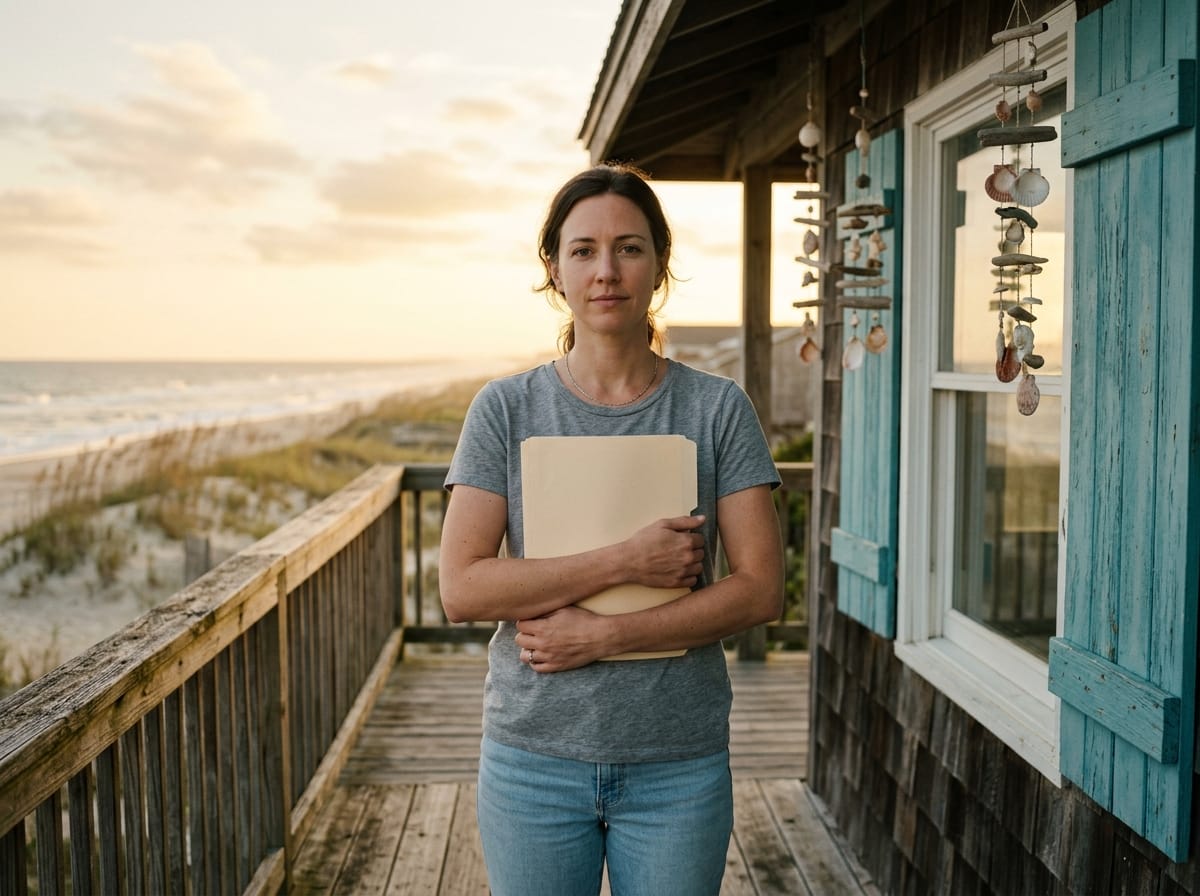
It was 9:18 a.m. The Atlantic was flat and gray. A brown pelican stood on the dock post like a sentinel.
I walked to the front door. My key still worked, which told me they had not changed the locks yet. I pushed it open.
Juniper was sitting on Grandpa Orson’s living room floor, surrounded by her toys. Milo was asleep on the couch under a blanket I had never seen before. Brielle’s coffee maker, a big stainless Cuisinart, sat on my grandfather’s kitchen counter next to a paper towel holder shaped like a rooster. Their shoes were lined up by the door. Their coats hung on his hooks.
Brielle came out of the back bedroom in a bathrobe.
“Oh good,” she said. “You’re here. We were going to call you.”
I said, “What is happening.”
“We moved some things in,” she said. “Just to start getting the kids settled. We figured you’d understand once you saw how happy they are here.”
Callan appeared from the hallway. He was holding a mug. My grandfather’s mug. The one with the chipped handle that said “World’s Okayest Fisherman” that I had bought Grandpa at a gas station in Beaufort when I was twelve.
“We’re not trying to make this a fight,” Callan said. “We’re trying to make it a family decision.”
I looked at the mug. I looked at Juniper, who smiled at me and held up a crayon drawing of a house with a big sun over it. I looked at Milo, still asleep, his stuffed turtle tucked under his chin.
I said, “I need you to leave.”
Brielle’s face shifted. “Maren.”
“Today,” I said. “I need you to take your things and leave today.”
“You’re going to make my children homeless,” she said. “Over a house you visit on weekends.”
There it was. The line they had prepared.
I did not raise my voice. I said, “I’m going to give you until noon to begin moving your things out. After that, I’m calling the police.”
Callan laughed. Not a mean laugh. A dismissive one. “You’re going to call the cops on your niece and nephew.”
“I’m going to call the police about an unlawful entry into my property,” I said. “The children are not the issue.”
I walked back outside, sat in my car, and called my attorney.
Her name was Patricia Osei. She was fifty-four, originally from Accra, Ghana, and she had the kind of voice that made opposing counsel feel like they had already lost. I had used her for a contract dispute two years earlier and kept her number because I trusted her instincts.
“Don’t touch anything,” she said. “Don’t move their belongings. Call the non-emergency police line, report an unlawful entry, and get an officer to document their presence. That report is your foundation.”
I called the Brunswick County Sheriff’s non-emergency line at 9:41 a.m.
Two deputies arrived by 10:15. They were professional and thorough. They documented Brielle and Callan’s presence, noted that the property deed was solely in my name, and issued a formal notice requiring them to vacate. Brielle cried. Callan argued. One deputy, a young woman named Officer Tate, looked at me with the steady expression of someone who had seen this exact situation before and said, “You’re doing the right thing.”
By 1:30 p.m., the minivan and the truck were gone.
But Grandpa’s “World’s Okayest Fisherman” mug was missing from the kitchen.
And when I walked into the back bedroom, I found something that made the unlawful entry feel like the smallest problem I had.
Part 3: What They Left Behind in the Back Bedroom
The back bedroom was where Grandpa Orson kept his desk.
It was an old rolltop, oak, with a dozen small compartments he used for stamps, tide charts, fishing licenses, and the kind of paperwork a man accumulates over eighty-one years of careful living. After he died, I had gone through most of it. I kept his letters, his fishing logs, his tide charts. I left the desk in place because moving it felt like erasing him.
When I walked in that Saturday afternoon, the desk had been opened.
Not ransacked. Not destroyed. Opened carefully, the way someone opens a thing they have been waiting to open for a long time.
The top left compartment, where Grandpa kept his personal documents, was empty.
I stood very still.
Then I called Patricia.
“They took documents from the desk,” I said.
A pause. “What kind of documents?”
“I don’t know yet,” I said. “But that compartment held his personal papers. I need to figure out what’s missing.”
“File a police report for theft,” she said immediately. “Tonight. Don’t wait.”
I filed the report that evening. Then I drove back to Charlotte, sat at my kitchen table with a legal pad, and started reconstructing from memory everything I had seen in that compartment. Grandpa’s original deed to the property. A copy of his will. Some old correspondence. And one document I had noticed but never fully read because it seemed like routine paperwork.
A letter from a trust administrator.
I called my grandfather’s estate attorney Monday morning. His name was Gerald Pruitt, and he had handled Grandpa Orson’s affairs for twenty years out of a small office in Wilmington. He was seventy, slow-talking, and precise.
“Mr. Pruitt,” I said, “did my grandfather have a trust in addition to his will?”
A pause that lasted just a beat too long.
“Miss Vale,” he said carefully, “I think we should meet in person.”
I drove to Wilmington that Wednesday.
What Gerald Pruitt told me in his office, with the afternoon light coming through venetian blinds and a cup of coffee going cold on his desk, rearranged everything I thought I understood about my family.
My grandfather had established a revocable living trust in 2019, three years before he died. The trust held the beach house and a separate investment account worth approximately $340,000. The will I knew about, the one that had been read at the family gathering after his death, was real. But it was not the whole picture.
The trust had a specific condition.
If the beach house was ever transferred, sold, or vacated by me as the named beneficiary within fifteen years of Grandpa’s death, the property and the investment account would pass not to my family, but to the Pelican Row Coastal Preservation Society, a nonprofit Grandpa had quietly supported for the last decade of his life.
In other words, my grandfather had built a wall around that house.
He had known, with the quiet certainty of a man who had watched his family for eighty-one years, that someone would try to take it.
“Did my mother know about this trust?” I asked.
Gerald Pruitt looked at his coffee cup. “Your grandfather chose not to share the trust details with the broader family,” he said. “He shared them with me, and with you, in a letter I was instructed to deliver only if the property was ever legally threatened.”
He opened his desk drawer and handed me an envelope.
My name was on it in Grandpa Orson’s handwriting.
I did not open it in that office. I drove to the beach house, sat on the back deck under the shell-and-bottle-cap wind chimes, and opened it there, where I could hear the ocean.
The letter was two pages, handwritten, dated six months before he died.
The last line read: “The house is yours, Maren. I built the fence. All you have to do is stand inside it.”
I sat there for a long time.
Then I called Patricia Osei and told her everything.
“The adverse possession petition,” she said, “just became a very expensive mistake for Douglas Fitch.”
Part 4: The Plan That Was Already in Motion
Here is what the beach house betrayal had actually been hiding all along.
Patricia spent two weeks working with Gerald Pruitt and a forensic accountant named Howard Briggs, who operated out of a modest office in Raleigh and had the energy of a man who genuinely enjoyed finding things that other people had tried to bury. What they found was not just a family dispute over a beach cottage.
It was a coordinated plan that had been running for at least eighteen months.
The adverse possession petition, drafted by Douglas Fitch, had been filed with the Brunswick County Clerk’s office eleven days before that October dinner. My family had not brought the folder to the table to start a conversation. They had brought it to pressure me into either signing a co-occupancy agreement, which would have established their residency and strengthened the adverse possession claim, or reacting badly enough to create a paper trail that showed I was an unstable, uncooperative owner.
Either way, I was supposed to lose.
But there was a second layer.
Howard Briggs traced the legal fees for Douglas Fitch’s petition. They had been paid from a joint account held by my mother, Lenora, and my father, Warren. Not by Brielle and Callan alone. My parents had funded the legal effort to strip me of my grandfather’s property.
My father, who had stared at his water glass at that October dinner, had written the check.
I sat with that for a full day before I could think clearly about it.
Then there was the third layer.
When Patricia subpoenaed the documents stolen from Grandpa’s desk, which Brielle had apparently handed to Douglas Fitch for review, Fitch’s office had made copies. Among those copies was the trust letter from Gerald Pruitt. They had known about the trust.
They had known, and they had filed the petition anyway, betting that I did not know, and that by the time I found out, they would already have established enough legal presence in the property to complicate the trust’s conditions.
It was not impulsive. It was not a family misunderstanding that got out of hand.
It was a plan.
Patricia filed four separate actions in the same week.
First, she filed a motion to dismiss the adverse possession petition, attaching the trust documents and the deed. Douglas Fitch withdrew the petition within seventy-two hours. He also quietly terminated his representation of Brielle and Callan. Attorneys, Patricia told me, do not like being on the wrong side of a trust with teeth.
Second, she filed a civil complaint against Brielle and Callan for unlawful entry and theft of personal property, specifically the documents taken from the desk and the coffee mug, which I included partly on principle.
Third, she referred the matter of the stolen estate documents to the Brunswick County District Attorney’s office. Removing documents from a property during an unlawful entry, particularly documents related to an estate, carries specific criminal exposure in North Carolina.
Fourth, and this was the one that mattered most, she sent a formal letter to my parents’ estate attorney, copying Gerald Pruitt, notifying them that any further legal action against the trust or the property would trigger a full forensic audit of the estate settlement, including the valuation of the cash inheritance Brielle had received and the appraisal of the suburban colonial my father had inherited.
Howard Briggs had already found something in those numbers.
The cash inheritance Brielle received had been calculated using an appraisal of the beach house that was, according to Howard, conservatively low by about $85,000. The suburban colonial my father inherited had been appraised at a number that Howard described, in his careful accountant’s language, as “optimistic.”
In plain English: the estate had been quietly tilted.
Not by Grandpa Orson. By someone who had influenced the appraisal process after his death.
My mother had served as the informal executor’s assistant during the estate settlement. She had recommended the appraisers.
The letter Patricia sent made clear that if this matter proceeded to litigation, all of it would be examined under oath.
The phone calls from my mother stopped that same week.
My father called once, on a Thursday evening in February, from his cell phone. I let it go to voicemail. He said, “Maren, I hope you know I never wanted it to go this far.” He sounded tired and old and genuinely sorry, and I believed him, and it did not change anything.
Some apologies arrive too late to be useful.
Part 5: What the Ocean Kept
Eight months after Officer Tate stood in my grandfather’s living room and told me I was doing the right thing, I drove to Pelican Row on a Friday afternoon in June.
The beach house betrayal had cost me a family dinner table, a sister’s phone calls, and the comfortable lie that everyone had simply been happy for me when the will was read.
What it gave me back was harder to name.
I unlocked the front door. The screen door stuck, same as always. The kitchen floor creaked near the sink. Grandpa’s sea glass still lined the windowsills, green and amber in the late afternoon light. His fishing hat still hung by the door. His recipe card was still taped inside the pantry cabinet.
The “World’s Okayest Fisherman” mug was back on the counter. Patricia had included it in the civil settlement, itemized at replacement value plus sentimental damages, which made Callan’s attorney visibly uncomfortable. I had driven to the Beaufort gas station and bought an identical one, because the original was gone and I was not going to pretend otherwise. But I put the new one in the same spot.
Some things you rebuild rather than recover.
I made coffee, tapped the machine twice, called it “sir,” and took my cup out to the back deck.
The wind chimes moved in the salt breeze. A brown pelican glided low over the water, unhurried, like it had nowhere to be and knew it.
I thought about my grandfather sitting in this same chair, watching the same water, knowing what he knew about the people who would come after him. He had not been bitter about it. He had just been prepared. He had built the fence quietly, told no one, and trusted me to stand inside it when the time came.
That is a specific kind of love. The kind that does not announce itself. The kind that shows up years later, in a lawyer’s desk drawer, in a letter written in a dying man’s careful hand.
I thought about Juniper, five years old, holding up her crayon drawing of a house with a big sun over it. I hoped she would not remember this as the story of how her parents tried to take something that wasn’t theirs. I hoped she would grow up and learn a different lesson from her own life.
I thought about my father’s voicemail. I had listened to it three times. I had not called back. Maybe I would, eventually. Some doors you leave cracked rather than locked.
But not yet.
As for Brielle and Callan, the civil complaint was settled out of court in April. They paid restitution for the stolen documents, legal fees, and the cost of the locksmith I hired the day after they left, because I changed every lock on the property that same afternoon. They moved into a rental in Wilmington. The kids were enrolled in school there. I heard through my cousin Delia that Juniper liked her teacher and Milo had made a friend who also carried a stuffed animal.
I was glad for that.
Douglas Fitch received a formal inquiry from the North Carolina State Bar regarding his role in the adverse possession filing and the handling of the stolen estate documents. I do not know the outcome. That is the bar’s business, not mine.
My mother has not called since February.
Howard Briggs’s findings about the estate appraisals were shared with Gerald Pruitt, who is reviewing whether any corrective action is warranted under the terms of the trust. That process is ongoing. I am not driving it. I handed it to the people whose job it is to handle it, and I let them work.
That is the thing nobody tells you about protecting what is yours. You do not have to become someone ugly to do it. You document. You call the right people. You let the systems that exist for exactly this purpose do what they were built to do. You stay calm enough to be credible, and you trust that the truth, laid out plainly, is more powerful than any folder of legal papers placed next to the good china.
My grandfather knew that.
He spent eighty-one years being that kind of man. Quiet, prepared, patient. He did not fight loudly. He built carefully.
I am trying to be worthy of what he built.
On that June evening, I sat on his back deck until the sun dropped into the Atlantic and the sky went the color of a ripe peach. The wind chimes rang softly. The pelican was gone. The tide was coming in.
There is a verse I have carried since I was young, from Psalm 37: “The meek shall inherit the earth, and shall delight themselves in the abundance of peace.” I used to think that meant passivity. Now I understand it means something different. It means you do not have to grab. You do not have to scheme. You do not have to become the thing that came against you.
You just have to hold your ground long enough for the truth to arrive.
It always does.
The lesson I keep coming back to is simple, and I think my grandfather knew it better than anyone: the people who love you quietly, who prepare for you in secret, who build fences you will not discover until you need them most — those are the people worth becoming.
Be that person for someone.
That is the whole inheritance.
Names and identifying details have been changed. This is a dramatized personal reflection shared for entertainment and educational purposes only. Any resemblance to real people or actual events is coincidental.
Read Beach House Betrayal and other true-to-life family dramas. For perspective on situations like this, see family dynamics.
