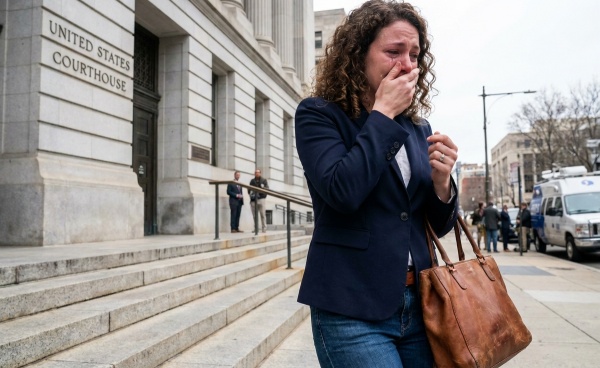
Ten minutes after signing the divorce papers, I left empty-handed, with only my car keys – while my ex-husband was celebrating with his new woman and his family. Then his lawyer called….
Part 1: The Woman Who Walked Out Empty-Handed
There is a specific kind of freedom that only arrives after you have lost everything you thought you needed.
Not the freedom of abundance — not the freedom of a woman who has options and resources and a clear path forward. The raw, stripped-down freedom of a woman who has walked out of a conference room in a downtown law office with nothing but her car keys and the specific, grounded knowledge that the thing she just signed away was never really hers to begin with, because anything built on a foundation of lies belongs, ultimately, to the lies and not to the people who lived inside it. My name is Joanna Prescott. I am forty-one years old, and I am a licensed occupational therapist in Austin, Texas, and I am telling this story because I believe in the specific, necessary power of telling the truth about the moments that define you — not the moments where you were strong and composed and handled everything perfectly, but the moments where you were sitting in a parking garage in your car with your hands on the steering wheel and your whole life rearranged around you and you had to decide, in that specific, unwitnessed quiet, who you were going to be on the other side of it.
My ex-husband’s name is Brandon Prescott. We had been married for eleven years when I signed those papers on a Thursday afternoon in February, in a conference room at a law firm on Congress Avenue in downtown Austin, with a mediator named Robert Chen who had the specific, professional neutrality of a man who has sat in rooms like this many times and has learned to be present without being invested. Brandon sat across the table from me with his attorney, a man named Gary Hollister who billed at $425 an hour and who had the smooth, unhurried confidence of someone who believes the outcome of the proceeding is not seriously in question.
I had my own attorney, a woman named Patricia Vega of Vega Family Law in Austin, who was sitting beside me with the organized, focused attention of someone who has reviewed every document in the room multiple times and knows exactly where every number comes from.
The settlement we were signing had been negotiated over four months.
I want to be honest about what it contained, because the honesty is essential to understanding what happened afterward. Brandon received the house — a four-bedroom home in the Tarrytown neighborhood of Austin that we had purchased seven years earlier for $680,000 and that had appreciated, in Austin’s extraordinary real estate market, to approximately $1.4 million. He received the primary investment accounts, the business interests, and the majority of the liquid assets. I received my car, my personal savings account, my retirement account, and a cash settlement of $85,000 that Patricia had negotiated as my share of the marital equity after accounting for the asset division.
On paper, it looked like I had lost.
Brandon’s attorney had structured the negotiation to make it look that way, and Brandon had accepted that framing with the specific, satisfied confidence of a man who believes he has outmaneuvered someone and is looking forward to the celebration he has been planning.
What Gary Hollister did not know — what Brandon did not know — was that Patricia Vega and I had spent four months building something that the settlement document did not contain, because what we had built existed entirely outside the four corners of that agreement, and it was going to arrive not in the conference room but in a phone call, forty-seven minutes after I walked out of the building with my car keys.
I signed the papers at two-fourteen p.m.
I was in the parking garage by two-twenty-four.
I sat in my car and looked at the concrete wall in front of me and breathed.
Then I drove to my sister’s house in South Austin and waited.
Part 2: The Eleven Years Before the Conference Room
I need to tell you about the eleven years, because the eleven years are the reason the phone call happened the way it did.
Brandon and I had met in 2012 at a mutual friend’s birthday party in the East Austin neighborhood, when Austin was still in the early stages of the transformation that would make it one of the most expensive real estate markets in the country and when the two of us were young enough to believe that the life we were building was as solid as it felt. He was thirty-two, a commercial real estate developer with a small firm he had founded two years earlier, and he had the specific, energetic confidence of a man who has a vision for his future and the drive to pursue it and who is, in those early years, genuinely compelling to be around. I was thirty, finishing my clinical hours for my occupational therapy license, and I was drawn to his certainty in the way that people who are still figuring out their own direction are sometimes drawn to people who appear to have already figured out theirs.
We married in 2013 at a ceremony at a ranch outside Fredericksburg, Texas, with Hill Country views and a guest list of two hundred people and the specific, celebratory energy of two families who believed they were watching something good begin.
For the first four years, it was good.
Brandon’s firm grew steadily in Austin’s expanding commercial market, and I built my occupational therapy practice from a part-time position at a rehabilitation center in North Austin into a full-time private practice with a client roster that I had developed through years of referral relationships and professional reputation. We bought the Tarrytown house in 2017. We talked about children and decided to wait. We were, by every external measure, the kind of couple that other couples pointed to as evidence that the thing was possible — the careers, the house, the partnership, the life that looked from the outside exactly like what it was supposed to be.
Then Brandon’s firm landed a major commercial development contract in 2018, and everything changed.
Not immediately. Not in a single, visible shift. But in the slow, incremental way that things change when a person’s circumstances expand faster than their character can accommodate — when the money gets bigger and the deals get larger and the social world expands to include people who are impressed by the version of you that you perform in professional settings, and you begin to prefer that version to the one that comes home at the end of the day and is simply a person.
I watched it happen over three years.
I watched Brandon become someone who was increasingly present in his professional life and increasingly absent from his personal one — not absent in the dramatic, obvious way of a man who has stopped trying, but in the specific, gradual way of a man who has decided that his home life is a backdrop rather than a priority, and who has surrounded himself with people who reinforce that decision.
Her name was Cassandra Webb. She was twenty-eight years old, a commercial real estate agent who worked in Brandon’s professional orbit, and she had been in our lives — in my life, at dinner parties and industry events and the specific, social geography of Austin’s real estate community — for two years before I understood what she actually was.
I found out in October, fourteen months before the conference room.
I found out the way people find out things in the modern age — not through a confrontation or a confession, but through a text message that appeared on a shared tablet that Brandon had forgotten was synced to his phone, containing a level of specificity about their relationship that left no room for alternative interpretation.
I sat with that information for three days.
Then I called Patricia Vega.
Part 3: What Patricia and I Built in Four Months
Patricia Vega had been practicing family law in Austin for eighteen years, and she had the specific, organized intelligence of someone who has spent nearly two decades watching people make financial decisions inside marriages and has developed a comprehensive understanding of where the bodies are buried, metaphorically speaking, in the financial architecture of a long-term marriage in Texas.
Texas is a community property state, which means that assets acquired during the marriage are generally owned equally by both spouses, and that the division of those assets in a divorce is governed by the principle of just and right division — which in practice means that a Texas family court judge has considerable discretion in how marital assets are allocated, and that the circumstances of the marriage, including fault, can be considered in that allocation.
Texas also recognizes fault as a factor in divorce proceedings.
This is the part that Gary Hollister had not fully accounted for when he structured Brandon’s negotiation strategy around the assumption that I would accept a settlement that gave me significantly less than half of the marital estate in exchange for a clean, uncontested resolution.
Patricia had spent four months building a fault case.
Not because I wanted to destroy Brandon — I want to be clear about that, because this story is not about revenge, and I am not a person who is motivated by the desire to cause damage. I wanted a just and right division of eleven years of marital assets, and I understood, with the specific clarity of a woman who had watched her husband’s firm grow from a small operation into a $12 million annual revenue business during the years of their marriage, that the settlement Gary Hollister was proposing was not just and right — it was a negotiated minimization of my legal entitlement, structured to look reasonable while being, in fact, considerably less than what Texas law supported.
Patricia’s forensic accountant was a woman named Dr. Renee Okafor who operated out of an office in North Austin and who had the specific, methodical precision of someone who has spent her career finding the things that people hide in the financial architecture of businesses and marriages. Dr. Okafor spent three months reviewing the financial disclosures from Brandon’s firm — the tax returns, the business valuations, the asset schedules — and what she found was a picture that was considerably more complex than the picture Gary Hollister had presented in the initial discovery responses.
Brandon’s firm had, over the previous two years, been structured in ways that had the effect of reducing its apparent value for the purposes of the divorce settlement — a series of transactions and reclassifications that were individually explainable but that collectively formed a pattern that Dr. Okafor described, in her written report, as “consistent with an effort to minimize the marital estate valuation in anticipation of dissolution proceedings.”
In plain language: the books had been managed to make the business look worth less than it was.
Dr. Okafor’s independent valuation of Brandon’s firm was $4.2 million — approximately $1.8 million higher than the valuation that Gary Hollister had submitted in the financial disclosures.
Patricia also had the fault documentation.
Fourteen months of it — the text messages from the synced tablet, the credit card statements showing expenditures that Patricia had identified as consistent with the affair, a pattern of hotel charges and restaurant bills and a weekend in San Antonio that Brandon had attributed to a client meeting, documented with the specific, organized precision of an attorney who understands that fault in a Texas divorce proceeding is not a moral judgment but a legal factor with financial consequences.
We had gone into the mediation knowing that we had a case that was considerably stronger than Gary Hollister believed.
We had also made a strategic decision.
We were going to sign the mediated settlement.
I know that sounds counterintuitive, and I want to explain it, because the explanation is the heart of the story. Patricia had advised me that the mediated settlement, while less than what we believed I was entitled to, was a guaranteed outcome — a bird in hand. The alternative was litigation, which was expensive, time-consuming, and uncertain, and which would require me to spend the next year of my life in a legal battle rather than rebuilding. The settlement gave me $85,000 in cash, my retirement account, and my car. It was not everything I deserved. But it was real and it was immediate.
What Patricia had also done, in the four months of preparation, was file a separate complaint with the Texas State Securities Board regarding the financial transactions in Brandon’s firm that Dr. Okafor had identified — the reclassifications and restructurings that had the effect of artificially reducing the business valuation in the divorce proceedings.
That complaint had been filed six weeks before the mediation.
Patricia had not told Gary Hollister about it.
She had not been required to.
And the Texas State Securities Board had been conducting its review quietly, without notifying Brandon or his attorney, for six weeks.
The call came forty-seven minutes after I walked out of the building.
Part 4: The Celebration and the Call
While I was sitting in my car in the parking garage on Congress Avenue, Brandon was already celebrating.
I know this because his sister, Marlene, posted photographs on social media that afternoon — Brandon and Cassandra and Brandon’s parents and his brother and a cluster of friends at a restaurant in the Domain, the upscale shopping and dining district in North Austin, with champagne glasses raised and the specific, public joy of people who believe they have won something and want the world to know it. The caption said something about new beginnings and fresh starts and the kind of language that people use when they want to perform happiness for an audience.
I saw the photographs at my sister’s house in South Austin, sitting on her couch with a cup of tea, and I felt something that I want to describe accurately because accuracy matters here. It was not the sharp, hot pain of jealousy or humiliation. It was something cooler and more structural — the specific, settled feeling of a woman who knows something that the people in those photographs do not know yet, and who is simply waiting for the information to arrive.
Patricia called me at three-eleven p.m.
“The Board moved faster than we expected,” she said. “They’ve issued a formal notice of investigation to Brandon’s firm. Gary Hollister just received it. He’s calling me in approximately ten minutes.”
I set down my tea.
“Okay,” I said.
“This changes the landscape significantly,” Patricia said. “A formal securities investigation affects the firm’s ability to close pending deals, its relationships with lenders, and its professional standing in the Austin commercial real estate market. Gary is going to want to talk.”
“What do we want?” I said.
“We want what you were always entitled to,” Patricia said. “A just and right division of the marital estate based on the accurate valuation of the business. Dr. Okafor’s number. Plus the fault consideration.”
“And if he doesn’t want to talk?”
“Then the investigation proceeds, the accurate valuation becomes part of the public record, and we file a motion to set aside the mediated settlement on the basis of the fraudulent financial disclosures. Either way, the outcome is the same. The only question is how long it takes.”
I looked at my sister, who was sitting across from me on the couch and who had heard enough of the conversation to understand the shape of what was happening.
She raised her eyebrows.
I nodded.
Gary Hollister called Patricia at three-twenty-two p.m.
The conversation lasted forty minutes, during which, according to Patricia’s subsequent account, Gary moved through several stages of the specific, professional recalibration of an attorney who has just discovered that the case he believed was concluded is, in fact, considerably more complicated than he understood, and that the opposing counsel he had been treating as a manageable obstacle has been building something for four months that he did not see coming.
At four-fifteen p.m., Patricia called me back.
“He wants to reopen the settlement negotiation,” she said.
“I know,” I said.
“He’s going to propose a revised asset division based on a number closer to Dr. Okafor’s valuation.”
“Good,” I said.
“There’s one more thing,” Patricia said. “Brandon called Gary directly, apparently from the restaurant. Gary said he could hear people in the background.”
I thought about the photographs. The champagne glasses. The new beginnings caption.
“What did Brandon say?” I asked.
“He said he wants to resolve this quickly and quietly,” Patricia said. “He’s concerned about the investigation’s effect on his pending deals. He has a $6.8 million commercial development closing in three weeks that requires clean lender relationships.”
I understood.
The investigation, regardless of its ultimate outcome, created uncertainty — and uncertainty was the enemy of commercial real estate transactions, which depended on lender confidence and professional reputation and the specific, fragile trust of parties who were committing significant capital to a deal. A formal securities investigation, even one that was ultimately resolved in Brandon’s favor, could unravel a $6.8 million closing if the lenders got nervous.
Brandon needed this resolved.
He needed it resolved before his closing.
And he needed it resolved on terms that Patricia and I were now in a position to dictate.
“Tell Gary we’re available Monday morning,” I said.
Part 5: What Monday Morning Looked Like
The revised settlement was negotiated over two sessions — Monday morning and Tuesday afternoon — in the same conference room on Congress Avenue where I had signed the original papers the previous Thursday.
The room looked the same. The mediator was the same. Robert Chen sat at the head of the table with the same professional neutrality, though I thought I detected, in the specific quality of his attention, a slight recalibration — the particular focus of a mediator who understands that the proceeding he is now facilitating is a different proceeding than the one he conducted four days earlier.
Gary Hollister was present and professional, which I respected. He did not perform anger or indignation. He was an attorney doing his job, which was now to negotiate the best available outcome for his client given a landscape that had changed significantly since Thursday afternoon. I respected the professionalism even as I understood that the professionalism had always been in service of an outcome that was not fair to me.
Brandon was not present for the Monday session.
He had sent Gary with authority to negotiate, which told me everything I needed to know about how seriously he was taking the situation. A man who had been celebrating with champagne on Thursday afternoon was now sending his attorney to a Monday morning negotiation with settlement authority, which is the specific, practical language of a person who has understood that the celebration was premature.
Patricia presented Dr. Okafor’s valuation — the $4.2 million figure, supported by the full forensic accounting report, with the specific transactions that had artificially reduced the business’s apparent value documented in detail. She presented the fault documentation — the credit card statements, the hotel records, the fourteen months of evidence that Patricia had assembled with the organized thoroughness of someone who understands that fault in a Texas divorce proceeding is a legal factor with financial consequences.
She presented what a just and right division of the marital estate looked like when based on accurate numbers and complete information.
Gary reviewed the materials.
He made a counter-proposal.
Patricia responded.
The negotiation took four hours on Monday and two hours on Tuesday, and the revised settlement that emerged from those six hours was a document that bore very little resemblance to the one I had signed the previous Thursday.
I received a revised cash settlement that reflected my equitable share of the accurate business valuation. I received a structured payment arrangement tied to the proceeds of Brandon’s pending commercial development closing — the $6.8 million deal that he needed to protect — that gave me a meaningful stake in the transaction he had been most anxious to preserve. I received a revised division of the investment accounts that reflected the fault consideration under Texas law.
The total value of the revised settlement was approximately $680,000 — nearly eight times the value of the original agreement.
Patricia called it “the just and right division that was always appropriate.”
I called it the truth, finally documented and delivered.
The Texas State Securities Board investigation was resolved six months later with a consent order that required Brandon’s firm to implement revised financial reporting practices and pay a civil penalty of $45,000 — not a criminal matter, not a firm-ending outcome, but a formal, public acknowledgment that the financial practices Dr. Okafor had identified were inconsistent with the standards the Board required.
Brandon’s $6.8 million commercial development closed on schedule, three weeks after the revised settlement was signed. The structured payment arrangement meant that a portion of those proceeds came to me, which was, I have always thought, the specific, satisfying symmetry of a situation where the thing someone was most anxious to protect became the mechanism of the fair outcome they had been trying to avoid.
I moved into a two-bedroom apartment in the Bouldin Creek neighborhood of South Austin in March, two weeks after the revised settlement was finalized. It was smaller than the Tarrytown house and it was entirely mine, and I painted the living room a warm, deep green that I had been wanting to use for years and had always deferred on, and I put my grandmother’s quilt on the bed in the bedroom, and I stood in the kitchen on the first morning and made coffee in the specific, quiet light of a South Austin morning and felt something I want to describe carefully because it deserves precision.
I felt like myself.
Not the self I had been performing for eleven years — the wife, the partner, the woman who managed the household and supported the career and showed up at the industry events and smiled at the people who were impressed by the version of her husband that he performed in professional settings. The self underneath all of that. The self that had been there the whole time, waiting with the specific, patient endurance of something that knows it will eventually have the room it needs.
My occupational therapy practice continued to grow in the months after the divorce, because it had always been built on my professional reputation and my clinical skill and my relationships with the physicians and rehabilitation specialists who referred clients to me, and none of those things had anything to do with Brandon or the Tarrytown house or the life I had been living inside. The practice was mine in the way that the things you build with your own hands and your own knowledge and your own daily commitment are yours — not in the legal sense of property ownership, but in the deeper sense of identity.
People have asked me, in the months since the revised settlement became known in the way that things become known in the professional and social circles of a city like Austin, whether I regret walking out of the conference room on Thursday afternoon with nothing but my car keys. Whether the ten minutes between signing the original papers and sitting in the parking garage were the worst ten minutes of my life.
My answer surprises them.
No.
Those ten minutes were some of the most clarifying of my life. Because in those ten minutes, sitting in my car in the parking garage with my hands on the steering wheel and my whole life rearranged around me, I understood something that I had been circling for months without quite landing on. I understood that the thing I had signed away was not my life. It was a version of my life that had been built around someone else’s priorities and someone else’s ambitions and someone else’s need to be the center of every room he walked into. I had confused that version with the real thing for eleven years, and signing those papers — even the inadequate, unfair papers I had signed on Thursday afternoon — was the moment I stopped confusing them.
The real thing was in the car with me.
It had been there the whole time.
Patricia Vega sent me a bottle of Texas Hill Country wine when the revised settlement was finalized, with a note that said: You were patient, you were prepared, and you trusted the process. That’s everything.
I kept the note.
I drank the wine on the back porch of the Bouldin Creek apartment on a warm March evening, with the specific, unhurried pleasure of a woman who has nowhere to be and nothing to perform and a life that is, finally and completely, organized around the truth of who she actually is.
Brandon and Cassandra are still together, as far as I know.
I wish them whatever they are capable of building honestly.
I am building something of my own.
It is going to be extraordinary.
