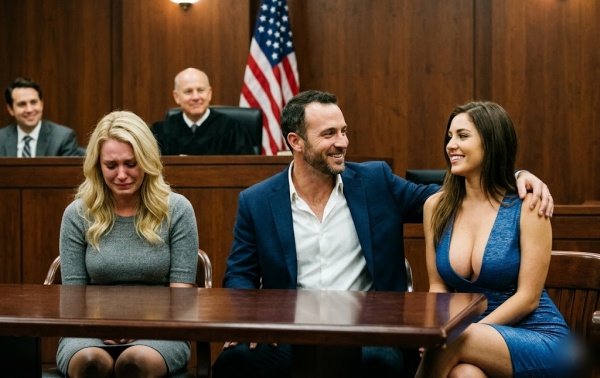
“My Ex-Husband Gave Me $50K and a Used Honda in Our Divorce—6 Months Later I Walked Into a Gala Worth $1.2 Billion”
I stood in a Chicago courtroom watching my husband Brandon offer me $50,000 and a 2015 Honda Accord as our divorce settlement while his Instagram model mistress giggled beside him. Six months later, I walked into the Chicago Finance Gala worth $1.2 billion and confronted him in front of 500 elites. This is how I turned divorce papers into the trap that destroyed him.
Part 1: The Courtroom Humiliation
My name is Victoria Chen, and three years ago, I stood in a Cook County courtroom in Chicago watching my husband of twelve years, Brandon Mitchell, and his attorney offer me what they clearly thought was a generous divorce settlement: $50,000 in cash and a 2015 Honda Accord with 87,000 miles on it. Brandon stood there in his $3,000 Armani suit, his arm casually draped around his mistress, Amber Hayes—a 26-year-old Instagram influencer with 400,000 followers who posted bikini photos and sponsored content for teeth whitening products.
I was 38 years old at the time, and I looked exactly like what I was: a woman who’d spent twelve years sacrificing everything for her husband’s career. My hair was pulled back in a simple ponytail. I wore a $89 dress from Target because I’d been living on a tight budget for months, ever since Brandon had frozen our joint bank accounts and moved into a luxury apartment in the Gold Coast with Amber. I had dark circles under my eyes from stress and sleepless nights, and I’d lost fifteen pounds—not in a healthy way, but in the way people lose weight when they’re too anxious to eat.
Brandon’s attorney, a slick corporate lawyer named Richard Hoffman who charged $650 an hour, laid out the settlement terms with barely concealed condescension. “Mrs. Mitchell—or should I say, Ms. Chen, since you’ll be reverting to your maiden name—my client is offering you $50,000 as a lump sum payment, plus the 2015 Honda Accord currently registered in your name. Additionally, Mr. Mitchell will cover your health insurance for six months following the divorce. We believe this is more than fair given the circumstances.”
The circumstances. That was lawyer-speak for the fact that I’d signed a prenuptial agreement twelve years ago when Brandon and I got married. Back then, Brandon was a junior analyst at Goldman Sachs, making $95,000 a year, and I was a software engineer at a tech startup, making $78,000. The prenup had seemed reasonable at the time—we’d each keep what we brought into the marriage, and anything we built together would be split 50-50. What I didn’t know then was that Brandon had been planning his empire from day one, and he’d been very careful to make sure none of it was in my name.
Over the course of our twelve-year marriage, Brandon had climbed the corporate ladder at Goldman Sachs, eventually leaving to start his own hedge fund, Mitchell Capital Management. The fund now managed $2.3 billion in assets, and Brandon personally was worth an estimated $180 million. But here’s the thing: technically, on paper, I wasn’t entitled to any of it. Brandon had structured everything through LLCs and trusts that predated our marriage or were set up in ways that excluded me. He’d used our joint money—money I’d contributed from my salary—to fund his early investments, but he’d been clever about how he documented everything.
My attorney, a kind but overworked public defender named Sarah Rodriguez who I’d gotten through legal aid because I couldn’t afford a private lawyer, looked at me with sympathy and frustration. “Victoria, I know this isn’t what you wanted, but given the prenup and the way Brandon structured his assets, this might be the best we can do. If we fight this in court, it could take years and cost hundreds of thousands in legal fees. The $50,000 and the car… it’s something. It’s a fresh start.”
I looked across the courtroom at Brandon. He was smiling—not even trying to hide it. Amber was whispering something in his ear, and he laughed, loud enough for everyone to hear. They thought they’d won. They thought I was just another discarded wife, too broken and too poor to fight back. They thought the prenup was ironclad, that Brandon’s team of expensive lawyers had covered every angle.
What they didn’t know—what nobody in that courtroom knew—was that I had a secret. A secret worth $1.2 billion.
Part 2: The Marriage That Built His Empire
Let me back up and tell you how I got here. I met Brandon Mitchell fourteen years ago at a networking event for young professionals in Chicago. I was 24, fresh out of MIT with a degree in computer science and a specialization in artificial intelligence. I’d been recruited by a small tech startup called NeuralSync that was working on machine learning algorithms for financial prediction. It was exciting work, cutting-edge stuff, and I was making $78,000 a year—good money for a recent grad in 2009, right after the financial crisis.
Brandon was 26, working as a junior analyst at Goldman Sachs in their Chicago office. He was handsome—6’1″, athletic build, dark hair, blue eyes, and that confident Wall Street swagger that made him stand out in any room. He approached me at the networking event and said, “You’re the smartest person here, aren’t you?” It was cocky, but somehow when he said it, it felt like a compliment rather than a line.
We started dating, and I fell hard. Brandon was ambitious, driven, and he had this vision for his future that was intoxicating. “I’m not going to be a Goldman analyst forever,” he told me on our third date. “I’m going to start my own fund. I’m going to be one of the biggest names in finance. And I want you by my side when I do it.” It felt like a partnership, like we were building something together.
We got married two years later, in 2011. It was a small wedding at a hotel in downtown Chicago—about 100 guests, nothing extravagant because we were both still building our careers. Brandon insisted on a prenup, and honestly, it didn’t bother me. We were both making decent money, we were both ambitious, and the prenup seemed like a practical way to protect ourselves. I signed it without really reading the fine print, trusting that Brandon had our best interests at heart.
For the first few years of our marriage, things were good. I continued working at NeuralSync, eventually becoming the lead AI engineer and getting my salary up to $145,000 by 2014. Brandon was climbing fast at Goldman, making managing director by the time he was 30, with a salary and bonus package worth about $850,000 a year. We bought a beautiful three-bedroom condo in Lincoln Park for $1.2 million—technically in Brandon’s name because his income qualified us for a better mortgage rate, but I contributed $80,000 from my savings for the down payment.
Here’s what I didn’t realize at the time: Brandon was using me. Not just emotionally, but professionally. NeuralSync’s AI algorithms were revolutionary—we’d developed a machine learning system that could predict market movements with unprecedented accuracy. The company was small, only about 25 employees, and we were all so focused on the technology that we didn’t think much about commercialization. We were scientists and engineers, not businesspeople.
Brandon, however, was very much a businessman. He’d come home from work and ask me about my projects, and I’d tell him everything—how our algorithms worked, what patterns we were finding, what our success rates were. I thought he was just being a supportive husband, interested in my work. What he was actually doing was stealing my intellectual property and using it to make his own trades at Goldman Sachs.
By 2015, Brandon had made enough money and built enough of a reputation that he was ready to leave Goldman and start his own hedge fund. He launched Mitchell Capital Management with $50 million in seed funding from wealthy investors he’d cultivated. What those investors didn’t know was that Brandon’s “proprietary trading algorithm” was actually based on the work I’d been doing at NeuralSync—work I’d shared with him in confidence, work that was legally owned by my company.
Part 3: The Betrayal and the Discovery
Brandon’s fund exploded. Within two years, Mitchell Capital Management was managing $800 million in assets. Within five years, it was $2.3 billion. Brandon became a fixture in Chicago’s financial elite—profiled in Crain’s Chicago Business, invited to speak at conferences, courted by politicians and philanthropists. We moved from our Lincoln Park condo to a $6.5 million mansion in Kenilworth, one of the wealthiest suburbs on the North Shore.
But as Brandon’s success grew, our marriage deteriorated. He started working longer hours, traveling more, becoming increasingly distant. He’d come home at midnight smelling like expensive perfume that wasn’t mine. He’d get texts at dinner that he’d hide from me. When I asked him about it, he’d get defensive and angry, accusing me of being paranoid and controlling.
Meanwhile, I’d left NeuralSync in 2016 to focus on what I thought would be starting a family. Brandon and I had talked about having kids, and he’d encouraged me to quit my job, saying he made enough money for both of us and that I should “relax and enjoy life.” What he really wanted was to get me out of the tech world so I’d stop developing algorithms he couldn’t access.
For three years, I was a stay-at-home wife in a mansion, increasingly isolated and depressed. Brandon kept putting off having kids, saying the timing wasn’t right, that he needed to focus on the fund. I later learned he’d gotten a vasectomy in 2017 without telling me. He’d never intended to have children with me—I was just useful to him until I wasn’t.
I discovered the affair with Amber in January 2020, right before the pandemic hit. I found texts on Brandon’s phone—explicit messages, photos, plans to meet at hotels. When I confronted him, he didn’t even try to deny it. “I’m in love with Amber,” he said coldly. “I want a divorce. You can keep the Honda and I’ll give you some money to get started, but that’s it. The prenup is clear—you’re not entitled to anything from the fund.”
I was devastated. Twelve years of marriage, gone. I’d given up my career for him. I’d supported him when he was nobody. I’d shared my work with him, trusted him, loved him. And he was throwing me away like garbage, replacing me with a woman twelve years younger who posted thirst traps on Instagram for a living.
But then, about two months into our separation, I got a call that changed everything. It was from my former boss at NeuralSync, Dr. James Park. “Victoria, I need to talk to you about something urgent. Can you meet me for coffee?”
We met at a Starbucks in Evanston, and Dr. Park looked nervous. “I don’t know if you’re aware of this,” he said, “but NeuralSync is being acquired by Google for $1.8 billion. The deal closes in three months.” I stared at him, not understanding. “That’s… that’s amazing, James. Congratulations. But why are you telling me?”
“Because you own 8% of the company,” he said. “You were one of our first employees, and part of your compensation package was equity. It’s been sitting in your name all these years. With the Google acquisition, your shares are worth approximately $144 million before taxes. After taxes, you’re looking at about $90 million.”
The world tilted. I’d completely forgotten about those shares. They’d been granted to me back in 2009 when I first joined NeuralSync, when the company was worth almost nothing. I’d never thought about them, never checked on them, because they’d seemed worthless. The company had never gone public, never paid dividends, so the shares had just sat there, quietly appreciating in value as NeuralSync grew.
“There’s more,” Dr. Park continued. “I’ve been going through our old records, and I found something disturbing. Do you remember sharing details about our algorithms with anyone outside the company?” I felt my stomach drop. “I… I talked to my husband about my work. But just in general terms. Why?”
Dr. Park pulled out a folder. “Because Mitchell Capital Management’s trading algorithm is nearly identical to the one you developed for us between 2012 and 2015. I had our legal team analyze it, and they believe Brandon stole your intellectual property. NeuralSync owns that IP, which means Brandon has been using stolen technology to make billions of dollars. We’re preparing to sue him for damages and to shut down his fund.”
Part 4: The Trap I Set With Divorce Papers
Suddenly, everything made sense. Brandon’s insistence that I quit my job. His refusal to have children. The way he’d structured all his assets to exclude me. He’d been planning this from the beginning—use my work to build his empire, then discard me before I could claim any of it.
But Brandon had made one critical mistake: he’d underestimated me. He thought I was just a naive engineer who didn’t understand business or law. He thought the prenup protected him. He thought I’d take the $50,000 and the Honda and disappear quietly.
What he didn’t know was that I now had $90 million from the NeuralSync acquisition, plus the evidence that he’d stolen my intellectual property. And I had a plan.
I told my attorney, Sarah Rodriguez, everything. She immediately brought in a team of specialists—intellectual property lawyers, forensic accountants, and a high-powered litigator named Patricia Huang who’d made her name taking down corrupt executives. We built a case that was absolutely airtight.
But here’s the brilliant part: we didn’t tell Brandon any of this. We let him think he’d won. We went to court for the divorce settlement, and I sat there quietly while his attorney offered me the insulting $50,000 and the used Honda. I watched Brandon smirk and Amber giggle. I listened to Richard Hoffman talk about how “generous” his client was being.
And then I said, “I accept the settlement.”
Brandon looked shocked that I’d given in so easily. His attorney looked pleased. Even my own attorney looked surprised—we’d discussed the strategy, but she’d been worried I wouldn’t be able to pull off the performance. But I did. I signed the divorce papers right there in the courtroom. The judge approved the settlement. It was done.
Brandon walked out of that courthouse thinking he’d gotten away with everything. He’d divorced me for pennies, kept his billions, and was free to marry his Instagram model. He even posted about it on social media that night—a photo of him and Amber at an expensive restaurant, with the caption “New beginnings” and a champagne emoji.
What Brandon didn’t know was that by accepting the divorce settlement, I’d closed the door on our marriage and opened the door to something much bigger: a $2 billion lawsuit for intellectual property theft, fraud, and unjust enrichment. The divorce was personal. The lawsuit was business. And unlike the divorce, where the prenup limited what I could claim, the lawsuit had no such restrictions.
Two weeks after our divorce was finalized, NeuralSync and I jointly filed suit against Brandon Mitchell and Mitchell Capital Management. We had everything—emails where I’d described the algorithms to Brandon, testimony from former Goldman Sachs colleagues who’d seen him using similar systems, forensic analysis showing that his fund’s trading patterns matched my work, and most damning of all, source code from Mitchell Capital’s servers that was nearly identical to NeuralSync’s proprietary code.
The lawsuit alleged that Brandon had stolen trade secrets worth at least $2 billion—the estimated value his fund had generated using the stolen algorithms. We weren’t just asking for damages. We were asking for the complete shutdown of Mitchell Capital Management and the seizure of all assets generated through the use of stolen IP.
Brandon’s world imploded overnight. His investors panicked and started pulling their money. The SEC launched an investigation. His board of directors forced him to step down as CEO. And suddenly, that $180 million personal fortune he’d been so proud of was at risk of disappearing completely.
Part 5: The Gala Where I Revealed Everything
Six months after filing the lawsuit, I received an invitation to the Chicago Finance Gala, the most prestigious event in the city’s financial calendar. It’s held every year at the Four Seasons Hotel, and attendance is limited to 500 of Chicago’s wealthiest and most influential people. Tickets cost $5,000 each, and most people can’t get in even if they can afford it—you need to be invited by the organizing committee.
I’d never been invited before. When I was married to Brandon, he’d attended several times, but he’d always gone alone, saying it was “business only” and that spouses weren’t welcome. I later learned that Amber had attended with him the previous year, so clearly spouses were welcome—just not me.
This year, I received my own invitation. Not as Brandon’s ex-wife, but as Victoria Chen, tech entrepreneur and investor. Because here’s what had happened in the six months since the lawsuit: I’d taken my $90 million from the NeuralSync acquisition and invested it brilliantly. I’d backed three startups that had all been acquired for massive returns. I’d bought into a pre-IPO company that had gone public and tripled in value. And I’d partnered with Dr. Park to start a new AI company that had just secured $200 million in Series A funding at a $1.2 billion valuation.
On paper, I was now worth approximately $1.2 billion. I’d gone from a discarded wife with a used Honda to a self-made billionaire in less than a year.
I decided to attend the gala. I bought a custom Valentino gown that cost $35,000—red, elegant, powerful. I hired a professional stylist and makeup artist. I arrived in a chauffeured Rolls-Royce. And when I walked into that ballroom at the Four Seasons, every head turned.
Brandon was there, of course. He’d managed to hold onto his invitation despite the scandal, probably because he’d paid for a table before everything blew up. He was standing near the bar with Amber, who was wearing a tight silver dress that looked like it cost about $500 from Fashion Nova. When Brandon saw me, his face went white.
I walked straight up to him, my head held high, and said loud enough for everyone nearby to hear, “Hello, Brandon. Lovely event, isn’t it? I’m so glad I could finally attend. You know, all those years you told me spouses weren’t invited? I realize now you just didn’t want me here because you were afraid I’d figure out what you were doing. But don’t worry—I figured it out anyway.”
Brandon stammered, “Victoria, I don’t know what you think you’re—”
I cut him off. “I think you stole my intellectual property and used it to build a $2 billion hedge fund. I think you manipulated me into quitting my job so I couldn’t develop any more algorithms you couldn’t access. I think you married me for my brain and divorced me when you thought you’d gotten everything you needed. But here’s what you didn’t think about, Brandon: I’m smarter than you. I always have been. And now I’m richer than you too.”
The crowd around us had gone completely silent. People were pulling out their phones. I could see the moment Brandon realized this was going to be all over social media and the financial news sites within minutes.
“The lawsuit is going to trial next month,” I continued. “My attorneys are very confident we’re going to win. Which means Mitchell Capital Management will be dissolved, and every dollar you made using my stolen work will be seized. That $180 million you’re so proud of? Gone. The mansion in Kenilworth? Gone. And that $50,000 you gave me in the divorce? I’m going to frame the check and hang it in my office as a reminder of how badly you underestimated me.”
Amber tugged on Brandon’s arm, whispering urgently that they should leave. But I wasn’t done.
“Oh, and Amber? You might want to rethink this relationship. Because in about six months, Brandon is going to be broke and possibly facing criminal charges. I, on the other hand, am worth $1.2 billion and growing. So if you’re looking for a sugar mama instead of a sugar daddy, give me a call.”
The crowd erupted in shocked laughter. Brandon’s face was purple with rage and humiliation. He grabbed Amber’s hand and practically dragged her out of the gala, leaving behind a room full of Chicago’s elite who were all buzzing about what they’d just witnessed.
I spent the rest of the evening networking, making connections, and enjoying the fact that I’d just publicly destroyed the man who’d tried to destroy me. The next morning, the story was everywhere—Bloomberg, CNBC, the Chicago Tribune. “Billionaire Tech Entrepreneur Confronts Ex-Husband at Gala Over $2B Lawsuit” read one headline. “From $50K Divorce Settlement to $1.2B Fortune: How Victoria Chen Got Her Revenge” read another.
The trial happened three months later. We won. The judge ruled that Brandon had indeed stolen my intellectual property and that Mitchell Capital Management had been built on fraud. The fund was dissolved, Brandon’s personal assets were seized to pay damages, and he was banned from the securities industry for life. He’s currently appealing, but every legal expert says he has no chance.
As for me? I’m 41 now, running a successful AI company, investing in other startups, and living my best life. I bought a penthouse in the Loop with views of Lake Michigan that cost $8 million. I drive a Tesla Model S Plaid, not because I need an expensive car, but because I can. And yes, I framed that $50,000 check from the divorce settlement and hung it in my office, just like I said I would.
Brandon thought he could use me and throw me away. He thought the prenup and his expensive lawyers made him untouchable. He thought I’d take the scraps he offered and disappear.
He was wrong. And now the whole world knows it.
