Part 1: The Word They Used Instead of the Truth
Family betrayal does not always arrive with a slammed door or a screaming match. Sometimes it arrives quietly, at a dining room table in Cedar Falls, Colorado, with mashed potatoes going cold on your plate.
My name is Nolan Vale. I am thirty-seven years old. And for most of my adult life, my family had one word for me.
Negative.
Not cruel. Not selfish. Not difficult to love. Just negative. That was the word they reached for whenever I said something honest in a room full of people who preferred comfortable fiction.
I noticed when my sister Maren smiled too wide while cutting someone down. I noticed when my brother Beckett borrowed four thousand dollars from our parents and called it “investing in himself.” I noticed when my mother said she only wanted everyone to be happy, but somehow everyone’s happiness required me to get smaller and quieter and further from the table.
Honesty, in my family, was treated like bad weather. And I was the forecast nobody wanted to check.
The first time I remember being branded that way, I was twenty-three. Beckett had just returned from a wellness retreat in Sedona, Arizona, wearing linen in December and explaining how a sound bath had healed something in his “ancestral energy.” I said, “That’s great. I got my ancestral energy healed by a parking ticket on Larimer Street.”
Maren snorted. My mother’s fork stopped halfway to her mouth.
“Nolan,” she said, soft and tired. “Why do you always bring that energy?”
That energy.
After that, the word stuck like a label gun had found the back of my neck.
The family group chat buzzed constantly until I typed something. Then it went silent, like I had dropped a stone into still water and everyone was waiting for the ripples to stop. Weekend cookouts became “last-minute things” I heard about on Monday. Beckett’s lake weekend in Grand Lake that summer was something I found out about through a photo Livia posted on Instagram. My father’s explanation was calm and reasonable.
“You hate crowds, Nolan.”
“I hate being forgotten,” I said.
He sighed like I had just proved his point.
Maren was worse because she wrapped her cruelty in the language of wellness. “Maybe people would include you more if you didn’t make everything so heavy.” She said this while holding her youngest son against her hip like a small shield, three days after I had spent a Saturday afternoon helping her husband Troy update his resume after he lost his sales job.
I was not a brother to them. I was a contaminant.
Still, I kept showing up. I brought my father a hand-carved walnut chessboard one Christmas because he used to teach me openings when I was eight years old, sitting at the kitchen table in our old house on Prospect Avenue. He opened it, smiled politely, then spent twenty minutes raving about the Bluetooth meat thermometer Beckett gave him.
I helped Troy rewrite his LinkedIn profile. Three months later, Maren posted a hiking photo with her family and captioned it: “Protect your peace from people who only bring clouds.”
Everyone knew who she meant. Including me.
The real break came in December 2021.
It had snowed early that year, the wet heavy kind that slaps against windows and turns sidewalks the color of old concrete. I had a small apartment above a closed tailor shop downtown, and I had bought a six-foot fake tree from Target and hung blue lights in the window and baked my grandmother’s molasses cookies because it felt wrong not to.
At noon on Christmas Eve, I texted the family group chat.
“What time is dinner tomorrow?”
No one answered.
At 4 p.m. I texted again. Nothing.
At 6 p.m. I called my mother’s cell. It rang four times and went to voicemail. I called my father. Same.
At 8 p.m., Maren posted a photo on Facebook. My parents’ living room, lit up with the big Douglas fir they always got from the lot on Route 9. Beckett and Livia on the couch. Maren and Troy and their three kids in matching red pajamas. My mother in her green cardigan, laughing at something off-camera.
The caption said: “Our whole world, right here.”
I was not in that world. I had not been invited. And no one had thought to mention it.
I sat on my apartment floor with a molasses cookie going stale in my hand, and I made a decision so quietly it barely felt like a decision at all.
I was done trying to earn a seat at a table that had already been cleared.
But what I did not know yet was that the exclusion was only the surface layer. What was underneath it would take me two more years to uncover, and it would change everything I thought I understood about my own family.
Part 2: What “Negative” Actually Meant
I spent the next year doing something my family would have called selfish.
I worked.
I had been a civil engineer for a mid-size infrastructure firm in Denver since I was twenty-six. Not glamorous. Not the kind of job that got mentioned at dinner parties. But it was steady, and I was good at it, and I had been living well below my means for years partly out of habit and partly because I had never had a reason to spend money on anything that required other people to enjoy it.
I drove a 2017 Honda Ridgeline with 90,000 miles on it. I cooked most of my meals. I had a gym membership at the YMCA on Colfax that cost thirty-two dollars a month. My rent was low because I had been in the same apartment for five years and my landlord, a retired electrician named Mr. Pham, had not raised it because I always paid on the first and never called him about anything he had not already fixed.
I was not rich. But I had been quietly, steadily saving for a long time.
After Christmas 2021, I called my financial advisor, a no-nonsense woman named Deborah Sacks who worked out of a small office in Lakewood and had been telling me for three years to stop sitting on my cash reserves and do something intentional with them.
“I want to buy property,” I told her.
“What kind?”
“Something in the mountains. Something that’s mine.”
Deborah pulled up listings. We talked about the market. We talked about what I could do without a mortgage. And then she said something I wrote down on the back of a grocery receipt and kept in my wallet for months.
“Nolan, the best investment you can make is in something that doesn’t need anyone else’s approval to hold its value.”
I thought about that for a long time.
I started looking at cabins in the Rockies, specifically in the area around Breckenridge and Fairplay. I was not in a hurry. I looked at forty-three properties over eight months. I drove up on weekends with a thermos of coffee and my dog, a seven-year-old shepherd mix named Corbin, and I walked through empty rooms and stood on back porches and tried to feel whether a place was real or just a picture.
In September 2022, I found it.
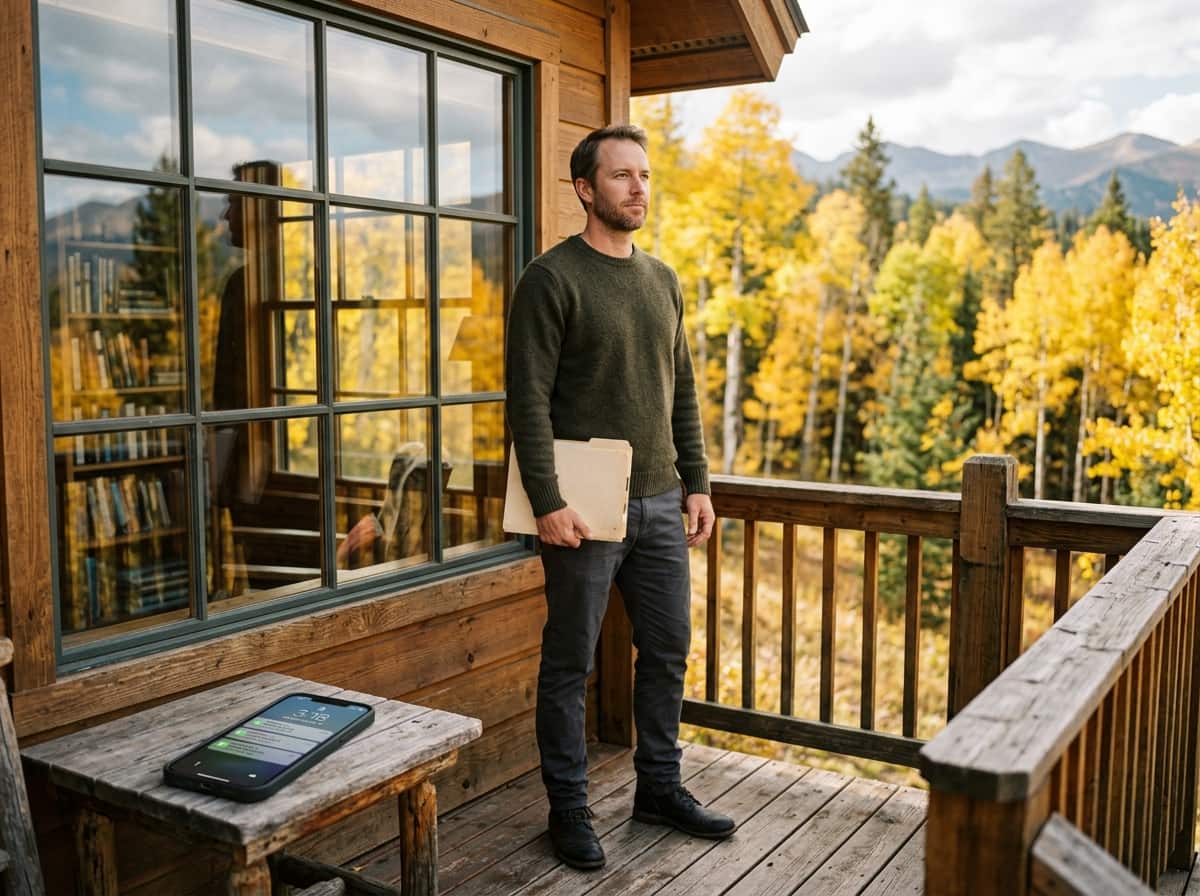
A two-bedroom cabin on four acres outside Fairplay, Colorado, at 9,800 feet elevation. Built in 1987, updated in 2014. Tongue-and-groove pine ceilings. A wood-burning stove in the living room. A covered porch that faced west toward the Mosquito Range, where the light in the late afternoon turned the ridgeline the color of copper.
The asking price was $287,000.
I paid cash.
I did not tell my family.
I told exactly three people: Deborah, Mr. Pham, and my friend Garrett, who had been my college roommate at Colorado State and who responded to the news by driving up with a case of Odell’s 90 Shilling and spending a weekend helping me split firewood and fix a section of fence along the north property line.
“You going to tell Beckett?” Garrett asked, on the second evening, sitting on the porch steps with his boots off.
“Eventually,” I said.
“Why eventually?”
I looked out at the ridge. The sun was going down behind it, and the sky was doing that thing it does at altitude where the blue gets so deep it almost looks like it’s pressing down on you.
“Because right now it’s just mine,” I said. “And I want to know what that feels like for a while.”
Garrett nodded and cracked open another beer.
What I did not know then, sitting on that porch in the quiet, was that my family had not just been excluding me from trips and dinners. They had been doing something else entirely. Something that had been going on for years, hidden in plain sight, and I was about to find out about it in the most ordinary possible way.
A phone call from my Aunt Rosalie in Pueblo, on a Tuesday afternoon in March, while I was eating a sandwich at my desk.
Part 3: The Inheritance Nobody Mentioned
Aunt Rosalie is my father’s older sister. She is seventy-one years old, lives alone in a house she has owned since 1979, grows tomatoes in the backyard, and has never once in her life said something she did not mean.
She called me at 12:47 p.m. on a Tuesday in March 2023.
“Nolan,” she said, “I need to ask you something, and I need you to be honest with me.”
“Always,” I said.
“Did your father tell you about your grandmother’s trust?”
I set down my sandwich.
My grandmother, Edna Vale, had died in 2019 at the age of eighty-eight. She had lived in the same house in Pueblo for fifty years, a small brick ranch with a garden and a detached garage where my grandfather had kept his woodworking tools. She had been careful with money her entire life, the kind of careful that comes from growing up during a time when careful was the only option.
I knew she had left a will. I knew there had been some kind of estate process. My father had handled it, and at the time I had not asked many questions because I was in the middle of a demanding project at work and my father had seemed to have it managed.
“What trust?” I said.
Rosalie was quiet for a moment. Then she said, “Your grandmother set up a trust in 2016. It was divided four ways: your father, me, you, and Beckett. Equal shares.”
I did not say anything.
“Your share was approximately forty-one thousand dollars,” Rosalie said. “It was distributed in early 2020. I received mine. Your father received his. Beckett received his.” She paused. “I assumed you received yours. I only found out last month that you did not.”
The room felt very still.
“How did you find out?” I asked.
“I was having lunch with your father’s attorney, a man named Gerald Finch who handled the estate. He mentioned something offhand, assumed I already knew. When I told him I did not, he got very quiet.” She exhaled. “Nolan, I am so sorry. I should have asked sooner. I assumed your father had handled it properly.”
I sat at my desk for a long time after we hung up.
Forty-one thousand dollars. Distributed in early 2020. The same year I had been quietly eating alone in my apartment above the tailor shop, showing up to family events I was barely invited to, fixing Maren’s van and rewriting Troy’s resume and bringing my father a chessboard he barely looked at.
The same year Beckett had bought a new Tundra and taken Livia to Cabo for their anniversary.
I did not call my father that night. I did not call Beckett. I did not send a single text.
Instead, I opened my laptop and started writing things down. Dates. Conversations I remembered. The name Gerald Finch. The year the trust was distributed. I forwarded myself Rosalie’s voicemail to my personal email account, the one no one in my family knew about, the one I used for nothing but financial records and important documents.
Then I called a probate attorney in Denver named Sandra Okafor, whose name I found through the Colorado Bar Association’s referral service. I explained what I knew. She asked me several careful questions. At the end of the call, she said, “If what your aunt is describing is accurate, you have a clear legal claim. I’d like to see the trust documents.”
I said, “How do I get them?”
She said, “That’s what I’m here for.”
I did not feel angry. Not yet. What I felt was something colder and more focused than anger. Like the moment before you make a very precise cut and you are absolutely certain of the line.
My family had not just left me out of dinners and lake weekends.
They had taken something that belonged to me. And they had done it while calling me the problem.
But there was still one more layer. One I had not found yet. And it would be the one that finally explained everything.
Part 4: What Sandra Found in the Documents
Sandra Okafor was forty-four years old, wore reading glasses on a beaded chain, and had been practicing probate and estate law in Denver for sixteen years. She had a framed print in her office that said “Precision is kindness” and she meant it in both directions.
She obtained the trust documents through a formal records request in April 2023. It took eleven days.
When she called me to go over them, she asked me to come in person.
I drove to her office on a Thursday morning, parked on the street, and fed the meter three dollars in quarters. I remember that detail because I stood at the meter counting out coins and thinking, I have been careful with every dollar I have ever had, and someone took forty-one thousand of them and said nothing.
Sandra had the documents spread across her conference table. She walked me through them slowly.
My grandmother’s trust had been established in 2016 with an estate attorney in Pueblo. It named four beneficiaries in equal shares: my father, Robert Vale; my Aunt Rosalie; me, Nolan Vale; and my brother, Beckett Vale. The distribution was triggered by my grandmother’s death in November 2019 and was to be completed within ninety days.
My father was named the successor trustee.
Sandra pointed to a signature page dated February 14, 2020. My father had signed as trustee, certifying that all distributions had been made to all beneficiaries.
My share had been transferred to a bank account.
Not my bank account.
An account in my father’s name.
Sandra let me sit with that for a moment before she continued.
“There’s more,” she said.
She turned to a second set of documents. These were bank records she had subpoenaed as part of the legal process. The forty-one thousand dollars had landed in my father’s account on February 18, 2020. Within thirty days, twenty thousand of it had been transferred to Beckett’s account. The remaining twenty-one thousand had been spent in increments over the following eight months: a patio renovation, a new HVAC system, a check to Maren’s household account for six thousand dollars.
Beckett had known.
Maren had received money from it.
My father had signed a legal document certifying that I had been paid.
Sandra looked at me over her reading glasses. “This is trustee misconduct. Potentially fraud. You have standing to pursue this in civil court, and given the documentation, I believe you have a strong case. But before we file anything, I want you to understand what this process looks like.”
“Tell me,” I said.
She told me. It would take time. It would be uncomfortable. It would likely end my relationship with my father and possibly my brother.
I looked at the bank records on the table. I thought about Christmas Eve 2021, sitting on my apartment floor with a stale molasses cookie. I thought about Maren’s hiking photo. “Protect your peace from people who only bring clouds.”
“File it,” I said.
Sandra filed the civil complaint in May 2023. She also referred the matter to the Colorado Division of Regulatory Agencies, which oversees fiduciary conduct, and sent a formal letter to Gerald Finch, the estate attorney, notifying him that his certification of distribution had been used in connection with a fraudulent transfer.
I did not call my family to warn them.
I did not post anything. I did not tell anyone except Garrett and Deborah and Aunt Rosalie, who cried quietly on the phone and said, “I am so sorry, Nolan. I should have checked years ago.”
“You didn’t do anything wrong,” I told her.
“Neither did you,” she said. “That’s what makes this so hard to look at.”
The process moved the way legal processes do: slowly, then suddenly. My father hired a defense attorney. Beckett hired one too. There were depositions. There were documents. There were several months of what Sandra called “the uncomfortable middle,” where nothing seemed to be happening but everything was.
And then, in the fall of 2023, while all of that was quietly grinding forward, my brother Beckett sent me a text.
He wanted to know if his family could use my cabin for winter break.
He had found out about it through Garrett’s wife, who had mentioned it at a neighborhood event without knowing the full picture.
I read the text twice. Then I typed back:
“Sorry, it’s just for people with sand energy.”
He called me immediately. I did not answer.
He called again. I did not answer.
He sent three more texts, each one escalating. The last one called me “childish” and “vindictive” and said I had “always been the problem in this family.”
I screenshot all of them and forwarded them to Sandra.
The next morning, he blocked me.
Part 5: What the Mountain Taught Me
The civil case settled in March 2024.
My father did not go to trial. His attorney negotiated a settlement in which he repaid the full forty-one thousand dollars plus interest, totaling just over forty-seven thousand dollars, directly to me through Sandra’s trust account. He also signed a formal acknowledgment of trustee misconduct as part of the settlement terms, which became part of the public court record.
The Colorado Division of Regulatory Agencies opened a separate administrative review of Gerald Finch’s role in certifying the distribution. That process was still ongoing as of the time I am writing this, but Finch’s firm quietly dissolved its estate practice division in the fall of 2024.
Beckett repaid the twenty thousand dollars he had received from my inheritance as part of a separate demand letter Sandra sent after the settlement. He did not do it graciously. He did it because his own attorney told him the alternative was being named as a co-defendant in a civil fraud action.
Maren was not legally required to return the six thousand dollars. Sandra told me I could pursue it, but that the cost and energy would likely exceed the return. I thought about it for about forty-eight hours. Then I let it go. Not because she deserved the grace, but because I did not want to spend one more hour of my life in a courtroom over her.
Some things you release not because they don’t matter, but because you matter more.
My father called me once, in April 2024, about three weeks after the settlement closed. I answered because I had decided I would answer once, and then I would decide what came next based on what he said.
He said he was sorry. He said he had told himself it was temporary, that he was going to pay it back, that things had gotten complicated with Beckett’s finances and he had made a bad decision that he kept not correcting.
I listened to all of it.
Then I said, “Dad, you signed a legal document saying you had paid me. That wasn’t a bad decision. That was a choice.”
He was quiet for a long time.
“I know,” he said finally.
“I hope you mean that,” I said. And I hung up.
I do not know what my relationship with my father will look like going forward. I am not sure he knows either. What I know is that I am not going to pretend the last several years were something other than what they were. Forgiveness, if it comes, will be a long and honest process. It will not look like a family photo in matching pajamas.
Maren has not contacted me. Beckett has not unblocked me. My mother sent a card in May that said she loved me and hoped we could “find our way back to each other.” I appreciated that she sent it. I have not yet decided what to write back.
Aunt Rosalie came up to the cabin in June 2024. She brought a jar of her tomato preserves and a photograph of my grandmother standing in her garden in Pueblo, squinting into the sun, holding a tomato the size of a softball.
We sat on the porch and watched the light change on the Mosquito Range, and Rosalie told me stories about my grandmother that I had never heard. How she had worked two jobs for years to save the money she eventually left behind. How she had told Rosalie once that she wanted her grandchildren to have a foundation, something solid under their feet so they could stand up straight.
“She would have liked this place,” Rosalie said, looking out at the ridge.
“I think she’s part of why I found it,” I said.
Corbin was asleep in a patch of afternoon sun near the porch steps. The aspens along the north fence line had gone gold. There was no noise except wind and the occasional creak of the porch boards.
I thought about the word they had used for me for so long. Negative. I thought about all the dinners I had shown up to anyway, all the vans I had fixed and resumes I had rewritten and chessboards I had carried in from the cold. I thought about Christmas Eve 2021 and the molasses cookies and the unanswered texts.
And I thought about what it means to be the person in a family who tells the truth.
It is not a comfortable position. It does not come with invitations to lake weekends or matching pajama photos. It comes with folding chairs near the hallway and captions about clouds and a decade of being told that your honesty is the problem.
But here is what I know now, sitting on this porch at 9,800 feet with my dog and my coffee and four acres of Colorado mountain that belong to no one but me:
The truth does not need to be popular to be true. And a person who tells it does not need to be invited to be worth something.
My grandmother worked two jobs so her grandchildren could stand up straight. She left me a foundation. My family tried to take it. And in trying to take it, they handed me something they never intended to give me: the clearest possible picture of exactly who they are and exactly who I am.
I am not negative.
I am precise.
There is a difference. And it took a mountain to teach me that.
If you are the truth-teller in your family, the one who gets labeled difficult or heavy or too much, I want you to hear this: your clarity is not a character flaw. It is a form of integrity. And integrity, unlike a family group chat, does not go silent when you show up.
Keep showing up. Keep your records. Keep your receipts. And if someone tries to take what is yours while calling you the problem, let the process work. Let the documents speak. Let the courts and the attorneys and the paper trail do what they are designed to do.
You do not have to be loud to be right.
You just have to be steady.
For anyone navigating a similar situation involving estate disputes or trustee misconduct, the American Bar Association’s estate planning resources offer guidance on finding qualified probate attorneys in your state.
And if you want to read about another family that found its footing after a long season of loss, this piece on rebuilding trust after betrayal is worth your time.
Names and identifying details have been changed. This is a dramatized story and personal reflection shared for entertainment and educational purposes only. Any resemblance to real people is coincidental.
Read Family Betrayal and other true-to-life family dramas. For perspective on situations like this, see family dynamics.
