Part 1: The Smell of Old Paper and a Name Nobody Expected
The Raven-12 betrayal did not begin in a courtroom. It began at a folding table in a two-bedroom apartment in Columbus, Ohio, with a cracked window that let in November air and a federal contract number Maren Voss had memorized before she ever owned a real desk.
But on a Tuesday morning in March, at 9:47 a.m., it was going to end in one.
The courtroom smelled like polished wood and burnt coffee. Not fear. Not justice. Not even money, though that room was thick with it. Just that stale courthouse smell — old paper, cheap carpet, nervous sweat, and coffee left too long on a warmer somewhere behind the clerk’s station.
Maren had been in that room before. In every version that mattered. At her parents’ kitchen table in Highland Park. On conference calls where her father let silence do the bruising. In email chains that stretched fourteen months and somehow never reached a real answer.
Her father, Calder Voss, sat across from her like the room had been built for him.
He always knew how to arrange himself when he believed he had already won. Navy suit, silver tie, one hand resting near his pen, the other flattened against the table as if he owned the surface beneath it. He had done the same thing at family dinners when he decided a conversation was finished. He had done it the day he told Maren she was “too sentimental” to understand corporate structure. He had done it the night she asked why her work had appeared inside one of his company’s licensing decks with her name missing.
“You’re confused, Maren,” he had said then, not even looking up from his steak. “Ideas evolve. Adults know that.”
Her mother, Diane, had dabbed the corner of her mouth with a linen napkin and whispered, “Don’t embarrass your father.”
That was the family version of a court order.
Now, in the actual courtroom, Calder smiled at his daughter with that same private patience. As if she were still the girl who had stayed quiet too long because quiet was cheaper than war.
His attorney, a sharp-shouldered woman named Liora Penn, had been speaking for nearly forty minutes. Her voice had the rhythm of someone used to expensive people listening to her. She called Maren’s claim “emotionally motivated.” She called her evidence “selective.” She called her relationship with her father “strained,” as if that explained why Maren’s federal contractor number had disappeared from documents where it had once been stamped in black ink.
Maren’s own attorney, Brynn Callow, sat beside her with a legal pad full of careful notes and one warning written in the margin in block letters: DO NOT REACT.
Maren hadn’t.
Not when Liora suggested she had exaggerated her role. Not when Calder shook his head gently, performing sadness for the judge. Not when he leaned toward his attorney and murmured something that made her mouth twitch.
Maren kept her hands folded in her lap. Her nails were short and bare because she had bitten one too close the night before and given up on pretending she was calm.
Behind them, the gallery held more people than she expected. Two journalists who pretended not to be journalists. Her younger brother, Soren, who had not spoken to her in two years but still wore the watch she gave him for graduation. Her mother sat beside him in winter white, perfectly still, her diamond earrings catching the overhead light whenever she turned her head.
Diane did not look at Maren once.
The case was supposed to be narrow. Attribution. Licensing amendments. Correction of origin. Calder’s company, Voss Meridian Systems, had built a profitable product line around a research framework called Raven-12. Publicly, it had been described as an internal collaborative methodology developed by a cross-functional team under Calder’s leadership.
Privately, it had begun with Maren.
But nobody wanted that version unless she could prove it.
And she could.
The problem was not proof. The problem was something else entirely. Three weeks earlier, while reviewing a stack of docket filings at her kitchen counter at 11:30 at night, Maren had found a footnote that changed the air around her. It was buried in a related case citation, the kind most people skim past because it looks procedural and dull. The footnote referenced the oversight program that had commissioned the early Raven-12 work.
And beside it was a name.
Judge Alden Kreiss.
Their judge.
Not as a party. Not as someone accused of anything. Just as a former administrative liaison, years before he reached the bench, connected to the original scope documentation that had created Maren’s contract.
She had sat there with her laptop open, refrigerator humming behind her, and read the footnote six times.
Then she had picked up her phone and called Brynn.
What Brynn said next was not what Maren expected.
Part 2: What Brynn Found at 2 a.m. in a Federal Archive
Brynn Callow was not the kind of attorney who panicked. She was 58, had practiced in Columbus for 31 years, and kept a framed needlepoint above her desk that read “Boring is expensive. Thorough is free.” She had taken Maren’s case nine months earlier not because it was easy but because she had reviewed the original contract documentation and said, flatly, “Someone stripped your name out of this. That’s not an accident. That’s a decision.”
When Maren called her at 11:47 p.m. about the footnote, Brynn was quiet for a long moment.
“Send me the page number,” she said. “Don’t forward the whole file. Just the page.”
Maren sent it.
Brynn called back at 2:14 a.m.
“Okay,” she said. “Here’s what I found.”
Judge Alden Kreiss had served as an administrative program officer for a federal technology development initiative from 2001 to 2004. During that period, he had signed off on a cluster of early-stage contracts, including the one that had funded Maren’s original Raven-12 framework work. His name appeared on three scope authorization documents. His signature was on the initial deliverable acceptance form.
He had not disclosed this when assigned to the case.
It may have been an oversight. Program officers from that era were rarely flagged in standard conflict checks because their role was administrative, not financial. The system had a gap. And Calder’s legal team, whether by luck or design, had filed in a jurisdiction where that gap existed.
“Does he know?” Maren asked.
“I don’t know what he knows,” Brynn said. “But here’s what matters. If he signed those documents, he has personal knowledge of the original scope. He knows what Raven-12 was before your father’s company touched it. He may not have connected it to this case. Or he may have and said nothing.”
Maren stared at her kitchen ceiling. The light above the sink had been flickering for a week. She had kept meaning to replace the bulb.
“What do we do?” she asked.
“We don’t accuse anyone of anything,” Brynn said. “We ask a question. In open court. On the record. And we let him answer.”
That was the plan.
It was also the most frightening thing Maren had ever agreed to.
She did not sleep that night. She made chamomile tea she did not drink. She sat at her kitchen table with the original contract documentation spread in front of her, the pages she had kept in a fireproof lockbox for three years, and she read through them again. Her name on page one. Her methodology outline on pages four through nine. Her federal contractor number stamped in the lower right corner of every deliverable.
She had kept copies of everything from the beginning. Not because she had expected a courtroom. But because something in her had always known that her father’s version of events had a shelf life.
Some people call that paranoia. Maren called it paying attention.
She had forwarded every relevant email to a personal account the week she left Voss Meridian. She had photographed the original whiteboard diagrams before they were erased. She had kept the USB drive with the timestamped draft files. She had a notarized letter from a former colleague, a systems architect named Dex Morales, who had been in the room during the original Raven-12 presentations and had signed a statement confirming who had led them.
Calder had not known about Dex.
He had assumed, as powerful men often do, that loyalty could be purchased and silence could be inherited.
He had been wrong about Dex. And he was about to be wrong about the judge.
But there was still one more layer Maren had not yet told Brynn about.
Something she had found not in a federal archive, but in her own family.
Part 3: The Raven-12 Betrayal Had a Second Floor
The Raven-12 betrayal was not only about intellectual property. Maren had known that for eighteen months. She had just not been ready to say it out loud.
It started with a phone call from her Aunt Cecile, her father’s older sister, on a Sunday afternoon in October. Cecile lived in Scottsdale, Arizona, had retired from a career in hospital administration, and had a habit of saying true things in the same tone other people used for weather reports.
“Your grandfather’s trust was amended,” Cecile said, without preamble. “In 2019. I thought you should know.”
Maren had been standing in her parking lot with a bag of groceries. She set the bag on the hood of her car.
“Amended how?” she asked.
“The intellectual property clause,” Cecile said. “The original trust included a provision that any commercially developed work originating from family-funded research would be subject to shared attribution and a percentage of licensing revenue. Your grandfather put it in because he funded your early work. He believed in what you were building.”
Maren’s grandfather, Walter Voss, had died in 2020. He had been a quiet, precise man who had made his money in civil engineering and believed that credit belonged to the person who did the work. He had given Maren a $40,000 grant in 2002 to fund her early research. He had told her, over coffee at his kitchen table in Columbus, “Put your name on everything. Every page. Every draft. Every version.”
She had.
“What did the amendment say?” Maren asked.
“It removed the clause,” Cecile said. “Entirely. And the amendment was filed six months before your grandfather died. When he was already sick.”
Maren stood very still in the parking lot. A car pulled in beside her. She did not move.
“Who filed it?” she asked.
Cecile paused. “Your father had power of attorney.”
The groceries sat on the hood of her car for a long time after that call ended.
Maren did not cry. She had learned, somewhere in the previous three years, that crying was something she could do later, in private, when it would not cost her anything. In the moment, she needed to think.
She called Brynn the next morning.
Brynn pulled the trust amendment records. She brought in a forensic document specialist named Harriet Osei, who had 22 years of experience reviewing estate modifications. Harriet examined the amendment, the signature dates, the notarization records, and the timeline of Walter Voss’s medical records, which Cecile had provided with written authorization.
Harriet’s conclusion, delivered in a nine-page report, was careful and precise. The amendment had been executed during a period when Walter Voss had documented cognitive decline. The notarization had occurred at a location 40 miles from his care facility. There was no record of independent legal counsel advising him on the change.
It was not proof of forgery. But it was enough to raise serious questions about capacity and undue influence.
Brynn filed a separate motion with the probate court in Columbus. That motion was still pending.
But in the attribution case, it was now relevant context.
And Calder did not know they had it.
He sat in that courtroom believing the fight was about one contract and one framework. He had no idea his daughter had spent nine months building a case with three separate floors. He had underestimated her the same way he always had.
That was his most expensive habit.
The judge called a brief recess at 11:15 a.m. Maren walked to the water fountain in the hallway, took two sips, and stood with her back against the cool tile wall.
Soren appeared beside her.
He did not say anything for a moment. He just stood there, looking at the floor, turning the graduation watch on his wrist.
“Dad told me you were doing this for money,” he said finally.
“I know,” Maren said.
“Is that true?”
She looked at her brother. He was 34, still had their grandfather’s eyes, and had spent two years choosing the easier version of their family because the easier version did not require him to give anything up.
“Grandpa gave me that grant,” she said. “He put my name on the contract. He told me to protect my work. I’m doing what he asked me to do.”
Soren was quiet for a long time.
“I didn’t know about the trust amendment,” he said.
“I know you didn’t,” Maren said.
She walked back into the courtroom.
What happened in the next twenty minutes would change everything. And it began with a single question.
Part 4: “Does the Name Raven-12 Mean Anything to You?”
At 11:34 a.m., Brynn Callow stood and addressed the court.
She did not raise her voice. She did not perform. She spoke the way she always did, with the measured confidence of someone who had done the reading and was not afraid of what it said.
“Your Honor,” she said, “before we continue, I’d like to ask the court a procedural question. It relates to a potential conflict of interest that may not have been flagged during case assignment.”
Liora Penn was on her feet immediately. “Objection. This is not the appropriate —”
“I’ll hear it,” Judge Kreiss said.
He was 63, silver-haired, and had the kind of face that had learned to stay neutral over decades on the bench. But something shifted in his expression when Brynn spoke the next sentence.
“Your Honor, does the name Raven-12 mean anything to you in a personal or professional capacity prior to this proceeding?”
The room went very quiet.
Calder Voss, who had been leaning back in his chair with the ease of a man watching a play he had already seen, sat forward.
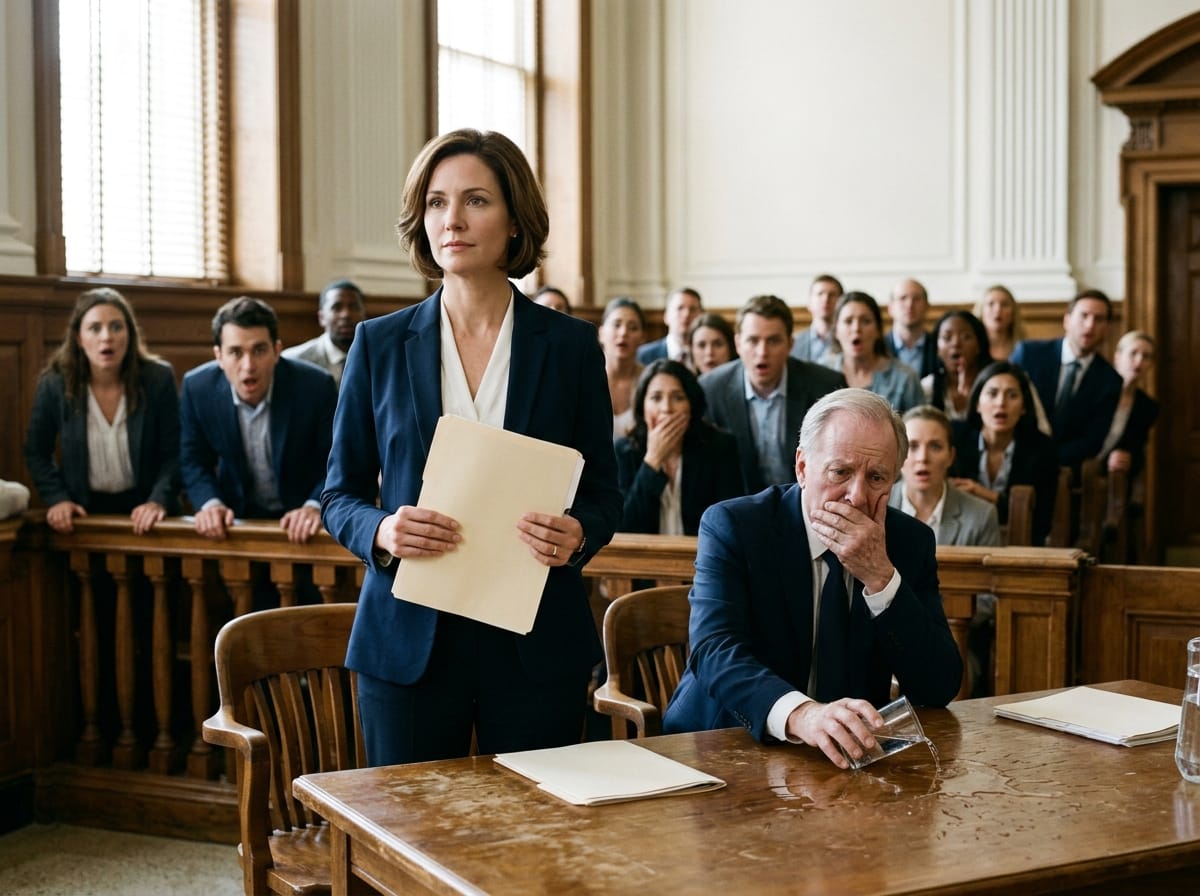
Judge Kreiss looked at Brynn. Then he looked at the document she was holding, a certified copy of the scope authorization form with his signature on the bottom line.
His face went white.
Not pale. White.
“Oh my God,” he said quietly. And then, almost to himself, “You’re the Raven-12 contractor. The original one.”
He was not speaking to Brynn.
He was looking at Maren.
Calder Voss stood up.
“Your Honor, I must object —”
“Sit down, Mr. Voss.”
Calder did not sit down immediately. He stood for one more second, and in that second Maren watched something happen in his face that she had never seen before. Not anger. Not calculation. Something closer to the recognition that the room had changed shape around him and he had not noticed until just now.
Then his legs gave.
He did not fall dramatically. He did not collapse in the movie sense. He simply sat down very heavily, as if the weight of the morning had become too much to hold upright, and his hand knocked his water glass sideways. It rolled off the table and shattered on the floor.
Nobody moved to clean it up.
Judge Kreiss called a recess. He left the bench without looking at either table.
In the hallway, Brynn turned to Maren and said, simply, “He remembered.”
What the judge remembered, as he would later explain in a written recusal statement filed that afternoon, was this: in 2003, he had personally reviewed the initial Raven-12 scope documentation as part of his administrative role. He had read the methodology outline. He had approved the deliverable. He had signed the acceptance form with the contractor’s name clearly printed at the top.
That name was Maren Voss.
He had not connected it to the current case because the case had been filed under the corporate attribution dispute framing, with Voss Meridian as the primary party. Maren’s name appeared in the filings, but the connection to the 2003 contract had not triggered his memory until Brynn said the words out loud in open court.
He recused himself that afternoon.
The case was reassigned.
But that was not the end of it. Because Judge Kreiss, before he stepped away, did something that nobody had asked him to do.
He submitted a voluntary statement to the court record confirming his recollection of the original 2003 documentation, including the contractor name, the scope of work, and the fact that the methodology outlined in that document was substantively identical to the framework his former program office had later seen commercialized under the Voss Meridian name.
It was not a ruling. It was not testimony. It was a statement from a federal judge, on the record, saying: I remember who built this. And it was not who has been claiming credit.
Calder Voss’s attorney filed a motion to strike it within the hour.
The new judge denied the motion two days later.
Part 5: What Raven-12 Was Always Worth
The reassigned case took four more months to resolve. The new judge, a no-nonsense woman named Judge Patricia Suh, had reviewed the full record before her first hearing and arrived at the bench with the look of someone who had already done the math.
She had.
In June, Judge Suh issued her ruling.
Voss Meridian Systems was ordered to amend all public documentation, licensing materials, and product descriptions to reflect Maren Voss as the originating developer of the Raven-12 framework. The company was required to pay Maren a retroactive licensing settlement covering seven years of commercial use. The amount was not disclosed publicly, but Brynn, who had negotiated the final figure, told Maren over the phone in a voice that was professionally calm and personally delighted, “It covers the apartment. And the cracked window. And then some.”
Maren sat on her back porch in Columbus with a glass of sweet tea and let herself feel it.
Not triumph. Something quieter than that. Something that felt more like the ground coming back under her feet after a very long time of standing on air.
The probate matter was resolved separately, three months later. The trust amendment was invalidated. The intellectual property clause her grandfather had written was reinstated. Cecile, who had driven from Scottsdale to Columbus for the hearing, sat beside Maren in the probate courtroom and held her hand without saying anything. She did not need to say anything.
Calder Voss did not attend either proceeding.
His attorney issued a statement calling the attribution ruling “a mischaracterization of collaborative creative processes.” The statement was four paragraphs long and used the word “nuanced” three times.
Nobody quoted it.
What people did quote, in the two trade publications that covered the case, was Judge Kreiss’s voluntary statement. Specifically, one line from it.
“The record is clear on who did the work.”
Voss Meridian’s board voted to remove Calder from his executive role six weeks after the ruling. The vote was not close. Three board members had been quietly uncomfortable with the attribution issue for years and had simply been waiting for a legal finding to act on. The company restructured. Two of the product lines built on the Raven-12 framework were relicensed under Maren’s name.
Calder moved to a smaller house in Scottsdale. He did not call Maren.
She did not expect him to.
Soren called her in August. He asked if she wanted to get coffee. She said yes. They met at a diner on Fifth Avenue in Columbus, sat in a corner booth, and talked for two hours about things that had nothing to do with the case. At the end, Soren looked at his watch, the one she had given him, and said, “I should have believed you sooner.”
“Yes,” Maren said. “You should have.”
She did not say it with anger. She said it the way her grandfather used to say true things, plainly, without decoration, because the truth did not need any.
Her mother sent a card in September. It was a generic sympathy card, the kind with a watercolor lily on the front, and inside Diane had written, “I hope you find peace.” There was no return address.
Maren put the card in a drawer and did not think about it for a long time.
What she did think about, on the evenings when she sat on her back porch with her tea and watched the light change over the yard, was her grandfather at his kitchen table in 2002. The coffee. The contract documents spread between them. His voice, steady and certain, saying, “Put your name on everything.”
He had known something she had not yet learned. That the record matters. That documentation is not paranoia. That the people who tell you to stop keeping track are usually the people who benefit from you forgetting.
Walter Voss had been gone for six years. But he had built something into the original contract that outlasted his own life. A clause. A name. A paper trail that his daughter’s son had tried to erase and had not quite managed to.
Some things are harder to bury than people expect.
The Raven-12 framework is now publicly attributed to Maren Voss, originating developer, contract date 2002, federal program authorization 2003. It is in the public record. It is in the licensing database. It is in the two trade publications that covered the ruling.
It is not going anywhere.
There is a lesson in all of this that has nothing to do with courtrooms or contracts or the particular cruelty of a father who looked at his daughter’s work and decided it was easier to take it than to acknowledge it.
The lesson is simpler than that.
Keep the receipts. Keep the emails. Keep the USB drive. Keep the notarized letter from the colleague who was in the room. Keep the original contract with your name on page one.
Not because you are planning for war. But because the truth, on its own, does not always survive. It needs a little help. It needs someone willing to carry it carefully, for as long as it takes, until the room is finally ready to hear it.
Maren Voss carried it for nine years.
The room was ready on a Tuesday morning in March, at 11:34 a.m., when a judge heard two words and remembered exactly who had done the work.
That is what her grandfather always believed would happen.
He was right.
Names and identifying details have been changed. This is a dramatized story and personal reflection shared for entertainment and educational purposes only. Any resemblance to real people is coincidental.
Read Raven-12 Betrayal and other true-to-life family dramas. For perspective on situations like this, see family dynamics.
