Part 1: The House They Laughed At and the Silence I Kept
This is a story about a family home betrayal that started long before anyone said a word out loud.
My name is Maris Vale. I am fifty-one years old, I live in Brookhaven, Georgia, and three years ago I bought the ugliest house on Caldwell Street for $187,000 cash.
It was 7:14 on a Tuesday morning when I got the keys. The closing attorney, a soft-spoken man named Gerald Pruitt, slid them across the conference table like he was handing me something fragile. Maybe he could tell. Maybe he had seen enough buyers to know the difference between someone purchasing a house and someone purchasing a second chance.
The house had peeling blue siding. A front porch that sagged at the left corner. A roof that wept every time Atlanta got rain, which in spring is basically every other afternoon. The kitchen smelled like old wood, pipe rust, and forty years of someone else’s cooking. Two cabinet doors hung crooked on their hinges. The backyard was a wall of waist-high crabgrass and a rusted shed leaning so far sideways that even the squirrels seemed to have given up on it.
To me, it had bones.
To my family, it was evidence.
My sister Bellamy closed on her house three weeks later. Hers was not a house. It was a declaration. Five bedrooms behind the black iron gates of Larkspur Ridge, the newest and most expensive development in Forsyth County. Marble countertops flown in from Portugal. A pool with underwater lighting. A home theater with leather recliners. A wine room with a climate system that cost more than my car. A three-car garage where her husband Calloway parked vehicles he washed more often than most people washed their hands.
From the moment Bellamy got those keys, my parents acted like she had been crowned.
Mom called me the evening of Bellamy’s closing. I was standing in my own living room, barefoot on plywood subfloor, holding a pry bar, with plaster dust in my hair and a half-eaten sandwich balanced on the windowsill.
“You should see her foyer,” Mom said. “The chandelier alone is bigger than your living room.”
“That sounds beautiful,” I said.
Mom sighed the way she always sighed when she thought I was being deliberately obtuse. “It is beautiful. It’s what happens when someone makes careful choices.”
I looked at the wall I had just opened. The studs behind it were dry, straight, and better than I had hoped. “Careful choices matter,” I said.
She laughed. Not cruelly enough to call it cruelty. Just enough to make me feel nine years old again.
Sunday dinners got worse. My parents hosted every week at their brick ranch in Dunwoody, and Bellamy’s mansion became the family’s favorite entertainment. Mom passed her phone around the table between bites of pot roast, showing photos like she was sharing ultrasound pictures of a royal baby.
“Look at this kitchen island,” she said to my aunt Tessa one evening. “Imported stone. Can you imagine?”
Aunt Tessa made a sound like she had seen the face of God.
Bellamy sat back in her chair with one arm draped over Calloway’s shoulder. She wore cream silk and gold hoops and the kind of smile that waits for applause before it fully opens.
My father Everett carved the roast with slow, satisfied movements. “That’s what I call investing in the future,” he said.
I kept my eyes on my plate.
Then Mom turned the phone toward me. The screen showed Bellamy in her enormous kitchen, one hand resting on the marble counter, smiling like the room had been built specifically to make a point.
“You’ll never own a home like your sister’s,” Mom said.
The table went quiet in the way tables go quiet when people want to see what you do with an insult.
I could smell the gravy cooling. I could hear the refrigerator humming behind me. My fork felt too light in my hand.
Dad did not look up. “She’s right, Maris. Some people just aim higher.”
Bellamy’s smile sharpened at the edges.
“My house needs work,” I said. “But it’s mine.”
Bellamy laughed. “It needs more than work. It needs a rescue team.”
A few relatives chuckled. Calloway smirked into his Cabernet.
I made my face calm. I nodded like the joke had passed around the table and not through the center of my chest.
But something went still inside me. Not broken. Not angry.
Still.
And still is where plans are made.
Part 2: What I Did While They Were Busy Laughing
I want to be clear about something. I did not renovate my house to prove a point to my family.
I renovated it because I had spent twenty-two years as a licensed occupational therapist, working long shifts at Northside Hospital, living in a one-bedroom apartment in Sandy Springs, and saving with the kind of quiet discipline that people mistake for lack of ambition. I had $214,000 in savings, no debt, and a clear picture in my head of exactly what I wanted a home to feel like.
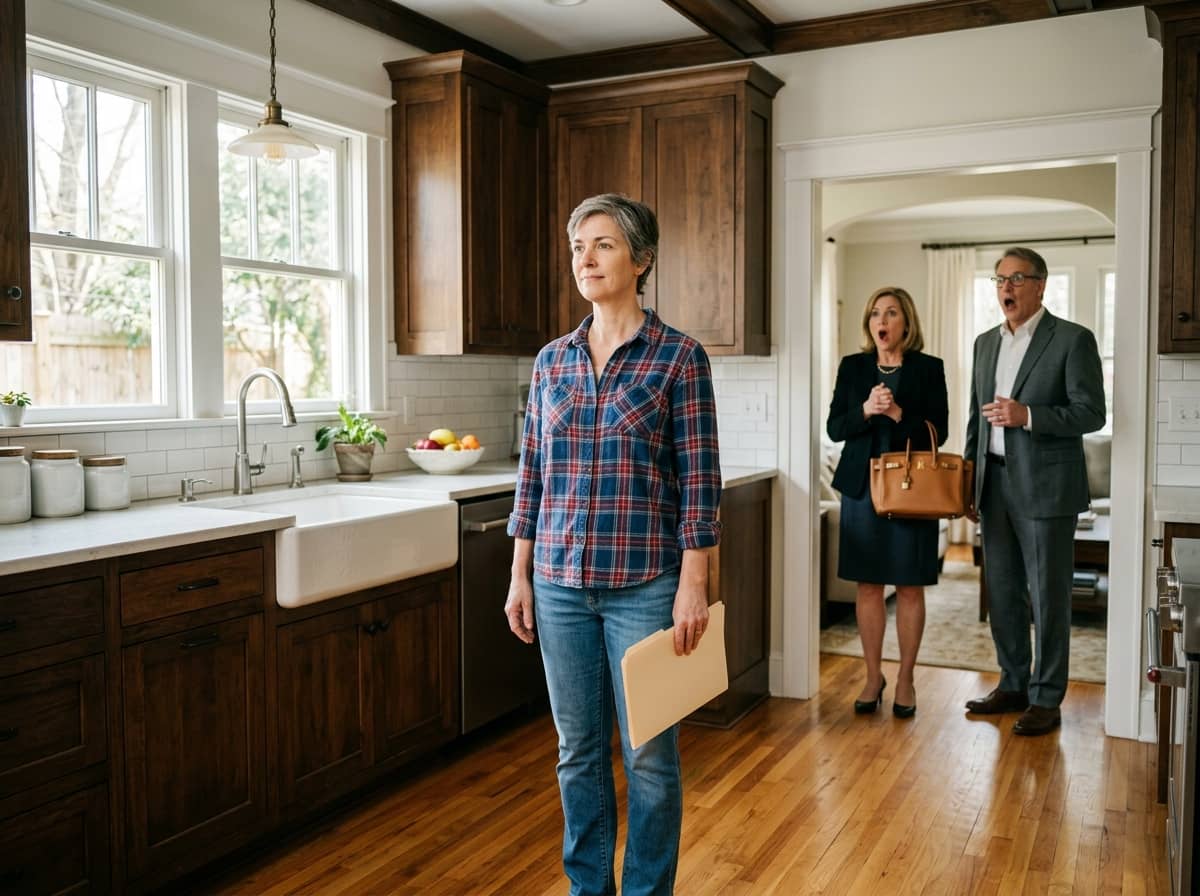
The family home betrayal I was living inside had taught me one useful thing: nobody was coming to hand me anything. So I had better know what I was doing before I started.
I hired a structural engineer named Dwayne Okafor before I even made an offer. Dwayne walked every inch of that house with a flashlight and a clipboard and told me the foundation was solid, the framing was honest, and the bones were better than most new construction he had seen in five years. The cosmetic damage was real but shallow. The problems were the kind you could fix with time, skill, and a contractor who showed up when he said he would.
I found that contractor. His name was Pete Sorrells, a sixty-year-old craftsman from Marietta who had been restoring old houses since before I was born. Pete did not talk much. He arrived at 7 a.m. every day in a white Ford F-250, drank black coffee from a thermos, and worked like a man who took personal offense at anything done poorly.
We spent the first four months on the invisible work. New electrical. New plumbing. Spray foam insulation in the attic. A roof that would outlast both of us. None of it was glamorous. None of it photographed well. But every dollar I spent on the bones meant the finish work would last.
Meanwhile, Bellamy posted.
Instagram. Facebook. A home design blog she started called “Living at Larkspur.” Photos of her kitchen at golden hour. Her pool at dusk. Her wine room lit like a jewelry store. She tagged local interior designers, furniture boutiques on Peachtree Road, and a flooring company in Buckhead that charged $28 per square foot for engineered hardwood.
Mom shared every post. Sometimes twice.
I was not on social media much that year. I was on my knees pulling up linoleum in the bathroom, finding original hexagon tile underneath that made Pete stop and whistle low through his teeth.
“You know what this is worth?” he said.
“I know,” I said.
I kept every receipt in a folder. Every contractor invoice, every material purchase, every permit pulled from Dekalb County. My friend Lorraine, a CPA who had done my taxes for eleven years, helped me track the cost basis carefully. Not because I was planning anything. Just because I had learned, in that family, that documentation was a form of self-respect.
At Sunday dinners, I said nothing about the progress. When Mom asked how the “fixer-upper” was going, I said, “Slowly.” When Bellamy asked if I had fixed the porch yet, I said, “Working on it.”
Bellamy told her friend group, which overlapped with my parents’ social circle, that I had bought a teardown and was in over my head. She said it the way people say things they want repeated.
It got repeated.
I heard it from Aunt Tessa, who called to check on me with the particular warmth of someone delivering bad news they are secretly enjoying. “People are worried about you, Maris,” she said. “Your mother thinks you made a mistake.”
“Tell Mom I’m fine,” I said.
I was more than fine. But I was not ready to show anyone yet.
The house was not finished. And the story was not finished either.
Because what I did not know yet, what none of us knew, was that Bellamy’s perfect house behind the iron gates of Larkspur Ridge was built on something that was already starting to crack.
Part 3: The Numbers Behind the Marble
It was Lorraine who first said something, on a Wednesday afternoon in February, sitting across from me at her desk in her office on Roswell Road.
She had been helping me refinance a small home equity line, and she had pulled some routine comparables for the neighborhood. She went quiet in a way that was not her usual quiet.
“Maris,” she said. She set her reading glasses on the desk. “Did you know Bellamy and Calloway took out a second mortgage in October?”
I looked at her. “On the Larkspur house?”
“On the Larkspur house. $340,000. And there’s a third lien from a private lender. Filed in November.” She turned the screen toward me. “I’m not snooping. This is public record. I just happened to see it pulling comps.”
I sat with that for a moment.
The marble counters. The wine room. The home theater. The Instagram posts with the golden-hour kitchen. The blog called “Living at Larkspur.”
None of it was paid for.
I did not feel triumphant. I want to say that clearly. What I felt was something closer to grief, the particular grief of watching someone you grew up with build a life out of performance instead of foundation, and knowing it will eventually fall.
But I also felt something sharpen in me. Because Bellamy had not just been performing for Instagram. She had been performing for our parents. And our parents had been performing her success back at me for two years, using it as a measuring stick, a verdict, a closed case.
And the case was not closed.
I asked Lorraine to say nothing. She nodded once. Lorraine was not the kind of woman who needed to be asked twice.
I went home that evening and sat in my finished kitchen, the one with the restored original hardwood floors Pete had found under three layers of vinyl, the one with the subway tile backsplash I had chosen myself from a salvage yard in East Point, the one with the open shelving I had built with my own hands on a Saturday in November. I made a cup of chamomile tea. I sat at the kitchen table I had bought for $40 at an estate sale in Decatur and refinished over two weekends.
I looked at the room around me.
This was mine. Fully. Completely. No liens. No second mortgage. No private lender. No performance.
I had paid $187,000 for the house. I had spent $91,000 on the renovation, every dollar documented. The house had been appraised six weeks earlier at $498,000.
I had not told my family.
I had not told anyone except Lorraine and Pete, who had walked through the finished rooms and said, quietly, “You did good, Maris.” Which from Pete was the equivalent of a standing ovation.
I thought about the family home betrayal I had been living inside for two years. The dinners. The phone screen turned toward me. The laughing. The “rescue team” comment. The way my mother had said “you’ll never” like it was simply a fact about the weather.
I thought about Bellamy’s second mortgage. Her third lien.
And I thought: the tea is ready.
I picked up my phone and sent my sister a text.
“I finished the house. Come see it. Sunday after dinner, just us. I’ll make tea.”
She replied in eleven minutes with a string of emojis I chose to interpret as yes.
She had no idea what she was walking into.
Neither, honestly, did I. Because what happened when Bellamy walked through my front door was not what I had planned.
It was bigger.
Part 4: The Sunday She Walked Through My Door
It was 4:22 p.m. on a Sunday in late March when Bellamy’s white Range Rover pulled up in front of my house on Caldwell Street.
I watched from the front window. I had repainted the porch that fall, a deep slate blue that Pete said made the original craftsman trim look like it had always been there. The corner that used to sag was level now, supported by new footings Pete had poured himself. The front garden had been cleared and replanted with knockout roses and ornamental grasses that moved in the wind like they had been there for decades.
Bellamy stepped out of the car in heels. She looked at the house from the sidewalk. I could see her face from the window. She was recalibrating.
I opened the front door before she knocked.
“Hey,” I said.
She walked in.
I watched her face move through the rooms the way a face moves when it is trying to hold a fixed opinion against incoming evidence. The original hardwood floors, refinished to a warm honey. The ten-foot ceilings with the original plaster medallions Pete had repaired by hand. The kitchen with the subway tile and the open shelving and the farmhouse sink I had found at an architectural salvage place in Chamblee for $180. The sunroom at the back, which had been a screened wreck when I bought the house and was now a room of white walls and afternoon light and a window seat I had upholstered myself in a fabric the color of sea glass.
Bellamy walked slowly. She did not say much.
She ran one hand along the kitchen counter. She stood in the sunroom doorway for a long moment. She looked at the backyard, which Pete’s crew had graded and seeded, and where I had put in a small flagstone patio with a fire pit and two Adirondack chairs painted the same slate blue as the porch.
“Maris,” she said finally. Her voice was different. “How much did you spend on this?”
“About $91,000 in renovation costs,” I said. “On top of the purchase price.”
She turned around. “What did you pay for it?”
“$187,000.”
She was doing the math. I could see it.
“It was appraised last month,” I said. I kept my voice even. “At $498,000.”
The room went very quiet.
Bellamy looked at me. Then she looked around the room again, like she was seeing it for the first time, which in a way she was.
“Calloway and I,” she started. She stopped.
I waited.
“We’re behind,” she said. “On the mortgage. Both of them.”
I had known about the liens. I had not known it had gotten to this.
“Both of them,” I said.
She nodded. Her eyes were bright in a way that had nothing to do with happiness. “The blog was supposed to bring in sponsorships. It didn’t. The design clients Calloway said he had lined up, they fell through. We’ve been using the equity line to cover the monthly payments.” She laughed, but it came out wrong. “We’ve been using debt to pay debt.”
I set two cups of chamomile tea on the kitchen table. The $40 estate sale table I had refinished on a Saturday afternoon with a borrowed orbital sander and a can of Minwax in Early American.
“Sit down,” I said.
She sat.
And then she picked up her phone.
I thought she was going to call Calloway. Instead, she called Mom.
I heard Mom answer on the second ring. I heard Bellamy’s voice go high and strange. “You need to get here. Now. You need to see this.”
Mom arrived twenty-two minutes later, still in her Sunday dinner clothes, my father pulling into the driveway behind her.
They walked through the same rooms Bellamy had walked through. They moved the same way, slowly, recalibrating, their faces doing the same complicated work of holding a fixed opinion against what their eyes were telling them.
Mom stood in the sunroom for a long time. She looked at the window seat. She looked at the backyard. She looked at the fire pit and the Adirondack chairs and the flagstone patio.
Then she looked at me.
“Maris,” she said. Her voice was very quiet. “I didn’t know.”
“I know you didn’t,” I said.
Dad stood in the kitchen doorway with his hands in his pockets. He looked at the floors. He looked at the ceiling medallions. He looked at the farmhouse sink. He did not say anything for a while.
Then he said, “You did all this yourself?”
“Pete Sorrells did the skilled work,” I said. “I did the rest.”
He nodded slowly. The way men nod when they are trying to locate an apology inside themselves and finding it harder than they expected.
But the afternoon was not over. Because Bellamy, sitting at my kitchen table with both hands around her tea cup, was about to say something that changed the shape of everything.
Part 5: What the House Was Always Trying to Say
Bellamy told us everything that afternoon.
The second mortgage had been Calloway’s idea, taken out to cover a business investment that had not paid off. The third lien, from a private lender in Alpharetta, was charging 14 percent interest. They were four months behind on the primary mortgage. The bank had sent a notice in January. Calloway had intercepted the mail and not told her.
She had found out three weeks ago, going through a filing cabinet looking for their car insurance documents.
She had been carrying it alone since then.
I listened. Mom listened. Dad listened. The afternoon light moved across the sunroom floor while Bellamy talked, and the house held all of it, the way good houses do.
This is the part of the family home betrayal story that I did not expect. I had expected the reveal. I had expected the moment my parents saw what I had built. I had not expected to spend that afternoon sitting with my sister while she came apart at a table I had refinished by hand, in a house they had all told me would never be worth anything.
I called Lorraine the next morning. She referred Bellamy to a housing counselor she trusted, a woman named Diane Marsh who worked with families navigating mortgage distress. Lorraine also quietly flagged the private lender’s terms to a colleague who specialized in predatory lending review.
The Larkspur Ridge house went on the market in June. It sold in eleven days for $1.1 million. After the mortgages and the lien and the realtor fees, Bellamy and Calloway walked away with $87,000. Not nothing. But not the empire it had looked like from the outside.
They moved into a rental in Smyrna. A nice rental, modest, with a small yard. Bellamy told me, two months after the move, that she slept better there than she had in two years.
Calloway got a job in commercial real estate, the kind that required actual work rather than the kind he had been performing. He was quieter now. Less polished. Possibly more honest.
My parents stopped hosting the Sunday phone-screen show. Mom called me more often, for actual conversations, the kind where she asked questions and waited for the answers. She came to my house on a Saturday in October and sat on the sunroom window seat with a cup of coffee and said, without preamble, “I was wrong about you.”
I did not say “I told you so.” It would have been accurate, but it would have cost something I was not willing to spend.
“You weren’t wrong about me,” I said. “You just didn’t see me yet.”
She was quiet for a moment. Then she said, “I see you now.”
Dad came the following weekend with a bottle of Maker’s Mark and sat at my kitchen table for three hours talking about nothing in particular. He looked at the ceiling medallions twice more before he left. Both times he shook his head slowly, the way people do when they are revising a story they have been telling themselves for years.
The house on Caldwell Street was appraised again in December at $521,000.
I am not telling you that number to brag. I am telling you because the number is not the point.
The point is what Dwayne Okafor told me the morning he walked through with his flashlight and his clipboard, before I had spent a single dollar, before I had swung a single hammer. He looked at the studs behind the opened wall and said, “The bones are good. Everything else is just time and work.”
He was talking about the house.
He was also talking about something else, though neither of us knew it yet.
Some things look like failure from the outside because the people looking have decided what success is supposed to look like. Marble counters. Iron gates. A chandelier bigger than someone else’s living room. A blog called “Living at Larkspur” with golden-hour photos and sponsored posts that never came.
But a house built on honest bones, paid for with honest money, finished with honest work, that house does not need a performance. It just needs time.
And time, as it turns out, is the one thing you cannot fake.
The real family home betrayal was never about the houses. It was about what my family had decided I was before I had finished becoming it. The verdict they handed down at a Sunday dinner table while the gravy cooled and the refrigerator hummed. The “you’ll never” delivered like a fact about the weather.
What I know now is this: “you’ll never” is not a fact. It is a dare.
And I have always been better at the long game than anyone in that family gave me credit for.
I answered the dare the only way that matters. Not with an argument. Not with a scene. With a pry bar, a flashlight, a contractor who showed up at 7 a.m., and the kind of quiet discipline that people mistake for lack of ambition.
The bones were good.
They always were.
Names and identifying details have been changed. This is a dramatized story and personal reflection shared for entertainment and educational purposes only. Any resemblance to real people is coincidental.
Read Family Home Betrayal and other true-to-life family dramas. For perspective on situations like this, see family dynamics.
