Part 1: The Empty Chair That Said Everything
It was 7:14 p.m. on a Friday in May when the family betrayal dinner I had dreaded for years finally showed its true face.
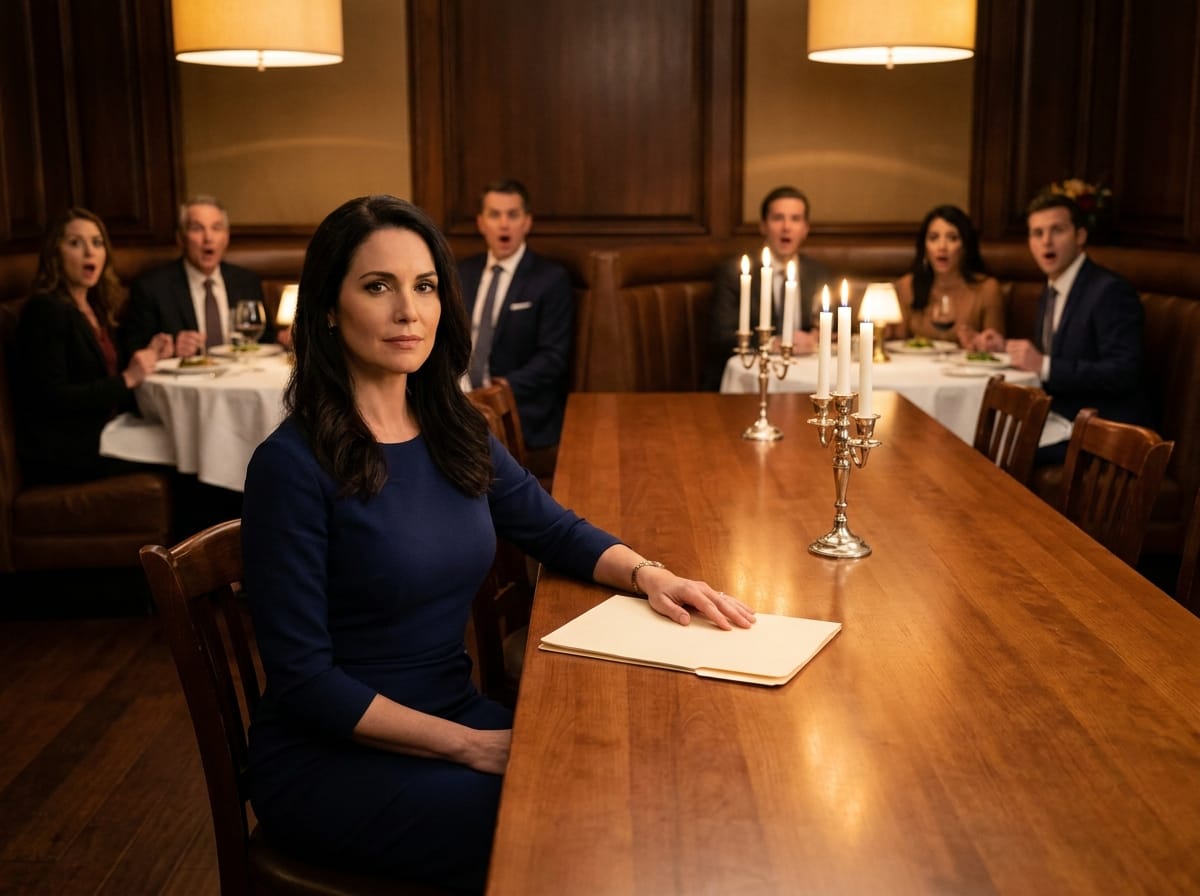
I stood at the entrance of The Aurelia’s private dining room in my navy satin dress, my grandmother’s pearl earrings cool against my neck, and I counted the chairs.
Twelve chairs. Twelve place cards. Twelve people already seated.
No seat for me.
The room smelled of gardenias and warm butter and something else underneath it all. Something sharp. Deliberate.
Cordelia Voss sat at the head of the table in pale gold silk, her silver hair pinned so tightly it looked like it hurt. She had the posture of a woman who had spent sixty-seven years making sure rooms arranged themselves around her. She looked at me the way a chess player looks at a piece she has already decided to remove from the board.
“Oh, Juliana,” she said, her voice pitched just loud enough for everyone. “How awkward. I suppose the staff miscounted.”
Nobody at that table believed that for one second.
I looked at my husband, Callan Voss. He sat halfway down the table, his jaw set, his eyes locked on the fork beside his plate like it owed him something. His sister, Sable, lifted her wineglass and studied the ceiling. Her husband, Bram, pressed his lips together over a smirk he did not bother to hide very hard. Callan’s father, Hollis, opened his menu with the careful focus of a man who had learned long ago that seeing nothing meant answering for nothing.
Callan did not stand.
He did not say, “That is my wife. Bring another chair.”
He said nothing at all.
Cordelia tilted her head. The small gold earrings at her ears caught the candlelight.
“Perhaps a diner down the street suits you better, dear,” she added.
The table laughed. Not loudly. That would have been too honest. It was the controlled, polished laughter of people who had been taught that cruelty delivered quietly was still acceptable behavior. Crystal clinked. Someone whispered. Sable looked back down at her plate with a small satisfied curve at the corner of her mouth.
My face went hot. Then cold.
I had been standing in this family for six years, building their company, fixing their contracts, choosing their menus, training their staff, and stepping slightly to the side whenever a camera appeared. I had swallowed more in six years than most people swallow in a lifetime.
But I had also spent fifteen years before Callan Voss in professional kitchens, and the first thing a kitchen teaches you is this: panic is expensive. Stillness is free.
So I stood very still.
And then I smiled.
Not the practiced smile I had worn in the parking lot. A real one. Because in that moment, standing in the doorway of The Aurelia with no chair and no husband willing to stand for me, I remembered something Cordelia did not know.
Something that was about to matter enormously.
I turned toward the front of the house and asked the nearest server if I could speak with the owner.
Cordelia laughed again, softer this time, more private. “Oh, Juliana. The owner is not going to seat you out of pity.”
She was right about one thing.
Pity had nothing to do with it.
Part 2: What Six Years Looks Like on Paper
Before I tell you what happened when the owner walked through that door, I need to back up. Because the family betrayal dinner at The Aurelia did not begin that Friday night. It began the morning I signed my name to a business agreement I did not fully understand, and it built slowly, the way water damage builds behind a wall.
You do not see it until the whole thing gives way.
I met Callan Voss when I was thirty-one. I had just left my position as executive chef at a mid-size hotel restaurant in Charlotte, North Carolina, and I was building my own consulting practice, helping independent restaurant owners restructure their operations. I was good at it. I understood food costs, labor ratios, vendor contracts, lease negotiations, and the particular psychology of a dining room that wants to feel special without knowing exactly why.
Callan was charming. He was also, I would learn, someone who had grown up believing that charm was a substitute for competence.
He had inherited a small hospitality group from his father, Hollis, three properties in the Charlotte metro area, all of them bleeding money in different ways. He hired me to fix them. Six months later, he asked me to marry him. I said yes because I was in love and because I believed, genuinely believed, that we were building something together.
What I did not understand then was the distinction the Voss family made between building and owning.
I built. They owned.
Over the next six years, I restructured all three properties. I brought in a new executive chef for the flagship location, renegotiated two commercial leases, cut food cost from 38 percent to 27 percent across the group, and helped Callan close a deal on a fourth property in the NoDa neighborhood that tripled the group’s revenue within eighteen months.
My name was on none of the operating agreements.
Callan had explained this early on. “It’s cleaner this way,” he said. “For tax purposes. You understand.”
I did not push back hard enough. That is my honest accounting of it.
What I did do, quietly and without making a point of it, was keep records.
Every email I sent, I blind-copied to a personal Gmail account I had set up before our wedding. Every contract I drafted, I saved a version to a cloud folder on my own laptop. Every financial summary, every vendor agreement, every lease amendment I had negotiated, I kept a copy. Not because I planned to use them. I just believed, the way a woman who has worked in professional kitchens believes in mise en place, that having everything in its place was simply good practice.
I had 847 documents by the time of the dinner at The Aurelia.
Callan did not know about the Gmail account.
Cordelia certainly did not.
But there was something else I had been keeping that neither of them knew about. Something I had discovered four months earlier, on a Tuesday morning in January, when I opened a bank statement that had been mailed to our home address by mistake.
It was not our account.
It was a business account I had never seen before, registered to a holding company called Voss Meridian LLC. The statement showed eighteen months of transfers. Regular, tidy, deliberate transfers. Out of the hospitality group’s operating accounts. Into Voss Meridian.
I recognized the amounts. I had seen them as line items in the operating reports, labeled as “management consulting fees.”
There was no management consultant.
I sat at our kitchen island for a long time with that statement in my hands. Then I photographed every page, emailed the images to myself, put the original back in the envelope, and placed it on Callan’s desk without saying a word.
He never mentioned it.
I never mentioned it.
But I made an appointment the following week with a forensic accountant named Patricia Osei, who worked out of an office on South Tryon Street and came recommended by a friend who had been through a difficult divorce. I told Patricia I needed to understand what I was looking at.
She told me to bring everything I had.
I brought 847 documents and a bank statement.
Patricia looked at the materials for two weeks. Then she called me and said, “Juliana, you need an attorney before we go any further.”
I already had one.
What I did not have yet was the full picture. I knew about the money. I did not yet know about the second layer. The one that would make the money look almost small by comparison.
That part would not surface until the night of the dinner at The Aurelia.
Part 3: The Family Betrayal Dinner Gets a New Guest
The server I had stopped was a young man named Theo, maybe twenty-four, with a pressed white jacket and the slightly panicked look of someone who understood that whatever was happening at table seven was above his pay grade.
“I just need a moment with the owner,” I said. “Please tell him Juliana Voss is here.”
Theo blinked. “Mr. Renard is in the kitchen, ma’am. I can let him know.”
“Thank you, Theo.”
I turned back toward the private dining room. Cordelia was watching me with the patient expression of someone who had already decided how this scene ended.
“The owner will not know who you are,” she said pleasantly.
“He might,” I said.
She laughed. Sable laughed. Bram raised his eyebrows at Hollis, who had gone back to studying his menu.
Callan finally looked up. Something moved across his face. Not guilt, exactly. More like the expression of a man who has just realized the ground under him is softer than he thought.
Forty seconds later, a man came through the kitchen door.
He was sixty-one years old, with close-cropped silver hair, a chef’s apron still tied at his waist, and the kind of hands that told you he had spent decades in professional kitchens before he ever owned one. He walked the way people walk when they have spent years being the last person standing at the end of a service.
His name was Gabriel Renard.
He had been my mentor for three years when I was twenty-four years old, working the line at his first restaurant in Asheville. He had taught me how to read a balance sheet, how to hold a room, how to fire a vendor who was stealing from you, and how to stand in a dining room that did not want you there without letting anyone see that it cost you anything.
He had opened The Aurelia fourteen months ago. I had known about it. I had sent him a card and a bottle of Burgundy when it opened. I had not yet had the chance to visit.
He saw me standing in the doorway of his private dining room with no chair and no seat and a table full of people who had just laughed at me.
He read the room in about four seconds.
“Jules,” he said, and his voice was warm and completely steady. “I am so sorry. We had a reservation issue tonight. Let me fix that right now.”
He looked at Theo. “Set a place at the head of the opposite end, please. The good china.”
Then he looked at Cordelia.
She had gone very still.
“Mrs. Voss,” Gabriel said, with perfect courtesy. “Your daughter-in-law trained in my kitchen for three years. She is one of the finest hospitality professionals I have worked with in forty years in this industry. She is always welcome at any table in this building.”
He pulled out the chair himself when Theo brought it.
The room was absolutely silent.
I sat down.
I unfolded my napkin.
I looked at Callan.
He looked like a man watching a wall he had built very carefully begin to crack.
But here is the thing about walls. Once the first crack appears, you start to see all the others.
And what came out of that crack next had nothing to do with a restaurant.
Part 4: What Patricia Found in the Second Layer
I want to be precise here, because precision matters when you are talking about what was done and who did it.
The dinner at The Aurelia ended quietly. Gabriel joined us briefly, spoke warmly about the menu, made sure I had everything I needed, and then returned to his kitchen. Cordelia did not speak to me again for the rest of the evening. Callan was careful and polite in the way people are careful and polite when they are frightened.
I drove home alone. Callan said he needed to ride with his parents to discuss something. I said that was fine.
I used the forty-minute drive to call my attorney, a woman named Renata Flores who practiced family and business law out of an office in Dilworth. It was 9:30 p.m. I left a message. I said I was ready to move forward.
Renata called me back at 7:15 the next morning.
Over the following six weeks, what Patricia Osei and Renata Flores uncovered together was not one betrayal. It was three.
The first was the money. Voss Meridian LLC had received $340,000 in transfers from the hospitality group’s operating accounts over twenty-two months. The transfers were disguised as consulting fees. There was no consulting work. Patricia documented this in a 34-page forensic accounting report.
The second was the operating agreements. When I had restructured the NoDa property, the one that had tripled the group’s revenue, Callan had presented me with what he described as a standard management agreement. I had signed it. What I had not noticed, because I had trusted him and because the language was buried in section 14, subsection C, was a clause that waived any equity interest I might otherwise have claimed through my operational contributions. Renata said it was aggressive but not uncommon in closely held family businesses. She also said it was exactly the kind of clause you include when you know someone is contributing value you do not intend to compensate.
The third layer was the one that took my breath away.
Patricia had been reviewing the corporate structure of the hospitality group when she found a second holding company. Not Voss Meridian. A different one. Registered in Delaware eighteen months before Callan and I married. Its name was Aldercroft Holdings.
Aldercroft Holdings was owned 50 percent by Callan Voss and 50 percent by Cordelia Voss.
Aldercroft Holdings held the master lease on the flagship restaurant property, the one I had renegotiated from a $14,000-per-month liability into a $9,200-per-month asset. The hospitality group paid rent to Aldercroft. Aldercroft paid a lower rate to the actual landlord and kept the difference.
For six years, the company I had been building had been paying rent to my mother-in-law.
I sat with that information for a full day before I said it out loud to anyone.
Then I said it to Renata.
She said, “I know. I have been sitting with it too.”
The question was what to do with it. Renata laid out the options clearly and without drama, the way good attorneys do. We could pursue a civil claim for unjust enrichment based on my documented operational contributions. We could file a complaint with the North Carolina Secretary of State’s office regarding the misclassified consulting fees. We could present the Aldercroft structure to the hospitality group’s outside board members, two independent directors who had been brought in as a condition of a business loan three years earlier, and let them determine whether the related-party transactions had been properly disclosed.
“That last one,” I said.
Renata looked at me. “That one is the slowest.”
“I know,” I said. “But it is the one that does not require me to be angry in public.”
She nodded. “It is also the one that is most likely to be permanent.”
We filed the disclosure complaint with the board on a Wednesday morning in late July. We attached Patricia’s forensic report, my 847 documents, and a six-page memo Renata had written summarizing the Aldercroft structure and its undisclosed nature.
Then I went home and made a pot of coffee and waited.
I did not call Callan. I did not call Cordelia. I did not post anything. I did not tell anyone except my sister, Margot, who lived in Decatur and who said, “Jules, I have been waiting for you to do this for four years,” and then cried a little, which made me cry a little, which was the first time I had cried through any of it.
The board met eleven days later.
Part 5: What Grows Back After the Ground Clears
The board’s response moved faster than Renata had expected.
The two independent directors, a retired CFO named Warren Chu and a corporate attorney named Diane Pettigrew, took the disclosure complaint seriously. They hired their own outside counsel. They reviewed the Aldercroft structure, the Voss Meridian transfers, and the operating agreements. They interviewed Patricia. They interviewed me.
Six weeks after we filed, the board issued a formal finding.
The Aldercroft lease arrangement had never been disclosed to the board as a related-party transaction, which was required under the terms of the business loan covenants. The Voss Meridian transfers had been approved by Callan as sole signatory without board knowledge. Both findings constituted material breaches of the loan agreement and the company’s own operating charter.
The lender was notified.
Callan was removed as managing director by a board vote of two to zero. Hollis, who held a nominal board seat, recused himself and did not vote. Callan’s attorney negotiated a settlement that required him to repay $340,000 to the company, dissolve Voss Meridian, and relinquish his managing interest in two of the four properties.
Cordelia’s involvement in Aldercroft was referred to the company’s outside counsel for a separate review. That process took another four months. It ended with Aldercroft being unwound, the master lease transferred directly to the hospitality group at the lower rate, and a written acknowledgment from Cordelia’s attorney that the arrangement had not been properly disclosed.
No criminal charges were filed. Renata had been honest with me about the likelihood of that from the beginning. Civil and administrative remedies were what the facts supported, and that was what we pursued.
My divorce was finalized on a Thursday morning in March, fourteen months after the dinner at The Aurelia. I sat in Renata’s conference room and signed the papers with a pen she had given me as a gift, a good one, a Pilot G2 in black ink, because she said the right pen mattered for the right documents.
The settlement included a negotiated equity payment reflecting my six years of operational contributions to the hospitality group. I will not put the number here. What I will say is that it was enough to do what I had been thinking about doing for a long time.
I called Gabriel Renard the following week.
I told him I was looking for a partner on a new project. A small restaurant, maybe forty seats, focused on sourced ingredients, the kind of place where the menu changed with what was available and the room felt like somewhere you could stay for two hours without anyone rushing you.
He said, “I have been waiting for you to call me about something like this.”
We opened fourteen months later, a place called Fieldwork, on a corner in the Plaza Midwood neighborhood of Charlotte. It seats forty-two. The menu changes every three weeks. We have a small private dining room in the back, eight seats, with a round table and no place cards.
Everyone who comes through that door gets a seat.
There is a thing I have thought about often in the time since all of this happened. It is not about Cordelia, or Callan, or the money, or the empty chair. It is something smaller and more specific.
On the night of the dinner at The Aurelia, when I asked Theo to get the owner, I was not certain Gabriel would come out. I was not certain he would remember me the way I remembered him. People move through years and careers and the details blur.
But he came out. And he read the room in four seconds. And he pulled out the chair himself.
I think about that a lot. Not because it saved me, because it did not save me. I had already been saving myself for months before that night. But because it reminded me that the people who teach you how to stand in a room that does not want you are the people worth building something with.
Cordelia thought she was removing me from a table.
She was actually showing me exactly which table I no longer needed to sit at.
That is the thing about being underestimated by people who should have known better. It has a way of clarifying everything.
You find out who your Gabriel is. You find out who your Renata is. You find out who your Margot is.
And then you build something that belongs entirely to you.
Names and identifying details have been changed. This is a dramatized story and personal reflection shared for entertainment and educational purposes only. Any resemblance to real people or actual events is coincidental.
Read Family Betrayal Dinner and other true-to-life family dramas. For perspective on situations like this, see family dynamics.
