Part 1: The Night Someone Handed Me a Humiliation and Called It a Dinner
The retirement dinner betrayal started the way most betrayals do — quietly, in a room full of people who should have known better.
My name is Maren Vale. I am forty-one years old, a former Army Major, and I have stood in rooms where the wrong word at the wrong moment could cost lives. I know what it feels like when a situation turns. I know the exact second the air changes.
That Tuesday night, the air changed at 6:47 p.m.
The Oakwood Room sat on the edge of a quiet suburb outside Chicago, tucked between a steakhouse and a golf pro shop — all dark wood, cream tablecloths, and brass pendant lights that made every wineglass look like it belonged in a magazine. It was the kind of place my family loved to be seen in and hated to pay for.
My father, Dorian Rowe, was retiring after forty years with the county transportation office. Forty years of white department trucks, bridge inspections, pothole reports, and coming home smelling like rain and black coffee. He had earned this night. I believed that completely, even then.
He sat at the head table in a navy suit, smiling while people applauded. My mother, Celeste, dabbed her eyes with a linen napkin as if she had personally survived every mile of his career. My younger sister, Sable, floated through the room in a silver dress, directing servers, kissing cheeks, and accepting compliments like a woman who had built the whole evening with her bare hands.
“Sable, this is just beautiful,” people kept saying.
“Oh,” she kept answering, pressing a hand to her chest, “we just wanted Dad to have the night he deserved.”
I sat near the middle table with my husband, Callen, and our seven-year-old daughter, Liora. My dress was simple navy. My hair was pinned back. My phone sat face down beside my water glass because I had promised myself I would stay present.
Liora had spent the afternoon making a drawing for her grandfather — a crayon portrait of him in his county truck, with a big yellow sun and the words “HAPPY RETIRMENT GRANDPA” spelled the way only a seven-year-old can get away with. She held it carefully on her lap so it would not wrinkle.
The appetizers arrived. Garlic butter and roasted mushrooms. Liora reached for a small dinner roll, fingers careful, trying not to disturb her drawing.
That was the moment Sable chose.
She walked up to our table, looked down at my plate, and smiled wide enough for the next two tables to see.
“Stop eating,” she said. “You didn’t pay a single dime for any of this.”
The room did not go silent all at once. It went quiet in waves, like sound draining from a bathtub. Forks slowed. Conversations thinned. Thirty people found something very interesting to look at — their napkins, their centerpieces, their own hands.
Sable’s best friend, Brynn Calder, laughed from two steps behind her. “Some people show up late to family and early to dinner.”
A few guests smiled the way people smile when they are uncomfortable but do not want to be the one who speaks up. One of my father’s old coworkers, a man named Gerald who had worked beside him for twenty years, looked down at his bread plate. My mother adjusted the centerpiece. My father stared into his whiskey glass.
No one said a word.
Liora still had the roll in her hand. She looked up at me with wide hazel eyes and asked, in a voice small enough to break something, “Did I do something wrong?”
I could have ended it right there. I could have said four words — “Check who signed it” — and watched Sable’s face collapse in front of every person she had been performing for all evening.
But I have learned that secrets revealed too early lose their weight.
I set my fork down. I folded my napkin into a neat square, the same way I used to fold field maps before putting them away. I placed it beside my plate. Then I looked at my daughter and said, “Come on, sweetheart. We’re leaving.”
Callen rose without a word. He reached over and smoothed the bent corner of Liora’s drawing before handing it back to her.
We walked out past the long table, past Sable’s perfume, past Brynn’s satisfied smirk, past my father’s retirement cake waiting under a plastic dome near the back wall.
The heavy oak door closed behind us with a soft, clean click.
What none of them knew was that the evening was not over. Not even close.
Part 2: What “We” Actually Meant
Callen pulled the car out of the Oakwood Room parking lot at 6:53 p.m. Liora sat in the back seat with her drawing on her knees, asking if we could get pancakes. Callen said yes before I could even answer, and I loved him for that.
I did not cry. I want to be clear about that. I sat in the passenger seat and watched the streetlights pass and felt something much colder than tears — the particular stillness that comes when you realize a thing you had been hoping was not true is, in fact, exactly as true as you feared.
Let me tell you what “we” actually meant when Sable said “we just wanted Dad to have the night he deserved.”
Six weeks earlier, my mother had called me on a Sunday morning. She said Sable had found the perfect venue but the deposit was due immediately and Sable was “a little short right now.” She asked if I could cover it temporarily. Just the deposit. Just until everyone could chip in.
The deposit was $1,500.
I put it on my Visa.
Two weeks after that, my mother called again. The venue required a guaranteed minimum for food and beverage. Sable had spoken to the event coordinator — a woman named Patricia Holt — and the minimum was $4,200. Could I put that on my card too? Just temporarily. Just until the family reimbursed me before the event.
I said yes.
Then came the bar tab guarantee, the cake order from a bakery in Naperville, the linen upgrade Sable had requested without asking anyone, and the parking validation stickers for the guests. By the time the final invoice was settled, my Visa held $6,200 in charges for an event I had just been told I did not contribute to.
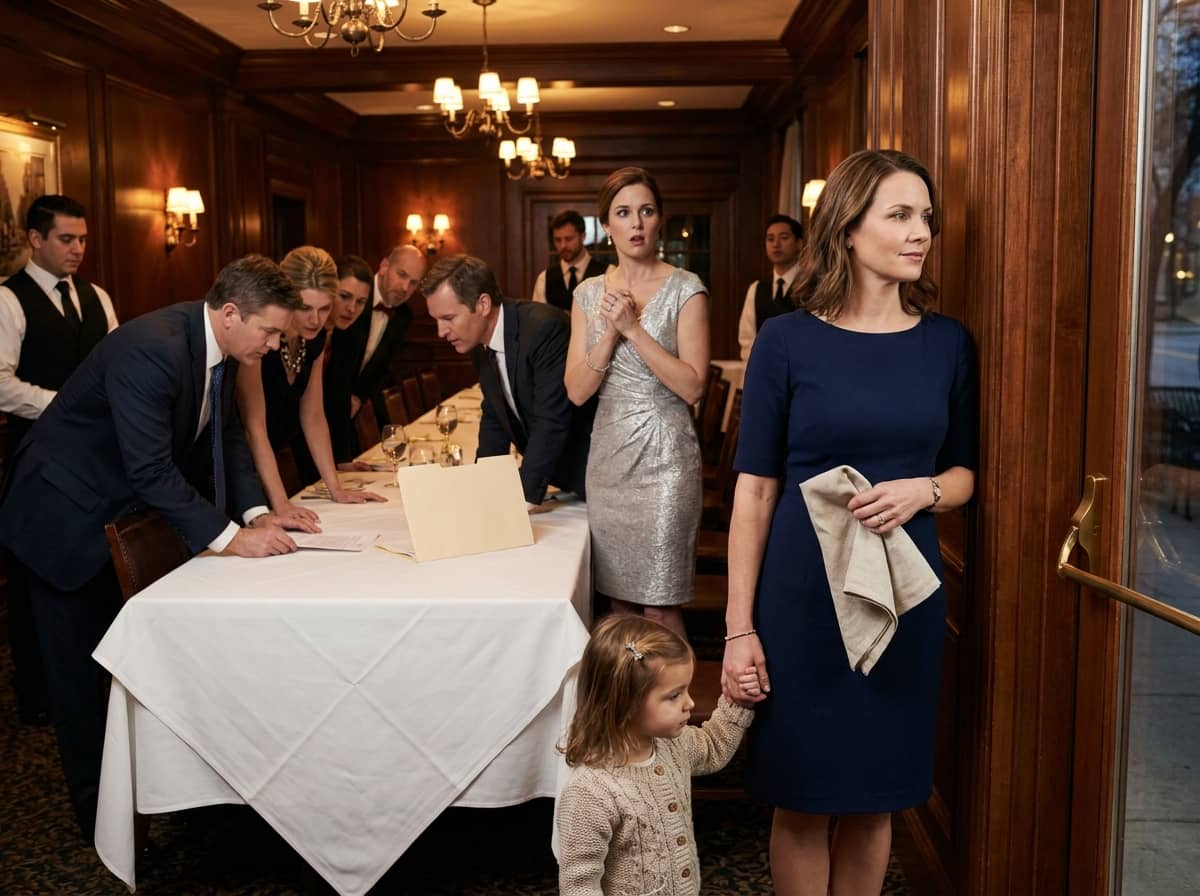
I had not said a word about any of it. Not at Sunday dinners, not in the family group chat, not when Sable sent a long message to everyone thanking herself for “putting this whole thing together.” I read that message, set my phone down, and went back to helping Liora with her homework.
Callen had asked me, twice, whether I was going to say something.
“Not yet,” I told him both times.
There is a kind of patience that looks like weakness from the outside. I had learned it the hard way, in places where patience was the only thing standing between a bad outcome and a catastrophic one. You do not move until you are ready. You do not speak until your words will land exactly where you need them to.
I had been ready since the second invoice.
What I had not anticipated was Sable choosing to humiliate me in front of Liora.
That changed the temperature of everything.
Sitting in the car while Callen drove toward the IHOP on Route 59, I opened my email on my phone. I found the thread with Patricia Holt. I found the contract with my name on the signature line. I found the three charge confirmations from my Visa. I forwarded all of it to a folder I had labeled, simply, “Oakwood.”
Then I texted my cousin Darla, who had been at the dinner and who I trusted completely: How’s it going in there?
She replied in four minutes: Awkward. Your mom looks upset. Sable is acting like nothing happened. Your dad hasn’t said anything.
I typed back: Let me know when the manager comes out with the final bill.
Darla sent a question mark.
I sent back: You’ll understand soon.
I put my phone in my purse and ordered the blueberry pancakes.
But what I did not know yet — what none of us knew — was that the $6,200 was only the first layer of what Sable had been hiding.
Part 3: The Bill, the Freeze, and the Retirement Dinner Betrayal Nobody Saw Coming
At 7:34 p.m., Darla sent me a voice memo instead of a text.
I stepped away from the IHOP table, walked to the small hallway near the restrooms, and pressed play.
I could hear the ambient noise of the Oakwood Room — glasses, low conversation, someone giving a toast. Then I heard a man’s voice, measured and professional. That was Marcus Webb, the Oakwood Room’s general manager. I had spoken with him twice by phone during the planning process. He had a calm, unhurried way of speaking that I had liked immediately.
“Excuse me,” Marcus said on the recording. “I need to speak with whoever is settling the account for this evening.”
Darla had held her phone under the table. The audio was muffled but clear enough.
Sable’s voice: “That’s me. I organized everything.”
Marcus: “I see. And you are — “
Sable: “Sable Rowe. This is my father’s event.”
A pause. Papers shuffling.
Marcus: “Ms. Rowe, the contract for this event is in the name of Maren Vale. The deposit and all charges were authorized on a card ending in 4471, which is also registered to Ms. Vale. I’m not able to release the final bill or close the account without her authorization or her card present.”
Silence.
Not the polite kind. The airless kind.
Darla’s voice, barely a whisper on the recording: “Oh my God.”
My mother: “What does that mean?”
Marcus, still calm: “It means the account holder is Ms. Vale. She is the only person authorized to settle this bill. The remaining balance is $847, which covers the bar extension and the cake service added this afternoon.”
Sable: “That’s — she left. She walked out.”
Marcus: “Yes, ma’am. I’m aware. I’ve already been in contact with Ms. Vale. She has authorized the final charge remotely and asked me to provide this to the table.”
The sound of paper being set down.
More silence.
Then my father’s voice, very quiet: “What is this?”
Marcus: “The itemized invoice, sir. Ms. Vale asked that it be shared with the family.”
I had emailed Marcus at 7:12 p.m. from the IHOP parking lot. I had authorized the final charge, asked him to print the full itemized invoice — every line, every date, every charge — and present it to the table at the end of the meal. I had also asked him to note, on the cover page, that all charges had been made by Maren Vale, and that no other family member had contributed financially to the event.
Marcus had replied within six minutes: Understood. Consider it done. I’m sorry for what happened earlier this evening.
That one line from a stranger meant more than I expected it to.
On the voice memo, I heard Brynn Calder say, “I’m sure there’s an explanation.”
I heard Sable say nothing.
I heard my father say, very slowly, “Six thousand, two hundred dollars.”
The retirement dinner betrayal was no longer a secret. It was a line item. Thirty people were looking at it in black and white on cream-colored paper under brass pendant lights.
I pressed stop on the voice memo and stood in the IHOP hallway for a moment.
Then I went back to the table and ate my pancakes.
But the invoice was not the end of what Marcus found. And what came next had nothing to do with the dinner at all.
Part 4: The Second Layer Nobody Asked For
My phone rang at 9:15 p.m. It was my mother.
I let it go to voicemail.
She called again at 9:22. Then Sable called at 9:31. Then my father called at 9:47, which was the first time he had called me directly in four months.
I did not answer any of them.
I answered Darla at 10:03, when Liora was already in bed and Callen was in the kitchen making tea.
“Maren,” Darla said, “there’s more.”
She told me that after Marcus presented the invoice, my father had gone very quiet. Not embarrassed-quiet. Thinking-quiet. He had asked Sable, in front of everyone, a simple question: “Where did the money go that I gave you for the party?”
Sable had told my father, three months ago, that she was planning the retirement dinner and needed a budget. My father had written her a personal check for $3,000 to cover the venue and food. Sable had cashed it.
She had then called me to cover the deposit and the food minimum, telling me the family would reimburse me.
She had kept my father’s $3,000.
She had used my card for $6,200.
She had accepted praise all evening for an event she had not paid a cent toward.
Darla said my father sat at the head table for a long time after that, not speaking. My mother had tried to smooth it over — “I’m sure she meant to sort it out” — but my father had put his hand up, flat, the way he used to when he was done with a conversation.
Gerald, his old coworker, had quietly paid for his own table’s drinks and left early.
Brynn had found her coat.
The room had emptied faster than anyone planned.
I sat with the phone against my ear and felt something I had not expected to feel: not satisfaction, not anger, but a deep, bone-level tiredness. The kind that comes when you have been carrying something heavy for a long time and you finally set it down — and then you realize how long you have been carrying it.
Sable had been doing versions of this for years. The birthday dinner where she collected money from everyone and then “forgot” to pay the restaurant. The vacation fund for our parents’ anniversary that she managed and that somehow came up $800 short. The small loans that were never small and never repaid.
I had always let it go. For the sake of the family. For my father’s feelings. For the idea that blood meant something.
But she had looked at my seven-year-old daughter and told her, in front of thirty people, that we did not belong at the table.
That was the thing I could not let go.
The next morning, I called an attorney.
Not to sue Sable. Not to make a scene. But because I had $6,200 on a Visa card and a cashed check that told a very clear story, and I wanted someone with a law license to help me tell it correctly.
My attorney, a woman named Diane Okafor who had handled my estate planning two years earlier, listened to the whole thing in twenty minutes. Then she said, “This is actually straightforward. Do you want the money back, or do you want something else?”
I said, “Both.”
Part 5: What Forty-Five Minutes Actually Cost
Three weeks have passed since the Oakwood Room.
Here is what has happened since.
Diane sent a formal demand letter to Sable on my behalf, itemizing the $6,200 in Visa charges and referencing my father’s $3,000 check as evidence of a pattern. The letter gave Sable thirty days to repay the $6,200 or Diane would file in civil court. It also noted that the $3,000 check — given by my father for a specific purpose and diverted — was a matter my father might wish to pursue separately.
Sable called me four times the day the letter arrived. I did not answer. I texted her Diane’s contact information and nothing else.
She repaid $4,000 within ten days. She said it was “all she had right now.” Diane filed for the remaining $2,200 in small claims court. The hearing is scheduled for next month. I will be there. I will bring the contract, the invoices, the email thread with Patricia Holt, and the charge confirmations. I will be calm. I will be prepared. I will let the paperwork do the talking.
My father called me on a Wednesday morning, twelve days after the dinner. Not to apologize exactly — my father is not a man who apologizes easily, and I have made my peace with that. But he called, and he stayed on the phone for forty minutes, which is longer than we have talked in years. He said he did not know about the charges on my card. He said he was ashamed of what Sable said to Liora. He said he had been thinking about a lot of things.
I told him I was glad he called.
I meant it.
My mother has not called. I am not surprised. She has always needed time to rearrange the story into something she can live with. I am giving her that time. Not because I owe it to her, but because I am forty-one years old and I no longer spend energy on things I cannot change.
Liora asked me, two days after the dinner, if Aunt Sable was mad at us.
I thought about how to answer that for a moment.
“Aunt Sable made a mistake,” I told her. “And sometimes when people make mistakes, they feel embarrassed, and embarrassed people can act unkind. That’s not your fault. That’s not our fault. We did nothing wrong.”
Liora nodded very seriously, the way she does when she is filing something away.
“Okay,” she said. “Can I still give Grandpa the drawing?”
I mailed it to him that afternoon, in a cardboard-backed envelope so it would not bend.
He texted me a photo of it on his refrigerator two days later. No words. Just the photo.
That was enough.
Here is what I want to say to anyone reading this who has been at a table where someone tried to make you feel like you did not belong there:
You do not have to argue. You do not have to perform your worth for people who have already decided not to see it. Sometimes the most powerful thing you can do is fold your napkin, take your daughter’s hand, and walk out — knowing that the truth is already on its way to the table.
The retirement dinner betrayal that Sable staged that night cost her $6,200, her reputation in front of every person my father had invited to celebrate forty years of honest work, and whatever version of sisterhood we had left.
It cost me one dinner.
I think about something my grandmother used to say, a woman who raised six children on a schoolteacher’s salary and never once raised her voice to make a point: “You can lie about who paid for the party. You cannot lie about who shows up when it matters.”
Sable showed everyone exactly who she was that night.
So did I.
The difference is, I am fine with what they saw.
There is a verse I have carried for years, from Proverbs 12:19: “Truthful lips endure forever, but a lying tongue lasts only a moment.” I did not need to say a word in that room. The invoice said it for me. The truth always finds its way to the table — sometimes it just needs forty-five minutes.
To my daughter Liora: you did nothing wrong. You never do. And the drawing on Grandpa’s refrigerator will be there long after anyone remembers what your aunt said that night.
That is the only thing that matters.
Names and identifying details have been changed. This is a dramatized personal reflection shared for entertainment and educational purposes only. Any resemblance to real people or specific events is coincidental.
Read Retirement Dinner Betrayal and other true-to-life family dramas. For perspective on situations like this, see family dynamics.
