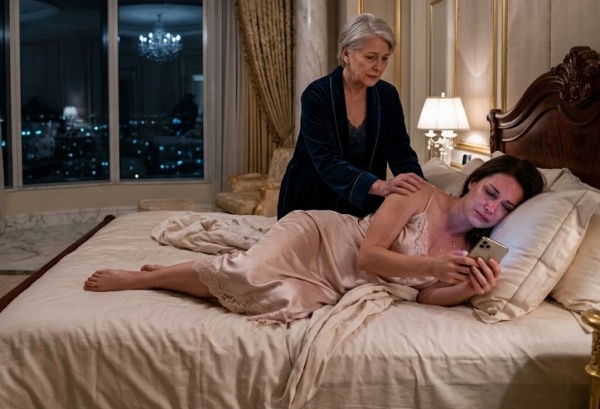
My Husband Texted, “I’m Staying With Her Tonight. Don’t Wait Up for Me.” But My Mother-in-Law Saw It First—Then a 1 A.M. Call Changed Everything… For seven years, I thought his mother would always defend him no matter what he did. But when she read those words first, the look on her face told me everything was about to change.
Part 1 — The Text on the Kitchen Counter
At 8:47 on a Friday night, my husband sent a text that was meant to break my heart quietly. It said, “I’m staying with her tonight. Don’t wait up for me.” The problem was, I was not the first person to see it.
My mother-in-law was.
Her name was Patricia Bennett, and she had been standing in my kitchen in Charlotte, North Carolina, holding my phone because I had flour on both hands. We were baking apple cinnamon muffins for the church fundraiser the next morning, pretending not to notice that her son, my husband Aaron, was already three hours late for dinner. When the screen lit up, she glanced down automatically.
I watched her face change before I knew why.
Patricia was sixty-four, a retired elementary school principal, and the kind of Southern woman who could silence a room with one raised eyebrow. She loved her son fiercely, sometimes too fiercely, and for most of my marriage, I had assumed that if Aaron ever hurt me, Patricia would find a way to explain it. Mothers often do, especially mothers of charming sons.
But that night, she did not explain.
She simply held the phone tighter and whispered, “Claire.”
My name sounded different in her mouth. Not casual. Not warm. Careful, like she was handing me something sharp.
I wiped my hands on a dish towel and took the phone from her. The message sat there on the lock screen, bright and impossible, under Aaron’s name. I’m staying with her tonight. Don’t wait up for me.
For a moment, I felt nothing.
That surprised me.
I had always imagined betrayal would feel like a scream, like something dramatic and cinematic. Instead, it felt like the sudden quiet after a power outage, when every appliance in the house stops humming and you realize how much noise you had been living with.
Patricia did not ask who “her” was.
Maybe she already knew.
Maybe every woman knows more than she wants to admit when a man starts coming home smelling like unfamiliar perfume and excuses. Maybe Patricia had seen what I had been trying not to name.
Aaron and I had been married for seven years. We lived in a brick ranch house in the Elizabeth neighborhood, close enough to Uptown that the skyline looked beautiful at night but far enough away that our street still had old oak trees and neighbors who waved from porches. From the outside, we looked like the kind of couple people used as evidence that marriage still worked.
He was thirty-eight, a financial consultant with pressed shirts, polished shoes, and a smile that made people trust him before he had earned it. I was thirty-five, a speech therapist at an elementary school, used to coaxing words out of children who were frightened to use them. Ironically, I had spent years losing my own voice inside my marriage.
The muffins were still in the oven.
The timer blinked twelve minutes.
Patricia slowly sat down at the kitchen table. She looked smaller than she had a minute before, as if the text had aged her in real time.
“Do you know who he means?” she asked.
I wanted to lie.
Not to protect Aaron.
To protect myself from the humiliation of saying her name out loud in front of his mother.
“Jenna,” I said.
Patricia closed her eyes.
That was when I understood she did know.
Jenna Hart worked at Aaron’s firm in SouthPark. She was twenty-nine, recently divorced, and the kind of woman who posted inspirational quotes about fresh starts while standing too close to married men at office happy hours. Aaron had introduced her to me once at a company Christmas party, calling her “a rock star with clients.”
She had looked me up and down and said, “Aaron talks about you all the time.”
At the time, I thought that was polite.
Now I wondered which version of me he had been describing.
Patricia stood and walked to the oven as if routine could save us. She took out the muffins, set the tray on the stove, and turned off the heat. Then she placed both hands on the counter and lowered her head.
“I raised him better than this,” she said.
I almost laughed, but it would have come out broken.
“Maybe you did,” I said. “Maybe he just chose worse.”
Neither of us spoke for a while.
Outside, a car passed slowly. The dishwasher hummed. Somewhere upstairs, the ceiling fan in the guest room clicked with every rotation, the same soft sound Patricia had complained about when she arrived that afternoon.
Then my phone buzzed again.
Not a text.
A call.
Aaron.
I stared at his name until the screen went dark.
Patricia looked at me. “Are you going to answer?”
“No,” I said.
The word surprised both of us.
For seven years, I had answered every call from Aaron. I answered when I was teaching, when I was sick, when I was in the grocery store, when I was angry, when I was crying in the bathroom after another canceled anniversary dinner. I had trained myself to be available to a man who treated my availability like furniture.
That night, for the first time, I let him ring.
Patricia reached across the table and placed her hand over mine.
It was not an apology.
Not yet.
But it was the first time I felt like someone from Aaron’s family had chosen the truth over him.
At 1:03 a.m., her phone rang.
That call changed everything.
Part 2 — The Marriage Everyone Thought Was Fine
Aaron and I met at a charity 5K in Freedom Park. I was there with coworkers, walking more than running, and he was volunteering at the water station in a Panthers hoodie. He handed me a paper cup, smiled, and said, “You look like you’re reconsidering all your life choices.”
I laughed so hard I spilled water on my shoes.
That was Aaron’s gift. He made ordinary moments feel like beginnings. By the end of the morning, he had asked for my number, and by the end of the week, we were eating tacos in NoDa and talking like people who had known each other longer than seven days.
He was attentive in the beginning.
Almost overwhelmingly attentive.
He sent flowers to my school after my students performed their first speech showcase. He remembered my coffee order. He drove forty minutes in the rain to bring soup when I had the flu.
When Aaron loved you, it felt like a spotlight.
You forgot that spotlights can also blind you.
Patricia liked me immediately, or at least I thought she did. She told Aaron I was “steady,” which I took as a compliment because I was too young to understand how often women are praised for being easy to lean on. Aaron’s father had died when Aaron was twenty-two, and Patricia had poured her whole life into making sure her only child felt important.
Important became expected.
Expected became entitled.
Entitled became the quiet third person in our marriage.
By year three, Aaron’s charm had become something he used outside the house more than inside it. Clients got the jokes. Coworkers got the patience. Friends got the version of him who remembered birthdays and picked up the check.
I got the sighs.
I got the late nights.
I got the half-listening nods while he scrolled through his phone.
When I tried to talk about it, he said I was sensitive. When I cried, he said he felt like nothing he did was enough. When I asked for counseling, he said he did not want to “pay a stranger to take my side.”
That sentence stayed with me.
Not because it was cruel.
Because it revealed that he thought marriage was a courtroom and I was an opponent.
We started trying for a baby in our fifth year. I tracked cycles, took vitamins, changed my schedule, and sat through appointments where doctors used words like “unexplained” and “options.” Aaron came to the first two appointments, then work became too demanding.
A year later, I had a miscarriage at nine weeks.
It was early, everyone said.
Common, everyone said.
At least you know you can get pregnant, someone actually said, as if grief needed a bright side to be acceptable.
Aaron cried with me the first night.
Then he went back to work like grief had office hours.
Patricia came over with casseroles and clean towels. She did not say much, but she washed dishes, folded laundry, and sat beside me while I stared at nothing. For a while, I loved her for that.
Then Aaron began rewriting the story.
He told people we were “taking a break from trying,” when really he had stopped touching me for months. He told Patricia I was anxious and needed space, when really he was the one sleeping with his back to me. He told his friends marriage was hard because “Claire wants the life plan more than she wants me.”
I heard that last one at a backyard barbecue when one of his friends had too many beers and said, “You two doing okay? Aaron says the baby stuff has been rough on him.”
On him.
The phrase landed like a slap.
I did not confront Aaron that night. I helped load the cooler into the car, smiled goodbye, and cried in the shower when we got home. That became my pattern: hold it together in public, fall apart quietly, wake up and try again.
Jenna entered our life six months later.
At first, she was only a name. Jenna closed the Myers account. Jenna knew a great bourbon bar. Jenna had a client emergency. Jenna understood how intense Aaron’s job was.
Then came the new cologne.
The guarded phone.
The “team dinners” that ended after midnight.
The sudden interest in fitness because Jenna ran half marathons and posted about discipline.
I asked him once, directly.
“Is there something going on with Jenna?”
He looked offended before I finished the sentence. That was one of Aaron’s talents: making my pain sound insulting to him. “You’re seriously jealous of a coworker?” he asked.
“I’m asking because something feels different.”
“You mean I’m busy.”
“I mean you’re gone.”
He rubbed his face like I was exhausting. “Claire, I cannot be responsible for every insecurity you have.”
I apologized.
That is the part I still hate.
Not the affair.
Not even the text.
I hate that I apologized for noticing my own life.
By the time Patricia came to stay that weekend, I was already carrying suspicions like stones in my pockets. She had driven from Asheville after a minor procedure on her knee, and Aaron insisted she recover with us for a few days because “family takes care of family.” He said it loudly in front of her, the way he said noble things when someone was there to admire him.
He was supposed to be home by 6:00 p.m. for dinner.
At 6:30, he texted that a client meeting had run long.
At 7:45, he said not to hold dinner.
At 8:47, he sent the message he meant for Jenna, or maybe the message he meant for me after months of cowardice.
I’m staying with her tonight. Don’t wait up for me.
But Patricia saw it first.
And the woman I had expected to defend him suddenly looked like someone watching her own parenting stand trial.
Part 3 — The 1 A.M. Call
After the text, Patricia refused to go to bed. I told her she should rest her knee, but she waved me off and made tea neither of us drank. We sat across from each other at the kitchen table like two witnesses waiting for a verdict.
Around midnight, she said, “Claire, has he done this before?”
I looked at my wedding ring.
“I think so.”
She inhaled slowly.
“Do you know, or do you think?”
“That’s the problem,” I said. “He made sure I only ever had enough to feel crazy, not enough to feel certain.”
Patricia’s eyes filled with tears, but she blinked them back. “That sounds like his father.”
I looked up.
She had never spoken badly about Aaron’s father. Not once. In our house, Robert Bennett had been a framed photograph, a scholarship fund, a man remembered for church attendance and firm handshakes.
Patricia folded her hands around the mug.
“Robert was charming too,” she said. “Everyone loved him. Everyone believed him. And I spent twenty-seven years being told that what I saw was not what I saw.”
The house seemed to settle around us.
I realized then that Patricia had not been blind to Aaron’s behavior because she did not care. She had been blind because seeing it meant recognizing a pattern she had survived once already. Sometimes denial is not loyalty. Sometimes it is scar tissue.
At 1:03 a.m., her phone rang.
Aaron’s name appeared on the screen.
Patricia stared at it for two full rings before answering.
“Put it on speaker,” I said quietly.
She hesitated.
Then she did.
“Aaron?” she said.
His voice came through low and urgent. “Mom, thank God. I need you to listen to me.”
Patricia’s eyes met mine.
“I’m listening.”
“I need you to tell Claire I came to your condo tonight.”
Patricia went still.
“What?”
“If she asks, I was with you. I drove you back to Asheville because your knee was bothering you, and I stayed there. Just say your phone died or something.”
I felt the room tilt.
Patricia’s face hardened.
“Aaron, why would I say that?”
He exhaled sharply, annoyed already. “Because Jenna’s ex-husband showed up at the hotel, and now there may be a scene. He saw my car. I don’t know what he’s going to do, and I need time to get ahead of it.”
The word hotel seemed to echo.
Patricia closed her eyes.
I gripped the edge of the table.
Aaron kept talking because men like him often mistake silence for cooperation.
“Claire can’t find out like this,” he said. “I was going to tell her after the holidays. I just need you to cover me tonight.”
Patricia’s voice was barely above a whisper. “You were going to tell your wife after the holidays that you are having an affair?”
There was a pause.
Then Aaron said, “Don’t make it sound cheap.”
That was the moment something inside Patricia changed.
I saw it.
A mother can excuse many things when she thinks her child is confused, stressed, or wounded. But hearing him ask her to become part of the lie stripped away every soft version of him she had protected.
“Is Jenna with you now?” Patricia asked.
“Not exactly.”
“What does that mean?”
“It means things got complicated.”
I almost laughed because that was Aaron’s whole life philosophy. Betrayal was never betrayal when he did it. It was complicated.
Then he said the sentence that changed the rest of the night.
“Look, I moved some money yesterday, but Claire might notice if she checks the savings account. I just need forty-eight hours before anyone starts asking questions.”
Patricia’s head snapped up.
My heart started pounding.
“What money?” she asked.
“Mom, please.”
“What money, Aaron?”
He cursed under his breath. “The emergency fund. Some of it. I was going to put it back.”
Our emergency fund had $32,000 in it.
It was money for medical bills, home repairs, and the future child we had once prayed for. It was money I had contributed to every month from my school paycheck while Aaron told me I worried too much. It was money I trusted him with because marriage, apparently, had made me careless with my own security.
“How much?” Patricia asked.
“Twenty-six.”
“Twenty-six hundred?”
Silence.
Patricia’s face went white.
“Twenty-six thousand dollars?” she said.
I stood so quickly the chair scraped the floor.
Aaron finally seemed to sense something. “Mom, where are you?”
Patricia looked at me, then at the phone.
“I’m in Claire’s kitchen.”
The silence on the line was immediate.
Then Aaron said, “Is she there?”
Patricia answered before I could.
“Yes. She’s here. She saw your text. I saw your text. And now we both heard you ask me to lie for you.”
“Mom—”
“No,” she said.
It was the sharpest word I had ever heard from her.
“No, Aaron. I will not lie for you. I will not help you humiliate your wife. And I will not pretend you are a confused boy when you are a grown man stealing from your marriage.”
He exploded then.
Not with threats, exactly.
With outrage.
He said Patricia was betraying him. He said I had turned her against him. He said the money was technically marital, that Jenna understood him, that I had made the house cold, that he had been unhappy for years.
There it was.
The classic speech.
The one where a man lights the match, watches the house burn, then blames the curtains for being flammable.
I did not speak until he said my name.
“Claire, if you’re listening, you need to calm down.”
I leaned toward the phone.
“I am calm.”
He laughed once. “You don’t sound calm.”
“I sound awake.”
Patricia covered her mouth.
Aaron went quiet.
I continued, each word steadier than the last.
“Do not come home tonight. Do not move another dollar. Do not contact me unless it is in writing. I am calling an attorney in the morning.”
“You’re overreacting.”
“No,” I said. “I am responding.”
Then I ended the call.
My hands were shaking, but not from fear this time.
From recognition.
Some nights do not destroy your life.
They reveal that your life has already been damaged, and they hand you the first tool to rebuild it.
Part 4 — The Morning After
At 7:15 the next morning, Patricia made coffee strong enough to qualify as a legal stimulant. Neither of us had slept more than an hour. The muffins sat untouched under foil, absurdly normal in the middle of a ruined marriage.
The first thing I did was check the bank account.
Aaron had transferred $26,000 from our joint savings into an account I did not recognize. He had done it the day before, while texting me that work was stressful and asking if I could pick up his dry cleaning. Seeing the number made the affair feel almost secondary.
Betrayal of the heart hurts.
Betrayal of security changes the locks inside you.
Patricia stood beside me while I took screenshots. “Send those to yourself,” she said. “Print them too.”
I looked at her, surprised.
She gave me a sad smile. “I was married to his father, Claire. I know what women forget when they are in shock.”
By 8:30, I had called a family law attorney named Meredith Shaw, recommended by a divorced coworker who once told me, “Hope is not a financial plan.” Meredith’s office was in Uptown Charlotte, and when I explained the text, the call, and the transfer, her assistant found me an emergency consultation that afternoon. She told me to bring bank statements, tax returns, mortgage documents, and anything related to shared accounts.
Patricia drove me.
Her knee was still sore, but she insisted.
On the way, Aaron called thirteen times.
I did not answer.
He texted apologies, then accusations, then apologies again. He said the money was not gone, just “temporarily moved.” He said Jenna meant nothing, then said Jenna understood parts of him I never tried to understand.
He said his mother had no right to get involved.
That was my favorite, in the bitterest way.
He had called her at 1:00 a.m. asking her to lie, then acted offended when she became a witness to the truth. Men like Aaron do not hate involvement. They hate accountability.
Meredith Shaw was calm, direct, and completely unimpressed by charm she had not even met yet. She explained that North Carolina is an equitable distribution state, meaning marital property and debt would be divided fairly, not necessarily equally. She also explained that moving funds right before separation could matter, especially if the money was used for non-marital purposes.
“Do not empty accounts in retaliation,” she said. “Do not post about him online. Do not contact the other woman. Preserve evidence, communicate in writing, and protect your safety.”
I nodded.
It felt strange that the most powerful thing I could do was not explode.
It was document.
That afternoon, Patricia asked to speak with Meredith alone for five minutes. I worried she was going to defend Aaron after all. Instead, when she came back into the room, her eyes were red but clear.
“I told her I heard the call,” she said. “I told her I will provide a statement if needed.”
I started crying then.
Not loud.
Just enough that Meredith quietly slid a box of tissues across the desk.
Patricia reached for my hand. “I should have seen more,” she said.
“You saw enough last night.”
“No,” she said. “I saw enough years ago. I just did not want to know what it meant.”
That confession mattered more than any speech defending me.
Aaron came home at 5:40 p.m.
Patricia and I were in the living room, not the kitchen. I had packed a bag and placed my important documents in a tote by the door. Meredith had advised me that if I felt unsafe or overwhelmed, I could stay elsewhere while legal steps began.
Aaron looked exhausted.
His shirt was wrinkled.
His eyes were bloodshot.
For one foolish second, I remembered the man at the 5K handing me water and making me laugh. Grief is cruel because it keeps showing you the person you lost, even when that person is standing right in front of you as proof they are gone.
“Claire,” he said softly. “Can we talk?”
Patricia stood.
Aaron looked at her. “Mom, please stay out of this.”
She did not move.
“No,” she said. “I stayed out of too much already.”
His face changed. “You’re choosing her over your own son?”
Patricia’s voice shook, but she did not back down. “I am choosing what is right over what is easy.”
Aaron turned to me. “I made a mistake.”
I looked at him.
“A mistake is forgetting milk,” I said. “You had an affair, asked your mother to lie, and moved $26,000 while planning to leave me after the holidays. That is not a mistake. That is a strategy.”
He flinched.
Good.
Some truths should land.
He tried to explain that Jenna made him feel alive, that he had been depressed, that he did not know how to talk to me. I listened for about two minutes before realizing every sentence still had him at the center. Even his apology was arranged around his discomfort.
Then his phone buzzed.
He glanced down.
I knew before he said anything.
Jenna.
Patricia laughed once, softly and sadly.
Aaron looked ashamed, but shame was no longer enough to move me.
“I’m leaving tonight,” I said. “All communication can go through email or attorneys unless it is about the house or finances.”
He stepped forward. “Claire, don’t do this.”
I picked up my tote.
“I didn’t.”
Then I walked out with his mother beside me.
Part 5 — What the Call Really Changed
I stayed with Patricia for nine days.
That surprised everyone, including me. She lived in a small townhouse outside Asheville with blue shutters, a screened porch, and shelves full of old school yearbooks. It was not the place I expected to heal, but life has a strange way of placing bandages in the hands of people who once missed the wound.
The first few days were ugly.
I cried in her guest room.
I checked my phone too often.
I reread Aaron’s texts until Patricia gently took the phone and said, “Pain does not need a second shift.”
She made soup. She sat with me during calls with Meredith. She told me stories about Robert, Aaron’s father, not to excuse Aaron but to explain the silence she had lived with for decades.
“I thought if I gave Aaron enough love, he would not become like him,” she said one night.
We were sitting on the porch with blankets over our knees.
“I forgot that love without accountability can become permission.”
That sentence stayed with me.
Aaron tried everything over the next month. Flowers. Emails. Long voicemails. Short angry texts. A handwritten letter that began with I take full responsibility and ended with but you have to admit we were both unhappy.
I did not admit that.
Because it was not true in the way he needed it to be true.
Yes, we had problems. Yes, we had grief. Yes, infertility and miscarriage had changed us. But I had not solved my pain by building a secret life with someone else and moving money out of our future.
Meredith filed the necessary documents.
Temporary financial restraints were requested.
The transferred money became part of the legal conversation, and Aaron eventually had to account for where it went. Some had been used for hotel stays, dinners, and a deposit on an apartment he claimed was “for space to think.”
Judges, I learned, hear that kind of sentence often.
They are rarely charmed by it.
Jenna did not become the grand villain of my life. That disappointed people who wanted a cleaner story. She had made choices, yes, but she had not promised me forever in front of 120 guests and my grandmother’s Bible.
Aaron had.
The legal process was slow, expensive, and deeply unromantic. There were financial disclosures, mediation sessions, attorney emails, and the strange grief of dividing furniture you once bought while imagining children running around it. The dining table went to him. The bookshelf went to me.
The house was eventually sold.
I cried when I locked the front door for the last time.
Not because I wanted Aaron back.
Because I remembered painting the hallway light gray, arguing over cabinet handles, planting hydrangeas that never bloomed right, and believing the house was a beginning. Losing a marriage is not just losing a person. It is losing every future version of yourself that expected that person to be there.
Patricia came with me on moving day.
Aaron did not.
He said it would be too painful.
I did not respond because I had learned not every statement deserves the dignity of an answer.
A year later, the divorce was final.
I kept my retirement account, my car, my grandmother’s china, and enough from the sale of the house to put a down payment on a small condo near Plaza Midwood. It had uneven floors, old windows, and a balcony just big enough for two chairs and a pot of basil. It was mine.
That word felt better than romantic love for a while.
Mine.
My keys.
My bills.
My quiet.
My mornings without checking the emotional weather of a man before I could decide how to breathe.
Patricia and I remained close, which confused people. Some friends thought it was unhealthy. Others thought it was beautiful. The truth was simpler: she had lost the version of Aaron she wanted to believe in, and I had lost the version I married.
We grieved different men with the same face.
She never asked me to forgive him.
Not once.
At Christmas, she mailed me an ornament shaped like a tiny house with my new address painted on the back. The card said, For the home you built after the one that broke. I cried harder over that ornament than I had over Aaron’s apology letters.
Aaron and Jenna lasted seven months.
I heard this from Aaron during a required email exchange about a tax document. He wrote, You’ll probably be happy to know Jenna left. Turns out she didn’t want the real life part.
I stared at the sentence for a long time.
Then I deleted the draft response I had started typing.
There was nothing useful to say.
His consequences were not my assignment anymore.
Two years after the 1:00 a.m. call, I saw Aaron at a coffee shop near Dilworth. He looked older, thinner, less shiny. For a second, I felt the old pull of concern, the muscle memory of being responsible for his comfort.
Then he smiled sadly and said, “I really messed us up, didn’t I?”
I could have corrected him.
I could have said you destroyed us.
I could have said you broke something I was still trying to save.
Instead, I said, “Yes.”
Just yes.
Clean.
True.
Enough.
He asked if I was happy.
I looked out the window at people crossing the street with grocery bags, strollers, dogs, ordinary lives. Happiness felt too large and too simple a word for what I had become. I was peaceful. I was safe. I was no longer shrinking inside someone else’s version of events.
“I’m honest,” I said.
He nodded like he understood, though I was not sure he did.
When I got home that night, Patricia called. She asked about my day, complained about her neighbor’s leaf blower, and told me she had found a new muffin recipe we should try. She never mentioned Aaron.
That was love too.
Knowing when not to reopen a wound just because you remember where it is.
Sometimes I think about that Friday night in my old kitchen. The smell of cinnamon. The flour on my hands. Patricia’s face when she saw the text meant for me.
I’m staying with her tonight. Don’t wait up for me.
He thought that sentence would make me feel discarded.
For a few minutes, it did.
But then his mother saw it. Then he called at 1:00 a.m. and asked the woman who raised him to help him lie. Then the truth finally had witnesses.
That call changed everything because it took the betrayal out of the shadows.
It showed me the affair.
It showed me the money.
It showed Patricia the son she had been protecting from consequences.
And most importantly, it showed me myself.
Not as the abandoned wife.
Not as the woman who was not enough.
Not as the person waiting up in a quiet house for a man who had already left in every way that mattered.
I became the woman who stopped waiting.
And that was the beginning of my life coming back to me.
