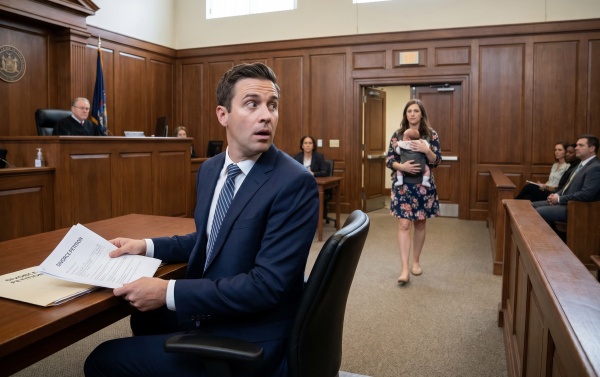
He Walked Into Court to Divorce His Wife, and Then She Walked In, Carrying a Baby He’d Never Met. Everything changed completely after that…
Part 1: The Morning I Thought My Marriage Would End
I walked into the Davidson County courthouse in downtown Nashville with a folder under my arm and a speech in my head. My lawyer, Rebecca, had told me not to speak unless the judge asked me a direct question, but I had still rehearsed everything in the mirror that morning. I wanted to sound calm, reasonable, like a man who had tried everything before finally choosing divorce.
The courthouse smelled like old paper, coffee, and raincoats. Outside, a March storm was soaking the sidewalks, turning Broadway into a blur of brake lights and umbrellas. Inside, couples sat on opposite sides of benches, staring at phones, shoes, or the floor between them.
My name is Ethan Walker, and that morning I believed I was there to close the saddest chapter of my life. My wife, Claire, had been gone for eleven months. No real goodbye, no long explanation, just a suitcase missing from the closet, her side of the bathroom empty, and a note on the kitchen counter that said, “I can’t keep disappearing inside this marriage.”
At first, I thought she would come back. Claire had left before after arguments, usually to stay with her sister in Louisville for a weekend. She would cool off, I would apologize badly, she would come home, and we would pretend the crack in the wall wasn’t getting wider.
But this time, she didn’t come back.
Her phone went straight to voicemail after the first week. Her sister stopped answering my calls. Her mother told me, in a voice colder than a Tennessee January, that Claire needed peace and that I should “try giving her some for once.”
So I gave her space.
That was what I told myself.
The truth was uglier. I was angry. I was embarrassed. I told friends Claire had abandoned me. I told my mother she was being dramatic. I told myself that if she wanted to walk away after seven years of marriage, I wasn’t going to chase her like some fool in a country song.
My mother, Barbara, encouraged that version of the story. She said Claire had always been too sensitive, too private, too quick to make me feel guilty. She said a wife who truly loved her husband didn’t leave a note and disappear.
By the end of summer, I believed her.
By Christmas, I had stopped leaving voicemails.
By February, I signed the divorce petition.
Rebecca, my attorney, said the hearing that morning would be procedural. Claire had finally responded through legal counsel after months of silence, which annoyed me more than I wanted to admit. She hadn’t called me, hadn’t written me, hadn’t asked to meet at a coffee shop or sit down like adults.
She had sent a lawyer.
So I wore my navy suit, the one Claire used to say made my eyes look less tired, and drove twenty-two miles from our house in Franklin to the courthouse. I parked in a garage that charged $18 for two hours and sat in my truck for almost ten minutes before going inside.
Part of me expected to feel relief.
Instead, I felt hollow.
Rebecca met me outside Courtroom 4B with a paper cup of coffee and her usual calm expression. She was in her early forties, sharp without being unkind, the kind of lawyer who could make bad news sound organized.
“Claire’s attorney checked in,” she said.
I nodded. “Is she here?”
“Not yet.”
Of course she wasn’t.
That irritated me too. Claire had always been on time when it mattered. Doctor’s appointments, dinner reservations, flights, weddings, funerals—she hated making people wait. The idea that she might be late to the legal ending of our marriage felt like one final insult.
Rebecca must have seen something on my face because she lowered her voice. “Ethan, today is not about winning emotionally. It’s about getting through the process.”
“I know.”
“Do you?”
I looked away.
Across the hallway, a young couple sat close together, holding hands even though they were outside a family courtroom. A little boy with a Spider-Man backpack leaned against his mother’s knees, eating Goldfish crackers from a plastic bag. Life kept going in that courthouse, even when people came there to divide it.
At 9:12 a.m., the courtroom doors opened, and we stepped inside.
The room was smaller than I expected. Wooden benches, fluorescent lights, a state flag in the corner, and a judge’s bench that made everything feel more serious than it had in emails. Claire’s attorney, a gray-haired man named Mr. Donnelly, sat at the opposite table with a leather briefcase and no client beside him.
Rebecca leaned toward me. “Stay calm.”
“I am calm.”
I wasn’t.
The judge entered at 9:20, and everyone stood. Judge Marjorie Ellis had silver hair, reading glasses, and the tired patience of someone who had heard every version of heartbreak people could bring into a courtroom. She moved through two cases before ours, both involving parenting schedules and child support.
I remember thinking, at least we don’t have that problem.
Claire and I didn’t have children.
That had been one of the deepest wounds in our marriage.
Two miscarriages in three years. A nursery we painted pale yellow and then used as storage. Boxes of baby clothes Claire couldn’t bring herself to return, stacked in the closet behind winter coats and Christmas decorations.
After the second loss, something in Claire went quiet. Something in me went hard. I didn’t know how to comfort her, so I worked more hours at the contracting company I ran with my cousin. I told myself bills didn’t stop because grief moved in.
Claire cried alone.
I drank beer in the garage.
That was how we lost each other, one room at a time.
“Walker versus Walker,” the clerk called.
Rebecca and I stood.
Mr. Donnelly stood too, still alone.
Judge Ellis looked over the file. “This is a divorce matter. Counsel, are both parties present?”
Before anyone could answer, the courtroom door opened behind us.
I didn’t turn right away.
Maybe I was afraid to see her.
Then I heard a soft sound.
Not footsteps.
A baby.
A tiny, restless whimper.
The kind that makes every adult in a room glance up without thinking.
I turned.
Claire was standing in the doorway.
She wore a dark green dress under a beige coat, her hair shorter than I remembered, her face thinner, but still so painfully familiar that my chest tightened. She looked exhausted in a way makeup couldn’t hide. In her arms, wrapped in a white blanket with tiny yellow ducks, was a baby.
For a moment, my mind refused to understand what my eyes were seeing.
Claire walked slowly down the aisle between the benches, holding the baby close against her shoulder. The child’s cheek rested near her collarbone, one small fist curled against the blanket. Claire didn’t look at me until she reached her attorney’s table.
When she finally did, her eyes filled with tears.
Not dramatic tears.
Not angry tears.
The kind that had been waiting a long time.
Judge Ellis looked from Claire to the baby, then down at the file again.
“Mrs. Walker,” she said carefully, “is there a minor child of this marriage?”
The courtroom went silent.
Claire swallowed.
“Yes, Your Honor,” she said.
My ears started ringing.
Rebecca turned toward me sharply. “Ethan?”
I couldn’t speak.
Claire adjusted the baby in her arms and looked directly at me.
“Her name is Lily,” she said. “She’s three months old.”
The floor seemed to drop under my feet.
Three months old.
Eleven months gone.
Seven years married.
A baby I had never met.
A baby who might be mine.
Everything I had prepared to say disappeared.
Part 2: The Baby in the Courtroom
Judge Ellis called a recess almost immediately.
Maybe she saw my face. Maybe she saw Claire trembling. Maybe she knew no legal proceeding could continue while a man stood at one table realizing his divorce petition might also be a paternity case.
Rebecca guided me into a conference room down the hall and closed the door behind us.
“Ethan,” she said, “sit down.”
I didn’t.
“Did you know she was pregnant?”
“No.”
“Are you certain?”
I stared at her. “Do you think I would be standing here like this if I knew?”
Rebecca held up one hand, not offended, just doing her job. “I have to ask. The court will ask. Her attorney will ask. If there is a child born during the marriage, Tennessee law generally treats that child as part of the marital case unless proven otherwise.”
My throat felt dry. “She said three months.”
“Yes.”
“She left eleven months ago.”
Rebecca’s expression softened slightly. “That timeline matters.”
I turned toward the small window overlooking the gray courthouse plaza. My reflection looked like a stranger’s: pale, stiff, too tall for the room. Somewhere outside, traffic moved like nothing had happened.
But everything had happened.
Claire had walked into court carrying a baby.
Lily.
The name echoed in my head.
Claire had always loved flower names. Years ago, before the miscarriages, we used to lie in bed on Sunday mornings and talk about baby names like ordering from a menu of futures. She liked Lily for a girl because her grandmother had grown lilies behind her house in Bowling Green.
I had forgotten that.
Or maybe I had buried it.
Rebecca asked, “Is there any chance the baby isn’t yours?”
The question hit like a slap, even though it was reasonable.
“I don’t know,” I said.
But that wasn’t true.
Not fully.
I had seen the baby’s face for only a few seconds, but something about her had already reached into me. The dark hair at the crown. The shape of her mouth. The tiny crease between her brows, the same one my father had when he was concentrating.
Still, resemblance was not proof.
And hurt makes people suspicious.
A knock came at the door. Mr. Donnelly stepped in alone. He looked at me not with anger, but with the guarded politeness lawyers use when emotion is a loaded gun.
“My client is willing to submit to a paternity test,” he said. “She has no interest in creating uncertainty.”
I laughed once, but it came out broken. “No interest in uncertainty? She disappeared for almost a year.”
Mr. Donnelly’s face tightened. “Mr. Walker, my client tried to contact you.”
“No, she didn’t.”
“She did.”
Rebecca stepped between us with her voice. “Let’s keep this productive.”
Mr. Donnelly opened his briefcase and removed a folder. “There are emails, certified mail receipts, and medical records. There are also text messages sent to Mr. Walker’s prior business number.”
“My prior—” I stopped.
Last spring, I changed my business number after we rebranded the company. I kept the old line active for a while, then my cousin shut it off because we were getting too many spam calls. Claire had that old number saved because for years it was the number I answered faster than my personal phone.
I felt the first crack in my certainty.
Mr. Donnelly continued, “Mrs. Walker also mailed a letter to the marital residence in May.”
“I never got a letter.”
“I can only tell you what she sent.”
Rebecca took the folder and scanned the first page. Her eyes flicked toward me, then away.
“What?” I asked.
She didn’t answer immediately.
That scared me more than anything.
The recess lasted twenty-five minutes. When we returned to the courtroom, Claire was seated at the table beside her attorney, the baby asleep against her chest in a sling. I couldn’t stop looking at them.
Claire looked different as a mother.
Not softer exactly.
Stronger.
Like she had crossed a burning bridge with that baby in her arms and didn’t care who approved of how she survived.
Judge Ellis resumed the case. “Given the information presented, this matter cannot proceed today as a simple divorce hearing. We have a child born during the marriage, and paternity, support, custody, and parenting time may be at issue.”
The words sounded official, but underneath them was my life rearranging itself.
My divorce was no longer just a divorce.
It was a question.
Who was I to that child?
Who had I been to Claire?
And what had really happened in the eleven months I had spent turning pain into blame?
Judge Ellis asked Claire to confirm the baby’s date of birth.
“December 8,” Claire said.
December 8.
I remembered that day. I had been at a Titans game with my cousin, freezing in the upper section, drinking overpriced beer and complaining about the offensive line. My daughter may have been coming into the world while I yelled at a football field.
I gripped the edge of the table.
The judge ordered temporary arrangements to be discussed after paternity testing. She instructed both parties not to harass, threaten, or disparage each other, especially given the presence of a child. Everything was measured, lawful, careful.
But inside me, nothing was measured.
When the hearing ended, Claire stood and gathered the diaper bag at her feet. The baby woke and made a small sound, not crying, just protesting the movement. Claire bounced her gently, the motion practiced and automatic.
I took one step toward her.
Rebecca whispered, “Ethan, be careful.”
I stopped a few feet away.
Claire looked at me as if she had been preparing for this moment and dreading it at the same time.
“Is she mine?” I asked.
Her eyes flashed with hurt. “Yes.”
“Why didn’t you tell me?”
She stared at me.
Then she said, “I tried.”
Two words.
Not shouted.
Not decorated.
Just placed between us like evidence.
I looked at the baby.
Lily opened her eyes.
They were blue-gray, unfocused, newborn-cloudy, but familiar enough to make my knees feel weak.
Claire tightened her hold slightly, not to punish me, but instinctively, like she had learned to protect both of them.
“I need to know the truth,” I said.
“So did I,” she replied.
Then she walked away.
Part 3: The Marriage We Both Remembered Differently
The paternity test was scheduled for the following week.
That gave me seven days to live inside a question that ate through everything. I couldn’t sleep. I couldn’t focus at work. I burned toast, forgot appointments, and sat in my truck outside job sites with the engine running and no memory of why I had driven there.
My mother called the day of court before I had even made it home.
“Well?” she asked.
I didn’t answer.
“Ethan?”
“Claire came.”
There was a pause. “And?”
“She had a baby.”
Silence.
Not confusion.
Silence.
That was the first thing I noticed.
A normal mother might have said, What? She might have gasped, asked if I was okay, asked if the baby was mine. My mother said nothing for three full seconds, and in those three seconds, something old and rotten shifted in the foundation of my life.
Finally, she said, “You don’t know whose it is.”
I pulled into my driveway and parked. The house looked the same as always: brick front, black shutters, porch swing Claire bought from a yard sale and painted white one weekend while I complained about the humidity.
“Mom,” I said slowly, “did Claire send anything here last spring?”
“What do you mean?”
“A letter.”
Another pause.
“I don’t remember.”
That was not no.
I sat in the truck until the rain blurred the windshield.
Claire and I had not had a perfect marriage before she left. I would never pretend that. We loved each other, but love had become buried under grief, money stress, my mother’s opinions, and my inability to talk about pain without making it sound like an accusation.
After our first miscarriage, people brought casseroles and flowers. After the second, they didn’t know what to bring, so they brought silence. Claire spent weeks barely eating, wearing one of my old Vanderbilt sweatshirts around the house, sitting in the yellow nursery with the lights off.
I told her we could try again.
She said she didn’t know if she could survive trying again.
Instead of hearing fear, I heard rejection.
I started working later. She started seeing a therapist. My mother said therapy made people selfish. I repeated that once during an argument and watched Claire’s face close like a door.
There were so many doors.
The final fight happened on a Saturday in April.
We were supposed to drive to Louisville for her niece’s birthday, but I canceled because a client wanted to meet about a $72,000 renovation contract. Claire stood in the kitchen holding a wrapped gift and said, “You always find a reason to choose work when my family is involved.”
I snapped back, “Work pays for this house.”
She said, “I never asked for a house that feels empty.”
Then my mother, who had stopped by uninvited with banana bread, stepped into the conversation like she had a right to be there. “Claire, men have responsibilities. You can’t expect Ethan to sit around discussing feelings all day.”
Claire looked at me.
Waiting.
Wanting me to defend her.
I didn’t.
That was one of the worst things I ever did: nothing.
Later that night, after my mother left, Claire asked me if I still wanted a family with her or if I only wanted a version of her who didn’t need anything.
I was tired. I was defensive. I was cruel in the lazy way people are when they think love will absorb any blow.
I said, “I’m tired of being punished for a life we don’t even have.”
She went still.
I knew immediately I had said something terrible, but pride got there before apology. I slept in the guest room. In the morning, she was gone.
For months, I told that story with the important parts removed.
I said she left after a fight.
I did not say what I said.
I said she refused to communicate.
I did not say I stopped trying when trying made me feel guilty.
Three days after court, Rebecca emailed me scanned copies from Claire’s attorney.
There was a certified mail receipt dated May 14.
A copy of a handwritten letter.
A printout of an ultrasound.
I opened the letter first.
Ethan,
I know you’re angry. I’m angry too. But I need you to know something before lawyers or your mother or my fear makes this worse. I’m pregnant. I found out two weeks after I left. I’m scared to tell you because I don’t know whether you’ll see this baby as hope or another reason to resent me.
I need space, but I don’t want to erase you. Please call me when you’re ready to talk without blaming me for being hurt.
Claire
I read it once.
Then again.
Then a third time, because the words would not stay still.
She had told me.
She had tried.
I walked to the hall closet where we kept old mail, warranties, batteries, and things nobody knew where else to put. I tore through boxes until I found a stack of envelopes tied with a rubber band, most of them forwarded business mail from the rebrand.
At the bottom was a pale blue envelope.
Opened.
Addressed to me.
Claire’s handwriting.
My hands went cold.
Inside was only a blank sheet of paper.
The letter was gone.
I drove to my mother’s house without calling.
She lived fifteen minutes away in a condo community where every lawn looked professionally embarrassed. Her car was in the driveway. She opened the door wearing gardening gloves, surprised but not enough.
I held up the envelope.
“Where’s the letter?”
Her face drained.
That was all the answer I needed.
She stepped back. “Ethan, you need to understand—”
“No,” I said. “You need to understand that my wife told me she was pregnant, and I never knew.”
“She was going to trap you.”
I stared at her.
My mother, who had held my hand at church after the miscarriages. My mother, who had cried and said she wanted grandchildren. My mother, who had told me Claire was unstable, selfish, dramatic.
“She was your wife,” I said.
“She left you.”
“And you decided that gave you the right to hide my child?”
Her eyes hardened. “I protected you.”
I felt something inside me break cleanly.
“No,” I said. “You protected your control.”
She recoiled as if I had cursed at her.
Maybe I had, in the only language that mattered.
I left without another word.
That night, I sat in the yellow nursery for the first time in almost a year. The crib was still disassembled against the wall. The old rocking chair Claire found on Facebook Marketplace sat in the corner, covered with a sheet.
I pulled the sheet off and sat down.
The room smelled like dust and paint.
I cried there, quietly, like a man who had finally run out of people to blame.
Part 4: Learning How to Be a Father From the Outside
The paternity results came back ten days later.
Rebecca called me at 8:06 a.m.
“Ethan,” she said gently, “the test confirms you are Lily’s biological father.”
I closed my eyes.
I thought the answer would calm me.
It didn’t.
It opened every door at once.
Relief. Shame. Joy. Grief. Anger. Love for a baby I had held only in my imagination. Horror at everything Claire had carried alone.
I asked Rebecca what happened next.
“Legally, we address parenting time, child support, medical expenses, and decision-making,” she said. “Emotionally, Ethan, that part is up to you.”
The first supervised visit happened at Claire’s sister’s house in Louisville because Claire did not feel comfortable coming to Franklin yet. I drove 175 miles north on I-65 with a diaper bag full of things I had panic-bought at Target: wipes, rattles, a tiny pink blanket, and a stuffed elephant with ears bigger than its body.
I arrived thirty minutes early and sat in the driveway like a teenager on a first date.
Claire opened the door holding Lily.
For a second, neither of us spoke.
She wore jeans, a gray sweater, and no wedding ring. I noticed that last part even though I had no right to. Lily was awake, staring at the ceiling fan like it had personally offended her.
Claire stepped aside. “Come in.”
Her sister, Megan, was in the kitchen pretending not to watch me like a hawk. I didn’t blame her. If Claire were my sister, I would have hated me too.
I washed my hands twice because I didn’t know what else to do.
Claire sat on the couch and adjusted Lily in her arms. “Support her head,” she said.
“I know.”
She gave me a look.
“I watched videos,” I admitted.
Something almost like a smile moved across her face, then disappeared.
She placed Lily in my arms.
The entire world became eight pounds and fourteen ounces.
Lily looked up at me with unfocused eyes and made a tiny clicking sound with her mouth. Her fingers opened and closed against my shirt. I had expected to feel instant certainty, some movie moment where fatherhood flooded me in golden light.
Instead, I felt terrified.
She was so small.
So real.
So unaware of how many adults had already failed her.
“Hi,” I whispered. “I’m Ethan.”
Claire’s eyes filled.
I corrected myself.
“I’m your dad.”
Lily sneezed.
Megan cried in the kitchen and tried to cover it by opening a cabinet.
I visited every Saturday after that. At first, Claire stayed in the room the whole time, not hovering exactly, but present. I learned how to warm bottles, change diapers, fold tiny laundry, and tell the difference between Lily’s hungry cry and her tired cry.
I learned that babies do not care how sorry you are.
They care if you show up.
So I showed up.
I paid temporary child support without arguing. I added Lily to my health insurance. I reimbursed Claire for part of the medical bills, including the hospital balance that had sat on her credit card gathering interest at 21.99 percent.
The money mattered, but it did not repair anything by itself.
Claire was polite, which hurt more than anger. Anger would have meant there was still heat between us. Politeness felt like standing outside a house where all the lights were on but no one would let you in.
One afternoon, while Lily slept in a bassinet beside the couch, I said, “I found the envelope.”
Claire looked up.
“My mother opened it.”
Her face changed, but not with surprise. “I wondered.”
“I didn’t know.”
“I believe you.”
Those three words should have comforted me.
They didn’t.
Because she followed them with, “But you made it easy for her.”
I nodded.
There was nothing to defend.
Claire looked toward Lily. “Your mother didn’t create the space between us, Ethan. She walked into it.”
That sentence stayed with me for weeks.
I started therapy in April.
Not because a judge ordered it. Not because Claire demanded it. Because one day Lily began crying in my arms, and I felt myself panic the way I used to panic when Claire cried. I realized I did not want my daughter to grow up with a father who treated tears like accusations.
Therapy was uncomfortable.
I learned that I confused being needed with being attacked. I learned that my mother’s approval had shaped more of my marriage than I wanted to admit. I learned that grief I refused to feel had not disappeared; it had leaked out as resentment.
Claire and I began mediation in May.
We sat in separate rooms at first, the mediator walking back and forth with proposals. Parenting schedule. Holidays. Health insurance. Daycare. Transportation between Nashville and Louisville.
It was strange negotiating time with a baby who had my chin and Claire’s stubborn little nose.
After two sessions, Claire agreed to sit in the same room.
I did not take that as forgiveness.
I took it as mercy.
At the end of one session, the mediator asked whether the divorce would proceed as filed.
Claire looked at me.
I looked at her.
For months, I had thought divorce was the answer because it gave shape to pain. But now the old question had changed. It was no longer, How do I get free of this marriage?
It was, What kind of family can survive the truth?
“I don’t know,” Claire said.
I said, “I don’t either.”
And for the first time in a long time, uncertainty felt honest instead of frightening.
Part 5: The Day Everything Changed Again
By Lily’s first birthday, I could change a diaper in the dark, install a car seat correctly, and sing every verse of “You Are My Sunshine” without feeling ridiculous. Claire had moved back to Nashville, not into our house, but into a small rental in East Nashville with blue shutters and a porch just big enough for two chairs and a stroller.
We had a parenting schedule by then.
I got Lily every Wednesday afternoon and every other weekend. It wasn’t enough, but it was what trust could hold at the time. I learned not to push for more by demanding it, but by becoming someone Claire did not have to fear disappointing our daughter.
My relationship with my mother remained strained.
She apologized eventually, but her apology began with, “I thought I was helping,” and that told me she still did not fully understand. I told her she could know Lily someday, but not until she accepted boundaries that were not negotiable.
That was the first time in my life I chose my family over my mother’s comfort.
Claire noticed.
She didn’t praise me for it.
She shouldn’t have had to.
But one evening, when I dropped Lily off after a weekend, Claire stood on the porch with her arms crossed and said, “Thank you for handling that.”
Two years earlier, I would have said something defensive like, She’s still my mom.
That night, I said, “I should have handled it a long time ago.”
Claire looked at me for a while.
Then she nodded.
Lily’s first birthday party was held at a park near Shelby Bottoms. Nothing fancy. A rented pavilion, grocery store cupcakes, balloons tied to a picnic table, and a pink smash cake Claire made herself because she said paying $65 for a baby to destroy frosting was “financial nonsense.”
Megan drove down from Louisville. My cousin grilled hot dogs. Claire’s mother kept side-eyeing me but handed me napkins anyway, which I considered progress.
Lily wore a yellow dress and a paper crown she hated immediately.
When everyone sang “Happy Birthday,” she stared at us with deep suspicion. Then she stuck one hand into the cake and looked personally betrayed by icing. Claire laughed, really laughed, and the sound hit me harder than I expected.
I had missed that laugh.
Not because she owed it to me.
Because the house of our marriage had once been full of it, and I had not noticed when it disappeared.
After the party, while everyone packed up coolers and folded chairs, Claire and I watched Lily toddle in the grass between us. She was still unsteady, arms out, determined to go farther than her legs were ready for.
“She gets that from you,” Claire said.
“What?”
“The stubbornness.”
I smiled. “I was going to say from you.”
“For her sake, let’s hope it’s both.”
The sun was setting behind the trees, turning the park gold. Kids shouted near the playground. Somewhere nearby, someone was playing country music from a Bluetooth speaker, low enough not to be rude but loud enough to be Nashville.
I said, “I never thanked you.”
Claire glanced at me. “For what?”
“For walking into court.”
Her expression softened, but her guard stayed where it was. “That wasn’t for you.”
“I know,” I said. “It was for Lily. And for you. But it changed my life.”
Claire looked down at our daughter, who had found a leaf and was trying to decide if it was food.
“I almost didn’t go,” she admitted.
I turned to her.
“My attorney said he could appear without me,” she continued. “I was tired. Lily had been up half the night. Part of me thought, let him divorce the version of me he made up in his head.”
My throat tightened.
“What changed your mind?”
Claire smiled sadly. “I didn’t want Lily’s first appearance in your life to be paperwork.”
That sentence nearly broke me.
Not because it was cruel.
Because it was generous.
I had spent months thinking Claire had punished me by staying away. Now I understood that even in pain, she had chosen the most human way to tell me the truth. She had carried our daughter into a courtroom because some truths are too alive to be filed in a folder.
The divorce case remained open for a while longer.
People expected a clean ending. Either we reconciled and became a perfect inspirational story, or we divorced and became a cautionary tale. Real life refused to be that simple.
Claire and I did not move back in together after one apology. We did not erase eleven months of silence with one paternity test. We did not pretend a baby was a bandage for wounds we had never learned to clean.
We kept going to therapy separately.
Then, eventually, together.
Some sessions were quiet. Some were painful. In one of them, Claire finally said, “I was afraid if I told you in person, you would make me feel small enough to doubt myself again.”
I cried in that office.
Not loudly.
Not dramatically.
But honestly.
“I did that to you,” I said.
She nodded. “Yes.”
“I’m sorry.”
“I know.”
That was not forgiveness.
But it was a door left unlocked.
Six months later, we dismissed the divorce petition without prejudice. Rebecca explained the legal phrase carefully, but all I heard was that the case was no longer moving forward. It did not mean everything was fixed. It meant we were choosing not to end the marriage in that courtroom.
We began dating again, which sounds strange when you share a child and a mortgage and years of history.
But that was what it felt like.
Coffee after Lily’s pediatrician appointment. A walk through Centennial Park. Dinner at a small Italian place where we talked about daycare costs, books, and whether we still liked each other when crisis wasn’t deciding for us.
The answer, slowly, was yes.
Not the same yes as before.
A wiser one.
A yes with boundaries.
A yes with counseling appointments and shared calendars and no uninvited opinions from my mother.
One Saturday morning, Claire brought Lily to the house in Franklin. The yellow nursery was finally finished. Not perfect, not Pinterest-worthy, but warm: white crib, soft rug, shelves with board books, and curtains Claire had picked out years ago and somehow kept.
She stood in the doorway for a long time.
“I thought I’d hate this room,” she said.
“Do you?”
She shook her head. “No. I think I’m just sad for who we were.”
I stood beside her, not touching, not rushing.
“Me too,” I said.
Lily crawled past us into the room, pulled herself up on the crib rail, and babbled at the wall like she had important business there.
Claire laughed.
I did too.
The room did not feel haunted anymore.
It felt unfinished.
And maybe that was enough.
Three years have passed since the morning I walked into court expecting to end my marriage.
Lily is now a talkative preschooler who believes pancakes are a food group and calls every dog “sir.” Claire and I are still married, though I no longer say that like it is something I own. I say it like something we are tending, carefully, with both hands.
Some people hear our story and want to make me the villain or the redeemed husband or the man who almost lost everything.
Maybe I am all of those things.
But I know this much: I walked into that courtroom with a folder full of legal papers and a heart full of certainty. I thought I knew the story. I thought my wife had abandoned me, that I was the reasonable one, that divorce would prove I had been wronged.
Then Claire walked in carrying Lily.
And everything I thought I knew became smaller than the truth in her arms.
That day did not magically fix me. It did not erase what I had said, what I had ignored, or what Claire survived without me. But it gave me one chance to stop defending the man I had been and start becoming the father and husband I should have been all along.
The first time Lily asked about the framed courthouse photo on Claire’s bookshelf, I froze.
It was not a picture from inside the courtroom. It was from outside afterward, taken accidentally by Megan while Claire stood under the courthouse awning holding Lily against the rain. I was in the background, blurred and stunned, looking at them like my life had just arrived without warning.
Lily pointed at the photo and asked, “Daddy, why you look sad?”
Claire and I looked at each other.
Then I knelt beside our daughter and said, “Because that was the day I learned I had been missing someone very important.”
Lily touched the glass over her tiny baby face.
“Me?”
I smiled.
“Yes, sweetheart. You.”
She thought about that, then climbed into my lap like the answer satisfied her completely.
Children can do that sometimes.
Accept the truth without needing it polished.
I held her and looked at Claire across the room. She did not smile exactly, but her eyes softened. That was how I knew we were still becoming something better—not perfect, not painless, but honest.
And if there is one thing I wish I had understood before the courthouse, before the letter, before the lost months, it is this:
Sometimes the truth does not arrive gently.
Sometimes it walks through a courtroom door in the arms of the person you hurt.
Sometimes it has your eyes.
And sometimes, if you are humble enough to stop arguing with it, the truth does not just end the life you were living.
It gives you the chance to begin again.
