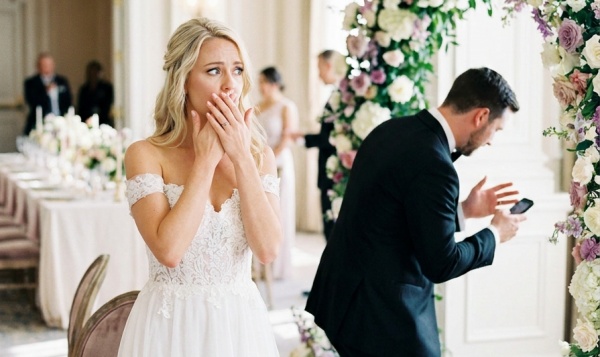
He whispered “I love you” to his mistress a few minutes before our wedding—and then I walked down the aisle doing the unthinkable in front of everyone.
He smiled at me from the altar like nothing was wrong, like I hadn’t just heard every word. He thought my silence meant obedience, and that my wedding dress would keep me trapped in the role he wrote for me. But when the pastor asked if anyone objected, I…
Part 1: The Perfect Morning That Wasn’t
By 9:00 a.m., the bridal suite smelled like hairspray, vanilla candles, and panic disguised as excitement. My best friend, Lauren, was kneeling on the carpet in her satin robe, trying to steam a wrinkle out of my veil while my mother stood by the window pretending not to cry into her coffee. Outside, the October sun was rising over Charleston, South Carolina, turning the harbor gold like it had been hired for the occasion.
I had imagined that morning for years. Not the expensive parts, not the flowers or the string quartet or the three-tier almond cake with buttercream roses, but the feeling. I imagined waking up certain, peaceful, full of the kind of joy women in wedding magazines always seemed to have.
Instead, my stomach felt like it was tied in a knot.
Everyone told me nerves were normal. “Cold feet are part of it,” my aunt Diane said while fastening her pearl earrings. Lauren said, “You’re about to make a life-changing commitment. If you weren’t nervous, I’d be worried.” Even my mom squeezed my hand and whispered, “Honey, marriage is big. It’s okay to feel overwhelmed.”
So I smiled. I nodded. I let the makeup artist dust powder under my eyes and call me “the calmest bride she’d ever seen.” Calm was easy to fake when you had spent the last year doing it.
My fiancé, Daniel Whitaker, was charming in the way Southern men are trained to be charming. He opened doors, remembered people’s names, called my mother “ma’am,” and sent flowers to my office after arguments. He was a commercial real estate broker with perfect teeth, polished shoes, and the kind of confidence that made strangers trust him before he earned it.
We met at a charity fundraiser in Savannah three years earlier. I was working for a nonprofit that helped families facing medical debt, and he was there because his company had sponsored a table. He told me he admired women who cared about something bigger than themselves, and I was too flattered to notice how practiced the line sounded.
For a long time, he made me feel chosen. He left little notes on my windshield. He drove forty minutes across town because I once mentioned craving shrimp and grits from a restaurant near the Battery. He proposed on Folly Beach at sunset with both our families hiding behind the dunes, holding champagne and phones.
People cried when I said yes.
The thing about being loved publicly is that it can make it harder to admit when you are being hurt privately.
Daniel never hit me. He never screamed at me in a way that would make a neighbor call the police. His cruelty was softer, more polished, easier to explain away. He corrected my stories at dinner. He told me my job was “sweet” but not serious. He said my friends were too dramatic, my dresses were too modest, my laugh was too loud when I had two glasses of wine.
And I adjusted.
I became a woman who checked herself before speaking. I stopped telling certain jokes. I stopped wearing my favorite red lipstick because he said it made me look “like I was trying too hard.” I told myself compromise was part of love.
Two months before the wedding, I found a receipt in his truck from a boutique hotel downtown. One room, one night, $318.42. He said he had booked it for a client who flew in from Atlanta, and when I asked why he used his personal card, he kissed my forehead and said, “Em, you’re exhausted. Don’t let wedding stress turn you into someone suspicious.”
That sentence embarrassed me into silence.
Three weeks later, I saw a text pop up on his phone while he was in the shower.
Can’t stop thinking about last night.
No name. Just a number.
When I asked him about it, he laughed. “It’s one of the guys from work messing around. You know how immature they are.” Then he looked disappointed, which was worse than anger. “Are we really doing this right before our wedding?”
So I apologized.
That is the part I hate remembering most. Not that he lied. Not that he cheated. But that I apologized for noticing.
On the morning of my wedding, I sat in front of the mirror wearing a white silk robe with Mrs. Whitaker embroidered on the back in gold thread. My mother had paid $95 for it on Etsy because she thought it would make a beautiful keepsake. I stared at those words in the reflection and felt like I was looking at a label someone had already sewn onto my future without asking if it fit.
Lauren touched my shoulder. “You okay?”
I wanted to say no. I wanted to say something inside me had been whispering for months, and I was tired of forcing it quiet.
Instead, I said, “I just need a minute.”
The venue was an old restored chapel attached to a garden hall. The bridal suite sat at one end of a narrow hallway, the groom’s room at the other. Guests were already arriving, their laughter floating through the walls, mixed with the soft tuning of violin strings.
I picked up my bouquet and set it down again. White roses, baby’s breath, eucalyptus. Beautiful. Expensive. Fragile.
Then my phone buzzed.
It was a message from Daniel.
Can’t wait to see you at the altar, beautiful. Today is the first day of forever.
I stared at it until the words blurred.
A year earlier, that message would have made me cry happy tears. That morning, it felt like reading a line from a commercial.
I slipped out of the bridal suite without telling anyone. I told myself I needed air. Just thirty seconds in the hallway, maybe a sip of water, maybe one quiet moment before I became someone’s wife.
Halfway down the hall, I heard Daniel’s voice.
At first, I smiled out of instinct. Then I stopped.
He was in the small side room near the chapel entrance, the one the venue coordinator used to store extra programs and emergency candles. The door was partly open. I could see his black dress shoes, the edge of his tuxedo pants, and a woman’s nude heels beside him.
Then I heard him whisper, low and warm, in the exact voice he used when he wanted me to feel safe.
“I love you.”
My hand tightened around the wall.
A woman laughed softly. “You shouldn’t say that today.”
“I mean it,” Daniel said. “Just get through the ceremony. I’ll handle Emily.”
The room tilted.
Emily.
Not my bride. Not my future wife.
Emily, like a problem on his calendar.
The woman said, “You promised this wouldn’t drag on forever.”
“It won’t,” he replied. “After the honeymoon, I’ll figure it out. I can’t walk away now. Do you have any idea what my father would do if I embarrassed the family today?”
A pause.
Then she asked, “So you’re marrying her for appearances?”
Daniel sighed. “For now.”
Those two words cracked something open in me.
For now.
I stepped back before they could see me. My heart pounded so hard I thought the walls could hear it. I walked to the nearest restroom, locked myself in a stall, and pressed both hands over my mouth.
I did not scream.
I did not faint.
I did not run.
I stood there in my wedding dress, breathing in the smell of lemon soap and old wood, and realized my life had just split in two.
There was the woman who had walked into that hallway believing she was nervous.
And there was the woman who walked out knowing she had been warned.
Part 2: Ten Minutes to Decide My Life
When I returned to the bridal suite, Lauren took one look at my face and shut the door behind me.
“What happened?” she asked.
My mother turned away from the window. “Emily?”
I opened my mouth, but nothing came out. It was as if the words were too large to fit through my throat. Finally, I whispered, “Daniel is with someone.”
The room went still.
A bridesmaid dropped a lipstick tube onto the vanity, and the tiny clatter sounded obscene in the silence. My mother’s face changed slowly, like she was trying to understand a language she had never wanted to learn. Lauren stepped closer and took my hands.
“What do you mean, with someone?”
“I heard him,” I said. “In the storage room. He told her he loved her. He said he’d handle me after the honeymoon.”
My mother sat down hard on the edge of the couch.
Lauren’s eyes sharpened. “Who?”
“I don’t know.”
But I did know. Not with proof, not yet, but with the sick certainty women are often told not to trust.
Madison Hale.
Daniel’s “family friend.” His father’s assistant. The woman who had been “like a sister” to him since college, even though no sister I knew wore backless dresses to rehearsal dinners and touched a man’s tie while talking to his fiancée.
Madison had been everywhere during the wedding planning. She recommended the florist. She knew the venue owner. She told me which country club members had to be seated far from each other because of “old drama.” I thought she was helping me because she cared about Daniel’s family.
Now I understood she had been helping arrange a stage.
Lauren grabbed my phone. “We are leaving.”
My mother nodded quickly. “Yes. We’ll go out the back. I’ll get your father.”
I looked at them both, these women who loved me enough to rescue me without asking for details, and for one moment I almost said yes. I imagined taking off the dress, getting into my father’s truck, driving home barefoot while guests whispered behind us.
But then I pictured Daniel standing in front of everyone with his tragic groom face, telling people I panicked. I could hear the story forming already. Emily was unstable. Emily had doubts. Emily embarrassed both families. Poor Daniel, left at the altar by a woman who couldn’t handle commitment.
Men like Daniel rarely needed to destroy women loudly. They just handed people a version of the truth that made themselves look reasonable.
“No,” I said.
Lauren blinked. “No?”
“I’m not sneaking out of my own wedding like I did something wrong.”
My mother’s voice shook. “Honey, you don’t have to prove anything.”
“I know,” I said. “But I’m done letting him write the story.”
The ceremony was supposed to start in fifteen minutes.
Fifteen minutes to decide whether I would disappear quietly or stand in the center of the room he had helped build and tear the lie down board by board.
My hands stopped shaking.
“Lauren,” I said, “go find the photographer.”
“What?”
“Tell her to stay ready. Not obvious. Just ready.”
Lauren stared at me for a second, then nodded like she understood something before I fully did.
“Mom,” I said, turning to her, “I need Dad.”
My father arrived two minutes later, red-eyed and broad-shouldered in his navy suit. He had spent the morning pretending he was fine, cracking jokes about how he wasn’t losing a daughter, he was gaining a son-in-law who better learn how to change his own oil. When he saw me, his smile vanished.
“What did he do?” he asked.
That was my father. No hesitation. No demand for proof. Just a quiet readiness that made me feel eight years old and safe.
I told him.
His jaw tightened, and for a terrifying second I thought he might walk down the hall and make the whole thing physical. I grabbed his arm.
“Dad, don’t.”
He looked at me, breathing hard. “Tell me what you need.”
“I need you to walk me down the aisle.”
His face broke. “Emily.”
“I’m not marrying him,” I said. “But I am walking in.”
My mother covered her mouth.
Lauren whispered, “Are you sure?”
No, I wasn’t sure. I was heartbroken, humiliated, furious, and still somehow grieving the wedding that had died before it began. But beneath all of that was something steadier than certainty.
Self-respect.
The venue coordinator knocked gently and opened the door. “Emily? We’re ready whenever you are.”
Everyone looked at me.
I stood in front of the mirror and saw myself clearly for the first time all day. Not Mrs. Whitaker. Not Daniel’s future wife. Not the sweet nonprofit girl lucky enough to marry into a powerful Charleston family.
Just Emily Rose Carter.
Thirty-one years old.
Daughter of Linda and Thomas Carter.
Woman who had been lied to, but not defeated.
I picked up my bouquet. “Let’s go.”
The hallway felt longer than it had before. Every step made the lace of my dress whisper against the floor. My father held my arm with one hand and clenched his other fist so tightly his knuckles were white.
At the chapel doors, the music began.
The wedding march.
I almost laughed.
Behind those doors were one hundred and forty-three guests, including Daniel’s parents, my grandparents, coworkers, cousins from Tennessee, college friends, and people whose names I only half remembered because weddings have a way of turning social obligations into place cards.
At the end of the aisle stood Daniel, wearing a tuxedo I helped him choose.
And somewhere among the guests, I knew Madison was sitting with her perfect hair and her careful smile, waiting for me to become the fool.
The chapel doors opened.
Everyone stood.
I lifted my chin.
And I walked.
Part 3: The Aisle Felt Like a Courtroom
The first thing I noticed was how beautiful everything looked. The white flowers tied to the pews. The candles flickering along the aisle. The sunlight spilling through stained glass in soft blue and amber patches across the floor.
It was almost cruel, how lovely a lie could be when enough money had been spent decorating it.
Daniel smiled when he saw me. For half a second, I saw relief in his face, as if he had been afraid I might have heard something and was grateful I was still playing my part. Then he looked proud.
That almost undid me.
Not guilt. Not fear. Pride.
He believed I belonged to him so completely that I could walk toward him carrying the truth and he still mistook it for obedience.
My father and I moved slowly. Guests smiled through tears. Someone whispered, “She looks stunning.” My cousin snapped a photo. Daniel’s mother dabbed at her eyes with a monogrammed handkerchief.
Madison sat in the third row on the groom’s side.
Of course she did.
She wore champagne silk, not white, but close enough to make a point. Her eyes were fixed on Daniel until she noticed me looking at her. Then she smiled.
A tiny smile.
A private one.
That smile became the nail in the coffin of my silence.
When we reached the altar, my father did not immediately give me away. The officiant, Pastor Bennett, smiled kindly and said, “Who gives this woman to be married to this man?”
My father’s voice was low. “She gives herself.”
A murmur rippled through the front rows.
Daniel’s smile faltered.
I squeezed my father’s hand once, then stepped forward. He kissed my cheek and sat beside my mother, who was crying openly now.
Pastor Bennett began with the usual words about love, commitment, patience, and faithfulness. Each word landed like a stone dropped into water. Faithfulness. Honesty. Covenant.
Daniel reached for my hands.
I let him take them.
His palms were warm. Mine were cold.
He leaned in slightly and whispered, “You look incredible.”
I looked at him and wondered how many women had mistaken compliments for character.
Pastor Bennett turned to the congregation. “Marriage is not to be entered into lightly, but reverently, thoughtfully, and with full understanding of the promises being made today.”
Full understanding.
I almost smiled.
The pastor continued, “If anyone here has reason why these two should not be joined in marriage, let them speak now or forever hold their peace.”
There it was.
The sentence people joke about but never expect anyone to use.
A hush settled over the chapel.
I took one breath.
Then I said, clearly, “I do.”
Gasps.
Not one, but many, sharp and overlapping.
Daniel’s hands tightened around mine. “Emily,” he whispered, warning threaded through my name.
I gently pulled my hands away.
Pastor Bennett froze. “Emily?”
I turned to face the guests. My knees were shaking beneath the dress, but my voice came out steadier than I felt.
“I’m sorry to interrupt,” I said. “I know many of you traveled far to be here. I know my parents, Daniel’s parents, and a lot of people we love spent money, time, and energy on this day. I wish I could stand here and pretend this is a misunderstanding, but I can’t.”
Daniel said through his teeth, “Don’t do this.”
I looked back at him. “You did this.”
The chapel went silent in a way I had never heard before. Even the baby in the back stopped fussing.
I turned again to the room.
“Minutes before this ceremony, I heard Daniel in a side room with another woman,” I said. “He told her he loved her. He told her he would handle me after the honeymoon. He said he was marrying me for now.”
Daniel’s mother made a sound like she had been slapped. His father stood halfway, then sat down again.
Madison’s face went pale.
Daniel stepped toward me. “Emily, stop. You misunderstood.”
I laughed once, softly, not because anything was funny but because that was always his first move. Confuse the woman. Make her doubt the obvious. Turn her own ears into unreliable witnesses.
“I heard you,” I said.
His expression hardened. “This isn’t the place.”
“No,” I replied. “This was never the place for your lies. But you brought them here anyway.”
A murmur moved through the crowd. My aunt Diane whispered something that sounded like a prayer. Lauren stood near the side aisle with the photographer behind her, both watching like the world had slowed down.
I did not name Madison.
Not yet.
That was not mercy. It was strategy. I refused to turn myself into a screaming bride pointing across a chapel while Daniel played calm victim. I wanted every person in that room to focus on the only thing that mattered: the man at the altar had built a marriage proposal on deception.
Daniel lifted both hands. “Everyone, please. Emily is emotional. She’s under a lot of stress.”
There it was.
The burial began.
Not of his body.
Of his performance.
I turned to the guests and said, “For the past year, whenever I asked Daniel reasonable questions, he told me I was stressed. When I found a hotel receipt, he told me I was suspicious. When I saw a message on his phone, he told me I was imagining things. And now, standing in front of all of you, after I heard him say the words myself, he is calling me emotional.”
Several women in the room shifted.
I saw recognition on their faces.
That quiet, terrible recognition.
Daniel looked around, suddenly realizing the room was no longer automatically his.
“Emily,” he said, softer now. “Please. Let’s talk privately.”
“Why?” I asked. “So you can convince me not to trust myself?”
His jaw clenched.
I looked at Pastor Bennett. “I’m sorry to involve you in this. But I cannot marry him.”
The pastor swallowed, then nodded slowly. “I understand.”
Daniel’s father stood. “Son?”
Daniel turned toward him. “Dad, I can explain.”
His father’s face was red. “Then explain.”
Daniel opened his mouth.
Nothing came out.
For the first time since I had known him, the room did not rush to fill the silence for him.
Part 4: The Woman in the Third Row
I could have walked away then. Honestly, I probably should have. I had said enough to stop the wedding, enough to protect myself, enough to make sure no one could say I simply panicked.
But Madison stood.
Maybe she thought leaving quietly would make her look guilty. Maybe she wanted to reclaim control. Maybe she believed Daniel would defend her if she forced the moment.
She smoothed her dress and said, “This is cruel, Emily.”
Every head turned.
There are moments in life when a person accidentally confesses by speaking before anyone accuses them.
I looked at her. “I didn’t say your name.”
Her lips parted.
Daniel whispered, “Madison, sit down.”
Too late.
The sound that moved through the chapel was not a gasp this time. It was heavier, more complicated. Recognition. Judgment. The collective rearranging of a story people thought they understood.
Madison’s mother, seated near the aisle, stared at her daughter like she had never seen her before.
Madison lifted her chin. “You’re humiliating everyone.”
“No,” I said. “I’m refusing to be humiliated alone.”
Daniel took another step toward me. My father stood immediately. He did not move into the aisle, did not raise his voice, did not threaten anyone. He just stood, and that was enough.
Daniel stopped.
I turned toward the guests one last time.
“I want to be very clear,” I said. “I am not asking anyone to hate Daniel. I am not asking anyone to attack Madison. I am not asking for a scene beyond the one that already exists. But I am asking every person here to understand that I will not begin a marriage by pretending betrayal is love.”
My voice cracked on the final word.
For the first time, I nearly lost composure. Not because of Daniel. Because I saw my grandmother in the second row crying into a tissue, and I thought about how excited she had been to see me marry “such a nice young man.”
Nice.
That word had fooled generations of women.
I handed my bouquet to Lauren, who had moved closer without me noticing.
Then I reached behind my neck and unclasped the delicate gold necklace Daniel had given me at our engagement party. A small diamond pendant, tasteful and expensive. He once told me it symbolized “forever.”
I placed it on the altar table.
Daniel stared at it. “Emily, don’t.”
I removed my engagement ring next.
The diamond caught the light one last time, bright and cold. I remembered the night he proposed, how everyone cheered, how I cried against his chest while cameras flashed. I remembered thinking love had finally made sense.
I set the ring beside the necklace.
“Your forever was conditional,” I said. “Mine isn’t for sale.”
Then I turned and walked back down the aisle alone.
Nobody clapped. This was not a movie. People were too stunned, too uncomfortable, too aware that they had just witnessed a life change shape in real time.
But as I passed the fourth row, my aunt Diane stood.
Then Lauren’s mother.
Then my college roommate.
Then Daniel’s older sister, which surprised everyone most of all.
One by one, people stood. Not cheering. Not celebrating. Just standing.
A quiet wall of witness.
My mother met me halfway down the aisle and wrapped her arms around me. I held myself together until I felt her hand on the back of my head, the way she used to comfort me when I was little. Then I cried.
Not delicate bridal tears.
Real ones.
The kind that make your chest hurt.
My father joined us, then Lauren, and somehow they moved me out of the chapel and into the garden hall, where the reception tables were waiting with gold chargers, folded napkins, and little jars of local honey labeled Emily & Daniel — Sweet Beginnings.
I stared at one of the jars and laughed through tears.
Lauren picked it up. “Well, that aged badly.”
That laugh saved me.
Within twenty minutes, the wedding had become something else. Guests lingered in clusters, whispering, hugging me, avoiding Daniel’s family, or pretending to examine floral arrangements because nobody knew what to do with their hands. The caterers stood near the kitchen looking terrified.
My mother, practical even in heartbreak, found the venue manager. “The food is paid for,” she said. “The bar is paid for. We are not wasting it.”
So we didn’t.
That afternoon, instead of a wedding reception, we held what my cousin later called “the most emotionally complicated dinner in South Carolina history.”
People ate crab cakes and roasted chicken under chandeliers while the groom disappeared into a private room with his parents and the other woman. My father made sure Daniel’s side of the family could leave discreetly if they wanted. Some did. Some stayed, especially the ones who had always liked me more than they liked the family reputation.
At 3:00 p.m., I changed out of my wedding dress.
Lauren helped me into the navy jumpsuit I had packed for our honeymoon flight to Hawaii. When she zipped it up, she looked at me in the mirror and said, “You look like yourself again.”
I did.
A tired, devastated version of myself.
But myself.
Downstairs, my brother had asked the DJ to stop playing romantic songs. Instead, soft Motown filled the room. My grandmother requested “Ain’t No Mountain High Enough,” and nobody argued with a woman who had survived two hip replacements and one cheating husband of her own.
Later, Daniel found me near the garden fountain.
His bow tie was undone. His hair, usually perfect, had fallen across his forehead. He looked less like a groom and more like a man who had lost control of the room and could not understand why charm had stopped working.
“Emily,” he said.
I turned but did not step closer.
“I’m sorry,” he said. “I made a mistake.”
“A mistake is forgetting the rings,” I replied. “A mistake is ordering chicken for someone who requested salmon. This was a choice. Many choices.”
He flinched.
“I panicked,” he said. “Everything got so serious, and Madison was there, and—”
“Don’t blame seriousness for your lack of character.”
His face hardened again. The apology mask slipped. “You didn’t have to humiliate me like that.”
There he was.
The real Daniel.
Not sorry he had hurt me. Sorry people knew.
I nodded slowly. “And you didn’t have to lie to me all the way to the altar.”
He looked past me toward the reception hall. “My father is furious.”
“I imagine he is.”
“My mother won’t speak to Madison.”
“That sounds like a family issue.”
He stared at me. “You’re being cold.”
“No,” I said. “I’m being finished.”
For a moment, he looked genuinely confused, as if he had never considered that a woman could stop loving him and survive it.
Then he said the thing men like him always say when apology fails.
“You’ll regret this.”
I smiled sadly. “Daniel, I almost married you. That was the regret.”
I walked away before he could answer.
Part 5: After the Burial
The story spread faster than I expected.
By Monday morning, half of Charleston seemed to know some version of it. Some people called it brave. Some called it dramatic. One woman from Daniel’s parents’ church said I should have handled it privately, which made me wonder how many women had been taught to protect the people who humiliated them.
I did not post about it online.
Not because I was ashamed, but because I had learned something at the altar: truth does not need to become entertainment to be real. I told the people who loved me. I let everyone else sit with whatever version they had earned.
The legal part was easier than divorce would have been. We were not married. No shared house. No children. No court battle over custody or property. There were contracts, deposits, and awkward conversations with vendors, but those were problems with receipts and deadlines, not vows and lawyers.
Emotionally, it was a wreck.
For weeks, I woke up reaching for a future that no longer existed. I would remember small things at random times: the honeymoon itinerary saved in my email, the thank-you cards stacked on my desk, the way Daniel used to put his hand on my lower back when guiding me through a room. Grief is strange that way. It does not only mourn what was good. It mourns what you hoped would become good if you loved harder.
Madison sent me a message once.
I never meant for it to happen this way.
I stared at it while sitting in my car outside Trader Joe’s with a bag of groceries melting in the trunk.
Then I deleted it.
Not every message deserves a response. Some people want forgiveness before they have even admitted the size of the wound.
Daniel called several times. I didn’t answer. He emailed too, long paragraphs about confusion, pressure, family expectations, fear of disappointing people, and how he had “lost himself.” The emails were beautiful in the way Daniel could make anything beautiful when beauty benefited him.
I forwarded them to a folder labeled Do Not Reopen.
Lauren came over every Friday for two months with takeout and terrible reality TV. My mother helped me return gifts and cried harder over the monogrammed towels than I did. My father quietly canceled the joint fishing trip he had planned with Daniel and never mentioned it.
One Sunday, my grandmother asked me to drive her to church.
I braced myself for whispers, but most people were kind. A few hugged me too tightly. A few avoided eye contact. After the service, an older woman named Mrs. Patterson touched my arm and said, “I wish I had done what you did in 1978.”
That stayed with me.
Because the more women I spoke to, the more I realized my story was not rare. The aisle was dramatic, yes. The timing was public, yes. But the betrayal itself? The doubting of instincts? The slow shrinking of a woman inside a relationship?
That was everywhere.
Six months later, I moved into a smaller apartment downtown with exposed brick walls, uneven floors, and windows that rattled when delivery trucks passed. It was not as impressive as the house Daniel and I had planned to buy in Mount Pleasant. But every single thing in it belonged to me.
I bought red lipstick again.
The first time I wore it to work, my coworker Angela said, “That color was made for you.”
I almost cried in the office bathroom.
Healing did not arrive like a lightning strike. It came in small, almost boring moments. Sleeping through the night. Going to dinner alone and enjoying my own company. Laughing without checking whether someone thought I was too loud. Rebuilding my savings after wedding expenses drained more than I liked to admit.
I also went back to therapy.
My therapist, Dr. Reeves, asked me one day what hurt most.
I expected to say the cheating. Or the humiliation. Or hearing him say “I love you” to someone else minutes before promising forever to me.
Instead, I said, “That I almost didn’t trust myself.”
She nodded like she had heard that before.
“You did trust yourself,” she said. “You just wish you had done it sooner.”
That was true.
But I no longer punish the woman who stayed as long as she did. She was not stupid. She was hopeful. She was trying to build a life with someone who kept moving the foundation when she wasn’t looking.
A year after the wedding that wasn’t, Lauren insisted we mark the date. I told her I didn’t want a pity party. She said, “Good, because I’m planning a survival party.”
We invited twelve friends to a rooftop bar overlooking the water. I wore a green dress, gold earrings, and the red lipstick Daniel hated. My mother sent flowers with a card that said, To the daughter who walked herself home.
At sunset, Lauren raised a glass.
“To Emily,” she said. “Who buried a lie before it could become a marriage.”
Everyone cheered.
I laughed, but my throat tightened.
Because that was exactly what happened.
I did not bury Daniel. I did not destroy him. I did not ruin his life. His choices belonged to him, and the consequences followed him like unpaid bills.
What I buried was the version of myself who believed love required silence.
I buried the fear that being embarrassed publicly was worse than being betrayed privately.
I buried the future he had designed for me without honesty, respect, or consent.
And in that same ground, something else started growing.
A woman who listens to her instincts.
A woman who does not confuse charm with devotion.
A woman who can stand in front of a room full of people, heart breaking beneath lace and silk, and still choose herself.
Sometimes people ask if I regret walking down the aisle.
I don’t.
Walking down that aisle was the last thing I ever did for Daniel and the first thing I ever did fully for myself.
If I had run, he would have owned the story.
Because I walked, I reclaimed it.
And if there is one thing I know now, it is this: when someone builds a beautiful life for you out of lies, you do not have to live inside it just because other people admire the view.
You are allowed to open the door.
You are allowed to step out.
You are allowed to let the whole thing collapse behind you.
And sometimes, when the dust settles, you realize the wreckage was never your ending.
It was your escape.
