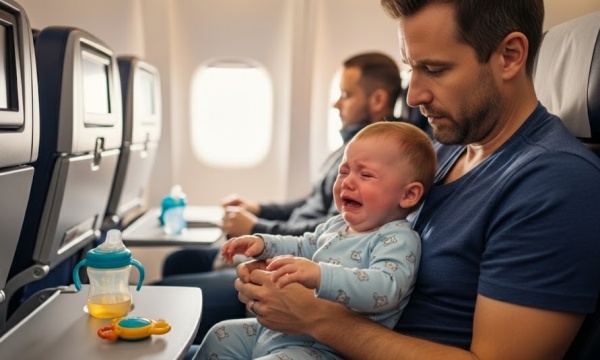
THE BABY WOULDN’T STOP CRYING ON THE PLANE. EVERY PASSENGER ROLLED THEIR EYES. THEN A WOMAN IN SEAT 12A STOOD UP AND DID SOMETHING NO ONE EXPECTED.
HE WAS A SINGLE DAD FLYING ALONE WITH HIS 8-MONTH-OLD FOR THE FIRST TIME — THREE MONTHS AFTER BURYING HIS WIFE.
When she took that baby from his shaking hands and the crying stopped, the whole cabin went silent. What happened next — over the following two hours at 35,000 feet — neither of them saw coming.
Now. Let me tell you about Flight 2247 from Chicago O’Hare to Charlotte Douglas — and the two strangers who sat down as seatmates and landed as something neither of them had a word for yet.
PART 1: THE MAN IN SEAT 14C
His name was Mark Calloway. He was thirty-two years old, and he was the kind of tired that sleep doesn’t fix.
Not the tired that comes from a bad night or a long week — the other kind. The kind that settles into your bones after months of operating on three hours a night, of waking at 2 AM to a crying infant in the dark, of lying in a bed that is too large and too quiet on the side that used to be someone else’s, of getting up anyway because there is a small person who needs you to get up and you are the only one left to do it.
Mark had been that kind of tired since January, when his wife Rachel died of a pulmonary embolism at thirty-one years old, four months after giving birth to their daughter Lily. She had been healthy. She had been fine. And then she was not, and then she was gone, and Mark had been left standing in the hallway of Northwestern Memorial Hospital in Chicago with a four-month-old daughter and a grief so large he could not find the edges of it.
He had spent the following months in their apartment in Wicker Park — the one with the exposed brick and the bay window where Rachel used to sit and read — trying to figure out how to be both parents at once. He had taken family leave from his job as a project coordinator at a mid-size logistics firm on the Near North Side. He had called his mother every day. He had watched approximately four hundred YouTube videos about infant sleep schedules and none of them had helped.
His sister, Dana, lived in Raleigh, North Carolina. She had a house with a spare bedroom and a husband who worked from home and two kids of her own who were old enough to be useful and young enough to still think babies were exciting. She had called Mark in February and said: “Come here. Just come. You don’t have to figure this out alone.”
It had taken him three months to say yes. Not because he didn’t want to — but because saying yes meant leaving Chicago, and leaving Chicago meant leaving the apartment with the bay window, and leaving the apartment meant accepting, in some final and physical way, that Rachel was not coming back to it.
He said yes in April. He packed what fit in a moving pod, sold the rest, gave notice on the apartment, and booked two seats on American Airlines Flight 2247 from O’Hare to Charlotte Douglas International — one for himself, one for Lily, who at eight months old was small enough to sit in a lap seat but large enough to have opinions about everything.
He had been awake since 4 AM. The flight was at 7:15. He had packed the diaper bag with the systematic thoroughness of a man who had learned, through repeated failure, that under-preparation with an infant is not an option: three changes of clothes, two bottles of formula, the pacifier she liked and the backup pacifier she tolerated, the small stuffed bear named Biscuit that Rachel had picked out at a shop on Armitage Avenue before Lily was born, two board books, a travel-size white noise machine, and enough wipes to supply a small daycare.
He had thought of everything.
He had not thought of the ear pressure.
PART 2: WHEN EVERYTHING FELL APART AT 35,000 FEET
The wheels left the ground at 7:28 AM, and Lily was fine for approximately four minutes.
Then the cabin pressure shifted as the plane climbed, and Lily’s face went from peaceful to confused to furious in the span of about eight seconds, and she opened her mouth and produced a sound that Mark had never heard her make before — raw and panicked and high, the cry of a small person experiencing something she had no framework for and no way to communicate except volume.
Mark tried the bottle. She pushed it away.
He tried the pacifier. She spit it out.
He tried Biscuit the bear. She threw him on the floor of the aisle.
He tried rocking, bouncing, swaying, whispering, singing the fragment of a lullaby he could half-remember from his own childhood. He tried holding her facing out. He tried holding her against his chest. He tried standing in the narrow space between his seat and the one in front of him, which was not really enough space to stand in, and swaying back and forth until the man in 13C turned around with an expression that communicated, without words, that he would prefer Mark to sit back down.
The whispers started around the third minute.
Seriously, can’t he control his kid?
This is why babies shouldn’t be allowed on planes.
I paid for the early boarding upgrade for this?
Mark heard every word. He was not angry — he did not have the energy for anger. He was just exhausted and failing in public, which is its own specific kind of pain. He could feel his eyes burning. He mouthed I’m sorry to the row across from him, and the woman in the window seat put her AirPods in and turned toward the glass.
Lily’s face was red. Her fists were curled tight against her chest. She was crying so hard she was hiccupping between screams, her whole small body shaking with the effort of it.
I’m sorry, baby, Mark thought, holding her tighter. I don’t know what you need. I’m trying. I don’t know what you need.
He had thought that a lot, in the months since January. He thought it at 3 AM when she wouldn’t sleep. He thought it at the pediatrician’s office when he couldn’t remember the answer to the question the doctor was asking. He thought it in the grocery store in the baby aisle, standing in front of forty-seven varieties of formula, completely unable to choose.
He thought it now, at 35,000 feet, with a cabin full of strangers sighing around him, holding his daughter against his chest and feeling, for the hundredth time since Rachel died, like he was doing this wrong.
He did not see the woman in 12A stand up.
PART 3: THE WOMAN WHO STOOD UP
Her name was Emily Navarro. She was thirty-four years old, and she was on her first solo trip in four years.
Her son, Marco, was four — old enough, finally, to spend a long weekend with her parents in Naperville without Emily spending the entire time convinced something was wrong. Her mother had practically pushed her out the door. Go, she had said. Sleep. Read a book. Remember you’re a person.
Emily was flying to Charlotte to visit a college friend who had moved there two years ago and who had been asking her to visit ever since. She had a window seat, a carry-on with actual adult clothes in it instead of snacks and wipes and a change of toddler pants, and a novel she had been trying to finish for six months. She had been looking forward to this flight the way you look forward to something when you have not had a quiet hour in four years.
She had heard Lily start crying before the seatbelt sign went off.
She had not immediately stood up. She had looked back, the way you look back when you hear a baby cry — instinctively, automatically — and she had seen Mark in 14C, his face red, his hands shaking, the baby pressed against his chest. She had seen the way his shoulders were hunched inward, the posture of a person trying to make himself smaller, trying to apologize for taking up space.
She had seen that posture before. She had worn it herself, in the pediatrician’s waiting room when Marco had a meltdown at eighteen months, in the grocery store when he knocked over a display of soup cans, in every public place where her son had been loud or inconvenient and strangers had looked at her the way strangers were looking at Mark now.
She knew what it felt like to be that person. She knew what it felt like to be failing in public with a small child and no backup.
She put her novel face-down on the tray table.
She stood up.
She was not entirely sure, later, that she had made a conscious decision. It felt more like her body had decided before her brain caught up — the way you reach out to catch something before you’ve thought about catching it. She walked down the aisle toward 14C, past the sighing passengers and the turned heads and the woman who muttered oh, now what under her breath, and she stopped beside Mark and waited until he looked up.
“Hi,” she said. She kept her voice soft, careful not to startle him. “I’m a mom too. Do you need a hand?”
Mark blinked. For a moment, his expression cycled through surprise and embarrassment and something that looked like relief fighting against pride — the specific conflict of a person who needs help and is not sure they are allowed to accept it.
“I don’t know what to do,” he said. His voice was barely above a whisper. “She’s never cried like this before.”
“The ear pressure,” Emily said. “It hits some babies really hard on the climb. It usually eases up once we level off, but that can take a few minutes.” She paused. “May I hold her?”
From the row behind, someone scoffed. What, she thinks she’s the baby whisperer or something?
Emily did not look back. She kept her eyes on Mark, giving him time, not rushing him.
His hands were trembling when he passed Lily to her.
PART 4: A FRESH HEARTBEAT
What happened next, the passengers in the surrounding rows would describe differently depending on who you asked.
The man in 13C, who had turned around twice to give Mark pointed looks, said later that it was like someone had turned a dial. The woman in 14A, who had been pressing her noise-canceling headphones harder against her ears, said she noticed the silence before she understood what had caused it. The flight attendant working the rear galley, a woman named Diane who had been on the job for nineteen years and had seen a great many things at altitude, said it was one of the quieter miracles she had witnessed in the air.
Emily held Lily against her chest — not differently than Mark had held her, not with any special technique that required instruction — but with the particular quality of calm that belongs to a person who is not afraid of the crying. She was not tense. She was not embarrassed. She was not scanning the cabin for other people’s reactions. She was just present, fully and completely, swaying gently in the narrow aisle with the unhurried rhythm of someone who has spent four years learning that babies can feel the difference between held-with-anxiety and held-with-peace.
She hummed. Something low and formless, not quite a song — just sound, steady and warm.
Lily’s cries softened.
Then slowed.
Then, with one long shuddering breath that seemed to come from somewhere deep in her small chest, stopped.
The cabin went quiet.
Mark stared. His mouth was slightly open. His shoulders, which had been locked up around his ears for the better part of forty minutes, dropped — slowly, like something releasing that had been held too tight for too long.
Emily looked at him over Lily’s head and smiled. “Babies can feel their parents’ stress,” she said quietly. “Sometimes they just need a fresh heartbeat.”
She did not return to her seat. Not for a long time.
She walked slowly up and down the aisle — past the overhead bins and the drink cart that Diane had paused mid-service to watch — keeping Lily comfortable, humming, swaying, while Mark sat in 14C with his face in his hands.
Not crying, exactly. Or maybe crying. He was past the point of being sure.
After a few minutes, Diane appeared at his elbow with a cup of water and a small bag of pretzels and the expression of a woman who has seen enough of human life to know when someone needs to be handed something without being asked. “You doing okay, hon?” she said.
Mark looked up. “I think so,” he said. “Yeah. I think so.”
PART 5: TWO HOURS AT 35,000 FEET
When Lily finally fell asleep — deeply, completely, the boneless sleep of an infant who has exhausted herself — Emily carried her back to 14C and settled into the empty middle seat beside Mark without asking, because Lily was asleep on her shoulder and moving seemed inadvisable.
“I’m Emily,” she said.
“Mark,” he said. “I owe you more than I know how to say.”
“You don’t owe me anything,” she said. “I have a four-year-old. I know what this looks like from the inside.”
They talked for the rest of the flight.
Not the careful, surface-level conversation of strangers on a plane — the weather, the destination, the polite exchange of information that goes nowhere. The other kind. The kind that happens when two people have just been through something together and the usual social scaffolding has been bypassed entirely.
He told her about Rachel. Not the whole story — not yet — but enough. He told her about the apartment in Wicker Park and the bay window and the stuffed bear named Biscuit that Rachel had picked out before Lily was born. He told her about his sister Dana in Raleigh and the spare bedroom and the decision to leave Chicago, and how the decision had felt like both the right thing and the hardest thing at the same time.
Emily listened the way people listen when they are not waiting for their turn to talk. She asked questions that were not intrusive — the kind of questions that open a door without pushing through it.
She told him about Marco. About the four years of single parenthood in a two-bedroom apartment in Lincoln Square, about her parents in Naperville who showed up every time she needed them and some times she didn’t know she needed them. About the friend in Charlotte she was going to visit and the novel she had been trying to finish for six months and the strange, slightly guilty feeling of sitting on a plane without a car seat next to her.
“Does it get easier?” Mark asked at one point. He was looking at Lily, asleep on Emily’s shoulder, her small fist curled against Emily’s collarbone.
Emily thought about it for a moment. “It gets different,” she said. “Some parts get easier. Some parts you just get better at carrying.” She paused. “But the part where you feel like you’re doing it wrong — that part does get quieter. I promise.”
Mark nodded. He looked out the window at the clouds below them, white and flat and endless.
“She looked like Lily,” he said, after a moment. “Rachel. Same nose.”
Emily didn’t say anything. She just shifted Lily slightly on her shoulder so the baby was more comfortable, and she let the silence be what it was.
The fasten seatbelt sign came on as they began their descent into Charlotte Douglas. Lily stirred, blinked, looked up at Emily with the calm, curious expression of a baby who has woken somewhere unfamiliar and decided, provisionally, that it is acceptable.
Emily handed her back to Mark. Lily went without protest, settling against her father’s chest and reaching up to grab his collar with one small fist.
“Hey, Lily-bug,” Mark said softly. “We made it.”
EPILOGUE: WHAT CHARLOTTE BECAME
Dana was waiting at the arrivals level of Charlotte Douglas with a handwritten sign that said WELCOME HOME, CALLOWAY CREW in purple marker, which Mark told her later was embarrassing, and which he secretly photographed and kept on his phone.
He texted Emily that evening from Dana’s guest room, Lily asleep in the travel crib beside him. Thank you. I mean that in a way I don’t have words for yet.
She wrote back: You’re going to be okay. So is she. I can tell.
They texted occasionally over the following weeks. Not constantly — not with any pressure or expectation — but in the easy, unhurried way of two people who had met at an altitude where the usual rules didn’t apply and found that the connection held at sea level too.
In September, Emily drove down to Raleigh with Marco for a long weekend. Dana made her famous pulled pork and her husband set up a kiddie pool in the backyard, and Marco and Dana’s kids ran through the sprinkler for three hours while Mark and Emily sat on the back porch and talked in the way they had talked on the plane — like people who had already passed the part where you perform for each other.
Lily sat in Mark’s lap and watched Marco with the focused, evaluating expression of a baby who is deciding whether a new person is trustworthy. By the end of the afternoon, she had reached out and grabbed Marco’s finger, which Marco accepted with the gravity of a four-year-old who understands that this is significant.
I am not going to tell you that everything was easy after that, because it wasn’t. Grief does not resolve on a schedule, and single parenthood does not become simple because you have found someone who understands it. Mark still had hard nights. Emily still had hard mornings. The distance between Raleigh and Charlotte — an hour and forty minutes on I-85 — was not nothing.
But they drove it. Back and forth, through the fall and into the winter, through the small and ordinary accumulation of shared meals and long phone calls and children who gradually stopped being strangers to each other.
Mark proposed on a Tuesday evening in March, in Dana’s backyard, with Lily on his hip and Marco sitting on the porch steps eating a popsicle and watching with the patient attention of a child who has been told something important is happening and is waiting to see what it is.
The ring was simple — a solitaire from a jeweler in downtown Raleigh that Mark had visited three times before he bought it. The speech was not long. He said: “You walked down an airplane aisle toward me when everyone else looked away. I’ve been thinking about that ever since. I don’t want to stop thinking about it.”
Emily said yes before he finished.
Marco ate his popsicle. Lily grabbed Emily’s hair. Dana cried from the kitchen window, where she had been watching through the glass and pretending not to.
They married the following October in a small ceremony at a venue in the NoDa neighborhood of Charlotte — sixty people, string lights, a playlist that Mark and Emily had built together over six months of shared music and late-night texting. Lily was the flower girl. Marco was the ring bearer. He took the job very seriously.
Diane, the flight attendant from American Airlines Flight 2247, sent a card when she heard the story through a mutual connection. It said: I’ve been flying for nineteen years. This one I’ll remember.
To everyone reading this: has a stranger ever done something for you — at exactly the right moment — that changed the direction of everything?
Tell me in the comments. And drop your city — I want to know where you’re reading from. 👇
Share this for every parent who has ever been the exhausted one in the middle of a crowd, hoping someone would see them. And for every person who stood up when they didn’t have to. You matter more than you know. 🤍
