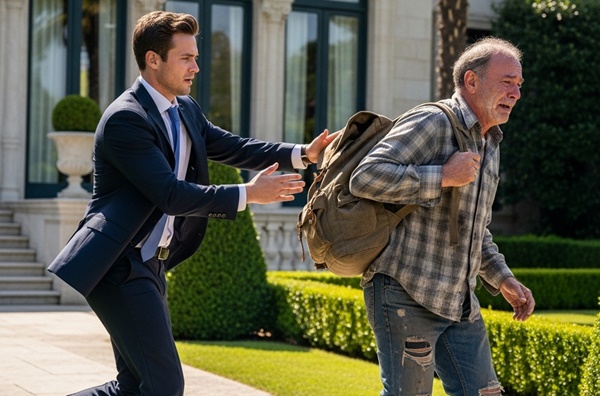
I make $20,000 a month, but I refused my foster dad a $3,000 sur;;gery loan. He sold his own plasma to pay for my Ivy League tuition. 25 years later, I turned him away at my doorstep….
The silence in my penthouse overlooking the San Francisco skyline was deafening. I sat at my mahogany desk, the warm glow of a designer lamp hitting my quarterly earnings report.
At 32, as a Chief Operating Officer pulling in over $20,000 a month, I was the living embodiment of the American Dream. But few knew that the foundation of this empire wasn’t built on venture capital—it was built on the literal blood of a stranger.
The doorbell rang, cutting through my thoughts. Through the 4K security camera, I saw a frail figure in a faded, thrift-store jacket, shivering in the Bay Area fog. It was Joe, my foster father.
Joe wasn’t my biological kin. He was my mother’s best friend from their days working the assembly lines in the Midwest. When she passed away in a hit-and-run, my relatives treated me like a tax liability. Only Joe, a man who barely made rent driving a beat-up tow truck, reached out his hand and led me to his cramped, one-bedroom apartment near the shipping docks.
I remember those days vividly. He worked 12-hour shifts, his hands stained with grease and oil. But there were nights he’d come home with a white bandage taped to the crook of his elbow. I’d ask him what happened, and he’d just give me that tired, gentle smile.
“Just a little ‘plasma donation’ at the clinic, kiddo,” he’d say, handing me a hundred-dollar bill. “The clinic gives a bonus for frequent donors. Take it. Buy those SAT prep books. Don’t let them tell you a kid from the docks can’t make it to Stanford.”
I was too young to realize that his “donations” were him literally selling his life force to buy my future. Those stacks of crumpled bills, smelling of antiseptic and sweat, paid for my textbooks, my flight to college, and the suit I wore to my first big interview.
Joe stepped into my foyer, his hesitancy palpable. He didn’t dare sit on the Italian leather sofa; he perched on the very edge of it, his gnarled, liver-spotted hands clutching his knees.
“Ben… I know you’re busy,” he started, his voice a gravelly whisper. “But I’m… I’m out of options.”
I took a cold sip of my $100 scotch. “Speak up, Joe. What’s so urgent that you had to take the Greyhound all the way up here?”
“The doctors found a tumor, Ben. It’s benign, but they need to operate before it blocks my airway. The deductible and the out-of-pocket costs are $3,000. I’ve saved most of it, but I’m short. I… I was hoping for a loan. I’ll pay you back. I’m still taking shifts at the yard when my breath holds up.”
I froze. $3,000. It was less than the monthly maintenance on my Porsche. It was less than the watch on my wrist. But in that moment, a grotesque, toxic arrogance flared up inside me. Success had turned me into something unrecognizable. I wanted to “test” him, or perhaps I wanted to prove I was no longer that charity case from the docks. I wanted to kill the boy who owed everything to this man.
I looked him dead in the eye, my voice turning to ice. “No. Not a dime. You spent your whole life living paycheck to paycheck, Joe. If you haven’t figured out financial planning by 70, that’s not my cross to bear.”
Joe went pale. The world seemed to stop spinning. His eyes, clouded by age and exhaustion, searched mine. There was no anger—just a deep, soul-shattering hollow. He licked his dry lips, started to say something, then stopped.
“Right… I understand,” he whispered. “You worked hard for what you have. I shouldn’t have burdened you.”
He stood up, his spine curved as if he were carrying the weight of a leaden sky. He walked out the door without a single word of reproach. I watched him from my floor-to-ceiling window. He stopped under a streetlamp, his thin shoulders shaking violently. He was sobbing. The man who never broke under the crushing weight of poverty was finally shattered by the coldness of the boy he loved.
I couldn’t sleep that night. Every time I closed my eyes, I heard his voice: “Just a little plasma donation, kiddo…” It echoed like a curse. I realized I had just committed the most soulless act a human being could commit.
At 5:00 AM, I grabbed a stack of cash and drove like a madman back to the old neighborhood near the docks. But his apartment was locked. A neighbor saw me and ran over, her face frantic.
“Ben? Joe collapsed on the sidewalk last night. The paramedics said he’s severely anemic and exhausted. He’s at General Hospital in the ICU.”
I sprinted into the hospital, the smell of antiseptic hitting me like a physical punch—the same smell that used to linger on the money he gave me. I found him in a ward filled with the sound of beeping monitors. He looked tiny in that hospital bed, his skin the color of ash.
When I grabbed his withered hand, his eyes fluttered open. Seeing me, he didn’t curse me out. He just wheezed out a whisper: “I’m sorry, Ben… I’m getting old. I’m a bit of an embarrassment for a COO, aren’t I?”
I collapsed to my knees on that cold, linoleum floor, tears streaming down my face. “Dad, stop! I’m the one who should be sorry! I’m a monster! I have millions in the bank, but I have nothing… I am nothing without you!”
He reached out his hand—the one still bruised from the IV and years of needles—and stroked my hair just like he did when I was six. “Just as long as you’re okay, son… that’s all I ever wanted. Don’t cry. You’re a big man now.”
In that moment, I understood that there are debts you can never repay with a check. I could buy him a mansion, I could hire the best surgeons in the world, but the scar I left on his heart was permanent.
I had the corner office and the seven-figure salary, but I almost traded my soul for it. I learned the hard way: your net worth means nothing if your “humanity” is bankrupt.
Engagement-Driving Outro:
Has a “success” ever blinded you to the people who helped you get there? How do we stay grounded when we finally “make it”? Drop a ❤️ if you believe family (foster or biological) is worth more than a paycheck. 👇