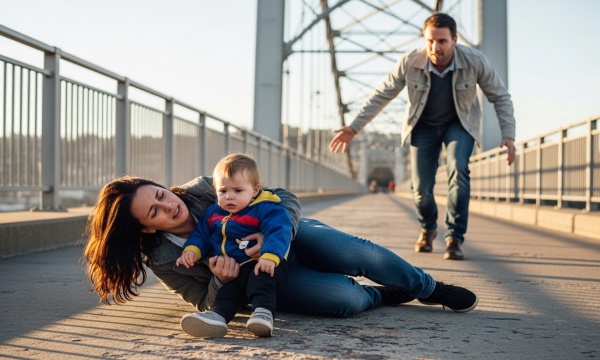
SHE FAINTED ON A BRIDGE HOLDING HER BABY. A STRANGER’S HAND SHOT OUT AND CAUGHT THEM BOTH BEFORE THEY HIT THE GROUND.
HE STAYED IN THE EMERGENCY ROOM FOR 12 HOURS WITH PEOPLE HE HAD NEVER MET IN HIS LIFE.
Six years later, that stranger is my husband. The baby he caught is our oldest daughter. And we just brought home our third child last spring.
Hello, everyone. Before I tell you this story, I want to know — which city are you joining from? Drop it in the comments below. I read every single one, and I mean that. Now. Let me tell you about the Tuesday morning that changed every single thing.
PART 1: WHO I WAS BEFORE THE BRIDGE
My name is Melissa Carr. I’m 34 years old, and I live in a blue craftsman house on a quiet street in Chattanooga, Tennessee, three blocks from the elementary school where my daughter Nora is in first grade and my son James is in pre-K. There is a tire swing in the backyard that my husband Daniel hung from the oak tree last summer, and a vegetable garden along the fence that I planted and mostly forget to water, and a baby named Clara who is fourteen months old and has her father’s eyes and my stubbornness and absolutely no interest in sleeping past 5:30 in the morning.
This is the life I have now. I want you to understand how completely I did not see it coming.
Six years ago, I was twenty-eight years old and I was not okay.
I want to be honest about that, because the honest version of this story is the only version worth telling. I had been not okay for a while — quietly, privately, in the way that people are not okay when they are very good at appearing functional. I had a studio apartment in the Northshore neighborhood of Chattanooga, a part-time administrative job at a physical therapy clinic on Broad Street, and a four-month-old daughter named Nora who was the most important thing in my world and also the thing that made the weight of everything else feel heavier than I knew how to carry.
Nora’s father — his name was Brandon, and I will not spend much time on him — had left when I was six months pregnant. Not dramatically, not with a fight. He just gradually became less present and then one day he was not present at all, and the apartment that had felt small for two felt enormous for one and a half. I filed for child support through the Hamilton County Child Support Services office. I attended the hearings. I did the paperwork. I did everything I was supposed to do, and I kept showing up for my daughter, and I told myself every morning that I was fine.
I was not fine. I was running on four hours of sleep and protein bars and the specific adrenaline of a person who cannot afford to stop moving.
The postpartum depression had been building since Nora was six weeks old. I had recognized it — I was not unaware of what was happening in my own body — but I had not yet done anything about it, because doing something about it required making a phone call and finding a provider and scheduling an appointment and arranging childcare and all of those steps felt, at the time, like being asked to climb a mountain when I was already carrying everything I owned.
My mother lived forty minutes away in Cleveland, Tennessee. She helped when she could. My best friend Jess, who lived two streets over, brought me food twice a week and sat with me on my couch and did not ask me to explain how I was feeling, which was the most useful thing anyone did for me during those months.
On the morning of October 14th, I had been awake since 2 AM with a colicky Nora. By 7 AM she had finally fallen asleep in her carrier against my chest. I needed air. I needed to move. I put on my shoes and walked out of my apartment and headed toward the Walnut Street Bridge, which is a pedestrian bridge over the Tennessee River that I had walked across a hundred times — a long, open stretch of green-painted iron with a view of the river and the North Shore and the mountains beyond, the kind of walk that had always, before Nora, before Brandon, before all of it, made me feel like Chattanooga was a place worth living in.
I was about two-thirds of the way across when my vision started going grey at the edges.
PART 2: THE HAND THAT CAME OUT OF NOWHERE
I want to try to describe what it feels like when your body decides, without consulting you, that it is done.
It is not dramatic, the way it looks in movies. There is no slow crumple, no graceful descent. What happened to me on the Walnut Street Bridge on October 14th was that the grey at the edges of my vision moved inward very quickly, my knees stopped working, and I had approximately one second of understanding what was about to happen before it happened.
Nora was in the carrier. She was against my chest. She was asleep.
That one second was the most terrifying of my life.
And then a hand came out of nowhere and caught me.
Not metaphorically. Literally — a hand, then a forearm, then a shoulder, and then I was not falling anymore. I was being held up by someone I had never seen before, someone who had been walking in the opposite direction and had apparently moved fast enough to get to me before I hit the ground.
I came back to consciousness in pieces. The bridge railing. The river below. The sound of the water. Nora, still in the carrier, still against my chest, still asleep — somehow, impossibly, still asleep.
And a man crouching in front of me, his hand on my shoulder, his voice steady and calm, saying: “Hey. Hey, I’ve got you. Stay with me. I’ve got you both.”
His name, I would learn later, was Daniel Carr. He was thirty-one years old. He was a structural engineer who worked for a firm in downtown Chattanooga and who crossed the Walnut Street Bridge every Tuesday and Thursday morning on his walk from the parking garage on Frazier Avenue to his office on Market Street. He had been about twenty feet away when he saw me start to go down.
He told me later that he had run. That he had not thought about it — he had just run, the way you run toward something before your brain has finished processing what your eyes are seeing.
He caught me and Nora with approximately one second to spare.
I sat on the bridge with my back against the railing and Nora still sleeping in her carrier and a stranger crouched in front of me, and I started crying. Not the quiet, controlled kind of crying I had been doing for months in my apartment after Nora went to sleep. The other kind. The kind that comes from somewhere deeper than sadness, from the place where exhaustion and fear and relief all arrive at the same time and your body does not know what else to do with them.
“It’s okay,” Daniel said. He did not move away. He did not look uncomfortable. He just stayed exactly where he was, steady and present, like staying was the most natural thing in the world. “You’re okay. She’s okay. Take your time.”
He called 911 from his cell phone. He stayed with me until the ambulance arrived. He rode with me — with a woman he had never met and a baby he had caught midfall — to Erlanger Health System on Third Street, because when the paramedic asked if there was someone who could come with me and I said I didn’t know, Daniel said, “I’ll come.”
Just like that. I’ll come.
PART 3: TWELVE HOURS IN AN EMERGENCY ROOM
I was admitted for observation, dehydration, and what the attending physician described as a vasovagal syncope episode likely exacerbated by exhaustion, inadequate nutrition, and acute stress. In plain language: my body had been running on empty for months and it had finally stopped.
They checked Nora. She was fine. Four months old, perfectly healthy, not a scratch. The carrier had held. Daniel had held.
My mother drove up from Cleveland. Jess came from two streets over. They arrived within forty minutes of each other, and by the time they got there, Daniel was sitting in the waiting area of the Erlanger ER with a cup of vending machine coffee and Nora in his arms — because I had been taken back for tests and the nurse had asked if there was someone who could hold the baby, and Daniel had said yes.
My mother told me later that she walked into that waiting room and saw a man she had never met in her life sitting very carefully in a plastic chair, holding a four-month-old infant with the focused concentration of someone who was determined not to drop something precious, and she had started crying before she even reached him.
He stayed for twelve hours.
I want to be clear about what that means. He had a job. He had a Tuesday. He had a life that had nothing to do with me or Nora or the Erlanger emergency department. He called his office from the waiting room and told them he had a family situation and would not be in. He ate a vending machine sandwich at 1 PM. He held Nora when my mother needed a break. He went to the hospital pharmacy and picked up the prescription the ER doctor had called in. He sat in a plastic chair for twelve hours for two people he had met that morning on a bridge.
When I was finally discharged at 7 PM, he was still there.
I walked out into the waiting room and saw him standing up from his chair, and I did not know what to say. There is no social script for this situation. There is no card you send, no phrase that covers it.
I said: “You stayed.”
He said: “Of course I stayed.”
I said: “You don’t even know me.”
He looked at me for a moment, and then he said something I have thought about many times since: “I know you’re a good mother. I watched you check on her every time they let you out of that room. That’s enough to know.”
I gave him my number because my mother, standing behind me, made a face that communicated very clearly that if I did not give this man my number she would give it to him herself.
He texted that evening to ask if we had gotten home safely. I said yes. He said good.
That was the beginning.
PART 4: HOW YOU BUILD A LIFE FROM A BRIDGE
He did not ask me on a date immediately. I want to tell you that, because the story could go a certain way from here — the dramatic rescue, the instant romance, the sweep of it all — and that is not what happened. What happened was slower and quieter and, I think, more real.
He texted every few days. Not constantly — not in the way that feels like pressure — but consistently, in the way that feels like someone is thinking about you without needing you to perform gratitude for it. He asked about Nora. He asked about me. He sent me an article about a hiking trail on Lookout Mountain that he thought I might like, with a note that said “when you’re feeling up to it, no rush.”
Six weeks after the bridge, I finally made the phone call I had been putting off for months. I found a therapist — a woman named Dr. Patricia Hollis who practiced in the Northshore neighborhood, three blocks from my apartment — and I started going every Thursday. I got on medication. I started sleeping more than four hours. I started, slowly and then less slowly, feeling like myself again.
Daniel knew I was in therapy because I told him. I told him because he had seen me at my lowest point on a bridge over the Tennessee River and had not looked away, and it seemed dishonest to perform wellness for someone who had already seen the truth.
He said: “Good. I’m glad you’re doing that.”
That was it. No questions. No discomfort. Just: I’m glad you’re doing that.
We had our first actual date in December — coffee at a place on Frazier Avenue, a Saturday morning, Nora in the stroller between us. It lasted three hours. We talked about his family in Knoxville, about my mother in Cleveland, about the structural engineering project he was working on, about the book I had been trying to finish reading for four months. We talked like people who had already passed the part where you are performing for each other and arrived at the part where you are just talking.
He pushed the stroller back to my apartment. At the door, he looked at Nora asleep in the stroller and then at me and said: “Same time next Saturday?”
I said yes.
We dated for two years. He was present in the way that I had not known, before him, that a person could be present — not occasionally, not when it was convenient, but consistently and without making it a point of pride. He showed up for Nora’s first steps. He drove us to the pediatrician when she had an ear infection at 11 PM on a Wednesday. He learned how to install a car seat correctly and then made Jess’s husband watch a YouTube tutorial because he had noticed the angle was wrong.
He proposed on the Walnut Street Bridge on October 14th — exactly three years after the morning we met. He had a ring from a jeweler on Main Street and a speech he had clearly practiced and then abandoned halfway through in favor of just saying the true thing, which was: “I have loved you and Nora since before I had any right to, and I would like to keep doing that for the rest of my life if you’ll let me.”
I said yes before he finished the sentence.
PART 5: THE FAMILY OF FIVE
We married in June of 2022 at a small venue in the North Shore neighborhood — sixty people, string lights, a bluegrass band that Daniel’s college roommate played in, and Nora as the flower girl in a white dress she had picked out herself and worn around the apartment for two weeks before the wedding.
My mother cried through the entire ceremony. Daniel’s mother cried through the entire ceremony. Jess cried and then denied it.
James was born in March of 2023. He arrived six weeks early — a terrifying two weeks in the NICU at Erlanger, the same hospital where Daniel had sat in a plastic chair for twelve hours three years before — and then he came home and immediately established himself as the loudest person in the house, a distinction he has maintained without effort.
Clara came last spring. She is fourteen months old and she has her father’s eyes and she has already figured out how to open the cabinet under the kitchen sink, which is a problem we are actively working on.
Nora is six now. She knows the story of the bridge — the age-appropriate version, the one where Mama got dizzy and a kind man helped her, and then the kind man became her dad. She has asked to walk across the Walnut Street Bridge every October 14th since she was old enough to ask for things, and we do. All five of us. We walk to the spot where it happened and we stand there for a minute and look at the river, and then we walk to the other side and get ice cream at a place on the North Shore, and Daniel holds Clara and I hold James’s hand and Nora runs ahead because she always runs ahead, and I think about the morning I almost fell and the hand that came out of nowhere and I think: this is what that moment was for.
I have thought a lot, over the past six years, about the nature of what happened on that bridge. About the fact that Daniel crossed it every Tuesday and Thursday and I had never once seen him before. About the fact that I left my apartment that morning because Nora had finally fallen asleep and I needed air, and if she had slept twenty minutes longer I would have left twenty minutes later and he would have already been past. About the fact that he was twenty feet away and moving in the opposite direction and he ran.
I do not know what to call that. I am not a person who uses the word fate easily, because fate implies a plan, and a plan implies that the hard parts were necessary, and I am not sure I am ready to say that the months I spent not okay were necessary. What I will say is that they were real, and that I survived them, and that on the other side of them was a man on a bridge who ran toward me instead of away.
That is enough. That is more than enough.
EPILOGUE: WHAT I KNOW NOW
Daniel is asleep upstairs right now. Clara is in the crib next to our bed, which is a temporary arrangement that has been temporary for fourteen months. James is in his room with the nightlight shaped like a dinosaur that he cannot sleep without. Nora is in her room with the book she was supposed to finish reading an hour ago and is definitely still reading.
I am sitting at the kitchen table with a cup of tea that has gone cold, writing this, because someone asked me recently how Daniel and I met and I told the short version — he caught me on a bridge — and they looked at me like I was being poetic, and I realized I wanted to tell the long version. The true version. The one where I was not okay and I did not have it together and a stranger’s hand came out of nowhere and changed the entire direction of my life.
I got help. I want to say that clearly, because it is part of the story and it matters. The therapy, the medication, the slow and unglamorous work of getting better — that was not a footnote. That was the foundation. Daniel did not save me. He caught me, and then he stayed, and then I did the work of saving myself, and those are three different things and all three of them mattered.
If you are reading this and you are in the place I was in — the exhausted, running-on-empty, holding-it-together-by-a-thread place — I want you to know that making the phone call is worth it. Finding the provider is worth it. Doing the paperwork and scheduling the appointment and arranging the childcare is worth it. You are worth it. Your children are worth it.
And if you are ever on the Walnut Street Bridge in Chattanooga on a Tuesday morning in October and you see a family of five walking toward the North Shore for ice cream — the tall one with the gray in his beard, the six-year-old running ahead, the toddler on his hip, the boy holding his mother’s hand — that’s us.
Come say hello. I’ll tell you the whole story.
To everyone reading this: has a stranger ever done something for you — or have you ever done something for a stranger — that turned out to matter more than either of you knew in the moment? Tell me in the comments. And drop your city — I want to know where you’re reading from. 👇
Share this for everyone who needs a reminder that kindness still exists, that help still comes, and that sometimes the best things in life start with a stranger’s hand shooting out on a bridge. 🤍
