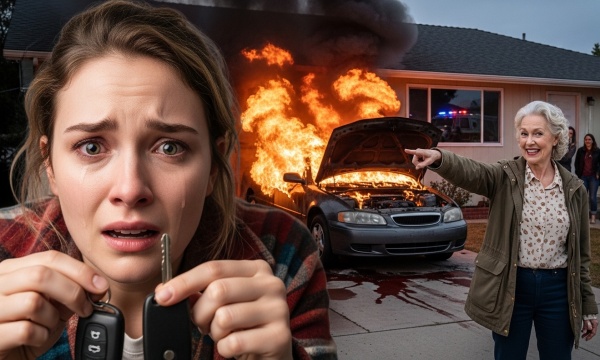
My Stepmother Poured Gasoline on My Car and Lit It on Fire Because I Wouldn’t Hand It to Her Daughter. She Laughed and Said: “If You Won’t Give It to Her, Then It Can’t Be Yours.”
What she didn’t know was that the car she just burned wasn’t just my property. It was the one thing in that driveway that had been quietly recording every single move she made — and automatically uploading it to my attorney’s email.
Hello, everyone. Thank you so much for being here with me today. Now. Let me tell you about the night my stepmother handed me the best evidence I ever could have asked for — and called it revenge.
PART 1: THE WOMAN WHO THOUGHT SHE OWNED THE AIR IN THE ROOM
My name is Claire Hayes. I’m 24 years old, and I grew up in a split-level house in a quiet neighborhood outside of Columbus, Ohio — the kind of street where everyone knows everyone’s car, everyone’s schedule, and everyone’s business. Which, as it turns out, matters more than you’d think.
My mother passed away when I was seventeen. Ovarian cancer, diagnosed late, gone fast — the kind of loss that doesn’t announce itself with time to prepare. She left me three things: her stubbornness, her handwriting in the margins of every book she ever owned, and a 2016 Honda Civic in pearl white that she had driven to every one of my school events, every doctor’s appointment, every Saturday morning errand run for six years.
My dad, Mark Hayes, is a good man in the way that some good men are — decent at his core, but susceptible to the wrong kind of certainty. He remarried three years after my mother died. Her name was Denise Calloway-Hayes, and she came with a daughter named Brianna, a talent for making herself comfortable in other people’s spaces, and a smile that was always slightly too composed to be entirely trustworthy.
I was nineteen when Denise moved in. I was twenty when I started locking my bedroom door.
The car situation started small, the way Denise’s campaigns always started small. A comment here. A suggestion there. Brianna needs something reliable for her commute. You’re young, you can take the bus. Your father helped pay for it anyway. The logic was always just slightly off, like a picture hung crooked on a wall — wrong enough to notice, not wrong enough to easily explain to someone who hadn’t been living with it.
What Denise consistently got wrong — what she had always gotten wrong about me — was the paperwork.
My father had helped with two months of payments when I was twenty-one and between jobs. The rest of the 36-month loan — $387 a month, financed through a credit union in Dublin, Ohio — I had paid myself. The title was in my name. The insurance was in my name. The registration was in my name. I had a folder in my lockbox with every payment receipt, every statement, and the original purchase agreement.
I am my mother’s daughter. She taught me to keep records.
The first time Denise asked for the car directly, she leaned against the kitchen counter like she owned the air in the room and said, “Brianna needs something reliable. You can take the bus for a while.”
I set my keys on the table — deliberately, far from her hand. “No. That car is mine.”
Her smile was small and sharp. “Your father bought it.”
“My father helped with two months,” I said. “I’ve been making payments for three years. It’s titled in my name.”
From the doorway, Brianna crossed her arms — twenty-two years old and perpetually aggrieved, the expression of someone who had learned early that pouting was a strategy. “You’re so selfish. You have a better job. I need it.”
I picked up my keys and left for my shift.
I did not argue. I did not explain. I had learned, by then, that explaining things to Denise was like pouring water into sand — it disappeared without leaving anything behind.
What I did instead, two months earlier, was install a dashcam.
Front and rear. Motion-activated. Automatic cloud upload. Linked to my personal account and, after a conversation with a family law attorney I’d consulted quietly in March, forwarded automatically to her email as a secondary backup.
I installed it because Denise had started going through my mail. Because my packages had been “misplaced” twice. Because I had come home one evening to find my bedroom door unlocked when I was certain I had locked it.
I installed it because I had stopped hoping things would be fair and started preparing for the possibility that they wouldn’t be.
That preparation saved everything.
PART 2: THE NIGHT SHE HANDED ME THE EVIDENCE
I came home from my shift at 12:30 in the morning to red and blue lights washing over our driveway.
The smell hit me before I even turned onto our street — burnt plastic and gasoline, thick and chemical, the kind of smell that gets into the back of your throat and stays there. I pulled up to the curb behind a fire truck from Columbus Fire Station 22 and sat in my coworker Jenna’s car for a moment, not understanding what I was seeing.
My car — my mother’s car — sat in the street like a blackened skeleton. The hood was warped upward. The windows had blown out. Smoke was still curling from the frame in thin grey ribbons.
I got out of the car.
Denise was standing on the front porch in a robe, hair pinned perfectly, eyes bright with something that looked unmistakably like satisfaction. When she saw me walking up the driveway, she laughed. Not a nervous laugh, not a surprised laugh — a genuine, delighted laugh, like she had been waiting for this moment and it had arrived exactly on schedule.
“You should’ve just handed it over,” she said, her voice carrying clearly across the yard, loud enough for the firefighter nearest the curb to turn and look at her. “If you can’t give this car to my daughter, it can’t be yours either.”
The firefighter looked at her. Then he looked at me. His expression was the expression of a professional who has seen a great many things and is, in this particular moment, genuinely struggling to process what he just heard a person say out loud at a crime scene.
My dad pushed through the small crowd that had gathered — neighbors in pajamas, a couple of people from down the block. His face was pale and stunned, the face of a man who had been pulled out of sleep and dropped into something he didn’t have a framework for.
“Denise,” he said, his voice barely above a whisper, “what did you do?”
She didn’t flinch. She didn’t hesitate. “I solved a problem,” she said.
I felt my hands go cold. Not from fear — from something else. Something settling into place, heavy and quiet, like a key turning in a lock.
Because Denise didn’t understand what she had just done.
She thought she had destroyed my property. She thought she had taken something from me and proven a point and won the argument she had been trying to win for two years.
What she had actually done was activate a motion-triggered camera system, generate a fire of suspicious origin that would require a fire marshal investigation, and hand the Franklin County Fire Investigation Unit a reason to look very closely at a driveway, a garage, and a household that had been hiding considerably more than a family dispute.
I did not yell. I did not cry. I did not give her the reaction she had staged this entire evening to receive.
I walked inside. I packed two duffel bags — clothes, laptop, documents, the lockbox from under my bed. I walked back out past Denise on the porch.
“Where are you going?” she said, the satisfaction still in her voice.
“Away,” I said.
I got into Jenna’s car. We drove to her apartment in Clintonville. I sat on her couch fully dressed with my phone on my chest, and I waited.
Because I knew the real explosion hadn’t happened yet.
PART 3: WHAT THE CAMERA SAW
At 6:12 in the morning, my father called.
His voice was rough and careful, the voice of a man navigating something he didn’t fully understand yet. He told me the insurance company had called. He told me the fire department had flagged the fire as suspicious. He told me — and his voice dropped when he said this — that Denise had told the investigator that I was the one who had set it.
“I don’t believe that,” he said quickly. “But they’re asking questions. She’s saying you threatened her.”
I closed my eyes. “Dad,” I said, “the car had a dashcam. Front and rear. Motion-activated. It uploads automatically.”
Silence.
“Uploads where?” he said.
“To my cloud account,” I said. “And to my attorney’s email.”
Another silence. Longer this time.
“Attorney?” he repeated.
“I’m twenty-four,” I said. “I stopped hoping things would be fair a while ago.”
I heard him sit down.
Two hours later, Fire Marshal O’Neal called from a Franklin County number. Professional, thorough, direct. He confirmed they were investigating an intentional vehicle fire and asked me to verify my whereabouts between 10 PM and 2 AM. I gave him Jenna’s address, her phone number, and told him I had footage.
When I opened the cloud files and watched the clips for the first time, I had to set my phone down for a moment.
At 11:47 PM, Denise walked into the driveway wearing Brianna’s oversized Ohio State hoodie. She looked left, then right, then walked to the garage and pulled out a red five-gallon gas can with the ease of someone who had thought this through. Brianna came out behind her, laughing, filming on her phone.
Denise poured gasoline along the driver’s side of the car. The dashcam’s audio was clear — no wind, quiet street, every word audible.
“Smile, baby,” Denise said. “This is what happens when people don’t share.”
A click. A flare of orange light. The camera shook as the heat hit the lens.
Brianna’s laugh was high and bright and entirely without hesitation. Denise’s voice came again, warm with satisfaction: “Now she’ll learn.”
I forwarded the complete video file to Fire Marshal O’Neal. I forwarded it to the insurance investigator. I forwarded it to my attorney, Patricia Nguyen, who practices family and civil law in Columbus and who, when she watched the footage, said: “Claire, I need you to come in today.”
I went in that afternoon.
And that is when I found out that the car wasn’t just evidence of arson.
PART 4: THE BOMB THAT WAS ALREADY THERE
Patricia sat across from me in her office on North High Street and pulled up the footage on her laptop — not the fire clips, but the earlier ones. Weeks of earlier ones.
The dashcam had been recording every time someone walked past the car in the driveway. Every time motion triggered it. Every time someone came or went.
“Claire,” Patricia said, “do you know what your father does with his business deposits?”
“He runs a small residential contracting company,” I said. “Hayes Home Services. Why?”
She turned the laptop toward me.
In the footage — multiple clips, multiple nights — Denise was carrying boxes from the trunk of her own car into the house late at night. Tossing envelopes into her purse. Meeting a man in a blue Honda Accord at the curb and handing him a folder. On one occasion, she was on the phone in the driveway, and the audio — faint but recoverable — included the words “the account in Westerville” and “he doesn’t check the statements.”
“I think,” Patricia said carefully, “that Denise has been siphoning money from your father’s business. And I think she used your car’s presence in the driveway as a reason to want the camera gone.”
The car wasn’t just my mother’s car. It wasn’t just my property.
It was the one thing in that driveway that had been watching.
Once the fire marshal investigation opened and investigators had legal grounds to examine the property, everything moved quickly. My dad found bank statements he had never seen — a secondary account at a credit union in Westerville, Ohio, opened in Denise’s name eighteen months ago. A credit card in her name with a $14,000 balance, paid monthly from an account that drew from his business revenue. A stack of IRS correspondence addressed to him, unopened, that Denise had been intercepting — including a notice regarding unreported income that was now fourteen months old.
In the guest room closet, behind a box labeled Brianna’s Keepsakes, investigators found a lockbox. Inside: forged authorization signatures on three business account transfers, receipts from transactions my father had never made, and documentation for an LLC registered in Delaware in Denise’s name that listed my father’s primary client contracts as “consulting relationships.”
My father did not defend her. Not once.
PART 5: THE CHARGES AND THE CALL I LET RING
Denise was arrested on arson charges — a second-degree felony under Ohio law, carrying a potential sentence of two to eight years. Because the fire occurred on a public street and created a public safety hazard, the Franklin County prosecutor treated it accordingly. The insurance claim was denied immediately upon receipt of the video evidence. My father’s homeowners carrier sent a letter that was polite in tone and devastating in implication.
Brianna was questioned separately. Her private Instagram story — in which she had posted a clip of the fire with a laughing emoji — had been screen-recorded by a mutual acquaintance and submitted to investigators before Brianna had time to delete it. She was charged as an accessory. She moved out of the house within the week and went to live with her biological father in Dayton, posting angry captions about “fake family” and “snitches” that her attorney almost certainly wished she would stop.
The financial investigation was referred to the Franklin County Prosecutor’s Office and the Ohio Department of Taxation. The Delaware LLC was flagged for review. The Westerville account was frozen pending investigation. The full scope of what Denise had been doing to my father’s business over eighteen months was still being untangled as of the last conversation I had with Patricia.
My father called me on a Friday night, late. He sounded older than I had ever heard him — not in years, but in weight.
“I failed you,” he said.
I sat on the edge of the bed in Jenna’s spare room and looked at my hands. “I asked you to listen for years,” I said.
“I know,” he said. “I thought keeping the peace meant keeping us together. But I was just letting her hurt you. And I was too comfortable to see what she was doing to me.”
He filed for legal separation the following Monday. Denise was released on a $25,000 bond but ordered by the court to have no contact with the residence. My father changed the locks that same afternoon.
Two weeks later, he replaced my car — not with something extravagant, but with a reliable 2020 Toyota Corolla and a check that covered the down payment I had already lost. It didn’t undo what happened. It wasn’t meant to. It was the first time he had taken responsibility without asking me to absorb the cost of someone else’s choices.
Denise called me once, from a blocked number, three weeks after her arrest. I watched my phone ring until it stopped. Patricia told me later that Denise’s attorney had reached out about a civil settlement — an offer to resolve my property damage claim quietly if I agreed not to pursue further civil action.
I pursued the civil action.
EPILOGUE: WHAT THE BLAST LEFT BEHIND
It has been four months since the night I came home to sirens and smoke and a woman laughing on a porch like she had won something.
I am living in a one-bedroom apartment in Clintonville — my own lease, my own name on the mailbox, a small balcony where I keep a pot of the same rosemary my mother grew in our backyard on Maple Ridge Drive. My commute is twenty minutes. My mornings are quiet. I make my coffee and I sit by the window and I do not miss the house I grew up in, which surprised me until I realized that what I had missed for years wasn’t the house — it was the version of my family that existed before we lost my mother, and that version was already gone long before the fire.
My father is in therapy. He said that to me plainly, without embarrassment, which is new for him and which I respect. We talk on Sundays. It is not easy and it is not fixed and it is real, which is more than I had before.
The criminal case is ongoing. I will not speculate about the outcome. I will say that the evidence is substantial and that Patricia is thorough and that the Franklin County Prosecutor’s Office does not appear to be treating this as a minor matter.
I think about my mother sometimes — about the fact that the car she drove me to school in, the car she handed down to me because she wanted me to have something of hers, ended up being the thing that caught the person who had been slowly dismantling what was left of our family. I think she would find that fitting. She had a very precise sense of justice, my mother. She believed that the truth had a way of surfacing eventually, and that the best thing you could do was keep your records clean and your patience intact and wait.
I kept my records. I kept my patience.
And the truth surfaced.
Denise set fire to my car because she wanted to erase my ownership, my boundaries, and the quiet little camera that had been watching her lies accumulate.
Instead, she gave investigators a reason to look closer.
And the house she had tried to rule with fear didn’t explode into flames.
It exploded into facts — documents, footage, charges, and a father who finally understood what keeping the peace had actually cost.
I left that night with my belongings because I knew something was about to blow.
I just didn’t expect the blast to be so clean.
Or so completely deserved.
To everyone reading this: have you ever had to walk away from a situation quietly — because you knew the truth would speak for itself? Tell me in the comments. And don’t forget — drop your city. I want to know where you’re reading from. 👇
Share this for everyone who was told to keep the peace — and chose to keep their dignity instead.
