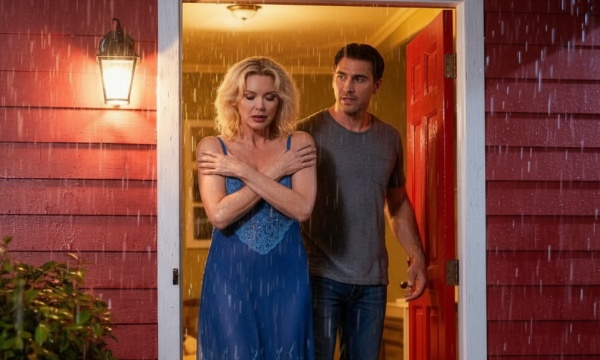
MY 61-YEAR-OLD NEIGHBOR KNOCKED AT MIDNIGHT. 20 MINUTES LATER, NOTHING IN MY LIFE WAS THE SAME.
I’m not a romantic. I’m a 39-year-old twice-divorced guy in rural Nebraska who names his vacuum cleaner. His name is Gerald. That’s not a joke. This is the story of the knock that changed everything.
PART 1: THE NEIGHBOR I NEVER REALLY KNEW
My name is Nathan Ellison. I’m 39, divorced twice, and I live in a small town called Millhaven, about forty minutes outside of Lincoln, Nebraska. My life runs on a schedule so predictable I could set a clock by it: coffee at 6:15, the commute to a job I tolerate, dinner from whatever’s in the fridge, and evenings spent on the couch with Gerald the vacuum cleaner standing sentinel in the corner.
I was once a man with plans. Then I became a husband — twice — and somewhere in the wreckage of two marriages, I became something simpler: the guy next door. The one who replaces his own light bulbs, keeps his lawn edged, and pretends to care about Sunday afternoon football.
To my left lives Dorothy Callahan. She’s 61, and she’s been a widow for twenty-three years.
Her husband, Jim, was killed in a car accident on I-80 when Dorothy was only 38. Since that night, she has lived alone in the pale yellow house with the wraparound porch — keeping company with her tabby cat, Oliver, drinking chamomile tea, listening to Patsy Cline on a turntable she’s had since the 1980s, and planting marigolds along her front walk every spring whether or not anyone notices them.
She’s the kind of woman who seems to have a quiet answer for everything but volunteers almost nothing about herself.
We’d been neighbors for nine years. Not friends, not strangers — something in between. The kind of relationship built entirely on brief waves from driveways and the occasional “How are you holding up?” exchanged over the fence. I never imagined that this woman, with whom I’d shared maybe two hundred words across nearly a decade, would be the person who turned my entire life sideways.
It started with a knock.
PART 2: MIDNIGHT
It was a Tuesday night edging toward Wednesday. I was stretched out on the couch, cycling through channels with the unfocused determination of a man who isn’t really watching anything — just filling the silence. Sleep was starting to pull at the edges of my consciousness.
Then I heard it. A knock. Not loud, but deliberate. The kind someone makes when they’ve been standing on a porch working up the nerve for a few minutes.
I dismissed it as the television. Then it came again.
I pulled myself up. The clock read 12:02 AM. I moved the curtain aside and looked out.
Dorothy Callahan was standing on my porch in a white terrycloth robe, her feet in soaked slippers, her silver hair loose and disheveled. Her face was the color of old paper. Her eyes were wide with the particular combination of confusion and fear that you only see in people who have been alone too long and have just run out of options.
I opened the door before she could knock again.
“Nathan.” Her voice was barely above a whisper. “There’s water everywhere in my kitchen. It’s just pouring out from under the sink. I didn’t know who else to call.”
I grabbed my shoes, snagged the flashlight off the counter, and followed her outside.
Her house looked exactly as it always did from the outside — neat, orderly, the porch light on — but something about it felt different tonight. Urgent. Water was seeping out from under the kitchen door.
Inside, a copper supply line under the sink had given out at a corroded joint, sheeting across the linoleum in a slow, spreading pool. The shutoff valves were frozen solid with age. I took the flashlight to the basement, found the main valve behind the old water heater, and cranked it shut.
When I came back up, Dorothy was standing in the middle of the flooded kitchen holding a mop bucket with both hands — like a soldier who had decided to make a stand and wasn’t entirely sure against what.
“It’s off,” I said.
She exhaled. A long, slow breath, as if she’d been holding it since she knocked on my door. And then, without warning, quiet tears moved down her face.
“I’m so sorry,” she whispered. “You were the only person I could think of.”
Something tightened in my chest. Not pity. Something more complicated than that. I looked at her — the posture, the exhaustion in her shoulders, the way she was gripping that bucket — and I understood that this wasn’t just about a broken pipe. This was a woman who had been handling everything alone for twenty-three years, and tonight, one copper fitting had finally forced her to ask for help.
“You did the right thing,” I told her. “This could’ve been a lot worse.”
We found towels and mopped up the worst of it. She insisted I put on dry socks and made chamomile tea. We sat in her living room. Oliver settled on the arm of the sofa and studied me with focused suspicion. The silence that settled between us was not awkward. It was comfortable — the kind of quiet that exists between two people who have, without planning to, just become something to each other.
“Nathan,” she said softly. “You’ve always struck me as a decent person. Not loud, not cold. Just steady. I haven’t felt steady in a long time. This is nice.”
For the first time in longer than I could remember, I felt genuinely needed. Not out of obligation. Just needed.
When I got up to leave, she walked me to the door.
“Thank you for not being asleep,” she said, with a small smile. “Or at least for answering.”
“Not everyone would have knocked,” I replied.
I walked back across the yard. It was 12:19 AM. Seventeen minutes had passed.
I lay in bed staring at the ceiling, thinking about how a single moment can quietly redirect the entire trajectory of a life. When I woke up the next morning, my first thought was that I needed to check on Dorothy. That felt significant.
PART 3: THE REPAIR — AND WHAT CAME WITH IT
I was on her porch at 9:00 AM with my toolbox. I didn’t call first. I just knocked.
She answered in a blue cardigan, holding a mug with both hands, looking tired but composed.
The damage under the sink was exactly what I’d expected: old copper pipe, corroded joint, a failure that had been building for years. I started loosening the old fittings. My hands were steady. My mind was less so.
“Coffee?” she asked.
“Only if the machine survived the flood.”
She laughed — light, genuine, free of the exhaustion from the night before. “It did.”
She set a mug on the counter beside me. When she reached past me to place it down, her hand brushed mine. A brief contact. She didn’t pull back or apologize. She just let it rest there for a moment.
I looked up. The anxious, frightened look from midnight was gone. What was there instead was something warmer — the look of a person deciding, carefully, how much to trust.
“I didn’t know who else to call,” she said again, quietly. Not a compliment. Something more honest than that.
“You made the right call,” I said.
She sat at the kitchen table while I worked. She didn’t fill the silence with chatter. She was just present — and her presence wasn’t distracting. It was the opposite.
“Do you always do everything yourself?” she asked after a while.
“Usually. Habit more than pride.”
“Same here. I got used to relying on myself. First because I had to, and then because I didn’t know any other way.”
“And now?” I asked.
She glanced toward the window. “Now sometimes I just wish someone were nearby. Not as a hero. Not as a plumber. Just — someone to sit with. And for that silence to feel right.”
I tightened the final fitting. “Your kitchen is officially rescued.”
She rose and came closer. Her eyes held a gratitude that wasn’t polite or obligatory. It was the kind that says I see you. In that simple look, there was more meaning than in all the words I’d heard across two marriages.
She gave me a brief, genuine hug. No dramatics. No pretense.
“Thank you, Nathan,” she whispered. “You have no idea how much this means.”
For the first time in a very long time, I felt truly wanted. Not for convenience. Not out of obligation. Simply because I was there.
PART 4: COFFEE, LETTERS, AND WHAT WE TOLD EACH OTHER
Three mornings later, I brewed two cups — one for me, one for her, light with a little honey the way she liked it — and walked next door. She was on her porch watering her marigolds. When she saw me, she paused.
“Good morning. Coffee. No repairs today, I promise.”
“That almost sounds like a date,” she said, then waved her hand. “Sorry. Just — it’s unusual. Someone showing up with something other than a wrench.”
We sat on the old bench along the porch railing. She tucked one leg beneath her like a teenager, and there was something in that small, unselfconscious movement I found unexpectedly moving.
I asked her about Jim. She told me everything — how they met when she was 22, him farming outside of Kearney, her waitressing at a diner on Route 6. How he left a note on a napkin that said: “Next time, try smiling. I don’t just come here for the coffee.” How he taught her to drive a tractor and she drove it straight into a fence post. How he said, “Well, now nobody can say you’re not memorable.” How sixteen years of honest, imperfect love ended on a rainy night on I-80, and how she didn’t leave the house for three weeks afterward.
“Do you know what finally got me outside again?” she asked.
“What?”
“A burst pipe. Old and rusty. Everything seems to break when it has no right to. I had to call someone. That’s how my life after Jim began.”
She looked at me. “I see you,” I said.
She seemed surprised — not because she hadn’t expected the words, but because she was hearing them for the first time from someone who wasn’t speaking out of pity.
A few mornings after that, she turned the question around.
“Why is someone your age already alone?”
I told her about my first marriage — two people who loved each other but spoke completely different languages. I told her about my second — a woman who wanted presence, not productivity, and a man who kept disappearing into his work until she called him a ghost and she was right. I told her that after the second divorce, I stopped trying seriously. That I’d learned to be afraid — not of other people, but of myself. Of giving someone hope and then letting them down.
She listened with her whole self. When I finished, she said: “And I’m afraid I’ve been alone so long I won’t know how to be with someone even if I want to.”
We sat in silence. Two people who were tired of being afraid but didn’t quite know how to stop.
“I’m glad you told me,” she said finally. “It makes you real.”
One Saturday, I came to fix her gate. While I worked, she sat in a lawn chair beside me providing live commentary like a retired sports announcer. When the job was done, she brought out a cardboard box — old, slightly worn, with Jim — 1979 to 1982 written in faded marker on the lid.
“Letters,” she said. “He wrote from Fort Hood almost every week. I waited for each one like it was a breath of air.”
She read the first one aloud. “Lynn — I saw two deer today near the fence line. One came close and the other stayed back, and I thought: that’s us. You’re always closer than I realize, and I’m the fool pretending I don’t feel it.”
Her voice trembled slightly. I sat completely still.
“I never thought I could read these with someone else present,” she said. “I was afraid it would feel like a betrayal.” A pause. “But today I’m not afraid.”
“Your heart isn’t locked away,” I said. “It remembers. It loves. But it isn’t closed — because you’re letting someone in. That’s not just trust. That’s courage.”
Her hand found mine on the table, and that was enough.
PART 5: THE RAIN, THE DAUGHTER, AND WHAT CAME NEXT
She called on a Wednesday evening. “I just don’t want to be alone with the rain tonight.”
“Bring the cookies. I’ll handle dinner.”
The rain started gently — not a storm, just that soft, steady sound that seeps through windows and makes you remember something good. I put on a vinyl record. Moon River. Dinner was simple: pasta, salad, toasted bread with parmesan. We talked about movies from our childhoods and recipes that had gone spectacularly wrong.
When dinner was over, we sat on the couch. Not touching, at first. The record had ended. Only the rain remained — and a silence that wasn’t empty but full.
Her hand touched mine. Lightly, like a question.
“Do you think life gives us second chances for a reason?” she asked.
“Maybe,” I said. “Or maybe life just got tired of watching us hide from it.”
“I’m not hiding,” she said softly. “At least not right now.”
“Me neither.”
We made no promises. We made no plans. We simply were — in that light, in that room, beneath that rain.
When she left, she said: “Tomorrow will be sunny. But I’ll remember this rain.”
I stood at the window for a long time after she left, watching the streetlight hold steady through the storm.
The following Sunday, I was two steps from her porch when I heard a voice through the screen door.
“What exactly are you thinking, Mom?”
In the living room stood a woman in her mid-thirties — tall, straight-backed, arms crossed. She turned her gaze on me immediately.
“You must be Nathan. I’m Claire. The daughter.”
She turned back to Dorothy. “He’s thirty-nine, Mom. What will people say? What will the family think?”
Dorothy took a slow breath. “I love you deeply, Claire. But I will not live my life according to what the neighbors think.”
“It’s not about the neighbors. I’m worried about you.”
“Who sits with me in the evenings? Who listened when I was hurting? Who was there when it was raining and I didn’t want to be alone?”
I stood near the doorway and said nothing. This was her truth to speak.
“He’s so much younger,” Claire said, her voice softening despite herself.
“So what?” For the first time, Dorothy raised her voice. “I have lived half my life in mourning. In silence. In comfortable numbness. And now, when I have finally started breathing again, you want me to stop?”
The room went quiet.
“I’m 61,” Dorothy said. “And I choose to be alive while I’m alive. Is that wrong?”
Claire looked at me. “Are you serious about this? Or is this temporary?”
“I don’t know what happens a year from now,” I said honestly. “But I know I can’t imagine getting through these days without her. And this isn’t a game.”
She nodded slowly, stood up. “I need to think.” The door closed softly.
I turned to Dorothy. She looked calm — like someone who has just said the truest thing they’ve said in years and is still standing.
“How do you feel?” I asked.
“Like I’m not hiding from myself anymore. Even if everything changes tomorrow — I didn’t let fear make my decisions for me. Not this time.”
We didn’t talk about it again that day. We chopped vegetables, turned on the movie, and laughed when the lead actor tripped over his own coat for the third time.
EPILOGUE: SIX MONTHS LATER
Nathan still wakes up earlier than he needs to sometimes — just to have the coffee ready before Dorothy walks into his kitchen in her old wool cardigan and says something like, “It smells like snow today.”
And he’ll say, “And you, as always, smell like chamomile and good sense.”
Their life is not a fairy tale. They are not a greeting card couple. They are real people — neighbors, friends, occasional kitchen-dance partners, and frequent opponents in debates about where the compost bin should go. But since that Tuesday night when Dorothy knocked on Nathan’s door at midnight, and seventeen minutes later he was standing in her flooded kitchen holding a flashlight, something in both of them shifted.
Not an explosion. Not a revolution. More like the quiet sound of a door that has been stuck for years finally swinging open.
Claire came back. Not often, but without the hostility. She sees that her mother laughs more easily now, breathes more deeply. She even said once, “Nathan, if you ever buy her flowers, don’t get them from the gas station. She deserves better than that.” It wasn’t quite a blessing. But it was close enough.
Oliver still sleeps on the red blanket — now at Nathan’s place, because he has apparently decided that Nathan’s couch has better afternoon light. Nathan doesn’t mind. He enjoys having someone to argue with over the remote.
Every Saturday, they make soup. Every Sunday, they listen to Patsy Cline. Dorothy sings slightly off-key, and Nathan pretends not to notice — though that, if he’s honest, is the part he loves most.
Sometimes people in town give them a second glance. They don’t pay much attention anymore.
“Remember when I used to worry about what people would say?” Dorothy asked one morning over breakfast in the backyard.
“I do.”
“And remember what you said?”
“That people will always say something. But our life isn’t their story.”
She nodded, and poured him more coffee.
“Those seventeen minutes,” she said. “They were terrifying and chaotic and wet. But without them, I’d still be living in silence. And you’d still be sleeping with the fan on and your heart switched off.”
They touched fingers across the table. No grand declarations. No performance.
Because real life isn’t a performance. It’s the moments you don’t plan for — the ones that change you from the inside out, quietly, permanently, and for the better.
One knock at midnight. Seventeen minutes. That’s all it took.
Have you ever had a moment — one small, unplanned moment — that changed the direction of everything? Tell me in the comments. I read every single one.
Share this for someone who needs to be reminded that it’s never too late to let someone in. 🌧️hare this for someone who needs to be reminded that it’s never too late to let someone in.
