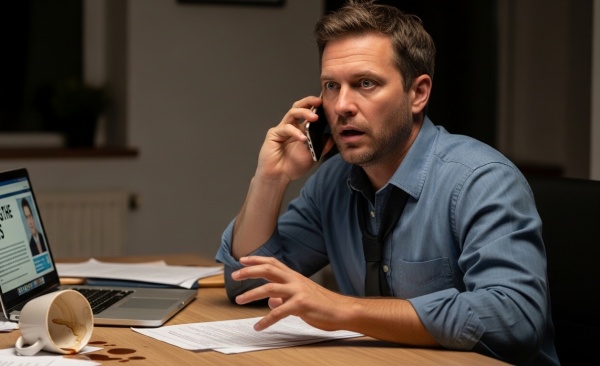
Divorced 3 Years. 3 A.M. Phone Call. “Your Ex-Wife Is in Surgery — You’re Her Emergency Contact.” I Drove 60 MPH Through a Dark Highway and Didn’t Look Back.…
I hadn’t spoken to my ex-wife in 847 days. I was in my car and on the highway before I even hung up the phone.
PART 1: THE MAN I HAD BECOME
Let me tell you who I was before that phone call.
My name is Ryan Calloway. I’m 41 years old, and I live in a two-bedroom rental on the east side of Columbus, Ohio, in a neighborhood where the houses are close together and everyone minds their own business, which suits me just fine. I work in logistics for a regional freight company — spreadsheets, dispatch schedules, the occasional vendor call. It’s not glamorous. It pays the bills and leaves enough left over for groceries, my daughter’s soccer cleats, and the cheap bourbon I keep on the kitchen counter for Friday nights.
My daughter is Lily. She’s nine. She has her mother’s dark eyes and my stubborn streak, and she is, without question, the best thing I have ever done with my life.
I have Lily every other week — Monday through Sunday, alternating. On my weeks, I pack her lunch with a note tucked inside, help with her spelling homework at the kitchen table, and sit in the cold on Saturday mornings watching her chase a soccer ball across a muddy field in Dublin, Ohio, cheering louder than any other parent in the bleachers. On my off weeks, the apartment is very quiet. I’ve learned to fill the silence with routine: the gym at 6 AM, work, dinner for one, the television on low.
I don’t date. I’ve tried twice since the divorce and both times it felt like wearing someone else’s coat — technically functional, fundamentally wrong. So I stopped trying and told myself I was fine with that, and most days I almost believed it.
My ex-wife’s name is Melissa. We were married for eight years. We met in our late twenties at a mutual friend’s backyard cookout in Westerville — she was laughing at something across the yard and I walked over without a plan and said something I can’t even remember now, and somehow it worked. We were good together for a long time. Then we weren’t. The divorce was mutual in the way that most divorces are mutual: both people had been unhappy long enough that the paperwork felt like relief.
We split custody of Lily down the middle. We were civil. We communicated through a co-parenting app — pickup times, school events, doctor appointments, the logistics of raising a child in two separate homes. We did not have conversations. We did not ask how the other person was doing. We had an arrangement, and the arrangement worked, and I told myself that was enough.
The last time I had a real conversation with Melissa — not a logistics exchange, an actual conversation — was 847 days before the phone rang at 3:04 AM on a Tuesday in February.
I know the number because I counted.
PART 2: THE CALL
My phone was on the nightstand. The screen lit up the ceiling.
The number wasn’t Melissa’s. It was a 614 area code I didn’t recognize, and my first half-asleep thought was that it was a wrong number or a scam. I almost let it go to voicemail.
I answered on the fourth ring.
“Is this Ryan Calloway?” A woman’s voice. Professional, controlled, but with an edge underneath it that I recognized immediately — the edge of someone delivering bad news and trying to do it carefully.
“Yes.”
“Mr. Calloway, my name is Dr. Patricia Nguyen. I’m the attending trauma surgeon at OhioHealth Riverside Methodist Hospital. I’m calling about Melissa Calloway.”
My stomach dropped before she finished the sentence.
“She was brought in by ambulance approximately forty minutes ago. She was involved in a serious car accident on I-270 near the Sawmill Road exit. She has significant internal injuries and she’s in surgery right now.”
I was sitting up. I don’t remember sitting up.
“We found your number listed as her emergency contact,” Dr. Nguyen continued. “Her parents are in Florida and can’t get here until morning. Her sister is in Seattle. You are currently the closest family contact we have on file.”
“How serious?” I asked. My voice came out steadier than I felt.
A pause. The kind of pause that tells you more than the words that follow.
“She’s in critical condition, Mr. Calloway. The surgical team is doing everything they can. But if there are decisions that need to be made — and there may be — we need someone here who can act as next of kin. Her parents have given verbal authorization over the phone, but they’ve asked if there’s someone who can be physically present.”
“Where is my daughter?” The question came out before anything else.
“Lily is here. She was in the car. She has a broken wrist and some lacerations, but she’s stable. She’s been asking for her dad.”
I was already out of bed. Already reaching for my jeans on the chair.
“I’m on my way,” I said. “Twenty minutes.”
I was in my car in four.
PART 3: THE HOSPITAL
I-270 at 3 AM in February is a different highway than it is at rush hour. Dark, mostly empty, the kind of drive where your headlights feel like the only light in the world. I drove faster than I should have and I don’t apologize for it.
The ER entrance at Riverside Methodist was lit up white against the dark. I parked in the first space I found, didn’t check if it was legal, and walked through the sliding doors into the particular cold brightness of a hospital at night.
A nurse at the desk recognized my name immediately — they’d been expecting me — and walked me back without making me wait.
Lily was in a curtained bay in the pediatric section of the ER. She was sitting up on the gurney in a hospital gown, her left wrist wrapped in a temporary splint, a small bandage above her right eyebrow. She looked small and pale and absolutely terrified.
When she saw me, she burst into tears.
I crossed the room in three steps and pulled her against my chest and held her there, and I didn’t say anything for a long moment because there was nothing to say that mattered more than just being there.
“Daddy,” she kept saying. Just that. “Daddy.”
“I’ve got you,” I told her. “I’m right here. I’ve got you.”
When she finally pulled back enough to look at me, her eyes were red and her voice was shaking. “Is Mommy going to be okay?”
I looked at her face — nine years old, terrified, needing an answer I didn’t have — and I made the only decision available to me.
“The doctors are taking care of her right now,” I said. “They’re really good at their jobs. And I’m going to stay right here with you until we know more. Okay?”
She nodded and pressed her face back into my shoulder.
I sat on the edge of that gurney and held my daughter and waited.
PART 4: THE WAITING ROOM
Dr. Nguyen found me in the surgical waiting room at around 4:30 AM. Lily had finally fallen asleep against my arm, her splinted wrist resting carefully in her lap.
The doctor was younger than I’d expected from her voice — mid-forties maybe, with the particular composure of someone who has delivered difficult news enough times to have developed a kind of practiced steadiness. She sat down across from me and leaned forward slightly, elbows on her knees.
“She’s out of immediate danger,” she said.
I let out a breath I felt like I’d been holding since the phone rang.
“She had a ruptured spleen and significant internal bleeding. We’ve repaired the damage, but she’s going to be in the ICU for at least the next forty-eight hours. The next twenty-four are still critical — we need to watch for complications.”
“But she’s alive.”
“She’s alive.”
I looked down at Lily sleeping against my arm.
“What happened?” I asked.
“A driver ran a red light on Sawmill. Hit the driver’s side. Your ex-wife took the full impact.” Dr. Nguyen paused. “She was wearing her seatbelt. It made a significant difference.”
I nodded. I didn’t trust my voice right then.
“Her parents will be here by morning,” the doctor said. “Is there anything you need right now?”
I looked around the waiting room — the vending machine humming in the corner, the fluorescent lights, the institutional carpet, the particular suspended-time feeling of a hospital at 4:30 in the morning.
“No,” I said. “I’m okay. We’re okay.”
I wasn’t entirely sure that was true. But Lily was asleep, and Melissa was alive, and that was enough to hold onto for now.
PART 5: THE MORNING
Melissa’s parents, Frank and Carol, arrived at 7:15 AM. Carol walked into the waiting room and stopped when she saw me — a brief flicker of surprise, then something warmer.
“Ryan.” She crossed the room and hugged me, which I hadn’t expected. “Thank you for coming. Thank you for being here with Lily.”
“There was nowhere else to be,” I said.
Frank shook my hand. He’s a quiet man, always has been — the kind of father-in-law who communicates primarily through firm handshakes and the occasional nod of approval. The handshake he gave me that morning was the longest one I could remember.
Lily woke up when she heard her grandparents’ voices and went to them immediately, and watching Carol hold her granddaughter in that waiting room — both of them crying, Lily’s splinted wrist held carefully out to the side — was the kind of moment that makes you recalibrate what actually matters.
At 9 AM, the ICU nurse told us Melissa was stable and conscious and could have one visitor at a time for short periods.
Carol went first. Then Frank. Then they looked at me.
“You should go,” Carol said. It wasn’t a question.
“I don’t know if she’d want—”
“Ryan.” Carol’s voice was gentle but firm. “Go.”
PART 6: THE ROOM
The ICU was quiet in the specific way that only ICUs are quiet — the hum of monitors, the soft beeping of machines, the hushed efficiency of nurses moving between curtained spaces. A nurse walked me to bay seven and pulled the curtain back slightly.
Melissa was propped up at a slight angle, an IV in her left arm, a monitor clipped to her finger, a bruise spreading along her left cheekbone that hadn’t been there the last time I saw her face. She looked pale and exhausted and smaller than I remembered.
She also looked alive, which was the only thing that mattered.
She opened her eyes when she heard me come in. For a moment, neither of us said anything. Three years of careful distance, of co-parenting app messages and school pickup logistics, of two people who had once known everything about each other choosing to know almost nothing — all of it sitting in the space between the door and her bed.
“You came,” she said. Her voice was rough from the breathing tube they’d removed an hour earlier.
“Of course I came.”
“You didn’t have to.”
“Melissa.” I pulled the chair close to the bed and sat down. “Lily was here. You were in surgery. Where else would I be?”
She looked at me for a long moment. Her eyes were wet, but she wasn’t crying — she seemed to be conserving energy for something.
“How is she?” she asked. “Tell me the truth.”
“Broken wrist. A cut above her eyebrow that they glued shut. She’s scared, but she’s okay. She’s with your parents right now. She’s been asking about you every twenty minutes.”
Something in Melissa’s face released — a tension she’d been holding since she woke up.
“She was so scared,” Melissa whispered. “In the car, right after it happened. She kept saying ‘Mommy, Mommy’ and I couldn’t — I couldn’t move and I couldn’t—” Her voice broke.
“She’s okay,” I said. “She’s okay. You kept her safe.”
“I didn’t do anything.”
“You were wearing your seatbelt. You made sure she was wearing hers. You did everything right.”
She closed her eyes. A tear moved down her cheek, tracing the edge of the bruise.
We sat in silence for a moment. The monitors beeped steadily. Outside the curtain, a nurse moved past.
“Ryan,” she said, without opening her eyes. “I’m sorry.”
I knew she didn’t mean the accident.
“Me too,” I said.
And I meant it the same way she did.
PART 7: THE HALLWAY CONVERSATION
I stepped out to let her rest and found Carol waiting in the hallway with two cups of coffee from the vending machine. She handed me one without asking.
We stood against the wall in the particular way that people stand in hospital hallways — side by side, looking at nothing, talking to the middle distance.
“She listed you as her emergency contact,” Carol said. “Did you know that?”
“No.”
“She updated it about six months ago. I saw it on some paperwork.” A pause. “I thought that was interesting.”
I didn’t say anything.
“She doesn’t talk about you,” Carol continued. “Not in a bitter way. Just — she doesn’t. But I’m her mother. I notice things.” She wrapped both hands around her coffee cup. “She’s been lonely, Ryan. Not in a way she’d ever admit. But lonely.”
“Carol—”
“I’m not telling you what to do. I’m not even suggesting anything. I’m just telling you what I see.” She looked at me directly. “And what I see right now is a man who drove across Columbus at 3 AM for a woman he’s been pretending doesn’t matter to him for three years.”
I looked down at the coffee cup in my hands.
“We didn’t work,” I said. “There were real reasons for that.”
“I know,” she said. “I was there, remember? I watched both of you.” She was quiet for a moment. “But I also watched two people who stopped trying at the same time. That’s different from two people who were wrong for each other.”
She pushed off from the wall.
“Lily’s going to need both of you more than ever for the next few weeks,” she said. “That’s all I’ll say.”
She walked back toward the waiting room, and I stood in that hallway for a long time, holding a cup of terrible vending machine coffee, thinking about the difference between a marriage that failed and two people who stopped trying at the same time.
PART 8: WHAT HAPPENED NEXT
Melissa was in the hospital for six days.
I won’t tell you that those six days were a movie — that we had some dramatic reconciliation scene with the monitors beeping in the background and everything resolved neatly. That’s not what happened. What happened was messier and quieter and more real than that.
I came back every day. Not because anyone asked me to — Melissa’s parents were there, her sister flew in from Seattle on day two — but because Lily needed consistency, and because every morning when I thought about not going, I found I couldn’t justify it.
On day three, Melissa and I had the first real conversation we’d had in nearly three years. Not about Lily’s schedule or school pickups. About us. About what had gone wrong. About the specific, accumulated ways that two people who loved each other had managed to make each other miserable — the long work hours, the unspoken resentments, the slow drift from partners into roommates into strangers sharing a mortgage.
It wasn’t a comfortable conversation. It wasn’t resolved in an afternoon. But it was honest, and honest felt like something.
On day five, she asked me to bring her the good coffee — not the hospital stuff — from the Starbucks on Fifth Avenue. I brought it with a sleeve of those shortbread cookies she’d always liked. She didn’t comment on the cookies. She just opened the package and ate three of them without a word, and somehow that felt like more than a conversation.
On day six, when the discharge paperwork was being processed, she looked at me from the bed and said: “I don’t know what this is. I don’t know what any of this means. But I don’t want to go back to the way things were. The silence. The arrangement. I don’t want that anymore.”
“Neither do I,” I said.
“I’m not saying—” She stopped. Started again. “I’m not saying I know what I want. I’m just saying I know what I don’t want.”
“That’s a start,” I said.
She almost smiled. “It’s a very small start.”
“Small starts are still starts.”
EPILOGUE: WHERE WE ARE NOW
It’s been four months since that phone call.
I won’t wrap this up in a bow, because life doesn’t work that way and anyone who tells you otherwise is selling something.
Here’s what I can tell you:
Melissa’s recovery took eight weeks. She’s back at work now — she’s a physical therapist at a clinic in Worthington, which, given everything, strikes both of us as either deeply ironic or perfectly appropriate. Lily’s wrist healed clean. She was back on the soccer field six weeks after the accident, and the first Saturday I sat in those bleachers watching her run, I cried behind my sunglasses like a complete idiot and I’m not even slightly embarrassed about it.
Melissa and I are not back together. I want to be clear about that, because this isn’t that kind of story — or at least, it’s not that kind of story yet. What we are is something we don’t have a clean word for. We have coffee sometimes, the three of us, on Sunday mornings. We talk — actually talk, not just logistics. We’re learning, slowly and carefully, how to be people to each other again instead of just co-parents with an app.
Last week, Lily asked me at dinner if Mommy and I were going to get married again.
I told her I didn’t know.
She thought about that for a second, then said: “That’s okay, Daddy. At least you’re friends now. That’s better than before.”
Nine years old. She’s smarter than both of us.
Carol called me last Sunday. Just to check in, she said. At the end of the call, she said: “You know, Ryan, most people would have let that call go to voicemail.”
“I almost did,” I told her.
“But you didn’t.”
“No,” I said. “I didn’t.”
I think about that sometimes. The version of that night where I let it ring. Where I rolled over and went back to sleep and found out in the morning through a text. Where Lily sat in that ER bay alone for four hours asking for her dad and nobody came.
I can’t live in that version. I won’t.
What I know is this: a phone call at 3 AM has a way of burning through everything that isn’t essential. The resentments, the distance, the careful walls you build to protect yourself from people who once knew you completely — all of it falls away when the only thing that matters is getting to the hospital before something irreversible happens.
I don’t know what Melissa and I are becoming. I don’t know if we’re building something new or just slowly remembering something old. Maybe it doesn’t matter what we call it.
What matters is that Lily has two parents who are present. What matters is that the silence between Melissa and me is no longer the cold, careful silence of two people avoiding each other — it’s the comfortable silence of two people who have been through something together and come out the other side still standing.
What matters is that I answered the phone.
Have you ever gotten a call that changed everything? Or been the person who almost didn’t pick up? Tell me in the comments — I read every single one. 👇
Share this for every parent who would drive across the city at 3 AM without a second thought. You know who you are. ❤️
