I Thought My Wife Cheated Because Our Daughter Looked Nothing Like Us — Then the DNA Test Revealed Something Worse
Part 1: The Beauty That Made Me Question Everything
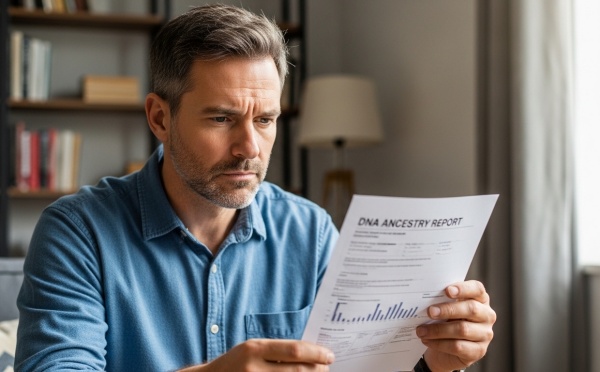
My name is David Chen, and I am 34 years old, and I am writing this from the living room of our home in Sacramento, California, where my wife Emily and I have been sitting in silence for the past three hours, staring at a DNA test result that has destroyed everything we thought we knew about our family. The document is printed on standard white paper with the logo of GeneDx Laboratory at the top, and it contains three names: mine, my wife’s, and our daughter Lily’s.
The conclusion, typed in bold letters at the bottom of the page, reads: “Probability of biological relationship: 0%. Neither tested individual is the biological parent of the child.” I am writing this because I need to document what happened, because the story is so impossible that I am still struggling to believe it myself, and because I think other families need to know that this can happen — that the child you love and raise can turn out not to be yours through no one’s fault, and that the truth can be both devastating and necessary at the same time.
I need to describe Lily before I describe the suspicion that led to the DNA test, because understanding what she looks like is essential to understanding why I began to doubt. Lily is five years old, and she is beautiful in a way that makes strangers stop us on the street to comment. She has large, dark eyes with long lashes, delicate features, porcelain skin, and thick black hair that falls in natural waves down her back.
She is petite and graceful, with the kind of natural elegance that seems impossible in a kindergartener. People tell us constantly that she should be a child model, that she is the prettiest little girl they have ever seen, that we are so lucky to have such a beautiful daughter. And every time someone says this, I smile and say thank you, but inside I feel a growing sense of unease.
The unease started when Lily was about two years old and her features began to really develop and take shape. I looked at her face and I looked at my face and I looked at Emily’s face, and I could not find a single feature that matched. Emily is Chinese-American, with round features, a wider nose, and straight black hair. I am also Chinese-American, tall and lean with angular features and glasses that I have worn since I was twelve.
Lily looks nothing like either of us. Her eyes are a different shape — larger, more almond-shaped, with a specific delicacy that neither Emily nor I possess. Her nose is small and perfectly straight, while both Emily and I have broader noses. Her face is heart-shaped, while ours are rounder. Even her skin tone is different — paler, more translucent, while Emily and I both have warmer, golden undertones.
I told myself that genetics are unpredictable, that children can inherit features from grandparents or great-grandparents, that I was being paranoid. But as Lily got older and the differences became more pronounced, I could not shake the feeling that something was wrong. Family members began to comment on it too. My mother said, “Lily is so beautiful, but she doesn’t look like anyone in our family.” Emily’s sister said, “Where did Lily get those eyes?
No one on our side looks like that.” At Lily’s fifth birthday party last month, one of Emily’s cousins pulled me aside and said, in a voice that was meant to be joking but that I knew was serious, “Are you sure that’s your kid? She doesn’t look anything like you or Emily.”
Part 2: The First Test and the Result That Destroyed My Trust
I lived with the suspicion for months before I did anything about it. I did not want to believe that Emily had been unfaithful, did not want to imagine that the daughter I loved was not mine, did not want to destroy our family based on a feeling. But the feeling would not go away. It kept me awake at night. It made me watch Emily for signs of guilt or deception. It made me look at Lily and wonder whose child she really was. Finally, in February, I made a decision.
I collected a sample of Lily’s hair from her hairbrush and clippings from her fingernails after I trimmed them one evening, and I sent them along with a cheek swab from myself to a DNA testing company called Paternity Depot that I found online. I did not tell Emily. I told myself I would only tell her if the results showed something wrong.
The results came back two weeks later. I opened the email on my phone while I was at work, sitting in my cubicle at the software company where I work as a developer. The subject line said “Your DNA Test Results Are Ready.” I clicked on the link with my heart pounding. The report loaded on the screen. I scrolled down to the conclusion: “Probability of paternity: 0%. The tested man is excluded as the biological father of the tested child.” I stared at the screen for a long time. Then I closed my laptop, walked to the bathroom, and threw up.
I did not go home that night until late. I drove around Sacramento for hours, trying to process what I had learned, trying to decide what to do. The result was clear: Lily was not my biological daughter. Which meant that Emily had been unfaithful, had gotten pregnant with another man’s child, and had lied to me for five years. I felt betrayed, devastated, furious. But I also felt a terrible sadness, because I loved Lily. I had raised her from birth.
I had changed her diapers, walked her to sleep, taught her to ride a bike, read her bedtime stories every night. She called me Daddy. She ran to me when I came home from work. She was my daughter in every way that mattered except biology. And now I had to face the fact that she was not mine.
But I am a careful person, methodical, trained by my work as a software developer to verify results before acting on them. I knew that DNA tests could be wrong, that there could be errors in the lab or contamination of the samples. So before I confronted Emily, I decided to do a second test with a different company.
I collected new samples — this time hair and saliva from Lily — and I sent them along with my own samples to a different laboratory called DNA Diagnostics Center. I waited another two weeks. The results came back identical to the first test: “Probability of paternity: 0%. The tested man is excluded as the biological father of the tested child.”
Part 3: The Confrontation and the Third Test That Changed Everything
I confronted Emily on a Saturday morning in March. Lily was at a playdate at her friend’s house, and Emily and I were alone in the kitchen. I put both DNA test results on the table in front of her and I said, “I need you to explain this.” Emily looked at the papers. Her face went pale. She picked up the first result and read it, then the second. Then she looked at me with an expression of complete shock and confusion. “What is this?” she said. “These say Lily isn’t your daughter. That’s impossible.”
“Is it?” I said, my voice harder than I intended. “Because the tests say otherwise. Two different tests, two different labs, same result. Lily is not my biological daughter. Which means you had an affair and you lied to me for five years.” Emily’s eyes filled with tears. “David, I swear to you, I never had an affair. I have never been with anyone else. Not before we got married, not after. Lily is our daughter. There has to be a mistake.”
“There’s no mistake,” I said. “I did two tests to make sure. The results are clear.” Emily was crying now, shaking her head. “Then test me,” she said. “If you think I had an affair, test my DNA with Lily’s. Prove that she’s mine. Because I know she is. I gave birth to her. I was there. There is no way she’s not my daughter.”
I stared at her. The certainty in her voice, the genuine confusion and pain in her eyes — it did not match what I expected from someone who had been caught in a lie. I said, “Fine. We’ll do a third test. You, me, and Lily. All three of us. And when it shows that she’s yours and not mine, we’re going to have a very different conversation about who the father is.”
We went to a medical clinic that same day and had official DNA samples collected — cheek swabs from all three of us, witnessed and documented by a nurse, sent to a certified laboratory called Labcorp. We were told the results would take seven to ten business days.
Those ten days were the longest of my life. Emily and I barely spoke. We went through the motions of parenting Lily, but the tension between us was suffocating. I slept in the guest room. Emily cried herself to sleep every night. And Lily, sweet, innocent Lily, kept asking why Mommy and Daddy were sad.
The results came back on a Thursday. The clinic called and asked us to come in to discuss them in person, which I knew was not a good sign — they only ask you to come in when the results are complicated or sensitive. Emily and I drove to the clinic in silence. We sat in a small consultation room with a genetic counselor named Dr. Patricia Huang, who looked at us with an expression of professional sympathy and said, “I need to share some very unusual results with you. The DNA test shows that neither of you is the biological parent of your daughter Lily.”
Part 4: The Hospital Mix-Up and the Search for Our Biological Child
The silence in that room was absolute. Emily made a sound like she had been punched in the stomach. I could not breathe. Dr. Huang continued, speaking carefully and gently. “This result indicates that there was likely a mix-up at the hospital where your daughter was born. It’s extremely rare, but it does happen.
Babies can be accidentally switched in the nursery, given to the wrong parents. Based on these results, the child you have been raising is not biologically related to either of you, which means your biological child is somewhere else, being raised by another family.”
Emily started sobbing — deep, wrenching sobs that shook her whole body. I sat frozen, unable to process what I was hearing. Dr. Huang gave us time to absorb the information, then said, “I know this is devastating. But I want you to know that there are steps we can take. We can contact the hospital where Lily was born and request an investigation. We can try to identify other babies who were born around the same time and see if there was a mix-up. There are legal processes for this. You are not alone.”
We left the clinic in a daze. When we got home, Emily’s mother was there watching Lily. Lily ran to us, happy and smiling, saying “Mommy! Daddy!” and I picked her up and held her and I started crying for the first time since this whole nightmare began. Because this beautiful little girl who I had loved and raised for five years was not mine. And somewhere out there was another little girl, my biological daughter, who I had never met, who was being raised by strangers, who did not know I existed.
Emily’s mother asked what was wrong. We told her. She stared at us in disbelief, then she collapsed — literally fainted and fell to the floor. We called 911. She was taken to the hospital and treated for shock and low blood pressure. She recovered, but the news devastated her. Lily was her only grandchild, the center of her world, and learning that Lily was not actually her biological granddaughter broke something in her.
We contacted the hospital where Lily was born — Mercy General Hospital in Sacramento. We provided the DNA test results and requested an investigation. The hospital’s risk management department took the case seriously. They pulled records from the maternity ward from the week Lily was born in February five years ago.
They identified three other baby girls who were born within 24 hours of Lily’s birth. They contacted those families and explained the situation and requested that they consent to DNA testing. Two families agreed immediately. The third family initially refused, but after the hospital explained the legal implications and the possibility of a lawsuit, they agreed.
Part 5: The Truth We Found and the Impossible Decisions We Face
The DNA results from the three families came back six weeks later. One of the families — a couple named James and Michelle Rodriguez — was a match. Their daughter, Sofia, who they had been raising for five years, was biologically mine and Emily’s. And our daughter Lily was biologically theirs.
The hospital confirmed that there had been a mix-up in the nursery on the night of February 14th, five years ago, when both babies were born within two hours of each other. A nurse had accidentally placed the identification bracelets on the wrong babies, and no one had caught the error. We had each taken home the wrong child.
We met the Rodriguez family for the first time in May, in a conference room at the hospital with attorneys and social workers present. It was the most surreal and painful experience of my life. James and Michelle looked as devastated as we felt. We looked at Sofia — our biological daughter — and she looked at us like we were strangers, which we were.
She had Emily’s round face and my angular features. She looked like she could be our daughter. But she did not know us. She clung to Michelle and called her Mommy. And Lily, sitting on Emily’s lap, looked at James and Michelle with the same wariness, because they were strangers to her too.
The question we are facing now — the question that keeps me awake every night — is what to do. Do we switch the children back? Do we try to raise our biological daughter and give Lily back to her biological parents? The social workers and attorneys tell us that this is one of the most complicated situations in family law, that there is no clear right answer, that we need to prioritize what is best for the children.
But what is best? Sofia has been raised by the Rodriguez family for five years. She loves them. They love her. Lily has been raised by us for five years. She loves us. We love her. Switching them would traumatize both children, would tear them away from the only parents they have ever known.
But we also cannot ignore biology. Sofia is my biological daughter. She has my genes, my family’s medical history, my heritage. I have a right to know her, to raise her, to be her father. And the Rodriguez family has the same right to Lily. We are currently in mediation, trying to find a solution that works for everyone.
The options being discussed include: shared custody arrangements where both children spend time with both families; keeping the children with their current families but allowing regular visitation with their biological families; or, the most drastic option, switching the children back and providing intensive therapy and support to help them adjust.
I am 34 years old and I am writing this from a home that no longer feels stable or certain, where the daughter I love may not be mine to keep, and where the daughter I have never met may become part of my life in ways I cannot yet imagine. I am writing this because I want other parents to know that hospital mix-ups, while rare, are real.
I want hospitals to implement better safeguards — DNA testing at birth, more careful identification procedures, anything that can prevent this from happening to another family. And I am writing this because I do not know what the right answer is, and I hope that by telling this story, someone who has been through something similar can tell me how they survived it.
Lily is not my biological daughter. But she is the child I have raised, the child who calls me Daddy, the child whose face I see when I close my eyes. Sofia is my biological daughter. But she is a stranger, a little girl I do not know, who does not know me. I love them both. And I do not know how to move forward in a way that does not break someone’s heart.
