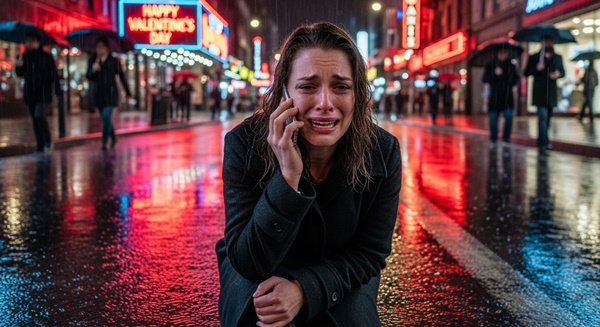
50 MISSED CALLS ON VALENTINE’S NIGHT — AND HIS WIFE’S LAST TEXT: “Honey… our son…”
HE TURNED OFF HIS PHONE TO SPEND VALENTINE’S WITH HIS MISTRESS. WHEN HE FINALLY TURNED IT BACK ON, HE DIDN’T JUST LOSE HIS MARRIAGE. HE LOST EVERYTHING THAT EVER MATTERED.
This is not a love story. This is a story about the exact moment a man realized that the life he threw away was the only one he was ever going to get.
PART 1: THE SMUG VICTOR
February 15th. 7:04 AM.
The cold Atlantic wind was already cutting through the canyons of Midtown Manhattan, carrying the smell of rain and wet concrete and the particular kind of quiet that only exists in a city of eight million people on the morning after Valentine’s Day — when the roses are already wilting in trash cans on every corner and the chocolate boxes are half-eaten and the magic, such as it was, is already gone.
Inside Suite 1408 at the Marriott Marquis on Broadway, none of that mattered to me.
The air in the room was thick — expensive bourbon, room service leftovers, and the particular staleness of a space where someone has been telling themselves a very comfortable lie for several hours. I stretched my arms across the silk sheets and stared at the ceiling with the slow, satisfied feeling of a man who believes he has gotten away with something.
Next to me, Tiffany — the 23-year-old “marketing intern” I’d been seeing behind my wife’s back for four months — was still asleep, her dark hair fanned across the pillow, completely unbothered by the world.
I was Tyler Davis. Thirty-six years old. Senior VP at a mid-size financial consulting firm in the Flatiron District. Married seven years to Sarah, the most patient woman I had ever met and, as I would soon understand, the most devastated. Father to Leo — four years old, obsessed with dinosaurs, the kind of kid who drew hearts on everything and handed them to strangers on the subway just because he thought it would make them smile.
I had told Sarah I had a last-minute corporate crisis. An emergency board meeting. An audit that couldn’t wait, not even on Valentine’s Day. I had looked her in the eyes and said it without flinching. I had kissed Leo on the top of his head — he was holding a construction paper Valentine’s card he’d been coloring all afternoon, red crayon, lopsided heart, “DADY I LUV YOU” in his best four-year-old handwriting — and I had walked out the door of our apartment on the Upper West Side and gotten into a cab heading downtown.
I powered my iPhone off at 8:00 PM sharp. I didn’t want interruptions. I didn’t want guilt. I didn’t want the buzzing reminder that I had a wife and a son and a life that I was in the process of quietly dismantling.
I thought I was being smart.
I reached for the phone on the nightstand, already composing my excuse in my head. Battery died. Crashed on the office couch. Merger negotiations ran until 3 AM. You know how it is, honey.
I pressed the power button.
PART 2: THE BLEEDING RED NOTIFICATIONS
The screen lit up.
Then the phone started vibrating.
It didn’t stop.
Notifications cascaded down the lock screen so fast the interface froze — just locked up completely for four or five full seconds, like the phone itself was struggling to process the volume of what had happened while I was asleep. When the screen finally caught up, I saw it.
A number in bright, unforgiving red.
50 Missed Calls.
Every single one from the same contact: Wife ❤️
The smug feeling evaporated so completely it was like it had never existed. My stomach dropped through the mattress. My hands went cold. I sat up straight, suddenly wide awake in a way that had nothing to do with the morning and everything to do with dread.
The apartment. Did something happen to the apartment? A fire? A break-in? Did she fall?
I swiped to the message thread. The texts began at 10:15 PM — and reading them was like watching a car accident in slow motion, frame by frame, completely unable to look away.
10:15 PM: “Tyler, pick up the phone. Where are you?? This isn’t funny anymore. I’ve been calling for an hour.”
10:42 PM: “There was an accident. Leo fell from the loft bed. He hit his head. It’s bad. An ambulance is here right now. PLEASE call me back.”
11:05 PM: “We’re at NewYork-Presbyterian Emergency. The doctors need your consent for surgery. Tyler, where ARE you?? He’s asking for you.”
11:58 PM: “They’re taking him into the OR. I’m signing the consent alone. I don’t understand. I don’t understand where you are.”
12:30 AM: “He’s in surgery. It’s been 90 minutes. He’s only four years old, Tyler. He’s four. Please. Please just come.”
1:47 AM: “I called your office. No one is there. There was no board meeting tonight. The building was locked at 9 PM.”
2:55 AM: “He needed a blood transfusion. You have the same rare type. We couldn’t find you. I had to find a donor through the hospital registry. It took two hours.”
3:17 AM — the last message:
“Tyler… our son… he made it through. But I need you to understand something. I called you fifty times tonight. Fifty. And you didn’t answer once. I know where you were. I checked the Tesla app. I saw the GPS. I know everything. Don’t come to this hospital. I don’t want to see your face. I’m done.”
The phone slipped out of my hand and hit the hardwood floor with a crack that sounded like a gunshot in the quiet room.
Tiffany stirred. “Tyler? What’s wrong?”
I didn’t answer her. I was already off the bed, grabbing my pants from the floor, my shirt from the chair, my jacket from the door handle, moving with the frantic, clumsy energy of a man who has just understood — truly understood, in his chest and his gut and his bones — the full weight of what he has done.
PART 3: THE MORNING AFTER
I ran out of that hotel with one shoe untied and my collar open, pushing through the revolving door into the cold February air of Broadway at 7:15 AM. The city was already moving — delivery trucks, dog walkers, the morning shift heading into the subway — and none of it cared about me at all.
I hailed a cab heading uptown. The driver had a radio on low, some morning show playing a recap of Valentine’s Day highlights — best proposals, romantic gestures, couples who’d been together for fifty years. I stared out the rain-streaked window and felt the memories come in like a tide I couldn’t stop.
Yesterday afternoon. Our apartment. Leo at the kitchen table with his crayons, his tongue pressed between his teeth in concentration, working on that Valentine’s card with the focused seriousness that only four-year-olds bring to art projects. He’d held it up when I walked through to get my coat.
“Daddy, look! I made a heart for you! It’s the biggest heart because you’re my favorite daddy!”
I had ruffled his hair. I had said “That’s great, buddy” in the distracted, half-present way of a man who is already somewhere else in his head. I had not sat down. I had not looked at the card properly. I had kissed Sarah on the cheek — a performative, guilty kiss — and I had walked out the door.
That was the last normal moment my family ever had.
And I had been in a hotel bar ordering a second round of Scotch while it was happening.
The cab pulled up to NewYork-Presbyterian on 168th Street. I shoved two twenties at the driver without waiting for change and ran through the sliding doors.
PART 4: THE HOSPITAL
“Leo Davis,” I said to the woman at the ER intake desk. “My son. He was brought in last night. Head trauma.”
She looked at me — wrinkled suit, bourbon still faint on my breath, a smudge of lipstick on my collar that I hadn’t noticed yet, the general appearance of a man who had not slept in a hospital waiting room but had very clearly slept somewhere — and her expression went through several stages in about two seconds.
“Sir, are you a family member?”
“I’m his father.”
She picked up the phone.
My mother found me before the nurse came back. She was sitting in the waiting area off the main corridor — I almost walked past her — and when she stood up and I saw her face, I knew that whatever I said, whatever excuse I had been half-forming in the cab, was not going to matter at all.
She crossed the distance between us in three steps and slapped me so hard across the face that my ears rang.
The waiting room went quiet.
“He survived,” she said, her voice barely above a whisper, which was somehow worse than if she had screamed. “He survived a two-hour brain surgery at two in the morning. He needed a blood transfusion, Tyler. He has your blood type — O-negative, one in fifteen people. We spent two hours trying to find a compatible donor because we could not find you.“
I opened my mouth.
“Don’t.” She held up her hand. “Your father-in-law drove here from Westchester in a snowstorm. Your wife signed surgical consent forms alone at midnight. And you—” she looked at me the way a person looks at something they no longer recognize — “you were at the Marriott Marquis. The GPS doesn’t lie.”
My father-in-law, Frank, was standing near the window. He was a big man, a retired NYPD detective, the kind of person who had spent thirty years seeing the worst of what people do to each other and had developed a very particular kind of quiet anger as a result. He looked at me once — just once — and then looked away, like I wasn’t worth the sustained attention.
I sat down on the floor. Not in a chair. On the actual floor, my back against the wall, my head in my hands.
Because there was nothing to say. There is no sentence in the English language that begins with “I can explain” and ends with anything that makes this okay.
PART 5: THE PAPERS
The ICU door opened at 8:30 AM.
Sarah walked out.
I had last seen her twenty-four hours ago — put-together, patient, in the yellow sweater she always wore when she was trying to make Valentine’s Day feel special even when I was making it difficult. The woman who walked out of that ICU door was not that woman. She had aged in a way that had nothing to do with time and everything to do with what the night had cost her. Her hair was pulled back roughly. Her eyes were swollen. Her white sweater — the one she’d been wearing when Leo fell — had dark, rust-colored stains on the sleeve and the hem.
I knew what those stains were.
I stood up. “Sarah—”
She stopped walking. She didn’t look at me with rage. She didn’t look at me with grief. She looked at me with something quieter and more final than either of those things — the expression of a person who has made a decision and is completely at peace with it.
She held out a folded set of papers.
“My friend Dana is a family law attorney,” she said. “She drove here from Brooklyn at 4 AM. We drafted these in the family consultation room while Leo was in recovery.”
I took the papers. Divorce filing. New York State. Irreconcilable differences. Sole physical custody of Leo pending court review.
“Sarah, please. Can we just—”
“I called you fifty times,” she said. Her voice was steady in the way that a frozen river is steady — solid on the surface, with something enormous and cold moving underneath. “Fifty times, Tyler. The first twenty, I thought you were in trouble. I thought something had happened to you. I was worried about you while our son was in surgery.”
She paused.
“And then I checked the Tesla app. And I saw that your phone’s last GPS ping before you turned it off was the Marriott Marquis on 45th Street. And I understood.”
I had no words. I had rehearsed excuses for the entire cab ride uptown, and standing in front of her, every single one of them dissolved.
“I’m not going to scream at you,” she said. “I’m not going to make a scene in this hospital. I’m going to go back into that room and sit next to our son, who has a drainage tube in his skull and has been asking for his father since he woke up at 6 AM.”
She took a slow breath.
“When Leo woke up this morning, the first thing he said was, ‘Is Daddy here yet?’“
The words hit me like a physical impact.
“What did you tell him?” I whispered.
She looked at me for a long moment.
“I told him that the daddy he knew wasn’t coming back. That the man who walked out that door last night was a stranger, and that his daddy — the one who loved him — would never have turned off his phone.”
She turned toward the ICU door.
“Don’t be here when I come back out. If you want to see Leo, go through the attorney. Her number is on the last page.”
The door closed behind her with a soft, hydraulic click — the kind of sound that is completely ordinary in a hospital hallway and absolutely devastating in every other way.
PART 6: THE LONG WINTER
I stood in that hallway for a long time.
The divorce papers were in my hand. The fluorescent lights hummed overhead. Somewhere down the corridor, a cart rattled past. A PA system called a doctor’s name. The world kept moving with complete indifference to the fact that mine had just stopped.
I thought about Leo coloring that Valentine’s card at the kitchen table. The biggest heart because I was his favorite daddy. I thought about the 50 missed calls stacked up on my lock screen like a monument to every choice I had made. I thought about Tiffany, probably awake now in that hotel room, wondering where I’d gone, and I felt — for the first time with complete clarity — that she was a stranger to me. A stranger I had chosen over my son’s blood type.
I walked out of the hospital into the February cold.
The rain had stopped, but the sky was the flat, colorless gray of a city that has moved on. On the corner, a bodega had a bucket of Valentine’s roses out front — red, half-wilted, marked down to $6 a bunch. A little boy about Leo’s age was pulling on his mother’s hand, pointing at them.
I sat down on a bench across the street from the hospital entrance and I didn’t move for a very long time.
There is a particular kind of grief that has no name — the grief of a man who has not lost someone to death or distance or fate, but to his own choices, made freely, with full knowledge, in real time. The grief of understanding that the emergency was always real, the love was always real, the child was always real — and you were the variable. You were the thing that failed.
I had spent four months telling myself that what I had with Tiffany was something Sarah couldn’t give me. Excitement. Freedom. The feeling of being chosen. I had built an entire private narrative to justify what I was doing, and that narrative had required me to make Sarah smaller in my mind — more boring, more demanding, less exciting — so that the lie would fit.
Sitting on that bench outside NewYork-Presbyterian, I couldn’t make her smaller anymore.
I could only see her clearly: a woman who had called her husband fifty times while their son was in surgery, who had worried about me while I was the one who had failed, who had sat alone in a consultation room at 4 AM drafting divorce papers with a friend because she had no other options left — and who had done all of it with more dignity than I had shown in four months of deception.
I signed the papers that afternoon. I didn’t fight them.
Leo spent eleven days at NewYork-Presbyterian. He came home with a small scar above his left ear and a renewed obsession with dinosaurs and absolutely no memory of the surgery. Kids are resilient in ways that break your heart.
I see him on the schedule the court approved — every other weekend, Wednesday evenings, alternating holidays. He still draws me hearts sometimes. He hands them to me at the door when Sarah drops him off, and I keep every single one of them.
I don’t know if that makes me a good father or just a man trying to become one.
I gave up the Flatiron apartment. I moved into a one-bedroom in Astoria. I ended things with Tiffany the same morning I left the hospital — a two-sentence text that she deserved more than but that I had nothing else to give. I started seeing a therapist on Tuesday evenings. I am learning, slowly and with great difficulty, to sit with the fact that some things cannot be undone — only carried.
Valentine’s Day is coming around again.
This year, Leo asked me if we could make cards together. Just the two of us, at my kitchen table, with construction paper and red crayons and the particular focused seriousness that he brings to art projects.
I said yes before he finished the sentence.
I will not be turning my phone off.
To the men reading this: No affair is worth what you think it is. No night away is worth fifty missed calls. No lie is worth the look on your child’s face when they ask if you’re coming and the answer is no.
To the women reading this: You deserved fifty calls answered. Every single one.
Tell me honestly in the comments — should she have let him back into Leo’s life at all? Or was giving him visitation already more grace than he deserved? I read every comment. Let’s talk. 👇
Share this if you believe that being present is the only thing that actually matters. 💙
