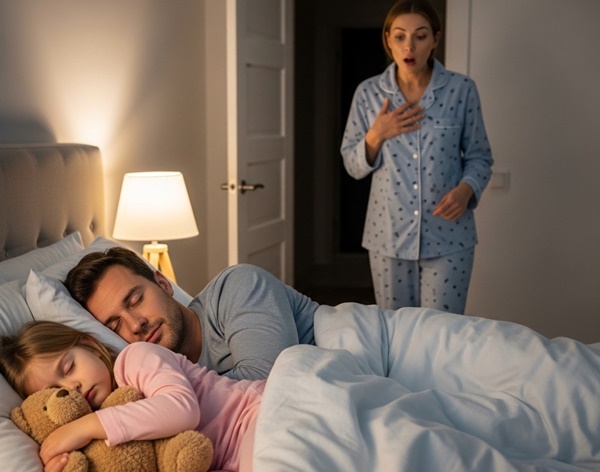
My eight-year-old complained of being “squeezed” in her sleep every night: “Mom, my bed feels too small…”. At 2 a.m., I checked the hidden camera to prove my daughter was just dreaming. What I saw on the screen made my blood run cold, then broke my heart into a million pieces.
PART 1: The Perfection of Suburbia
My name is Sarah Miller, and for a long time, I believed I had “won” at life.
If you drove through our neighborhood in the rolling Hill Country just west of Austin, Texas, you’d see a row of pristine, $850,000 Craftsman-style homes. Ours is the one with the wrap-around porch and a lawn so perfectly manicured it looks like a CGI render.
By day, our life is a whirlwind of Starbucks runs, soccer practices, and high-stakes career moves. My husband, Mark, is a trauma surgeon at one of the busiest Level 1 centers in the state. He’s a man of cold logic, surgical precision, and 80-hour work weeks. I’m a corporate consultant. We are the definition of the “Type A” American power couple.
We have one daughter, Maya. She’s eight, has a wild mane of curls, and an IQ that keeps us on our toes. From the moment we brought her home from the hospital, Mark and I had a blueprint for her life. We weren’t just raising a child; we were engineering an independent woman.
We didn’t do “co-sleeping.” We didn’t do “monsters under the bed.” We raised her to be self-reliant. We started her 529 College Savings Plan before her first tooth fell out. We bought her a Queen-sized Casper mattress with cooling gel technology because, in our minds, comfort plus independence equaled success.
Every night at 8:30 PM, the routine was sacred:
- 20 minutes of reading (Harry Potter or Percy Jackson).
- A glass of filtered water.
- The “Galaxy Projector” turned on to map the stars on her ceiling.
- A kiss on the forehead and my signature line: “See you at sunrise, kiddo. Stay brave.”
Maya was a rockstar. She never cried. She never crept into our room after a nightmare. She was the perfect product of our perfect system.
Until the Tuesday after Labor Day.
PART 2: “Mom, I’m Being Squeezed”
It started over a plate of organic blueberry pancakes and maple syrup.
“Mom,” Maya said, her fork hovering over a pancake. “I think my bed is shrinking.”
I laughed, pouring my second shot of espresso. “Maya, honey, you’re four-foot-two. You have a Queen bed. You could fit a whole WNBA team in there with you.”
She didn’t laugh back. Her little eyebrows knitted together in a way that looked far too old for her face. “I know the math, Mom. But last night… it felt cramped. Like I was being squeezed to the edge. I didn’t have room to turn over.”
“Did you leave your giant Squishmallows on the bed again?” I asked, reaching for my car keys. “I told you, those things take up half the zip code.”
“No,” she whispered. “I put them on the accent chair like you told me to.”
I brushed it off. I figured it was a growth spurt or maybe “proprioception” issues—terms I’d read in Parenting Magazine. I told her to tighten her sheets and caught the school bus.
But Wednesday morning was different. Maya had dark, bruised-looking circles under her eyes. She looked like she’d gone ten rounds in a boxing ring.
“I didn’t sleep at all,” she said, her voice trembling. “I felt like I was being pushed to the very edge of the mattress. I almost fell off twice.”
A cold, sharp needle of dread poked at my chest. This is America in 2026—we all watch too much ID Channel and listen to too many true-crime podcasts. My mind immediately jumped to the “Phrogger” urban legends—strangers living in attics, crawling out at night.
“Maya,” I said, my voice dropping an octave. “Did you see anyone? Did you hear the floorboards creak?”
She looked down at her lap, twisting a loose thread on her hoodie. “No. But I felt… breathing. Warm breath on my neck. And a weight next to me. I thought it was you, Mom. I thought you finally came to sit with me because it was cold. Were you there?”
My blood turned to ice water. “No, baby. I was in my room with Dad all night. The door was locked.”
PART 3: The Digital Witness
I didn’t tell Mark. He was finishing a grueling 24-hour shift at the trauma center and the last thing he needed was “ghost stories.”
Instead, I drove straight to Best Buy. I bought a Google Nest Cam—the one with the 4K sensor and enhanced night vision. I didn’t want a “baby monitor.” I wanted a tactical surveillance tool.
I told Maya it was a “Smart Night Light” to help her feel safe. I mounted it high in the corner of her room, angled to capture the bed, the closet, and the door.
That night, I didn’t go to sleep. I sat on our Italian leather sofa in the living room, the iPad glowing in my hands. The house was silent, save for the rhythmic thump-thump of the dryer and the occasional howl of a coyote in the distance.
- 9:00 PM: Maya is out cold. The galaxy projector is swirling purple and blue across her face.
- 11:30 PM: Mark gets home. He’s a zombie. He kisses my head, mumbles something about a car wreck victim, and collapses in our bedroom.
- 1:00 AM: Nothing. Just the grainy black-and-white feed of a sleeping child.
I must have drifted off. I woke up at 2:14 AM. The iPad had fallen onto the rug. I scrambled to grab it, my heart hammering against my ribs like a trapped bird.
I looked at the screen. My breath hitched.
The bedroom door—which I had personally latched shut—was standing wide open. A dark sliver of the hallway was visible.
Then, a shadow entered the frame.
It was a slow, shuffling movement. Not the aggressive stride of an intruder, but something more haunting. My hand went to my mouth to stifle a scream. I was ready to call 911. I was ready to grab the baseball bat under the bed.
Then, the figure stepped into the soft, rotating light of the galaxy projector.
It wasn’t a burglar. It wasn’t a monster.
It was Evelyn. My mother-in-law.
PART 4: The Ghost of Chicago
Evelyn is 76. She moved in with us six months ago after the “glitches” started. She’d leave the stove on for hours. She’d forget how to get home from the grocery store two blocks away. The doctors at the Mayo Clinic had been clinical and brief: Early-Onset Alzheimer’s.
We had built a beautiful “Mother-in-law suite” on the first floor. We thought we were doing the “right thing.” We provided the best healthcare, the best food, the best environment. But we treated her like a guest in a luxury hotel, not a member of a family.
On the 4K screen, I watched Evelyn approach Maya’s bed. She looked so small. This wasn’t the woman who had once run a famous bakery in Chicago, the woman who could knead dough for ten hours straight. She looked like a ghost of herself.
With agonizing slowness, she lifted the edge of Maya’s $200 weighted blanket. She didn’t make a sound. She climbed into the bed, her movements stiff and fragile.
She didn’t wake Maya. She just lay there on her side, staring at the back of her granddaughter’s head with a look of intense, heartbreaking longing. Then, she reached out a trembling hand and gently stroked Maya’s hair. She whispered something into the air—words the tiny microphone couldn’t pick up.
Maya, in her sleep, instinctively moved to the very edge of the mattress to make room. She wasn’t being “squeezed” by a monster. She was making space for a lonely woman who was drowning in her own vanishing mind.
I sat in the dark living room, tears hot and fast, blurring the screen of the iPad. I wasn’t scared anymore. I was shattered.
PART 5: The Memory of the Cold
I realized in that moment that Evelyn wasn’t “wandering.” She was searching for a version of her life that no longer existed.
Mark’s father had died in a car accident on an icy Chicago road when Mark was only five. Evelyn had been a widow at twenty-six. She had no safety net, no “529 plans,” no $850,000 houses.
Mark once told me a story from his childhood—one I had dismissed as “poverty nostalgia.” He told me that during the brutal Chicago winters, when they couldn’t afford to pay the heating bill for their tiny, drafty apartment, they would sleep in the same bed. Evelyn would wrap him in every coat they owned and hold him close to keep his heart beating warm. She would hum “You Are My Sunshine” until the shivering stopped.
The Alzheimer’s was stripping away her short-term memory, but it was unlocking her deepest, most primal instincts.
At 2 AM, in her mind, she wasn’t in a climate-controlled house in Austin. She was back in that freezing Chicago flat. She was a young, terrified mother, and she was looking for her son. She was looking for the only person who ever made her feel like she had a purpose.
She wasn’t trying to take Maya’s space. She was trying to survive the cold of her own mind.
PART 6: The New American Dream
The next morning, I didn’t call the neurologist. I didn’t look for “Memory Care” facilities.
When Mark woke up, I didn’t say a word. I just handed him the iPad and hit Play on the recorded clip from 2:14 AM.
He sat on the edge of our bed, still in his surgical scrubs. I watched his face change from confusion to horror, and finally, to a raw, soul-crushing grief. He didn’t speak for ten minutes. He just wept—the kind of deep, chest-heaving sobs of a man who realized he’d spent his whole life saving strangers while letting his own mother fade into a shadow in the next room.
“She’s looking for me, Sarah,” he choked out. “She’s freezing, and I’m right here, and she still can’t find me.”
That day, the “Miller Family Manual” went into the trash.
We stopped focusing on “independence” and started focusing on connection. We moved Evelyn’s room upstairs, directly across from ours. We installed a motion-sensor chime, not to “catch” her, but so we could wake up and go to her when she felt lost.
And I sat Maya down. I told her the truth—about Chicago, about the cold, and about how much Grandma loved her.
Last night, I walked past Maya’s room. The door wasn’t latched. I peeked in.
The galaxy projector was off. The “Queen-sized” bed didn’t look too big anymore. Maya had moved her pillows to the very center of the mattress. She was fast asleep, her small hand gripped tightly around Evelyn’s wrinkled one.
“It’s okay, Mom,” Maya had told me earlier. “Grandma isn’t squeezing me. She’s just keeping me warm. And I have plenty of room to share.”
We spend so much time in this country building bigger houses, taller fences, and more “independent” lives. We measure our success by the square footage of our bedrooms.
But I learned that your house is only as big as your heart. Maya’s bed was never too small. Our lives were.
But we’re growing now. One night at a time.
