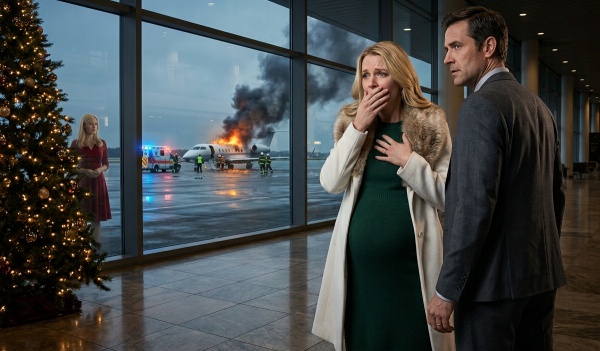
He Replaced His Pregnant Wife With His Mistress on a Christmas Flight—Then His Jet Went Down With His Mistress On Board
Seven months pregnant, Nora was ready to fly home for Christmas with her husband—until his assistant informed her that her seat had been canceled. Hours later, she learned the truth: her husband had taken another woman in her place. Then the private jet never made it to New York.
Part 1 — The Flight She Wasn’t Allowed to Take
On December 23rd, at 6:14 in the morning, my husband canceled my seat on our private jet. I found out while standing barefoot in the marble kitchen of our Aspen house, one hand resting on my seven-month pregnant belly and the other holding a mug of peppermint tea that had already gone cold. Outside, snow fell quietly over the mountains, covering the driveway, the pine trees, and the peaceful world my husband had spent millions trying to create. Inside, my phone lit up with a message from his assistant.
Mrs. Langford, there has been a change in today’s travel arrangements. Mr. Langford has requested that you remain in Aspen until after Christmas. A commercial flight may be arranged later if needed. That was how my billionaire husband told me I was no longer invited home for Christmas.
Not with a conversation. Not with an apology. Through his assistant. I stood there staring at the screen, feeling our daughter move beneath my palm, wondering when I had become someone my husband could leave behind like luggage.
My name is Nora Langford, though before I married Callum Langford, I was Nora Ellis from Portland, Maine. I was the daughter of a high school English teacher and a Coast Guard mechanic, raised in a house where Christmas meant paper snowflakes, hot cocoa from a packet, and my mother reading old books beside a woodstove. Callum grew up with catered parties, private schools, homes in four states, and a family foundation named after his grandfather. When I met him, I thought his wealth was the least interesting thing about him.
Callum was charming, restless, and brilliant in the way men become when the world rewards their confidence early. He built Langford Meridian from inherited real estate, venture capital, luxury resorts, and private equity deals that made business magazines call him “the prince of American hospitality.” To me, he was once the man who drove three hours in a snowstorm because I had the flu and wanted tomato soup. That man had become harder and harder to find.
By our fifth year of marriage, Callum’s tenderness came in flashes, like an old house with faulty wiring. He could be generous in public and cold in private, remember anniversaries but forget conversations, and send flowers after arguments instead of apologizing. Lately, he had begun looking at my pregnancy as if it was not the miracle we had prayed for, but an inconvenience that arrived during the wrong quarter. Our baby girl was due in February.
I had already named her in my heart, though Callum kept saying we should wait until “after the holidays.” He had said the same thing about the nursery, the pediatrician, and whether he would be in the delivery room if an investor conference in Singapore ran long. We were supposed to fly from Aspen to Teterboro that morning, then drive into Manhattan for Christmas Eve with his mother at the Langford townhouse on East 72nd Street. I had packed gifts, maternity dresses, baby clothes, and a tiny pair of red socks with white snowflakes.
Now he wanted me to stay behind. I called him once, and he did not answer. I called again, and this time he picked up on the fifth ring, sounding impatient before I even spoke. “Nora,” he said, “I’m in the middle of something.”
“You canceled my flight,” I said. There was a pause before he replied, “I adjusted the plan.” I looked out at the soft, steady snow and told him my OB had cleared me to travel last week. He said it was not a good idea for me to fly because the weather had shifted.
“If the weather were unsafe, no one would be flying,” I said. Callum exhaled in the tired way he used when he had already decided I was being difficult. “Don’t make this difficult,” he said. There it was, the sentence powerful men use when your feelings have become an obstacle to their plans.
“I’m seven months pregnant,” I said. “I’m your wife. Christmas is tomorrow.” He told me that was exactly why he did not need me stressed, as if canceling my seat through his assistant was an act of concern. I held the phone tighter and asked the question I already feared the answer to. “Who’s on the plane?”
Silence. It lasted only two seconds, but two seconds can hold an entire marriage. “Business guests,” he said finally. When I asked which business guests, he said, “You don’t know them.”
I knew then. Not every detail, not the name, not yet, but I knew the shape of the lie. For three months, there had been signs: Callum stepping into the garage to take calls, perfume that was not mine on his scarf, a Santa Monica hotel charge when he had told me he was in Denver. And there was Sloane Mercer, the polished thirty-one-year-old consultant who appeared too often in foundation photos, always near him, always laughing like she had been promised something private.
“Is Sloane on the plane?” I asked. Callum’s voice changed. “This is not the time.” My chest tightened because that was not a denial. “Are you leaving me in Aspen for Christmas so you can fly home with your mistress?” I asked.
“Don’t use that word,” he said. “What word would you prefer?” I replied. He lowered his voice and told me I was emotional. I placed my palm against the counter and said, “No, Callum. I am informed.”
Then he said something I would remember forever. “You need to think about the baby and stop creating drama.” The cruelty of it was not loud, and that made it worse. I did think about the baby, every minute of every day.
I thought about what it would mean to bring a daughter into a home where her mother swallowed humiliation just to keep the furniture arranged. I thought about the little red socks in my suitcase and the Christmas I had wrapped around a man who had already uninvited me. I thought about my mother, who would have driven through a blizzard before letting my father make her feel disposable. Then I told Callum, “I’m not staying here alone.”
“You are not alone,” he said. “Staff is there.” I almost laughed because staff was not family. Then he said he had to go, and before I could answer, he hung up. A minute later, his message appeared on my screen: We’ll discuss this after Christmas. Please be reasonable.
I stared at the word reasonable until something inside me cooled into place. Then I called my older brother, Daniel, in Maine. He answered sleepily, but the moment he heard my voice, he was awake. “Nor? Everything okay?”
“No,” I said. “Can you come get me?” There was no hesitation in his voice when he asked where I was. When I said Aspen, he did not complain about the distance or the holiday. He only said, “Nora, I asked where you were, not whether you were worth the trip.”
That was the first time I cried.
Part 2 — The Plane That Never Made It Home
By noon, Daniel had booked a flight from Portland to Denver and arranged to rent an SUV with snow tires. He told me not to lift anything, not to answer Callum unless I wanted to, and not to let the staff make me feel like a guest in my own life. My brother had never trusted Callum completely. He said rich men who needed everyone to know they were rich were often poor in the places that mattered.
At 1:10 p.m., I watched from an upstairs window as the Langford Gulfstream left Aspen/Pitkin County Airport. I could not see the plane from the house, not really, but I knew when it departed because Callum’s assistant sent a final itinerary update by mistake. Passenger manifest confirmed. Departure completed. Estimated arrival Teterboro: 6:42 p.m. Eastern.
Attached was a PDF. I opened it with my heart already sinking. Callum Langford. Sloane Mercer. Graham Pike, corporate counsel. Two senior executives. Flight crew. My name had been removed.
For several minutes, I sat on the edge of the bed and stared at the manifest. There she was in black letters, seated where I should have been, flying home for Christmas with my husband while I sat pregnant in a house full of decorations chosen by strangers. The pain was sharp, but beneath it was something stranger. A terrifying kind of clarity.
I forwarded the PDF to myself, then to my attorney, Lila Grant, in New York. I had hired Lila quietly six weeks earlier after finding the Santa Monica hotel charge. She specialized in high-net-worth divorces and had a voice like warm steel. At the time, I told myself I was only protecting the baby and learning my options.
At 3:47 p.m. Mountain Time, the first alert came across my phone. Breaking: Private aircraft reported missing from radar during approach to New Jersey. I did not connect it to Callum at first because private aircraft sounded too general. Then my phone rang, and Lila’s name appeared on the screen.
“Nora,” she said carefully, “are you sitting down?” The air left my body before she finished the sentence. She told me a jet believed to be connected to Langford Meridian had gone down outside Teterboro during approach, and emergency responders were on scene. For a second, I heard nothing except my pulse.
“No,” I whispered. I did not know whether I was refusing the accident, the timing, or the fact that my husband had removed me from a plane that had not made it home. I asked if Callum was on it, and Lila said they believed so. When I asked about Sloane, her pause answered me.
The room seemed to move away from me. I slid down the side of the bed onto the rug, one hand clamped protectively over my belly. The baby moved again, and that small roll beneath my palm pulled me back from the edge of shock. Whatever was happening, I was still her mother.
Lila told me not to make a statement, not to answer press calls, and not to speculate with anyone. She said she would contact hospital networks, the company’s general counsel, and aviation counsel. I asked the question no one wanted to answer. “Is he dead?”
“We don’t know yet,” she said softly. But I knew. Not because anyone had confirmed it, but because some old animal part of me understood absence before language could catch up.
By sunset, it was everywhere. A Langford Meridian private jet had crashed during final approach in difficult winter conditions. The National Transportation Safety Board would investigate, and the Federal Aviation Administration had issued preliminary statements. Names were being withheld pending family notification.
Family notification. I sat in the Aspen living room wrapped in a blanket, watching the Christmas tree glow while reporters repeated my husband’s name with increasing certainty. The staff moved quietly, bringing tea I did not drink and soup I could not swallow. Daniel was still hours away, driving through snow from Denver.
At 8:22 p.m. Eastern, Lila called again. “Nora,” she said. “Callum did not survive.” I closed my eyes and felt the truth enter the room like cold air under a door. There are moments so enormous that emotion cannot reach them immediately.
I did not scream. I did not throw the phone. I did not curse his name or bless the fact that I had not been on that plane. I simply sat there, breathing in and out, while the truth took its impossible shape. My husband was dead.
The father of my unborn child was dead. The man who betrayed me was dead. And the woman he had chosen over me for Christmas was dead too. Grief arrived in pieces that did not fit together.
I remembered Callum at thirty-two, laughing as we ate lobster rolls in Maine with butter dripping down his wrist. I remembered him holding my hair back during my first trimester when morning sickness was brutal. I remembered him lying to me, canceling my seat, and telling me to stop creating drama. Then I bent forward and sobbed so hard the baby kicked.
By the time Daniel reached the house after midnight, I was sitting on the floor beside the Christmas tree, holding the tiny red socks. He came in wearing a snow-dusted parka and the face of a man trying not to fall apart before his little sister did. He crossed the room without speaking and wrapped his arms around me carefully. I pressed my face into his coat and cried until there was nothing elegant left in me.
“He left me here,” I whispered. Daniel held me tighter. “I know.” I told him Callum had put her on the plane, and he said he knew that too. Then I confessed the thing that scared me most: “I wished he would hurt the way I hurt, but I didn’t wish this.”
Daniel’s voice broke. “Of course you didn’t.” That was the first burden I had to put down. Anger is not murder. Betrayal is not a death sentence. Pain can be real without making tragedy deserved.
But the world would not be that kind. By morning, the headlines had begun. BILLIONAIRE DIES IN PRIVATE JET CRASH DAYS BEFORE CHRISTMAS. MISTRESS ALLEGEDLY ON BOARD. PREGNANT WIFE WAS REMOVED FROM FLIGHT HOURS BEFORE DEPARTURE. And beneath them, strangers started building stories out of the worst day of my life.
Part 3 — The Widow They Wanted to Blame
The first reporter appeared at the Aspen gate before breakfast. By noon, there were six, and by evening, satellite vans were parked along the road with their headlights glowing through the snow like watching eyes. Someone had leaked the passenger manifest. Someone had leaked that I had been scheduled to fly and then removed.
I became a headline before I had even chosen a funeral home. The internet did what the internet always does: some people called me lucky, some called me cursed, and some called the crash karma as if death were a gossip caption. Others asked whether I had known, whether I had fought with him, whether I had somehow benefited by staying behind. Lila called those comments predictable and legally irrelevant.
Daniel called them disgusting. I called them noise because if I called them cruelty, I would have to feel them. The NTSB opened an investigation, and aviation experts appeared on television to explain things they could not possibly know yet. Every sentence included the word preliminary, but almost nobody listened to that part.
Langford Meridian’s board issued a statement mourning Callum and the others lost. Sloane was described as a valued consultant, the executives as visionary leaders, and the pilots as experienced professionals. Everyone became polished in death. I was advised to release a statement too.
Lila drafted it, and I revised one line. My family is devastated by the tragic loss of Callum Langford, the passengers, and the crew. I ask for privacy as I grieve the father of my unborn child and cooperate respectfully with all appropriate authorities. Please remember that every person lost was loved by someone.
That last sentence was mine. Even Sloane. I hated what she had helped destroy, but I refused to pretend she had not been a daughter, a friend, and a woman whose life had ended before anyone could make sense of it. There was no healing in becoming cruel because I had been humiliated.
Callum’s mother, Vivian Langford, did not agree. She arrived in Aspen two days after the crash wearing black cashmere, pearls, and the kind of grief that needed a target. Vivian had never warmed to me. She found me too plain, too practical, and too uninterested in the rituals of old money.
When she walked into the living room, her eyes went straight to my belly, then to my face. “You should have been with him,” she said. Daniel stood immediately and said, “Careful.” Vivian ignored him and added, “A wife belongs beside her husband.”
I stared at her. “He canceled my flight.” Her mouth tightened. “Because you were pregnant.” I answered quietly, “Because Sloane was going.”
The room went still. Vivian looked away first, and that was how I knew she had known. That hurt in a new way. I said, “You knew about her.”
Vivian removed her gloves finger by finger. “Men under pressure make foolish attachments,” she said. I told her Sloane was not an attachment; she was a person. Vivian called her a mistake. I said, “She died.”
That silenced her for half a second. Then she said, colder, “And now you stand to inherit everything.” There it was, not sorrow or concern for the baby, but suspicion. I placed my hand over my belly and said, “I would trade every dollar to have not received that phone call.”
“Would you?” she asked.
Daniel stepped forward and told her to leave. Vivian lifted her chin and said this was her son’s house. Then Lila’s voice came from the doorway. “No.”
I had not heard Lila arrive. She stood there with snow on her coat, a leather briefcase in hand, and the calm expression of a woman who enjoyed correcting rich people with documents. “This property is held in a marital trust with Mrs. Langford as current beneficiary,” she said. “If you would like to discuss access, we can do that through counsel.”
Vivian flushed and said she was grieving her son. Lila replied, “So is my client, while seven months pregnant.” For one moment, Vivian looked at me as if she might soften. Instead, she picked up her handbag and said, “This family will not be embarrassed further.”
I almost laughed because Callum had said nearly the same thing days earlier. Do not embarrass me. Apparently, in the Langford family, embarrassment was a greater emergency than betrayal. After Vivian left, Lila sat across from me and opened her briefcase.
“Nora, we need to discuss the will,” she said. I told her I could not, and she said she knew. But there were decisions coming whether I was ready or not. Callum’s estate was complicated: trusts, corporate holdings, insurance policies, homes in New York, Aspen, Palm Beach, and Los Angeles, plus an unborn child with legal rights that needed protection.
Lila explained the broad estate framework and the importance of protecting my daughter’s interests properly. Callum had updated some papers after I became pregnant, but not all. There would be probate steps, trust administration, board transitions, and possibly challenges from Vivian if she believed I was gaining too much control. My head ached just listening.
“What about Sloane?” I asked. Lila said her family might have claims depending on employment status, the circumstances of travel, and insurance. She told me not to contact them directly. Then I asked the question I hated asking: “What if she was pregnant too?”
Lila’s expression changed, not in shock, but in professional alertness. “Do you have reason to believe that?” I shook my head and said I did not know anything anymore. She answered gently, “We will not speculate. If anything legally relevant exists, it will surface through proper channels.”
That became the rule of my life. Do not speculate. Do not respond emotionally to headlines. Do not let grief make decisions. Do not let humiliation become your lawyer.
Christmas came two days later. There was no family dinner in Manhattan, no townhouse tree, and no Callum charming everyone while I sat beside him like proof his private life was respectable. Instead, I spent Christmas morning in Aspen with Daniel, eating toast, crying without warning, and watching snow fall over a world that kept moving. That night, I opened the tiny red socks and placed them under the tree.
“For you,” I whispered to my daughter. Then I said the name I had chosen without Callum. “Clara.”
Part 4 — What the Investigation Revealed
In January, the preliminary NTSB report was released. It did not blame anyone, because preliminary reports rarely do. It outlined conditions, timeline, aircraft information, crew communications, weather factors, and the fact that the investigation would continue for months. But it confirmed one thing.
My name had been removed from the passenger list the morning of departure by request from Callum’s office. Not by the pilots. Not for medical reasons. By Callum’s office.
The media seized on it again. PREGNANT WIFE SPARED AFTER LAST-MINUTE REMOVAL. BILLIONAIRE’S FINAL BETRAYAL? INSIDE THE CHRISTMAS FLIGHT SCANDAL. I stopped reading after Lila told me one outlet had called me “the widow who survived humiliation and tragedy in the same morning.”
I did not feel like a survivor. I felt like a woman standing in the wreckage of three lives: the marriage I thought I had, the death I had not wanted, and the motherhood I now faced alone. Callum’s funeral was held at St. Bartholomew’s in Manhattan on a bitterly cold day when the city looked carved from gray stone. Security kept photographers behind barriers.
Inside, the church was filled with politicians, CEOs, art donors, old classmates, and people who had met Callum twice but wanted to be seen mourning him. I wore black. Vivian sat in the front pew on one side. I sat on the other, with Daniel beside me and Lila a few rows back.
When the minister spoke of Callum’s ambition, generosity, and restless spirit, I listened without anger. All of it was true. Not all truth is complete truth. A person can fund hospitals and still break a heart.
A man can create jobs and still abandon his pregnant wife for Christmas. After the service, Vivian approached me near the side entrance, looking smaller than I had ever seen her. “Was he happy?” she asked. The question startled me.
“With you,” she said. “Before all this.” I could have punished her with honesty. I could have said he was restless, vain, unfaithful, and terrified of aging into anything ordinary. Instead, I told the truth that mercy allowed.
“For a while,” I said. “I think he was.” Her eyes filled. “He was difficult even as a boy.” I said, “I know.”
“I wanted him to be great,” Vivian whispered. “He was,” I said, “but greatness didn’t make him good at staying.” She looked at me for a long moment. Then, to my surprise, she said, “I’m sorry he left you in Aspen.”
It was not enough. But it was something. Sloane’s memorial was private, and I did not attend. I sent flowers anonymously through Lila’s office, white lilies and winter greenery, with a card that said only: May peace find all who loved her.
I did not need her family to know the flowers were from me. In fact, it was better if they did not. In February, my daughter was born during a snowstorm in New York. Clara Ellis Langford arrived at 2:18 a.m., six pounds and nine ounces, furious at the world and very much alive.
Daniel was in the delivery room, holding one of my hands while a nurse held the other. When Clara cried for the first time, something inside me that had been frozen since December finally broke open. They placed her on my chest, warm and perfect, and I cried into her dark hair. “You’re here,” I whispered.
For the first few weeks, the world shrank to bottles, diapers, stitches, sleep deprivation, and the tiny sounds Clara made when she dreamed. Grief changed shape after she was born. It became less theatrical and more practical. There were forms to sign, pediatric appointments to attend, trust documents to review, and midnight feedings where I sometimes searched her face for Callum.
She had his mouth. That hurt. Then she would curl her fingers around mine, and I would remember she was not a monument to him. She was herself.
By spring, the estate conflict began. Vivian challenged aspects of the trust administration, arguing that I was making decisions under emotional distress and that the family legacy required broader oversight. In simpler language, she wanted control. Not because she needed money, but because she wanted Callum’s world to remain arranged around Callum’s bloodline as she understood it.
Lila responded with filings, not fury. The documents were clear. I was Clara’s mother, and I was named trustee over certain assets for Clara’s benefit. Vivian could petition, argue, and posture, but she could not simply take over because she disliked me.
During one mediation session, Vivian said, “You were married to him for only six years.” I looked at her across the polished conference table. “And I will be Clara’s mother for the rest of my life.” That ended the conversation. After that, the objections began to lose their force.
The Langford Meridian board asked me to take a formal role in the foundation, at least temporarily. I almost refused because the idea of sitting in Callum’s conference rooms felt like wearing someone else’s skin. Then I reviewed the foundation’s work: children’s hospitals, rural health clinics, scholarships for first-generation college students, and aviation safety research. Not everything Callum touched was ruined.
That was another hard truth. So I agreed, but with conditions: more transparency, independent oversight, no vanity projects named after living donors, a new grant for maternal health access, and support services for families affected by sudden transportation tragedies. At the first foundation meeting, one board member said, “Mrs. Langford, this is a generous expansion.” I corrected him.
“Ms. Ellis-Langford,” I said. Then I added, “And it is not generous. It is necessary.”
Part 5 — The Christmas She Chose for Herself
One year later, I returned to Aspen for Christmas. Not because I had forgiven the house, because houses do not betray people. But rooms remember, and I needed to teach those rooms a new story. I brought Clara, Daniel, his wife, their two boys, and my mother’s old box of handmade ornaments from Maine.
There were no decorators. No white-glove installation. No twelve-foot designer tree. We bought a crooked pine from a local lot for eighty-five dollars and decorated it ourselves.
Clara, ten months old and determined to eat every ribbon she could reach, sat on a blanket in front of the fireplace. Her cousins argued about whether a lobster ornament belonged near the top or bottom. Daniel burned the first batch of cookies, and my sister-in-law made chili. Snow fell outside just as it had the year before, but this time the silence did not feel like abandonment.
It felt like space. On December 23rd, at 6:14 in the morning, I woke without an alarm. For a moment, I did not know why my body had remembered the time. Then I looked at Clara sleeping in the travel crib beside my bed, one fist pressed against her cheek, and memory entered quietly.
A year ago, at that exact hour, I had learned my husband did not want me on his plane. A year ago, I thought being left behind was the humiliation. Now I knew it had also been the door. I slipped out of bed, wrapped myself in a robe, and went downstairs.
The kitchen looked different in the early blue light. Less like a showroom, more like a place where people had actually lived. There were mugs in the sink, a high chair by the table, mittens drying near the vent, and a grocery list stuck to the refrigerator with a magnet shaped like a moose. Then my phone buzzed.
For one second, old fear touched my chest. Then I saw Lila’s name. Final estate order entered. Clara’s trusts confirmed. Vivian withdrew remaining objections. Merry Christmas, Nora.
I sat at the kitchen table and read the message twice. It was over. Not grief, because grief does not end because a judge signs paper. Not memory, because memory is not a case that closes. But the legal war, the question of control, and the last formal attempt to make me feel like a temporary guest in my daughter’s life were finally over.
Clara was protected. I was still standing. Vivian and I had reached an uneasy peace by then. She visited Clara once a month in New York, always by schedule, always with boundaries.
She brought expensive dresses Clara immediately drooled on. She sometimes cried when Clara smiled in a way that resembled Callum. I let her have those moments because Clara deserved a grandmother who was trying, even imperfectly. But I never gave Vivian the power to rewrite the story.
Callum had betrayed me. Callum had removed me from the flight. Callum had died in a tragic accident that also took other lives. All three things were true, and none canceled the others.
That afternoon, Daniel and I drove into town for groceries. Aspen was bright and crowded, full of skiers, tourists, couples in matching parkas, and families taking photos beneath holiday lights. At checkout, a woman recognized me. I saw the moment her eyes widened, the quick glance at my bare left hand, then at Clara in the cart seat chewing on a teething ring.
“You’re Nora Langford,” she said softly. I braced myself. Instead, she touched her own wedding ring and said, “I read about what happened. I just wanted to say… I’m glad you and your baby are okay.”
For a moment, I could not speak. Then I said, “Thank you.” Outside, Daniel loaded groceries into the SUV while I buckled Clara into her car seat. She babbled at me, completely unimpressed by tragedy, inheritance, scandal, or public sympathy.
Her world was warm socks, applesauce, songs, and whether I made funny faces when fastening the straps. That saved me more than anything. Children do not let you live entirely in the past. They need breakfast, clean clothes, and someone to notice the moon from the car window.
On Christmas Eve, I took Clara outside after dinner. The sky was clear, and the stars looked sharp above the mountains. I bundled her in a white snowsuit and carried her down the driveway, past the place where reporters had stood a year earlier. No cameras waited now.
No vans. No strangers building theories from my pain. Just snow. Just breath. Just my daughter looking up at the sky with Callum’s mouth and my mother’s eyes.
“I need to tell you something,” I whispered, though she was too young to understand. “Your father was not only one thing. He was brilliant, charming, selfish, generous, unfaithful, loved, and lost. You are allowed to love the good in him without carrying the harm he caused.”
Clara blinked at me. I smiled through tears and told her she was not the reason I stayed, or the reason I left, or the reason anything happened. She was not a scandal, an inheritance, or the end of his story. Then I kissed her cold cheek and whispered, “You are the beginning of mine.”
On Christmas morning, we opened presents in pajamas. Daniel’s boys tore through wrapping paper like tiny wolves, while Clara preferred the cardboard box to the wooden toy inside it. My sister-in-law cried when I gave her my mother’s old recipe book. Daniel gave me a framed photo from the hospital: me holding Clara for the first time, exhausted, pale, and smiling like the whole world had been placed on my chest.
Later, after everyone went outside to build a snowman, I stayed behind for a few minutes. The house was quiet, but not empty. I walked to the living room window and looked at the mountains. Somewhere beyond them was the flight path Callum had taken.
Somewhere beyond that was New York, where legal files sat closed and a foundation carried a complicated name. Somewhere in between was the woman I had been a year ago, standing in this house with a cold mug of tea, believing she had been discarded. I wished I could reach back and take her hand. I would tell her humiliation is not the same as defeat.
I would tell her that being left behind can sometimes save your life, though no one should call it luck too soon. I would tell her that grief and anger can sit at the same table without one making the other false. I would tell her not to let strangers turn her pain into a moral lesson simple enough for a headline. But maybe she had learned all of that the only way people truly do—by living through the day after the day that broke her.
My phone buzzed with a message from Vivian. Merry Christmas. Kiss Clara for me. I looked at it for a long moment, then replied, Merry Christmas. I will. It was not forgiveness, not exactly. It was peace with a fence around it.
Outside, Clara squealed as Daniel lifted her near the snowman’s crooked carrot nose. I could see her little red mittens waving in the cold air. The same red as the socks I had placed under the tree the year before. The same red as the first proof that even in my worst moment, I had been preparing for love.
I stepped outside, and the cold hit my face, clean and bright. Daniel called, “Nora, we need a judge. Is this snowman structurally sound?” I looked at the lopsided creature leaning dangerously to one side and said, “Absolutely not.” His sons cheered anyway.
Clara laughed because everyone else was laughing. And there it was, the sound I had not known I was waiting for. Not justice. Not revenge. Not the world admitting what had been done to me.
Just my daughter laughing on Christmas morning in a place that no longer belonged to Callum’s choices. It belonged to ours. A year earlier, my husband canceled my Christmas flight so he could take another woman home in my place. The plane never made it.
That terrible fact would always live somewhere inside me, impossible to soften or explain without reopening the wound. But it was not the whole story. The whole story was what came after: the baby who survived inside me while everything else collapsed, the brother who crossed half the country because I asked, and the attorney who protected my daughter’s future while I could barely protect my own heart.
It was also the grandmother who learned that access was not ownership, the house that became warm only after the truth moved in, and me. Nora Ellis-Langford. Not the discarded wife. Not the lucky survivor. Not the pregnant widow from the headlines.
Just a woman who had been left behind, then chose not to stay there.
